Chapter 9 Hemoglobin: An Allosteric Protein
Matching Questions
Use the following to answer questions 1-10:
Choose the correct answer from the list below. Not all of the answers will be used.
a) cooperative
b) oxygen
c) fMRI
d) carbamate
e) histidine
f) hyperbolic
g) myoglobin
h) bicarbonate ion
i) sickle-cell anemia
j) protoporphyrin
k) fetal
l) carbonic acid
1.
____________ The shape of the myoglobin binding curve that shows that it is not regulated
allosterically.
2.
____________ This is the organic portion of the heme group in hemoglobin.
Section: 9.2
3.
____________ This method of studying hemoglobin monitors changes in magnetic fields during
the binding of oxygen.
Ans: c
4.
____________ This is the chemical form in which most of the carbon dioxide is transported in
the blood.
Section: 9.5
5.
____________ This substance is produced when carbon dioxide reacts with water.
Section: 9.5
Section: 9.1
Chapter 9 Hemoglobin: An Allosteric Protein
2
6.
____________ This type of hemoglobin is composed of two α chains and two γ chains.
7.
____________ This is the molecule whose function is to facilitate diffusion of oxygen in muscle
cells.
Ans: g
Section: Introduction, 9.1
8.
____________ The iron atom in heme is bound to the fifth coordination site of this molecule.
Ans: e
Section: 9.3
9.
____________ This type of binding is indicated by a sigmoidal-shaped binding curve.
Ans: a
Section: 9.1
10.
____________ This condition is a result of a single-point mutation in the β chain of
hemoglobin.
Ans: i
Section: 9.6
Fill–in-the Blank Questions
11.
Under normal conditions, the heme iron in myoglobin and hemoglobin is in the oxidation
state.
Ans: ferrous, or Fe+2 Section: 9.2
12.
The ability of myoglobin to bind oxygen depends on the presence of a bound prosthetic group
called .
Ans: heme Section: 9.2
13.
The form of hemoglobin found in the R state is called .
Ans: oxyhemoglobin Section: 9.3
14.
The binding of 2,3-bisphosphogycerate to hemoglobin (increases; decreases) its affinity of
oxygen binding.
Ans: decreases Section: 9.4
15.
The effect of pH on oxygen binding of hemoglobin is referred to as the .
Ans: Bohr effect Section: 9.5
Ans: k
Section: 9.4
Chapter 9 Hemoglobin: An Allosteric Protein
3
16.
Carbon dioxide reacts with the amino terminal groups of hemoglobin to form carbamate groups,
which carry a charge.
17.
The T state of hemoglobin is stabilized by a salt bridge between β1 Asp 94 and the C-terminal
of the β1 chain.
Ans: histidine Section: 9.5
18.
In normal adult hemoglobin, HbA, the β6 position is a glutamate residue, whereas in sickle-cell
hemoglobin, HbS, it is a residue.
Ans: valine Section: 9.6
19.
As the partial pressure of carbon dioxide increases, the affinity of oxygen binding to
hemoglobin .
Ans: decreases Section: 9.5
20.
2,3-Bisphosphoglycerate binds only to the form of hemoglobin.
Ans: T-, or deoxy Section: 9.4
Multiple-Choice Questions
21.
What factor(s) influence(s) the binding of oxygen to myoglobin?
A)
the concentration of bicarbonate ion, HCO3–
B)
the partial pressure of oxygen, pO2
C)
the concentration of hemoglobin present
D)
the concentration of 2,3-BPG
E)
B and D.
Ans: B Section: 9.2
22.
Which of the following is correct concerning the differences between hemoglobin and
myoglobin?
A)
Both hemoglobin and myoglobin are tetrameric proteins.
B)
Hemoglobin exhibits a hyperbolic O2 saturation curve while myoglobin exhibits a
sigmoid-shaped curve.
C)
Hemoglobin exhibits cooperative binding of O2 while myoglobin does not.
D)
Hemoglobin exhibits a higher degree of O2 saturation at all physiologically relevant
partial pressures of O2 than does myoglobin.
E)
All of the above.
Ans: C Section: 9.1
23.
Which of the following is NOT correct concerning myoglobin?
A)
The globin chain contains an extensive α-helix structure.
B)
The heme group is bound to the globin chain by two disulfide bonds to cysteine residues.
C)
The iron of the heme group is in the Fe2+ oxidation state.
D)
The diameter of the iron ion decreases upon binding to oxygen.
E)
The function of myoglobin is oxygen storage in muscle.
Ans: B Section: 9.2
Ans: negative Section: 9.5

Chapter 9 Hemoglobin: An Allosteric Protein
4
24.
The structure of normal adult hemoglobin can be described as
A)
a tetramer composed of four myoglobin molecules.
B)
a tetramer composed of two αβ dimers.
C)
a tetramer composed of two α2 and two β2 dimers.
D)
a tetramer composed of two α2 and two γ2 dimers.
E)
None of these accurately describe hemoglobin.
25.
Which of the following is correct concerning fetal hemoglobin?
A)
Fetal hemoglobin is composed of two α and two γ subunits.
B)
Fetal hemoglobin binds 2,3-BPG more tightly than normal adult hemoglobin.
C)
Fetal hemoglobin binds oxygen less than HbA at all pO2.
D)
Fetal hemoglobin does not exist in the T-form.
E)
None of the above.
Ans: A Section: 9.4
26.
Hemoglobin binding of oxygen is best described as a:
A)
concerted model.
B)
Michaelis–Menten model.
C)
sequential model.
D)
combination of sequential and concerted models.
E)
None of the above.
Ans: D Section: 9.3
27.
2,3-Bisphosphoglycerate
A)
binds in the central cavity in the T-form of hemoglobin.
B)
preferentially binds to deoxyhemoglobin and stabilizes it.
C)
is present in the red blood cells.
D)
All of the above.
E)
None of the above.
Ans: D Section: 9.4
28.
What is the Bohr effect?
A)
the ability of hemoglobin to retain oxygen when in competition with myoglobin
B)
the regulation of hemoglobin binding by hydrogen ions and carbon dioxide
C)
the alteration of hemoglobin conformation during low oxygen stress
D)
All of the above.
E)
None of the above.
Ans: B Section: 9.5
29.
Which of the following statements is correct for hemoglobin and oxygen transport?
A)
The oxygen binds to the proximal histidine residue of the globin chain.
B)
Bonding of carbon dioxide to hemoglobin molecules increases the binding of oxygen.
C)
Hemoglobin binds more oxygen as the pH is lowered.
D)
Hemoglobin binds more oxygen at higher [BPG] concentrations.
E)
The binding of each O2 molecule to hemoglobin increases its affinity for the next O2.
Ans: E Section: 9.3
Ans: B Section: 9.3

Chapter 9 Hemoglobin: An Allosteric Protein
5
30.
Which of the following describes the Bohr effect?
A)
Lowering the pH results in the release of O2 from oxyhemoglobin.
B)
Increasing the pressure of CO2 results in the release of O2 from oxyhemoglobin.
C)
Increasing the pH increases the T-form of hemoglobin.
D)
All of the above.
E)
A and B.
31.
Which of the following is correct concerning the following equilibria?
CO2 + H2O H2CO3
A)
An increase in the pressure of CO2 will result in a decrease of pH.
B)
This reaction is catalyzed by carbonic anhydrase.
C)
The H2CO3 dissociates to H+ and bicarbonate ion, HCO3–.
D)
The majority of CO2 is transported to the lungs in the form of HCO3–.
E)
All of the above.
Ans: E Section: 9.5
32.
Carbon dioxide forms carbamate groups in proteins by reaction with:
A)
aspartate residues.
B)
cysteine residues.
C)
N-terminal amino groups.
D)
tyrosine residues.
E)
heme groups.
Ans: C Section: 9.5
33.
Sickle-cell anemia is caused by:
A)
a decreased production of α chains of hemoglobin.
B)
a substitution of a Glu residue for a Phe residue at the β6 position.
C)
the loss of the heme group because the proximal His is oxidized.
D)
a substitution of a Val residue for a Glu residue at the β6 position.
E)
a substitution of Glu residue for His at the C-terminal of the α chain.
Ans: D Section: 9.6
Ans: E Section: 9.5
Chapter 9 Hemoglobin: An Allosteric Protein
6
34.
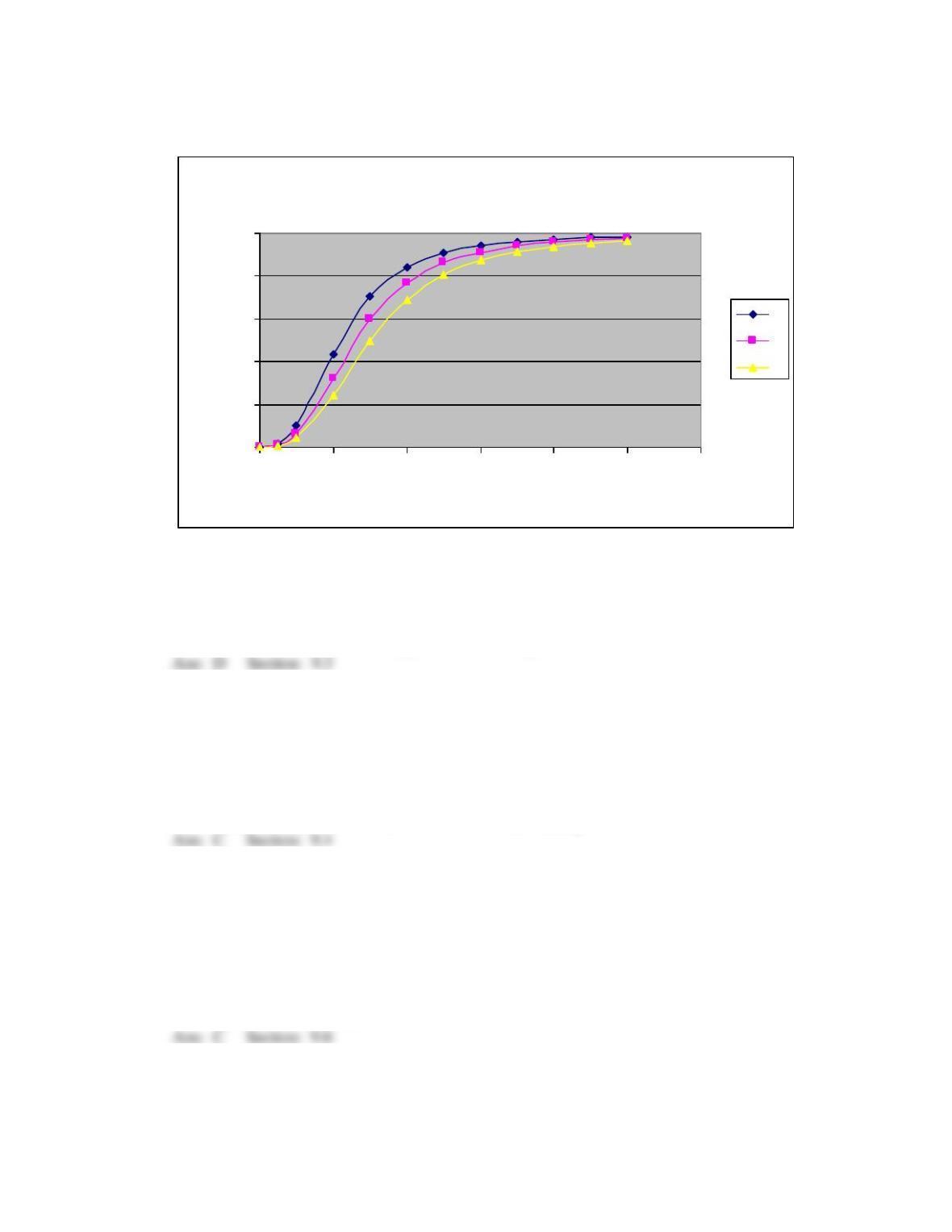
Which of the following is correct concerning the oxygenation plot of proteins X and Y shown in
the graph below?
Oxygen Binding plot
0.0
0.2
0.4
0.6
0.8
1.0
020 40 60 80 100
pO2 (torr)
Y (fraction saturation)
X
Y
A)
Protein Y exhibits tighter oxygen binding than protein X.
B)
Protein Y corresponds to fetal hemoglobin, and protein X corresponds to normal adult
hemoglobin.
C)
Protein X corresponds to fetal hemoglobin, and protein Y corresponds to normal adult
hemoglobin.
D)
Protein X corresponds to myoglobin, and protein Y corresponds to hemoglobin.
E)
None of the above.
35.
Which of the following is NOT correct concerning the oxygenation plot of proteins X and Y
shown in the graph below?
Oxygen binding plot
0.0
0.2
0.4
0.6
0.8
1.0
020 40 60 80 100
pO2 (torr)
Y (fraction saturation)
X
Y
A)
Protein X exhibits tighter oxygen binding than protein Y.
B)
Protein Y would function as a better transport protein than protein X.
C)
Protein X exhibits cooperative binding, whereas Y does not.
D)
Protein X corresponds to myoglobin, and protein Y corresponds to hemoglobin.
E)
Protein Y contains multiple-binding sites.
Ans: D Section: 9.1
Ans: C Section: 9.4
Chapter 9 Hemoglobin: An Allosteric Protein
7
36.
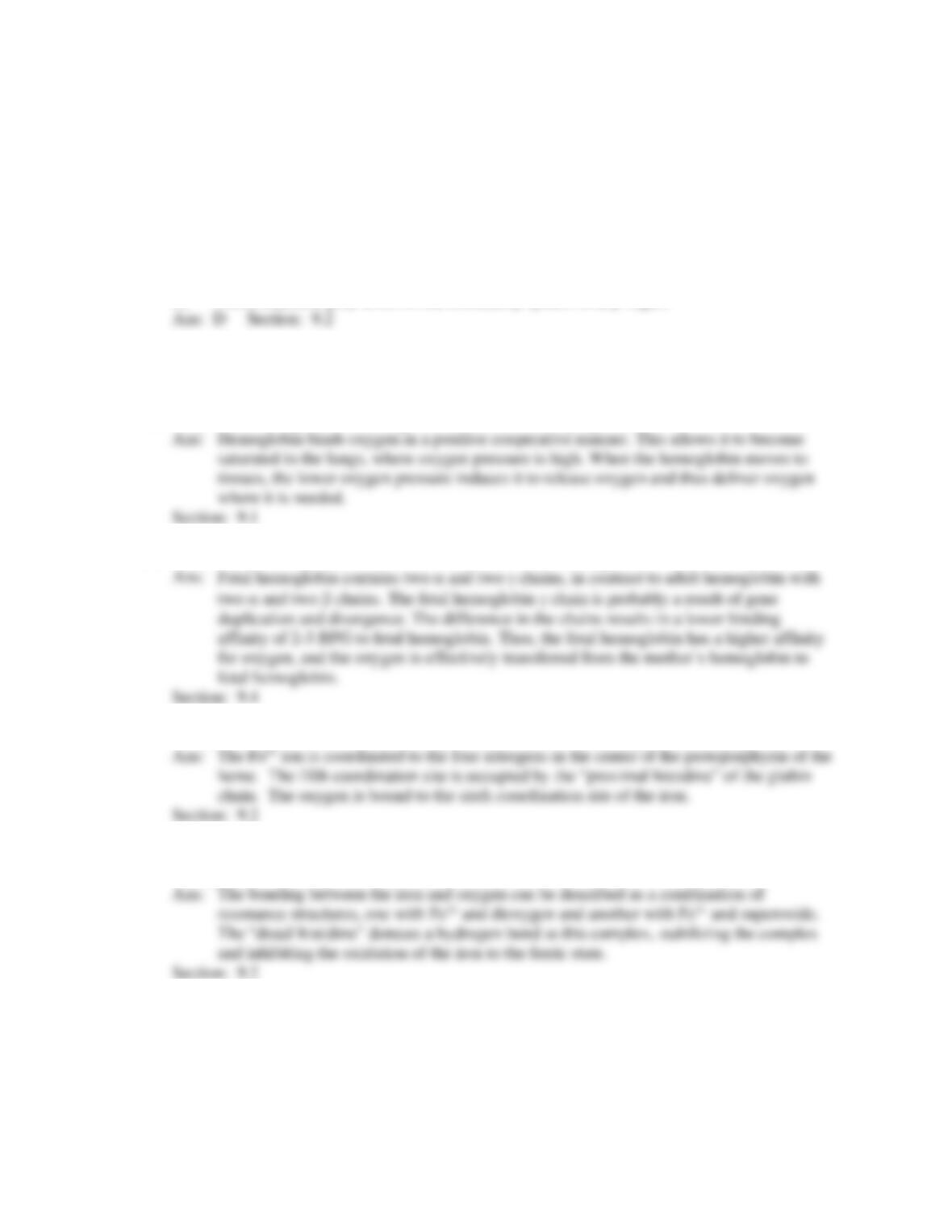
Consider the oxygen-binding profile at three different pH values of 7.6, 7.4, and 7.2. Which
statement is most correct?
Hb Oxygen binding
0
0.2
0.4
0.6
0.8
1
020 40 60 80 100 120
pO2 (torr)
Y (fraction saturation)
X
Y
Z
A)
Curve X most likely corresponds to pH 7.2.
B)
Curve Z most likely corresponds to pH 7.6.
C)
Hb has a higher affinity for oxygen at the pH of curve Z.
D)
Curve Y most likely corresponds to pH 7.4.
E)
pH has no effect on the oxygenation of hemoglobin.
37.
What would be the expected result of a Lys residue being substituted with a Ser residue in the
BPG binding site of hemoglobin?
A)
BPG would bind tighter because of the loss of a positive charge.
B)
BPG would bind tighter because of the gain of a positive charge.
C)
BPG would bind less tightly because of the loss of a positive charge
D)
BPG would bind less tightly because of the gain of a positive charge.
E)
This substitution would have no effect on the binding of BPG.
Ans: C Section: 9.4
38.
Why are blood transfusions a successful treatment for thalassemia but not sickle-cell anemia?
A)
Thallasemia results from a reduced solubility of the deoxygenated form of hemoglobin.
B)
Thallasemia results in high concentrations of deoxygenated hemoglobin.
C)
Thallasemia results in low levels of functional hemoglobin leading to decreased
production of RBCs.
D)
Sickle-cell anemia has a single amino acid substitution of valine for glutamate.
E)
Sickle-cell anemia results in tetramers that contain only the β chain leading to decreased
production of RBCs.
Ans: C Section: 9.6
Ans: D Section: 9.5
Chapter 9 Hemoglobin: An Allosteric Protein
8
39.
What does fMRI measure on the molecular level and what does this mean at the tissue level?
A)
fMRI measures the changes in the fifth coordination site in binding iron revealing the
amount of carbon monoxide bound in carbon monoxide poisoning.
B)
fMRI measures the changes in the fifth coordination site in binding iron revealing sensory
brain activity.
C)
fMRI measures the changes in magnetic properties of γ-chain hemoglobin and is a
noninvasive way of measuring fetal hemoglobin levels during pregnancy.
D)
fMRI measures the changes in magnetic properties of hemoglobin revealing the relative
amounts of deoxy- and oxyhemoglobin in the circulation of a specific organ
E)
fMRI measures pO2 levels in the circulatory system in any organ.
Short-Answer Questions
40.
Why is it advantageous for hemoglobin to have allosteric properties?
tissues, the lower oxygen pressure induces it to release oxygen and thus deliver oxygen
where it is needed.
Section: 9.1
41.
What is fetal hemoglobin? How does it differ from adult hemoglobin?
for oxygen, and the oxygen is effectively transferred from the mother’s hemoglobin to
fetal hemoglobin.
Section: 9.4
42.
Describe the octahedral coordination sphere of the iron ion in hemoglobin and myoglobin.
heme. The fifth coordination site is occupied by the “proximal histidine” of the globin
chain. The oxygen is bound to the sixth coordination site of the iron.
Section: 9.2
43.
What functional role does the “distal histidine” play in the function of myoglobin and
hemoglobin?
The “distal histidine” donates a hydrogen bond to this complex, stabilizing the complex
and inhibiting the oxidation of the iron to the ferric state.
Section: 9.2
Chapter 9 Hemoglobin: An Allosteric Protein
9
44.
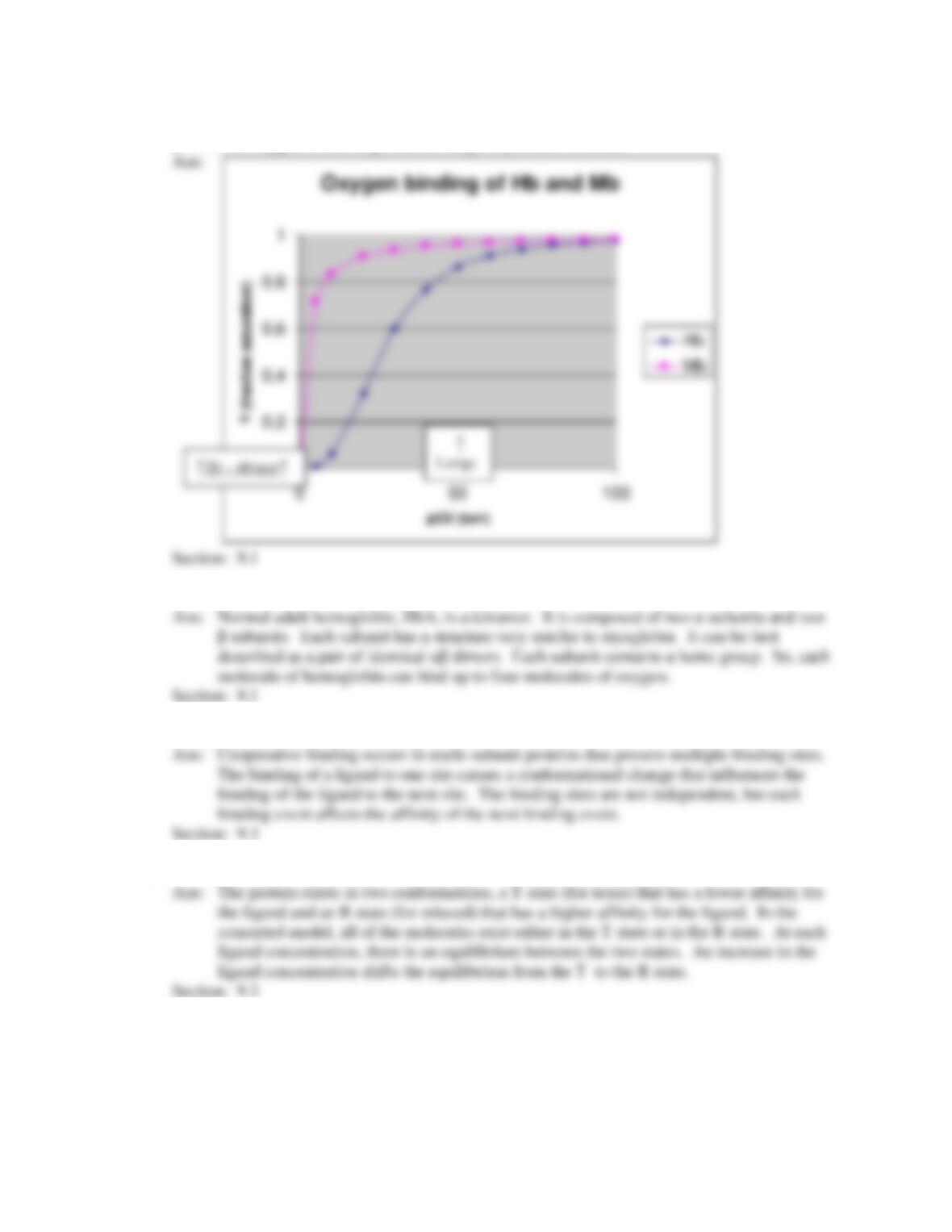
Draw the oxygen-binding curve of myoglobin and that of hemoglobin. Indicate the partial
pressure of oxygen in the lungs and the range of pressure in tissue.
45.
Describe the structure of normal adult hemoglobin.
molecule of hemoglobin can bind up to four molecules of oxygen.
Section: 9.1
46.
Briefly describe cooperative binding.
binding event affects the affinity of the next binding event.
Section: 9.3
47.
Describe the concerted model to explain allosteric cooperative binding.
ligand concentration shifts the equilibrium from the T to the R state.
Section: 9.3
Section: 9.1
Chapter 9 Hemoglobin: An Allosteric Protein
10
48.
Describe the role of 2,3-bisphosphoglycerate in the function of hemoglobin.
49.
Describe the chemical basis of the Bohr effect.
state to the T state, thus releasing oxygen.
Section: 9.5
50.
Describe how carbon dioxide affects the oxygenation of hemoglobin.
oxygen to the tissues producing the most CO2.
Section: 9.5
51.
Briefly describe the cause of sickle-cell anemia.
sickled cells are then destroyed, resulting in the anemia.
Section: 9.6
52.
How does the binding of oxygen to hemoglobin result in the T-to-R-state transition?
in quaternary structure that corresponds to T-to-R-state transition.
Section: 9.3
Chapter 9 Hemoglobin: An Allosteric Protein
11
53.
Describe the molecular and physiological adaptations for the high-altitude flying bar-headed
goose.
54.
What is the driving force for moving CO2 out of body tissues and into red blood cells?
for CO2 from the actively metabolizing tissue to the RBC.
Section: 9.5
the Himalayas.
Section: 9.4