Campbell Biology in Focus, 2e (Urry)
Chapter 9 The Cell Cycle
9.1 Multiple-Choice Questions
1) Beginning with a fertilized egg (zygote), a series of five cell divisions would produce an early
embryo with how many cells?
A) 4
B) 8
C) 16
D) 32
E) 64
2) A cell in G2 of the cell division cycle contains 20 chromatids. How many centromeres are
present in this cell?
A) 10
B) 20
C) 30
D) 40
E) 80
3) Eukaryotic chromatin is composed of
A) condensed DNA only.
B) DNA and RNA.
C) DNA and carbohydrates.
D) DNA and proteins.
E) DNA and ribosomes.
4) What is produced if a cell completes mitosis but does not undergo cytokinesis?
A) two cells, one cell containing two nuclei and a second cell without a nucleus
B) two cells, each cell with half of the genetic material of the parent cell
C) two cells, each cell with an identical nucleus containing the genetic material of the parent cell
D) one cell with one nucleus containing half of the genetic material of the parent cell
E) one cell with two nuclei, each identical to the nucleus of the parent cell
5) Humans produce skin cells by mitosis and gametes by meiosis. The nuclei of skin cells
produced by mitosis will have
A) half as much DNA as the nuclei of gametes produced by meiosis.
B) the same amount of DNA as the nuclei of gametes produced by meiosis.
C) twice as much DNA as the nuclei of gametes produced by meiosis.
D) four times as much DNA as the nuclei of gametes produced by meiosis.
6) Compared to most prokaryotic cells, eukaryotic cells typically have
A) more DNA molecules and larger genomes.
B) the same number of DNA molecules but larger genomes.
C) the same number of DNA molecules and similarly sized genomes.
D) fewer DNA molecules but larger genomes.
E) fewer DNA molecules and smaller genomes.
7) During mitosis in animal cells, at which phase do centrioles begin to move apart?
A) prophase
B) prometaphase
C) metaphase
D) anaphase
E) telophase
8) If there are 20 centromeres in a cell at anaphase of mitosis, how many chromosomes are there
in each daughter cell following cytokinesis?
A) 5
B) 10
C) 20
D) 40
9) Where do the microtubules of the spindle originate during mitosis in animal cells?
A) centromere
B) centrosome
C) centriole
D) chromatid
E) kinetochore
10) Taxol is an anticancer drug extracted from the Pacific yew tree that binds to microtubules
and prevents their depolymerization. Actively dividing cells treated with Taxol become blocked
in which phase of mitosis?
A) prophase
B) prometaphase
C) metaphase
D) anaphase
E) telophase
11) Which of the following are primarily responsible for cytokinesis in plant cells but not in
animal cells?
A) spot desmosomes
B) tubulin and dynein
C) actin and myosin
D) centrioles and centromeres
E) Golgi-derived vesicles
12) Movement of the chromosomes during anaphase would be most affected by a drug that
prevents
A) nuclear envelope breakdown.
B) cell wall formation.
C) elongation of microtubules.
D) shortening of microtubules.
E) formation of a cleavage furrow.
13) Measurements of the amount of DNA per nucleus were taken on a large number of cells
from a growing fungus. The measured DNA levels ranged from 3 to 6 picograms per nucleus. In
which stage of the cell cycle would the nucleus contain 6 picograms of DNA?
A) G0
B) G1
C) S
D) G2
14) A group of cells is assayed for DNA content immediately following mitosis and is found to
have an average of 8 picograms of DNA per nucleus. How many picograms would be found at
the end of S and the end of G2?
A) 8; 8
B) 8; 16
C) 16; 8
D) 16; 16
E) 12; 16
15) A group of cells is assayed for DNA content immediately before beginning mitosis and is
found to have an average of 16 picograms of DNA per nucleus. How many picograms would be
in a cell nucleus following completion of mitosis and cytokinesis?
A) 4
B) 8
C) 16
D) 32
16) The beginning of anaphase is indicated by which of the following?
A) loss of kinetochores from sister chromatids
B) enzymatic cleavage of cohesin
C) joining of the sister chromatids to each other by cohesin
D) polymerization of spindle microtubules
17) At which phase of mitosis do the sister chromatids become daughter chromosomes?
A) prophase
B) prometaphase
C) metaphase
D) anaphase
E) cytokinesis
18) What is a cleavage furrow?
A) a ring of vesicles forming a cell plate
B) an indentation between daughter prokaryotic cells
C) a groove in the plasma membrane between daughter nuclei
D) the metaphase plate where chromosomes attach to the spindle
19) You have the technology necessary to measure each of the following in a sample of animal
cells: chlorophylls, organelle density, picograms of DNA, cell wall components, and enzymatic
activity. Which would you expect to increase significantly from M to G1?
A) organelle density and enzymatic activity
B) cell wall components and DNA
C) chlorophyll and cell walls
D) organelle density and cell walls
E) chlorophyll and DNA
20) A plant-derived protein known as colchicine can be used to poison cells by blocking the
formation of the spindle. Which of the following would result if colchicine is added to a sample
of cells in G2?
A) The cells would immediately die.
B) The cells would be unable to begin M and stay in G2.
C) The chromosomes would segregate but in a disorderly pattern.
D) Chromosome condensation would occur, but the chromosomes would fail to align at the
metaphase plate.
21) Where are the motor proteins that move chromosomes toward the poles of the mitotic spindle
located?
A) on the centrioles
B) in the centrosomes
C) on the kinetochores
D) along the length of kinetochore microtubules
22) When a cell is in late anaphase of mitosis, which of the following may be seen?
A) a clear area in the center of the dividing cell
B) decondensing chromosomes clustered at the poles
C) individual chromatids beginning to separate from one another
D) chromosomes clustered tightly at the center of the dividing cell
E) nuclear envelopes forming at the poles
23) Diatoms and some yeasts are unicellular eukaryotes that have mechanisms of nuclear
division that may resemble intermediate steps in the evolution of mitosis. Which of the following
is a characteristic feature of nuclear division in these organisms?
A) They have circular chromosomes that are segregated by attachment to the plasma membrane.
B) They have circular chromosomes that are segregated by attachment to spindle microtubules.
C) Chromosomes are not condensed during nuclear division.
D) The nuclear envelope remains intact during division.
24) Cells from advanced malignant tumors frequently have very abnormal chromosomes as well
as an abnormal number of chromosomes. What might explain the association between malignant
tumors and chromosomal abnormalities?
A) Cancer cells replicate chromosomes multiple times per cell cycle.
B) Cancer cells are no longer anchorage dependent.
C) Cell cycle checkpoints are not in place to stop cells with chromosome abnormalities.
D) Cells with abnormal chromosomes have increased metabolism.
25) Which is the first checkpoint in the cell cycle where a cell will be caused to exit the cycle if
this point is not passed?
A) G0
B) G1
C) G2
D) S
E) M
26) Which of the following is released by platelets in the vicinity of an injury?
A) PDGF
B) separase
C) protein kinase
D) cyclin
27) The cell cycle is regulated at the molecular level by a set of proteins known as
A) ATPases.
B) separase proteins.
C) cohesins.
D) cyclins.
28) Density-dependent inhibition is explained by which of the following?
A) As cells become more numerous, they begin to squeeze against each other, restricting their
size and ability to produce growth factors.
B) As cells become more numerous, the protein kinases they produce begin to compete with each
other, such that the proteins produced by one cell essentially cancel those produced by its
neighbor.
C) As cells become more numerous, the cell surface proteins of adjacent cells bind to each other
and send signals that inhibit cell division.
D) As cells become more numerous, the level of waste products increases, eventually slowing
down metabolism.
29) Which of the following is true concerning cancer cells?
A) They exhibit density-dependent inhibition when growing in culture.
B) They must be attached to a substrate to divide in culture.
C) They evade the normal controls that trigger programmed cell death.
D) They stop dividing in culture when growth factors are depleted.
30) Besides the ability of some cancer cells to divide uncontrollably, what else could logically
result in a tumor?
A) enhanced anchorage dependence
B) changes in the order of cell cycle stages
C) lack of appropriate cell death
D) inability to form spindles
31) Why do neurons and some other specialized cells divide infrequently?
A) They no longer have active nuclei.
B) They no longer carry receptors for signal molecules.
C) They have been shunted into G0.
D) They no longer produce cyclins.
32) Most animal cells exhibit anchorage dependence, which means that in order to divide
A) all chromosomes must be attached to spindle microtubules.
B) nonkinetochore microtubules from opposite poles must overlap and be attached by motor
proteins.
C) cell-surface phospholipids must be attached to those of adjoining cells.
D) cells must be attached to a substrate or extracellular matrix of a tissue.
33) The protein complex that activates progress through the M phase checkpoint will allow
which of the following to occur?
A) cleavage of cohesin proteins by separase
B) modification of separase by cohesins
C) disassembly of spindle microtubules at the centromere
D) assembly of spindle microtubules
34) Researchers began a study of a cultured cell line. Their preliminary observations showed
them that the cell line did not exhibit either density-dependent inhibition or anchorage
dependence. What could they conclude right away?
A) The cells originated in the nervous system.
B) The cells show characteristics of tumors.
C) The cells have altered series of cell cycle phases.
D) The cells were originally derived from an elderly organism.
35) For a chemotherapeutic drug to be useful for treating cancer cells, which of the following is
most desirable?
A) It is safe enough to limit all apoptosis.
B) It does not affect metabolically active cells.
C) It only attacks cells that are density dependent.
D) It targets only rapidly dividing cells.
36) You have a series of cells, all of which were derived from tumors. How might you determine
which ones are malignant?
A) Identify the ones that are not dividing uncontrollably.
B) Identify the ones with higher rates of apoptosis.
C) Prepare karyotypes to identify the ones with aberrant chromosome number or structure.
D) Identify the ones with elongated cell cycles.
9.2 Art Questions
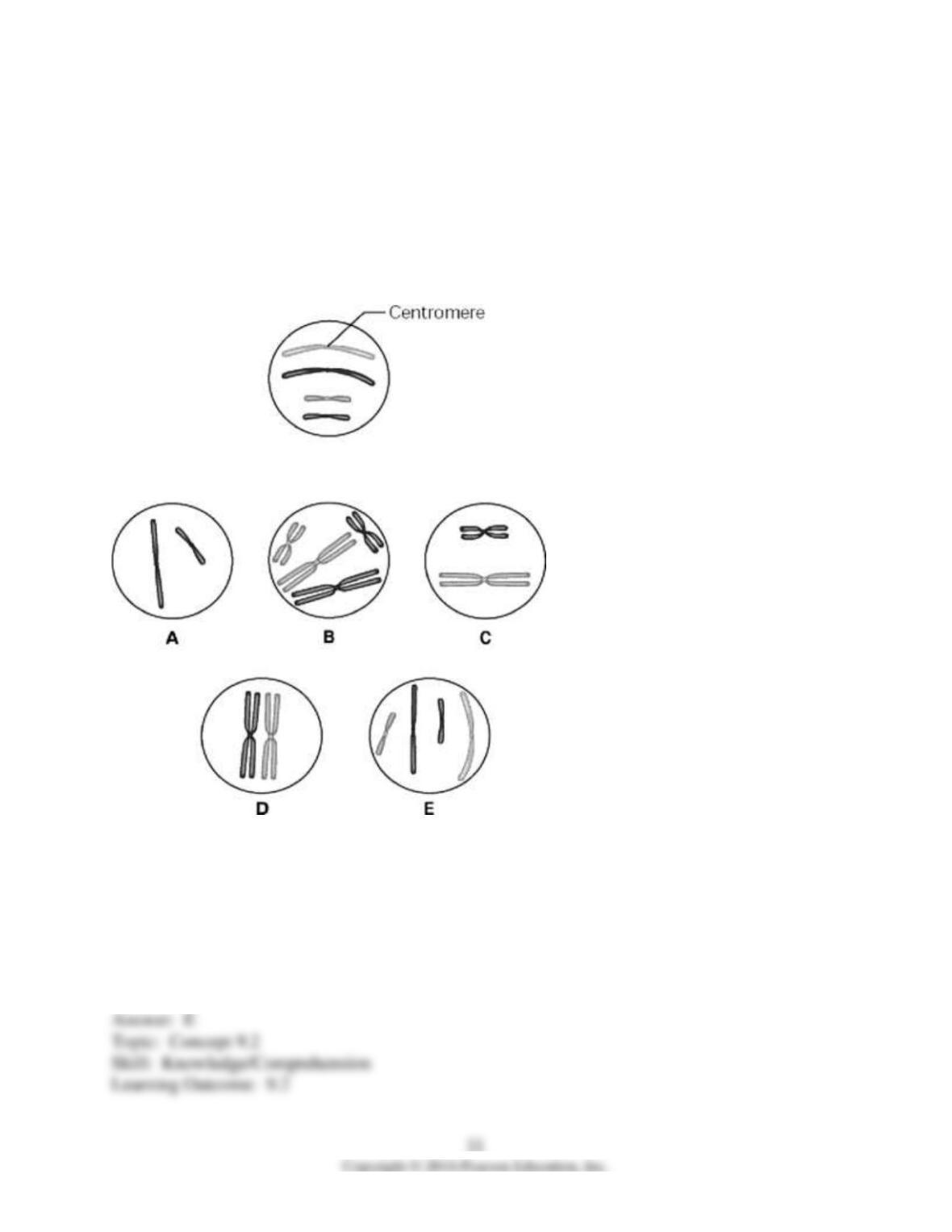
Please use the following information to answer the question(s) below.
The unlettered circle at the top of Figure 9.1 shows a diploid nucleus with four chromosomes
that have not yet replicated. There are two pairs of homologous chromosomes, one long and the
other short. One haploid set is black, and the other is gray. The circles labeled A-E show various
combinations of these chromosomes.
Figure 9.1
1) Which image displays the chromosomal composition of one daughter nucleus at telophase of
mitosis?
A) A
B) B
C) C
D) D
E) E
2) What is the correct chromosomal condition for a nucleus at prophase of mitosis?
A) A
B) B
C) C
D) D
E) E
3) What is the correct chromosomal condition for a nucleus in G1 of the cell division cycle?
A) A
B) B
C) C
D) D
E) E
4)
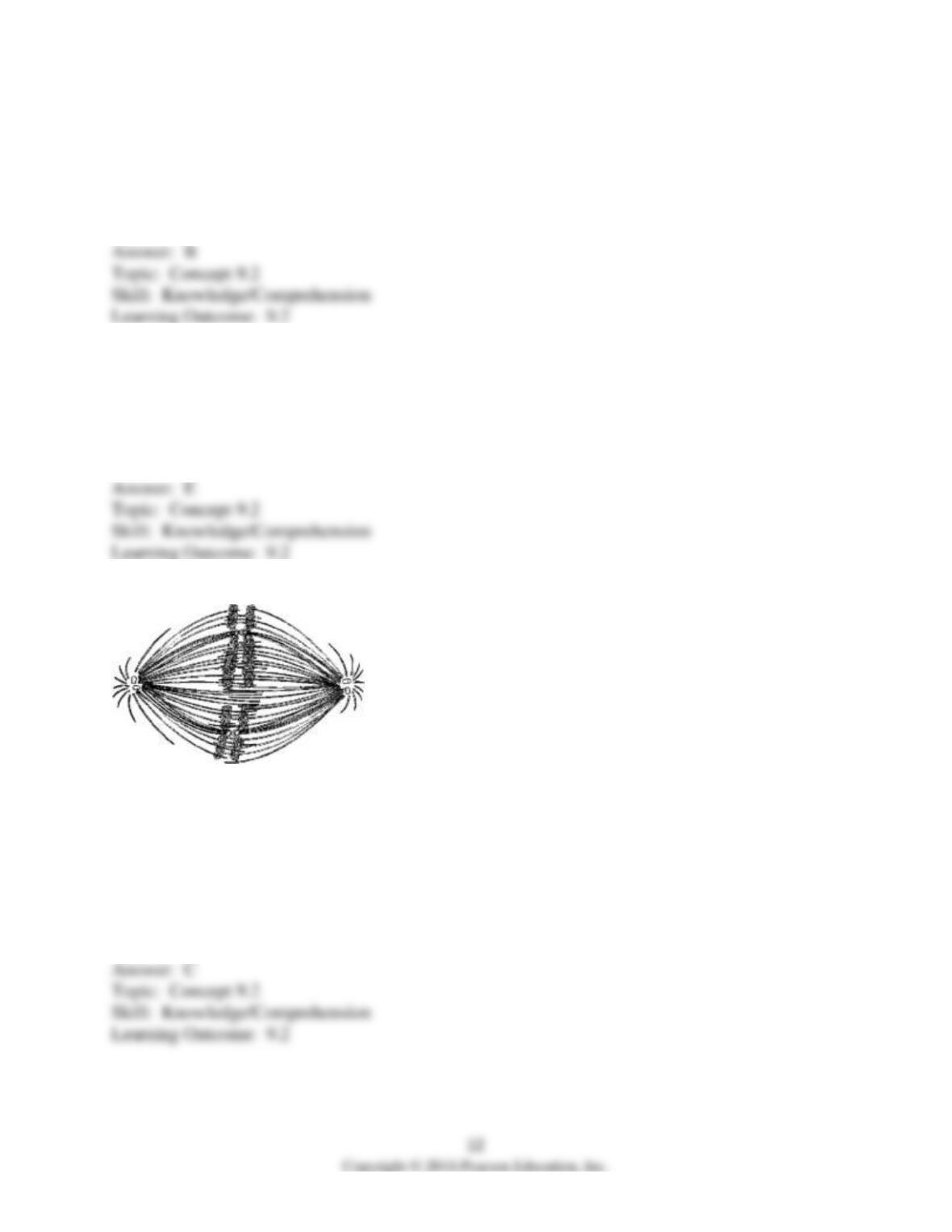
Figure 9.2
If the cell whose nuclear material is shown in Figure 9.2 continues toward completion of mitosis,
which of the following events would occur next?
A) cell membrane synthesis
B) alignment of chromosomes at the metaphase plate
C) segregation of daughter chromosomes toward the poles
D) formation of telophase nuclei
E) synthesis of sister chromatids
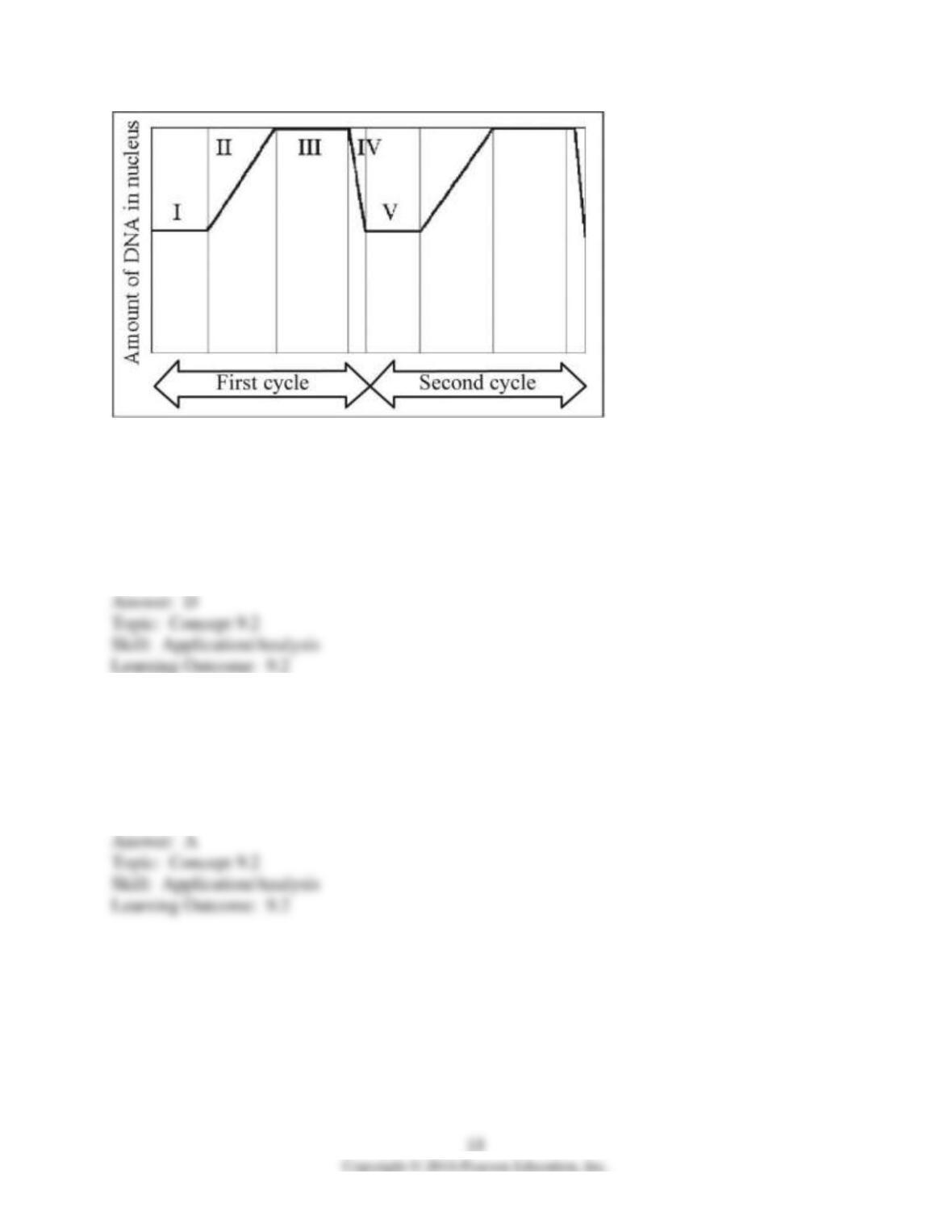
Figure 9.3
5) In Figure 9.3, mitosis is represented by which numbered parts of the cycle?
A) I
B) II
C) III
D) IV
E) V
6) In Figure 9.3, G1 is represented by which numbered parts of the cycle?
A) I or V
B) II or IV
C) III only
D) IV only
E) V only
7) In Figure 9.3, DNA synthesis is represented by which numbered parts of the cycle?
A) I
B) II
C) III
D) IV
E) V
8) In Figure 9.3, which number represents the point in the cell cycle during which the
chromosomes are replicated?
A) I
B) II
C) III
D) IV
E) V
9) In Figure 9.3, which of the numbered regions would contain cells at metaphase?
A) I and IV
B) II only
C) III only
D) IV only
E) V only
10) In Figure 9.3, G2 is represented by which numbered parts of the cycle?
A) I or V
B) II or IV
C) III only
D) IV only
E) V only
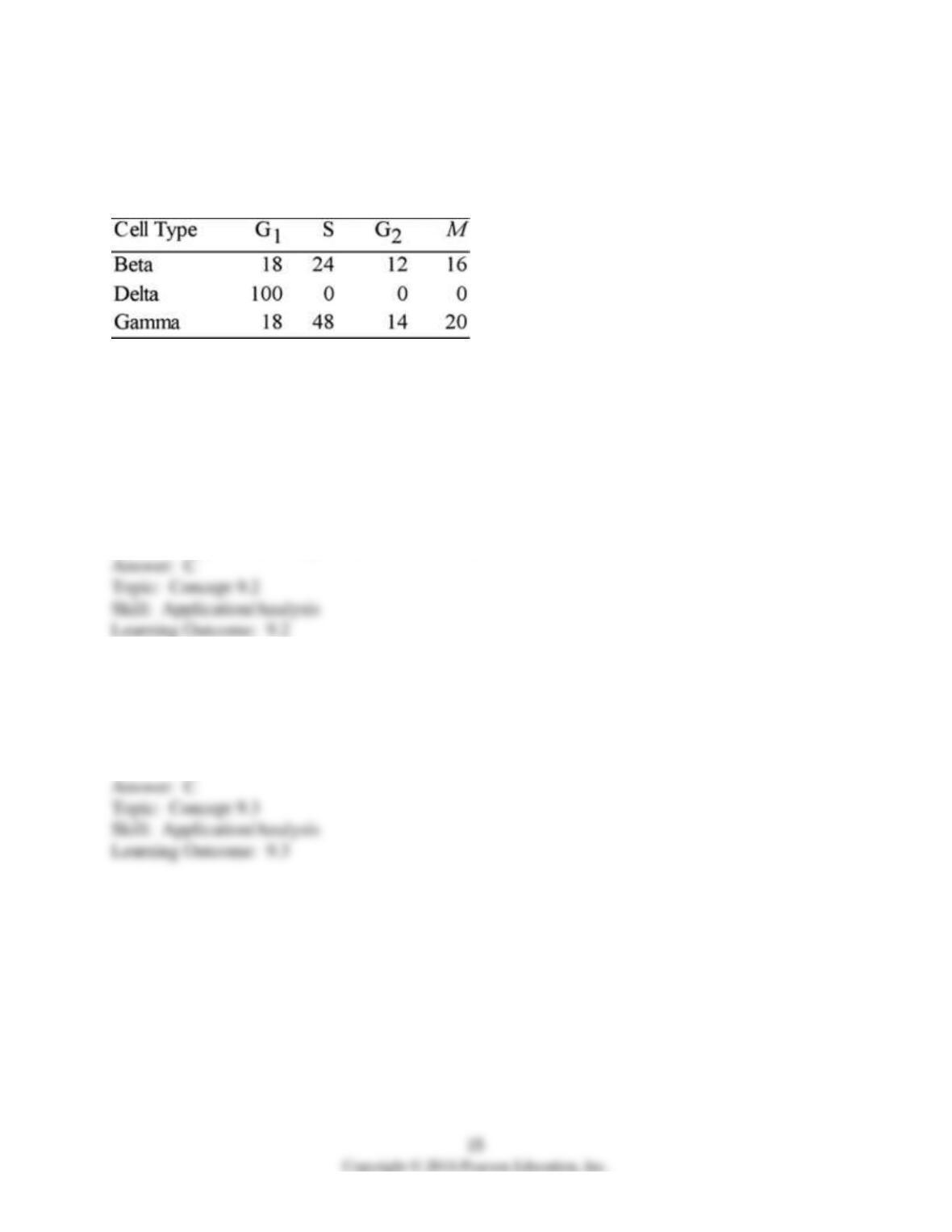
Please use the following information to answer the question(s) below.
The data in Table 9.1 were obtained from a study of the length of time spent in each phase of the
cell cycle by cells of three eukaryotic organisms designated beta, delta, and gamma.
Table 9.1
Minutes Spent in Cell Cycle Phases
11) Which of the following is the most plausible explanation for the difference in time spent in S
phase by beta and gamma?
A) Gamma is unicellular and beta is multicellular.
B) Beta is tetraploid and gamma is diploid.
C) Gamma contains more DNA than beta.
D) Beta reproduces asexually and gamma reproduces sexually.
E) Beta is a plant cell and gamma is an animal cell.
12) The best conclusion concerning delta is that the cells
A) contain no DNA.
B) contain only one chromosome that is very small.
C) are actually in the G0 phase.
D) synthesize DNA in the G1 phase
9.3 Scenario Questions
1) Several organisms, including a number of protists, have intermediate mitotic organization.
Which of the following is the most probable hypothesis regarding these intermediate forms of
cell division?
A) They represent a form of cell reproduction that must have evolved completely separately from
those of other organisms.
B) They demonstrate that these species are not closely related to any of the other protists and
may well be a different kingdom.
C) They rely on totally different proteins for the processes they undergo.
D) They may be more closely related to plant forms that also have unusual mitosis.
E) They show some but not all of the evolutionary steps toward complete mitosis.
Please use the following information to answer the question(s) below.
Nucleotides can be radiolabeled before they are incorporated into newly forming DNA and can
therefore be assayed to track their incorporation. In a set of experiments, a student-faculty
research team introduced labeled T nucleotides into the culture of dividing human cells at
specific times.
2) Which of the following questions might be answered by such a method?
A) How many cells are produced by the culture per hour?
B) What is the length of the S phase of the cell cycle?
C) When is the S chromosome synthesized?
D) How many picograms of DNA are made per cell cycle?
E) When do spindle fibers attach to chromosomes?
3) The research team used the setup to study the incorporation of labeled nucleotides into a
culture of lymphocytes and found that the lymphocytes incorporated the labeled nucleotide at a
significantly higher level after a pathogen was introduced into the culture. They concluded that
A) the presence of the pathogen made the experiment too contaminated to trust the results.
B) their tissue culture methods needed to be relearned.
C) infection causes lymphocytes to divide more rapidly.
D) infection causes cell cultures in general to reproduce more rapidly.
E) infection causes lymphocyte cultures to skip some parts of the cell cycle.
9.4 End-of-Chapter Questions
1) Through a microscope, you can see a cell plate beginning to develop across the middle of a
cell and nuclei forming on either side of the cell plate. This cell is most likely
A) an animal cell in the process of cytokinesis.
B) a plant cell in the process of cytokinesis.
C) a bacterial cell dividing.
D) a plant cell in metaphase.
2) In the cells of some organisms, mitosis occurs without cytokinesis. This will result in
A) cells with more than one nucleus.
B) cells that are unusually small.
C) cells lacking nuclei.
D) cell cycles lacking an S phase.
3) Which of the following does not occur during mitosis?
A) condensation of the chromosomes
B) replication of the DNA
C) separation of sister chromatids
D) spindle formation
4) A particular cell has half as much DNA as some other cells in a mitotically active tissue. The
cell in question is most likely in
A) G1.
B) G2.
C) prophase.
D) metaphase.

5) The drug cytochalasin B blocks the function of actin. Which of the following aspects of the
animal cell cycle would be most-disrupted by cytochalasin B?
A) spindle formation
B) spindle attachment to kinetochores
C) cell elongation during anaphase
D) cleavage furrow formation and cytokinesis