Microbiology: An Introduction, 13e (Tortora et al.)
Chapter 8 Microbial Genetics
8.1 Multiple-Choice Questions
1) A gene is defined as
A) any random segment of DNA.
B) three nucleotides that code for an amino acid.
C) a sequence of nucleotides in DNA that codes for a functional product.
D) a sequence of nucleotides in RNA that codes for a functional product.
E) the RNA product of a transcribed section of DNA.
2) Which of the following pairs is mismatched?
A) DNA polymerase – makes a molecule of DNA from a DNA template
B) RNA polymerase – makes a molecule of RNA from an RNA template
C) DNA ligase – joins segments of DNA
D) transposase – cuts DNA backbone, leaving “sticky ends”
E) DNA gyrase – relaxes supercoiling in DNA ahead of the replication fork
3) Which of the following statements is FALSE?
A) DNA polymerase joins nucleotides in one direction (5′ to 3′) only.
B) The leading strand of DNA is made continuously.
C) The lagging strand of DNA is started by an RNA primer.
D) DNA replication proceeds in only one direction around the bacterial chromosome.
E) Multiple replication forks are possible on a bacterial chromosome.
4) DNA is constructed of
A) a single strand of nucleotides with internal hydrogen bonding.
B) two complementary strands of nucleotides bonded A–C and G–T.
C) two strands of nucleotides running in an antiparallel configuration.
D) two strands of identical nucleotides in a parallel configuration with hydrogen bonds between
them.
E) None of the answers is correct.
5) Which of the following is NOT a product of transcription?
A) a new strand of DNA
B) rRNA
C) tRNA
D) mRNA
6) Which of the following statements about bacteriocins is FALSE?
A) The genes coding for them are on plasmids.
B) They cause food-poisoning symptoms.
C) They can be used to identify certain bacteria.
D) Bacteriocins kill bacteria.
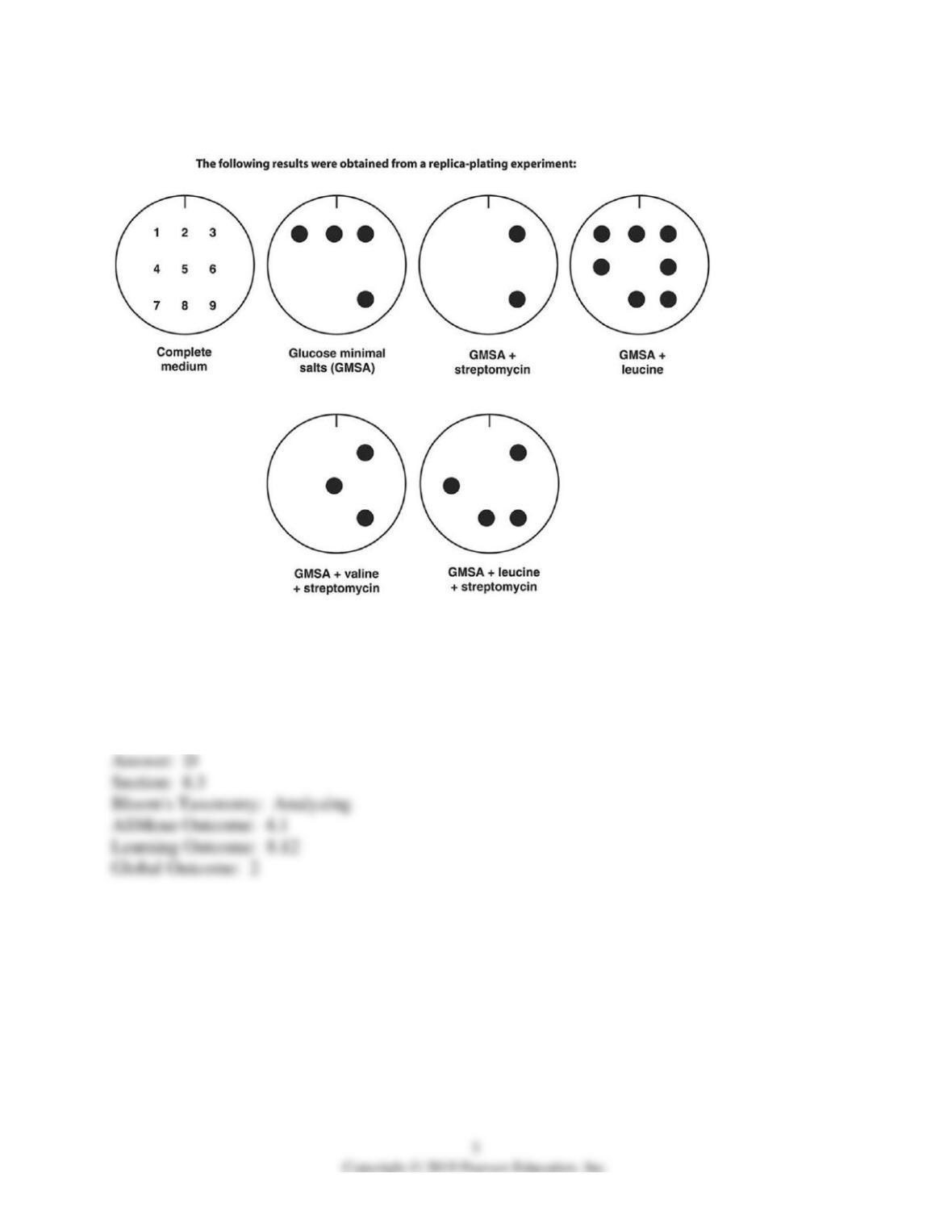
7) Figure 8.1
In Figure 8.1, which colonies are streptomycin-resistant and leucine-requiring?
A) 1, 2, 3, and 9
B) 3 and 9
C) 4, 6, and 8
D) 4 and 8
E) 5 and 6
Table 8.1
Culture 1: F+, leucine+, histidine+
Culture 2: F–, leucine–, histidine–
8) In Table 8.1, what will be the result of conjugation between cultures 1 and 2 (reminder: F+ has
a different meaning than Hfr)?
A) 1 will remain the same;
2 will become F+, leucine–, histidine–
B) 1 will become F–, leu+, his+;
2 will become F+, leu–, his–
C) 1 will become F–, leu–, his–;
2 will remain the same
D) 1 will remain the same;
2 will become F+, leu+, his+
E) 1 will remain the same;
2 will become F+ and recombination may occur
9) In Table 8.1, if culture 1 mutates to Hfr, what will be the result of conjugation between the
two cultures?
A) They will both remain the same.
B) 1 will become F+, leu+, his+;
2 will become F+, leu+, his+
C) 1 will remain the same;
recombination may occur in 2
D) 1 will become F–, leu+, his+;
2 will become Hfr, leu+, his+
E) The answer cannot be determined based on the information provided.
5
10) An enzyme produced in response to the presence of a substrate is called a(n)
A) inducible enzyme.
B) repressible enzyme.
C) restriction enzyme.
D) operator.
E) promoter.
11) Transformation is the transfer of DNA from a donor to a recipient cell
A) by a bacteriophage.
B) as naked DNA in solution.
C) by cell-to-cell contact.
D) by crossing over.
E) by sexual reproduction.
12) Genetic change in bacteria can be brought about by
A) mutation.
B) conjugation.
C) transduction.
D) transformation.
E) All of the answers are correct.
13) Which of the following statements regarding a bacterium that is R+ is FALSE?
A) It possesses a plasmid.
B) R+ can be transferred to a cell of the same species.
C) It is resistant to certain drugs and heavy metals.
D) It is F+.
E) R+ can be transferred to a different species.
14) The initial/first effect of ionizing radiation on a cell is that it causes
A) DNA to break.
B) bonding between adjacent thymines.
C) base substitutions.
D) the formation of highly reactive ions.
E) the cells to get hot.
15) According to the operon model, for the synthesis of an inducible enzyme to occur, the
A) end-product must not be in excess.
B) substrate must bind to the enzyme.
C) substrate must bind to the repressor.
D) repressor must bind to the operator.
E) repressor must not be synthesized.
16) Synthesis of a repressible enzyme is stopped by the
A) allosteric transition.
B) substrate binding to the repressor.
C) corepressor binding to the operator.
D) corepressor-repressor complex binding to the operator.
E) end product binding to the promoter.
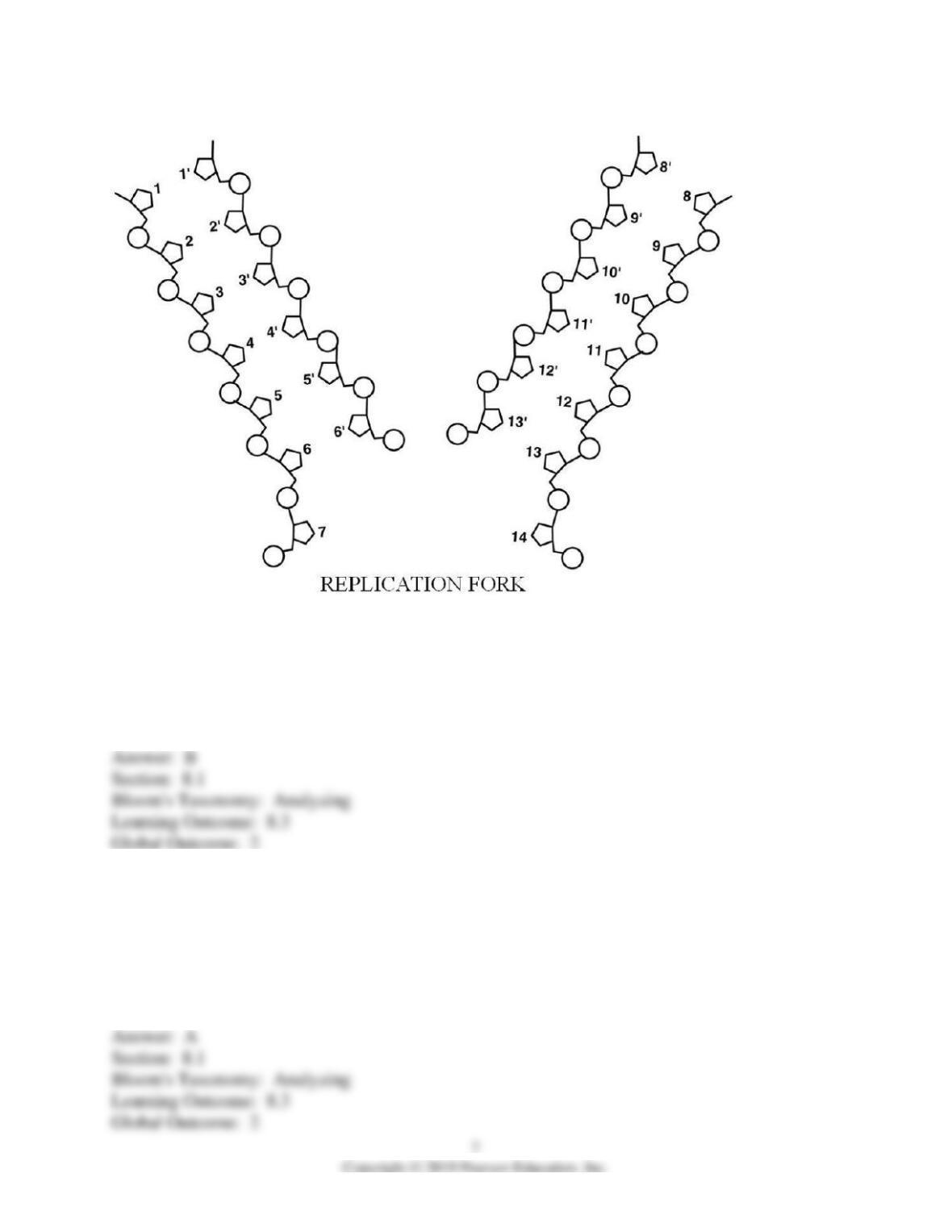
Figure 8.2
17) In Figure 8.2, if base 4 is adenine, what is base 4′?
A) adenine
B) thymine
C) cytosine
D) guanine
E) uracil
18) In Figure 8.2, if base 4 is adenine, what is base 11′ (remember the complimentary
configuration of bases in DNA)?
A) adenine
B) thymine
C) cytosine
D) guanine
E) uracil
19) In Figure 8.2, base 5 (and ONLY the base) is covalently bound/attached to
A) ribose.
B) phosphate.
C) deoxyribose.
D) thymine.
E) The answer cannot be determined based on the information provided.
20) The DNA damage caused by ultraviolet radiation is
A) never repaired.
B) repaired during transcription.
C) repaired during translation.
D) cut out and replaced.
E) repaired by DNA replication.
Table 8.2
Codons in mRNA molecule and their corresponding amino acids
UUU Phenylalanine UAU tyrosine
UUA leucine UAA nonsense
GCA alanine AAU asparagine
AAG lysine UGC cysteine
GUU valine UCG, UCU serine
21) Refer to Table 8.2. If the sequence of amino acids encoded by a strand of DNA is serine-
alanine-lysine-leucine, what is the order of bases in the sense strand of DNA?
A) 3′ UGUGCAAAGUUA 5′
B) 3′ AGACGTTTCAAT 5′
C) 3′ TCTCGTTTGTTA 5′
D) 5′ TGTGCTTTCTTA 3′
E) 5′ AGAGCTTTGAAT 3′
22) Refer to Table 8.2. If the sequence of amino acids encoded by a strand of DNA is serine-
alanine-lysine-leucine, the coding for the antisense strand of DNA is
A) 5′ ACAGTTTCAAT 3′.
B) 5′ TCTGCAAAGTTA 3′.
C) 3′ UGUGCAAAGUUA 5′.
D) 3′ UCUCGAAAGUUA 5′.
E) 3′ TCACGUUUCAAU 5′.
23) Refer to Table 8.2 The anticodon for valine is
A) GUU.
B) CUU.
C) CTT.
D) CAA.
E) GTA.
24) Refer to Table 8.2. Identify the sequence of amino acids encoded by the following sequence
of bases in a strand of DNA (pay attention to the polarity of the DNA here):
3′ ATTACGCTTTGC 5′.
A) leucine-arginine-lysine-alanine
B) asparagine-arginine-lysine-alanine
C) asparagine-cysteine-valine-serine
D) Translation would stop at the first codon.
E) The answer cannot be determined based on the information provided.
25) Refer to Table 8.2. If an indeterminate frameshift mutation occurred (that is, one at a random
location) in the sequence of bases shown below, what would be the sequence of amino acids
coded for?
3′ ATTACGCTTTGC
A) leucine-arginine-lysine-alanine
B) asparagine-arginine-lysine-alanine
C) asparagine-cysteine-valine-serine
D) Translation would stop at the first codon.
E) The answer cannot be determined based on the information provided.
26) Refer to Table 8.2. When amino acid sequences from a cell cycle control protein from a
patient with cancer and a healthy person are aligned, the sequence from the cancer patient
indicates one amino acid has changed from phenylalanine (Phe) to leucine (Leu). A mutation in
the cancer patient’s DNA must have taken place. Identify the result of this DNA change in the
mRNA codon that led to this change in the protein sequence.
A) UUU altered to UCU
B) UUU altered to UAU
C) UCU altered to UUA
D) CAA altered to UUU
E) UUU altered to UUA
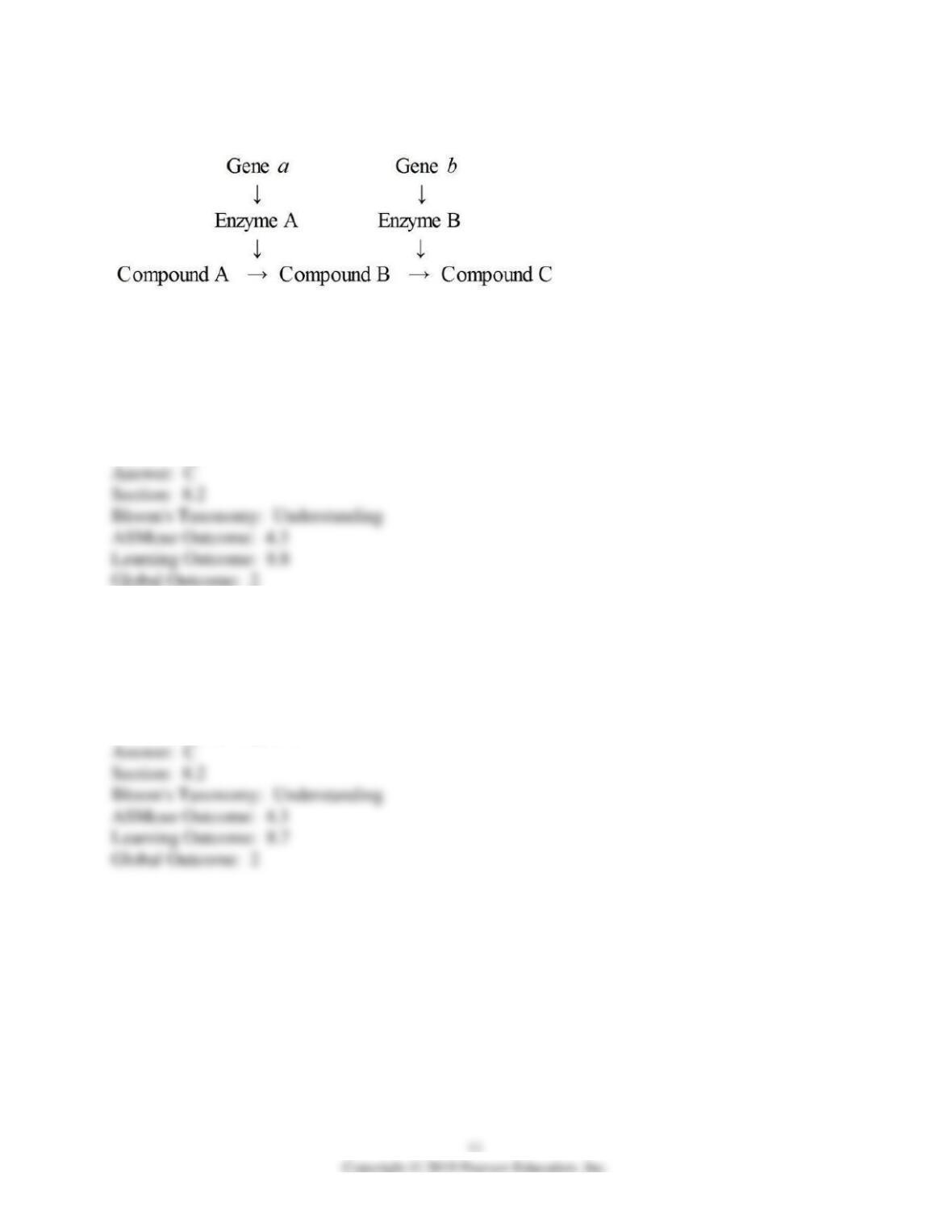
Figure 8.3 – Metabolic Pathway
27) In Figure 8.3, if compound C reacts with the allosteric site of enzyme A, this would
exemplify
A) a mutation.
B) repression.
C) feedback inhibition.
D) competitive inhibition.
E) transcription.
28) In Figure 8.3, if enzyme A is a repressible enzyme, compound C would
A) always be in excess.
B) bind to Enzyme A.
C) bind to the corepressor for Gene a.
D) bind to RNA polymerase.
E) bind directly to gene a.
29) In Figure 8.3, if enzyme A is an inducible enzyme,
A) compound C would bind to the repressor for Gene a.
B) compound A would bind to the repressor for Gene a.
C) compound B would bind to enzyme A directly.
D) compound A would react with enzyme B directly.
E) compound C would react with gene a directly.
30) Conjugation differs from reproduction because conjugation
A) replicates DNA.
B) transfers DNA vertically, to new cells.
C) transfers DNA horizontally, to nearby cells without those cells undergoing replication.
D) transcribes DNA to RNA.
E) copies RNA to make DNA.
31) The necessary ingredients for DNA synthesis can be mixed together in a test tube. The DNA
polymerase is from Thermus aquaticus, and the template is from a human cell. The DNA
synthesized would be most similar to
A) human DNA.
B) T. aquaticus DNA.
C) a mixture of human and T. aquaticus DNA.
D) human RNA.
E) T. aquaticus RNA.