Chapter 8 Recombinant DNA Technology
8.1 Multiple Choice Questions
1) Which of the following is the best definition of biotechnology?
A) The use of microorganisms to produce useful products.
B) The sequencing of microbial genomes.
C) The study of replication and recombination in microbes.
D) The study of genetic expression in microbes.
E) The deliberate modification of the genome of an organism for practical purposes.
2) In the 20th century, scientists harnessed the natural metabolic reactions of bacteria to make
________ for the first time in an industrial setting.
A) soy sauce
B) acetone
C) wine
D) cheese
E) alcohol
3) Which of the following items is NOT a part of the name of a restriction enzyme?
A) the Gram reaction of the source bacterium
B) the specific epithet of the source bacterium
C) Roman numerals to indicate its order of discovery
D) the strain of the source bacterium
E) the genus of the source bacterium
4) The natural role of restriction enzymes in bacteria is to
A) make conjugation more efficient.
B) allow transposons to move to another place in the chromosome.
C) protect the cell from invading phages.
D) allow cells to accept foreign DNA.
E) provide the cell with new phenotypes, such as antibiotic resistance.
5) Which of the following is a product of recombinant DNA technology?
A) rice that produces vitamin A
B) bacteria that produce antibiotics
C) yeast that produces alcohol
D) bacteria that produce acetone
E) microbes that digest crude oil
6) Which of the following restriction enzyme sites would produce blunt-ended fragments? (The
arrow represents the cutting site of the enzyme.)
A) C↓CGG
B) G↓GATCC
C) G↓AATTC
D) CCC↓GGG
E) A↓AGCTT
7) The enzyme reverse transcriptase
A) synthesizes DNA from a DNA template of the same polarity.
B) synthesizes DNA from an RNA template.
C) synthesizes RNA from an RNA template.
D) synthesizes RNA from a DNA template.
E) can synthesize DNA or RNA from an RNA template.
8) Which of the following statements regarding vectors is FALSE?
A) Vectors are usually autonomously replicating DNA molecules.
B) A useful vector contains multiple restriction sites for insertion of DNA.
C) Vectors are generally over 100,000 base pairs in size.
D) Cloning vectors frequently contain sequences necessary for expression of inserted
sequences.
E) Cloning vectors include a “marker” to facilitate identification of cells containing them.
9) Synthetic nucleic acids are useful as
A) DNA probes.
B) primers for PCR.
C) antisense RNAs.
D) DNA probes and antisense RNAs.
E) DNA probes, primers, and antisense RNAs.
10) Mutagens are useful in biotechnology research for
A) producing organisms with altered phenotypes.
B) producing new organisms which have beneficial traits from two or more organisms.
C) selecting genetic mutants resistant to radioactivity.
D) removing undesirable traits from microbes.
E) producing DNA fragments for cloning.
11) Which of the following is essential in PCR?
A) DNA polymerase
B) antisense RNAs
C) reverse transcriptase
D) DNA primers
E) both DNA primers and DNA polymerase
12) If a researcher used Escherichia coli DNA polymerase instead of Thermus aquaticus DNA
polymerase in the PCR procedure, what would be the result?
A) DNA replication would occur more slowly than normal.
B) DNA replication would not occur at all.
C) Many mistakes would occur.
D) DNA replication would occur twice as fast as normal.
E) DNA replication would stop after one cycle.
13) What is the function of the low temperature second step in PCR (polymerase chain
reaction)?
A) Activation of the DNA polymerase.
B) Allowing primers to bind complementary sequences.
C) Facilitate DNA synthesis.
D) Deactivate DNA polymerase to pause synthesis.
E) Facilitate the base pairing of deoxyribonucleotide triphosphates.
14) The technique known as real-time PCR is used to
A) prepare cDNA molecules for cloning.
B) detect the presence of specific genetic sequences in a sample.
C) isolate DNA fragments for cloning.
D) measure the number of copies of a DNA sequence in a sample.
E) both detect and isolate DNA fragments in a sample.
15) In gel electrophoresis, DNA molecules move toward the ________ electrode because they
have an overall ________ charge.
A) negative; negative
B) positive; positive
C) negative; positive
D) positive; negative
E) negative and positive; neutral
16) Which of the following procedures might be used to detect the presence of genetic
sequences of a virus in a sample?
A) microarray
B) cloning
C) PCR
D) genome mapping
E) microarray or PCR
17) A northern blot differs from a Southern blot in the
A) type of probe used.
B) presence or absence of a nitrocellulose membrane.
C) size of the genetic sequences involved.
D) number of genetic sequences detected.
E) type of nucleic acid being isolated.
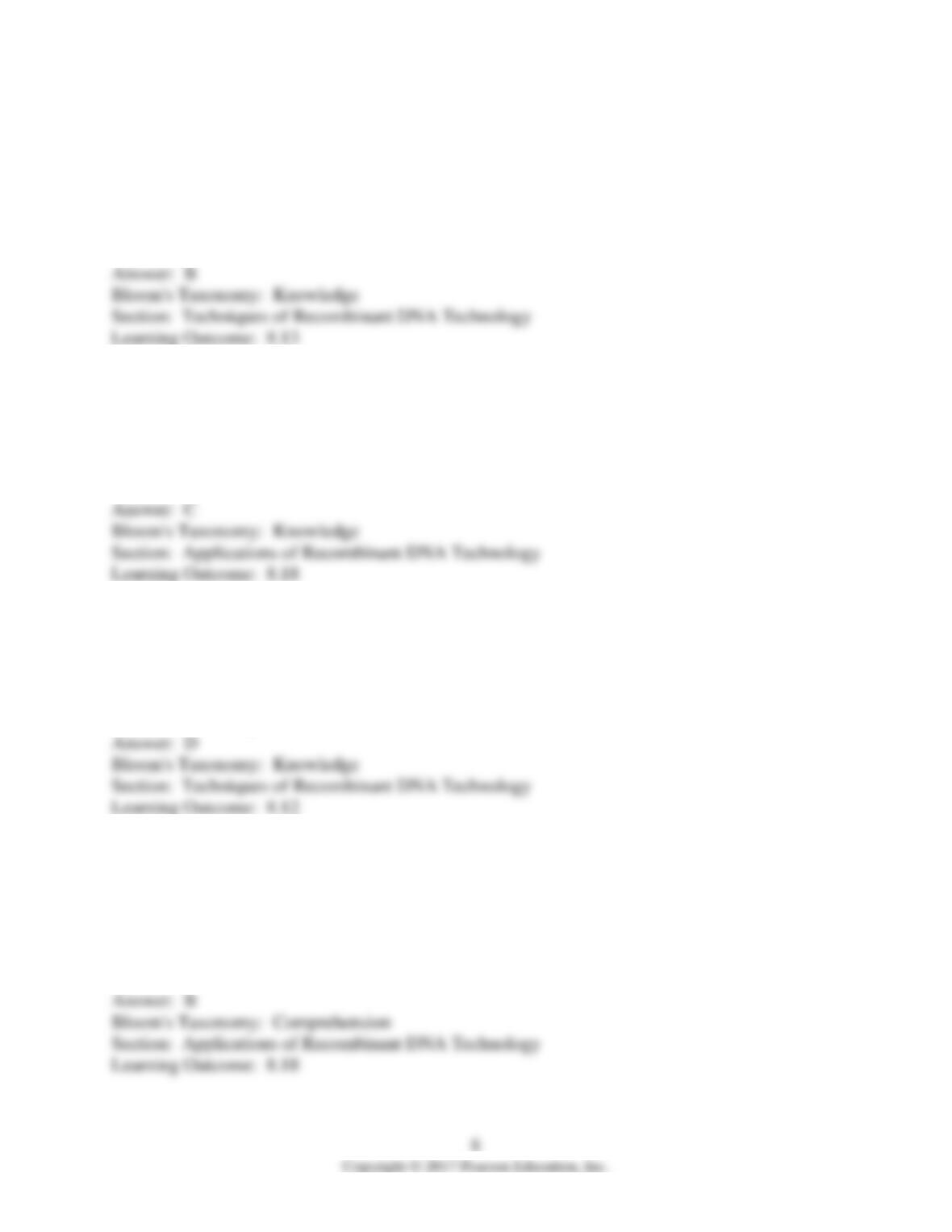
18)
Which method of inserting DNA into cells is illustrated in Figure 8.1?
A) protoplast fusion
B) injection
C) electroporation
D) a gene gun
E) transduction
19) Small single strand DNA molecules with a fluorescent molecule attached that are used to
identify a clone containing a specific gene fragment is called a
A) primer.
B) probe.
C) plasmid.
D) promoter.
E) peptide.
20) The sequencing and analysis of an organism’s genetic information is called
A) protein synthesis.
B) gene therapy.
C) genomics.
D) northern blotting.
E) PCR.
21) Which of the following devices is used for PCR?
A) an electrophoresis chamber
B) a gene gun
C) a DNA sequencer
D) a thermocycler
E) a nucleic acid synthesis machine
22) The technique of ________ is a means of determining the function of a gene by the
phenotype resulting from its absence.
A) gene therapy
B) gene knockout
C) probe analysis
D) expression vector cloning
E) FISH

23) A researcher inserted DNA fragments from an organism into plasmids and introduced the
modified plasmids into bacterial cells. Which of the following methods would be an effective
means of identifying which clones contain a specific gene of interest?
A) Sequence the DNA of the plasmids from each isolate.
B) Use a microarray to detect a transcript of the gene.
C) Isolate clones that still have the vector’s genetic marker.
D) Assay for activity of the gene product.
E) Use a northern blot to detect the mRNA of the gene.
24) Subunit vaccines are safer than traditional vaccines because they
A) are acellular.
B) are administered in food.
C) do not pose a risk for causing the disease.
D) are acellular and do not pose a risk for causing the disease.
E) are acellular and can be administered in food.
25) Which of the following is common to both Sanger sequencing and next-generation
sequencing?
A) radioactive labels
B) gel electrophoresis
C) tethered DNA fragments
D) chain terminating nucleotides
E) lasers
26) Transgenic organisms
A) contain cells from other organisms.
B) contain genetically engineered microbes.
C) are the same as clones.
D) contain genes from other organisms.
E) have genomes that have been sequenced completely.
27) Which of the following microbes produces a protein that kills a variety of insect pests?
A) Pseudomonas
B) Haemophilus influenzae
C) Bacillus thuringiensis
D) Thermus aquaticus
E) Plasmodium falciparum
28) Replacing a patient’s defective gene with a fragment containing a functional gene is
A) gene therapy.
B) genomics.
C) gene cloning.
D) gene mapping.
E) gene selection.
29) If all the following DNA fragments were analyzed on an electrophoresis gel, which one
would migrate farthest from the negative electrode?
A) 5000 base pairs
B) 750 base pairs
C) 1000 base pairs
D) 250 base pairs
E) 2500 base pairs
30) Which of the following procedures would be used to introduce DNA into a single mouse
cell?
A) Southern blotting
B) electroporation
C) gene gun
D) microinjection
E) protoplast fusion
31) The procedure used to determine whether a person has a heritable disease is known as
A) DNA sequencing.
B) microarray analysis.
C) genetic screening.
D) northern analysis.
E) xenotransplantation.
32) Double strand DNA fragments are separated by size using
A) restriction analysis.
B) FISH.
C) PCR.
D) northern blotting.
E) gel electrophoresis.
33) Which of the following is generally NOT considered an ethical issue regarding recombinant
DNA technology?
A) the modification of crop plants
B) screening of humans for genes that predispose them to disease
C) unforeseen impact on the environment
D) the modification of animals to produce pharmaceuticals for humans
E) answering basic research questions
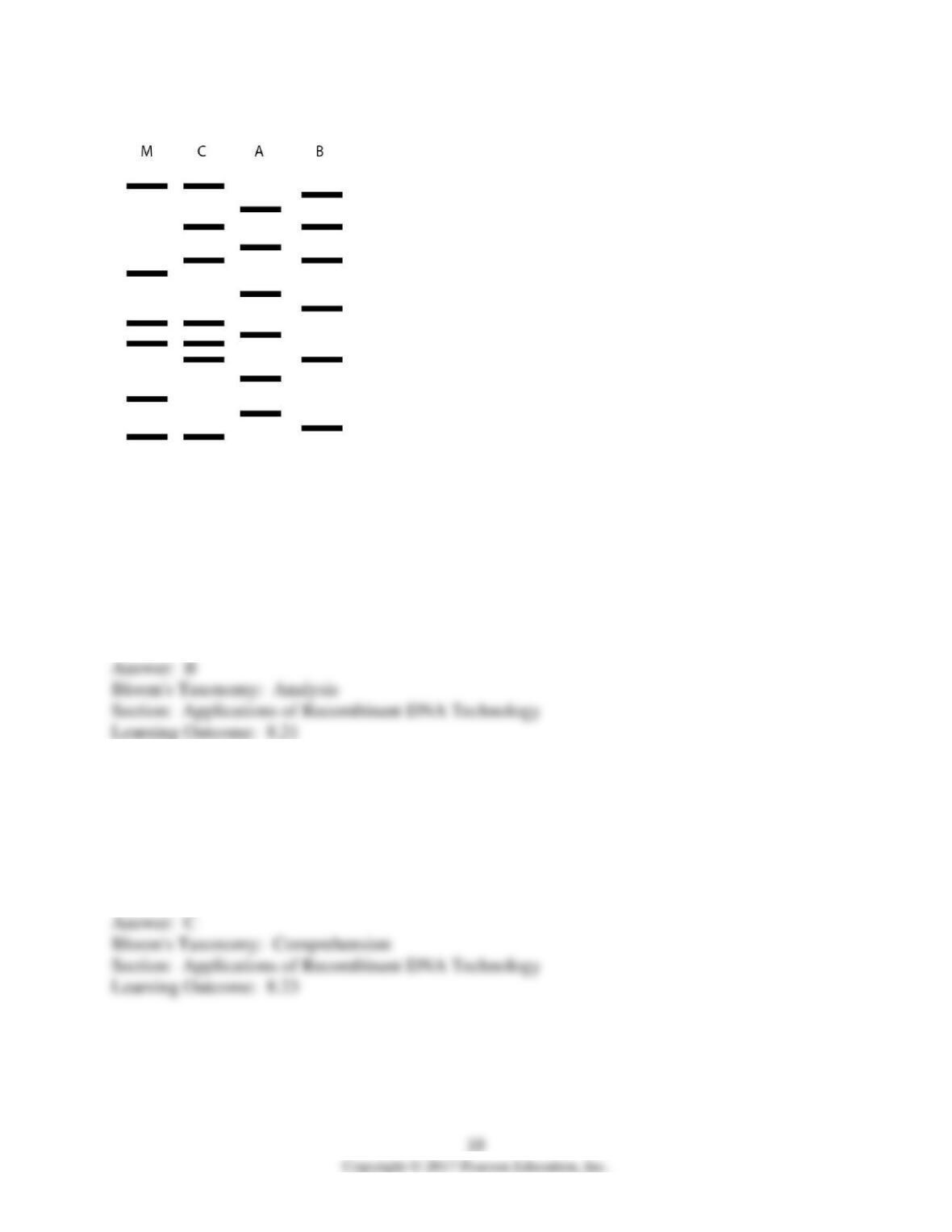
34)
Two men may be the father of a child. Figure 8.2 shows the results of a DNA fingerprint
analysis to determine paternity. M is the mother, C is the child, A and B are the two men. What
is the best interpretation of these results?
A) The man identified as A is probably the father.
B) The man identified as B is probably the father.
C) Neither man is this child’s father.
D) Either man could be this child’s father.
E) Paternity cannot be determined from this data.
35) Which of the following microbes has been genetically engineered to contain a protein that
helps protect crops from freezing?
A) Deinococcus radiodurans
B) Bacillus thuringiensis
C) Pseudomonas
D) Salmonella
E) Escherichia coli
36) Synthesis of cDNA requires the use of
A) DNA ligase.
B) agarose.
C) reverse transcriptase.
D) restriction enzymes.
E) fluorescent synthetic nucleotides.
37) Probes used for detecting genetic sequences are frequently composed of
A) agarose.
B) synthetic nucleic acids and labeled conjugates, such as fluorescent dyes.
C) restriction enzymes.
D) silicon chips.
E) nitrocellulose.
38) ________ are used for cutting DNA molecules into fragments.
A) Antisense RNAs
B) Mutagens
C) DNA polymerase and DNA ligase
D) Restriction enzymes
E) RNA polymerases
39) The templates for next-generation sequencing are
A) double-strand restriction fragments.
B) double-strand DNA on silicon chips.
C) double-strand PCR products.
D) single-strand DNA on silicon chips.
E) single-strand DNA on slides.
40) Which of the following is NOT a goal of recombinant DNA technology?
A) combining genetic material from more than one organism to produce new useful organisms
B) making it possible to clone humans
C) eliminating undesirable traits from livestock or crops
D) being able to remove or correct damaging traits in humans
E) creating organisms capable of producing useful products
41) In Southern blotting, DNA molecules are immobilized on
A) silicon chips.
B) nitrocellulose membranes.
C) agarose.
D) gold beads.
E) paper.
42) ________ are used in the detection of DNA by FISH.
A) Restriction fragments
B) Reverse transcriptase and DNA polymerase
C) Synthetic DNAs and fluorescent tags
D) Compressed air and gold beads
E) DNA polymerase and DNA ligase
43) Injecting DNA into cells can be accomplished using
A) nitrocellulose membranes.
B) silicon chips and nucleic acids.
C) compressed air and gold beads.
D) micropipettes.
E) micropipettes, or compressed air and gold beads.
44) DNA encoding a normal gene is inserted into cells from a patient with a defective form of
the gene. Recombinant cells are identified and isolated, and returned to the patient’s body. This
is an example of
A) gene therapy.
B) genomics.
C) genetic mapping.
D) genotyping.
E) biotechnology.
45) Some of the strongest opposition to the application of recombinant DNA technology
concerns
A) DNA fingerprinting.
B) modification of food crops.
C) correcting gene defects in animals.
D) sequencing of the human genome.
E) pest control measures.
8.2 True/False Questions
1) Gene therapy for human genetic diseases has not been successful yet.
2) Reverse transcriptase synthesizes a DNA molecule from an RNA template.
3) The goals of recombinant DNA technology include production of new organisms with useful
combinations of traits.
4) Restriction enzymes are useful only on synthetic DNAs.
5) Under ideal conditions, the number of DNA molecules produced during PCR increases
exponentially.
6) Sticky-end fragments generated by EcoRI will hydrogen bond to any other sticky-end
sequence.
7) A collection of bacterial clones each of which contains a portion of the gene sequences of an
organism is known as a microbiome of that organism’s genome.
8) Southern blotting is a technique that can be used to identify microbes that cannot be cultured.
9) The microbes resident on human skin are part of the human microbiome.
10) Pest resistant cotton plants that produce Bt were produced by selective breeding.
8.3 Short Answer Questions
1) The use of microbes to make practical products such as vaccines or hormones is called
(genomics/recombination/biotechnology).
2) A technique using fluorescent-tagged probes to detect specific DNA sequences in their
natural locations is known as (FISH/PCR/BLOTTING).
3) Nucleic acid molecules used to deliver new genes to cells are called
(plasmids/vectors/clones).
4) Restriction (enzymes/proteases/polymerases), first isolated from bacterial cells, cut DNA
molecules at specific sites.
5) Short nucleic acid molecules used to locate complementary sequences in a larger population
of molecules are called (probes/primers/vectors).
6) A set of clones representing the entire genome of an organism is known as a gene
(recombinant/map/library).
7) The technique called (northern/Southern/western) blotting is useful for using probes to
identify specific DNA fragments that have been separated by electrophoresis.
8) Small RNAs that bind to an mRNA and alter its expression are known as
(antisense/probes/restriction) RNAs.
9) The process of locating genes within the nucleic acid of an organism is called
(genetic/library/clone) mapping.
10) The insertion of foreign DNA directly into a cell’s nucleus using a glass micropipet is called
(microporation/electroporation/microinjection).
11) Genetic (screening/sequencing/cloning) can be used to detect mutant genes associated with
genetic diseases in individuals before any clinical symptoms are noted.
12) A DNA (library/microarray/screen) may be used to study the complex, changing patterns of
mRNA production in an organism.
13) Beta-carotene, the biochemical precursor to vitamin A, can be added to rice by using
(biotechnology/cloning/recombinant) DNA technology, thereby increasing its nutritional value.
14) Crop plants modified to be resistant to insect damage produce Bt toxin from a
(bacterial/fungal/synthetic) gene.
15) Vectors usually contain genetic (markers/sequences/probes) such as antibiotic genes or
fluorescent tags.
8.4 Essay Questions
1) Discuss some of the impacts that tools and techniques of recombinant DNA technology have
had on medicine.
2) Discuss one of the pros and cons regarding the application of recombinant DNA technology.
3) Compare and contrast the two major categories of restriction enzymes.
4) Outline a procedure for producing a useful new recombinant product.
5) Explain what a transgenic organism is, and give two examples.