Chapter 8—Plant Organs: Leaves Key
1. What are the two parts of a typical leaf?
2. The major tissues of the leaf are
3. One can distinguish between the upper epidermis and the lower epidermis of a typical leaf because
4. The epidermis has evolved ____ in order to prevent water loss.
5. Changes in the shape of the ____ control the opening and closing of the stomata.
6. Stomata open when
7. The hairlike structures on the epidermis are called
8. The primary function of the palisade mesophyll is
9. The primary function of the spongy mesophyll is
10. In leaves that have the mesophyll specialized as palisade and spongy mesophyll, where is the palisade
mesophyll located relative to the spongy mesophyll?
11. Which tissues are found in vascular bundles in the leaf?
12. The layer of nonvascular cells surrounding a leaf vein is the
13. What is the function of the bundle sheath?
14. Bulliform cells are found in the leaves of
15. The loss of water vapor from the aerial parts of a plant is called
16. Stomata can open and close
17. ____ is an environmental signal for the opening of stomata.
18. ____ must be pumped out of the guard cells in order for a stoma to open.
19. What specialization(s) have conifers evolved in order to prevent large amounts of water loss during the
winter?
20. What specialization(s) have deciduous plants evolved in order to prevent large amounts of water loss during
the winter?
21. Special openings at the tips of leaf veins through which liquid water is exuded are ____.
22. Leaf abscission
23. The leaf abscission zone is
24. Modified leaves that are hard and pointed are called
25. The winter buds of a dormant woody plant are protected by
26. ____ are modified leaves that are associated with flower clusters.
27. ____ are underground structures that have fleshy leaves designed for storage or water or sugars.
28. These modified leaves are used by vines to support their weight.
29. An epiphyte is
30. Most insectivorous plants grow in soil that is deficient in
31. Widespread forest decline is apparently caused by
32. A simple leaf has a single blade, and a compound leaf has a blade with two or more leaflets.
33. Opposite leaf arrangement has one leaf at each node.
34. Parallel leaf venation is generally found in monocots.
35. Netted veins may be palmately or pinnately netted.
36. Typical leaf epidermal cells usually have chloroplasts.
37. Stomata are only found in the upper epidermis.
38. Leaf veins have xylem and phloem tissues.
39. The bundle sheath provides support for the leaf.
40. Both monocot and eudicot leaves usually have a petiole and a broad flat blade with netted venation.
41. During drought, the bulliform cells on the leaves of certain grasses may help the leaf fold inward, thereby
reducing water loss by transpiration.
42. When a plant’s cells lose turgor, the plant wilts.
43. Stomata close in response to low levels of CO2 (carbon dioxide).
44. Stomata open in response to blue light.
45. Opening of stomata requires the opening of ion channels.
46. Deciduous trees loss their leaves during a particular season.
47. Transpiration is the process by which water is lost from the leaves and guttation is the process by which
water is absorbed through the leaves.
48. Chlorophyll is the only pigment present in green leaves.
49. Spines are leaves that are modified for photosynthesis.
50. Carnivorous plants catch insects and other small animals.
51. Plants such as walnut have a(n) ____________________ leaf arrangement, with one leaf at each node.
52. The waxy ____________________, secreted by the leaf epidermis, reduces water loss.
53. Openings (pores) in the leaf epidermis are called ____________________.
54. Hairlike structures on the surfaces of many leaves are called ____________________.
55. The upper epidermis of some grasses have ____________________ which are involved in rolling or folding
a leaf during drought conditions.
56. The two specialized epidermal cells that flank each stoma are ____________________.
57. When stomata are open, ____________________ can enter the leaf. This gas is needed for photosynthesis.
58. The ____________________ mesophyll has cells that are loosely and irregularly arranged.
59. The first step in blue light-induced stomatal opening is the activation of ____________________.

60. The ____________________ of the water lily leaf elongates greatly so that the leaf floats on the surface of
the water.
61. Woody eudicots of temperate climates that loose their leaves during the winter are
____________________.
62. The rate of ____________________ is influenced by environmental factors, such as humidity.
63. In leaf abscission, enzymes dissolve the ____________________, the “cement” that holds the walls of
64. Many vines have ____________________, specialized leaves that grasp and hold onto other structures.
65. ____________________ are modified leaves that discourage animals from damaging the plant.
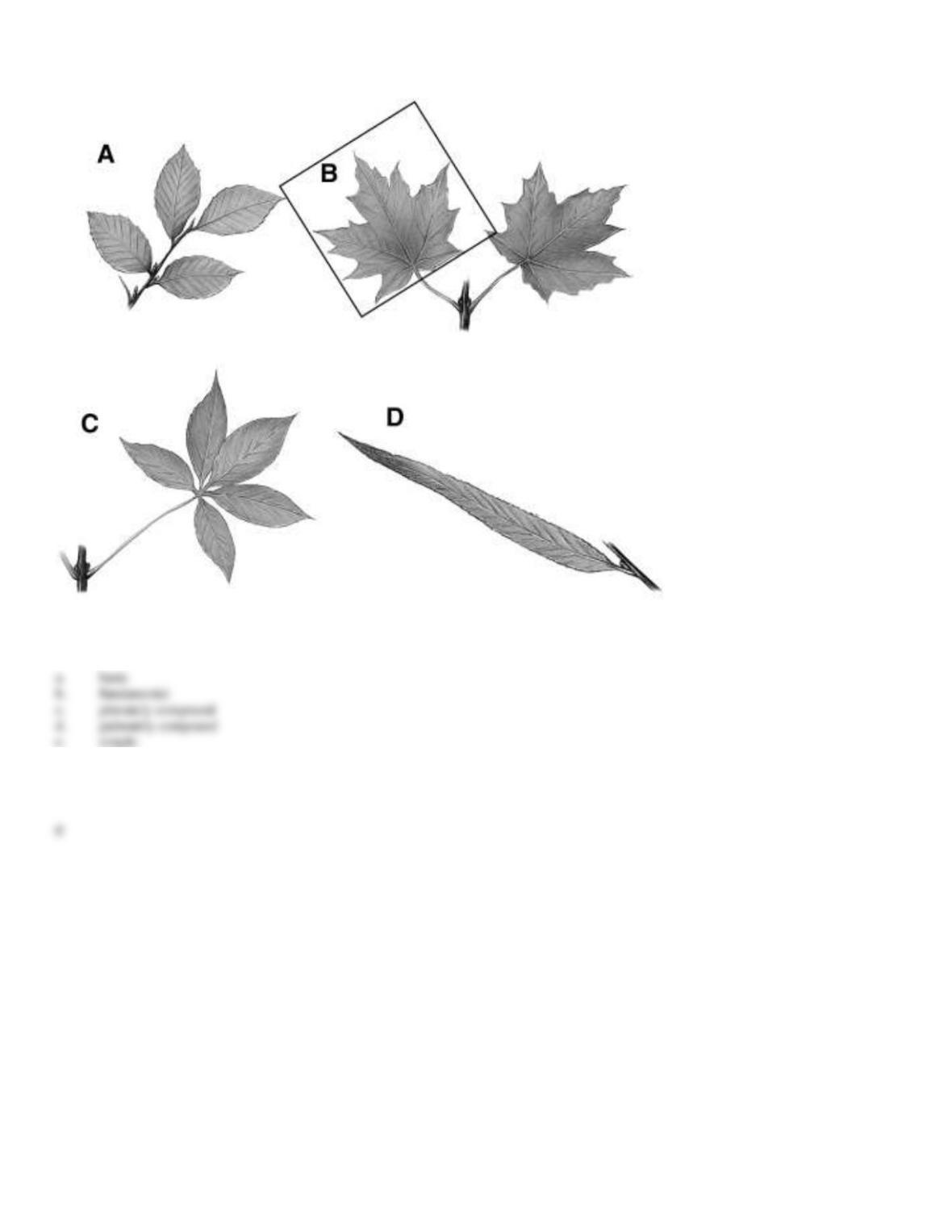
66. Figure 8-1
Refer to Figure 8-1. What type of leaf is shown in A?
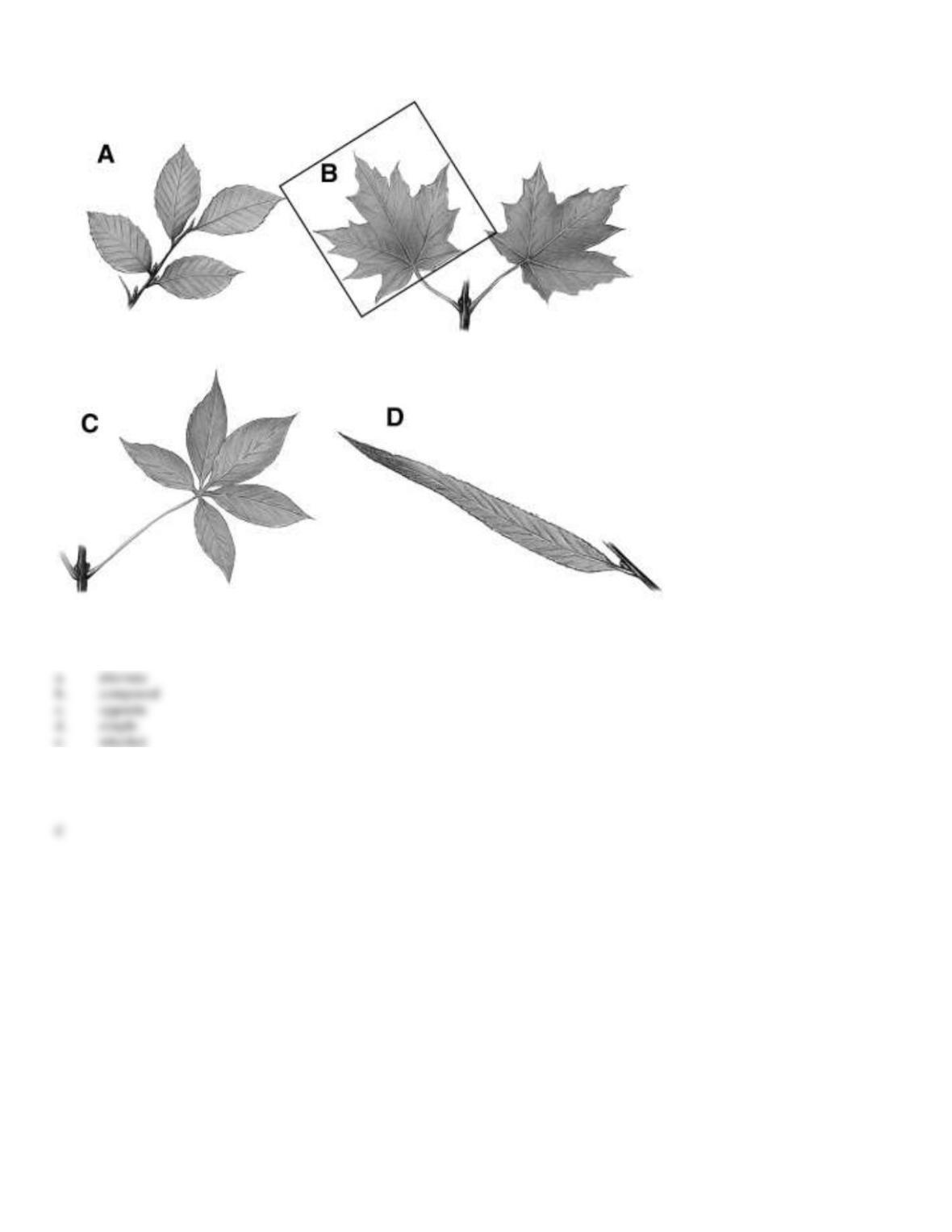
67. Figure 8-1
Refer to Figure 8-1. What type of leaf arrangement is shown in B?
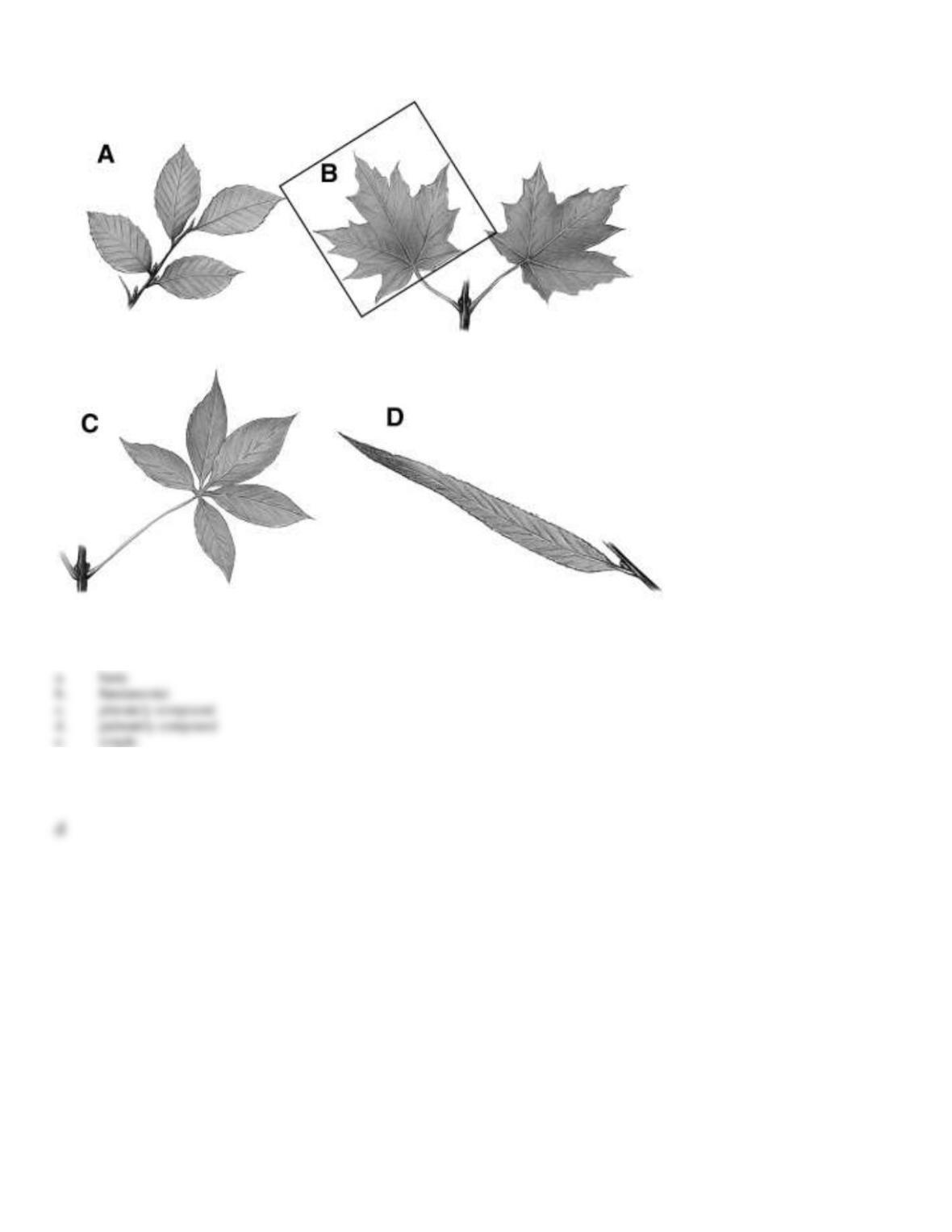
68. Figure 8-1
Refer to Figure 8-1. What type is leaf is shown in C?
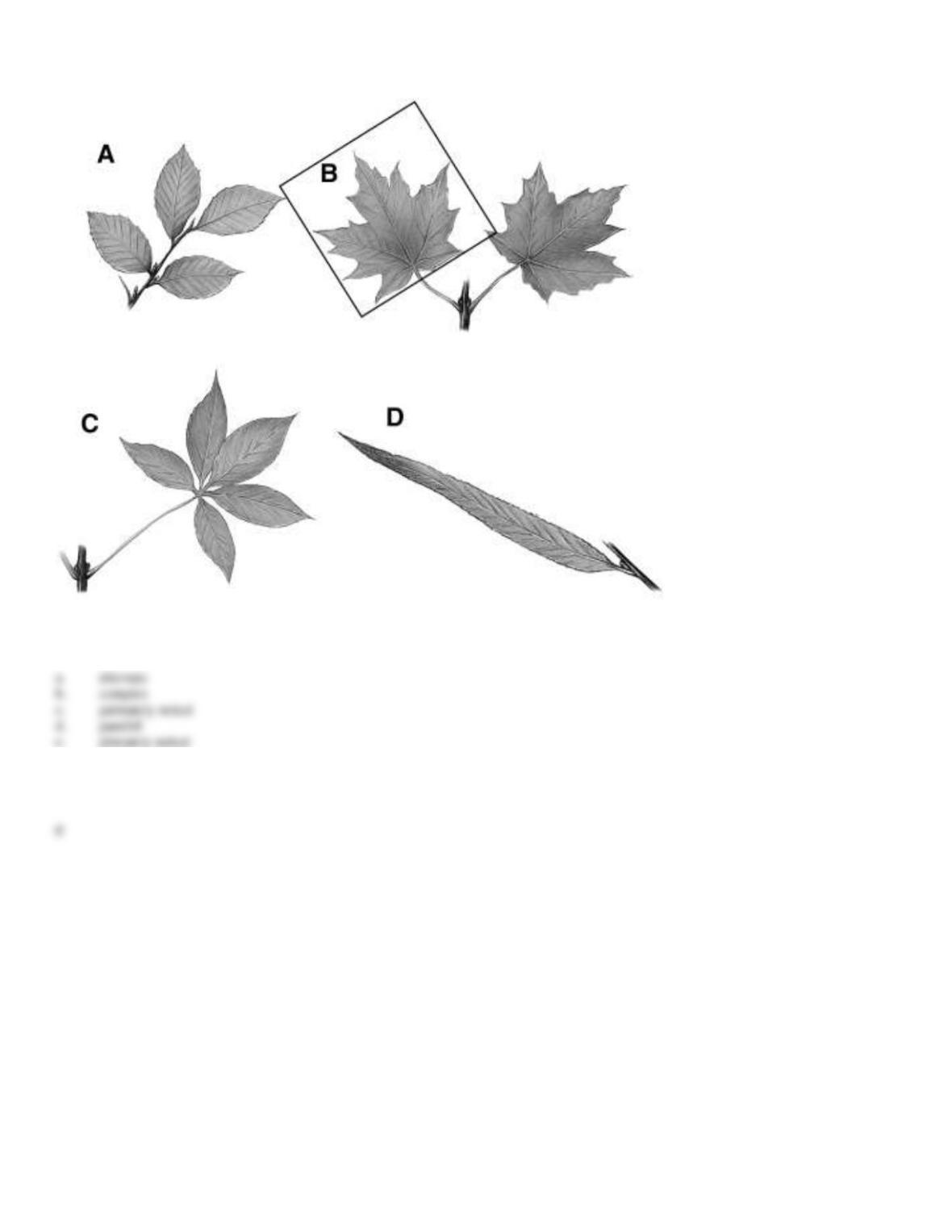
69. Figure 8-1
Refer to Figure 8-1. What venation pattern is shown in D?
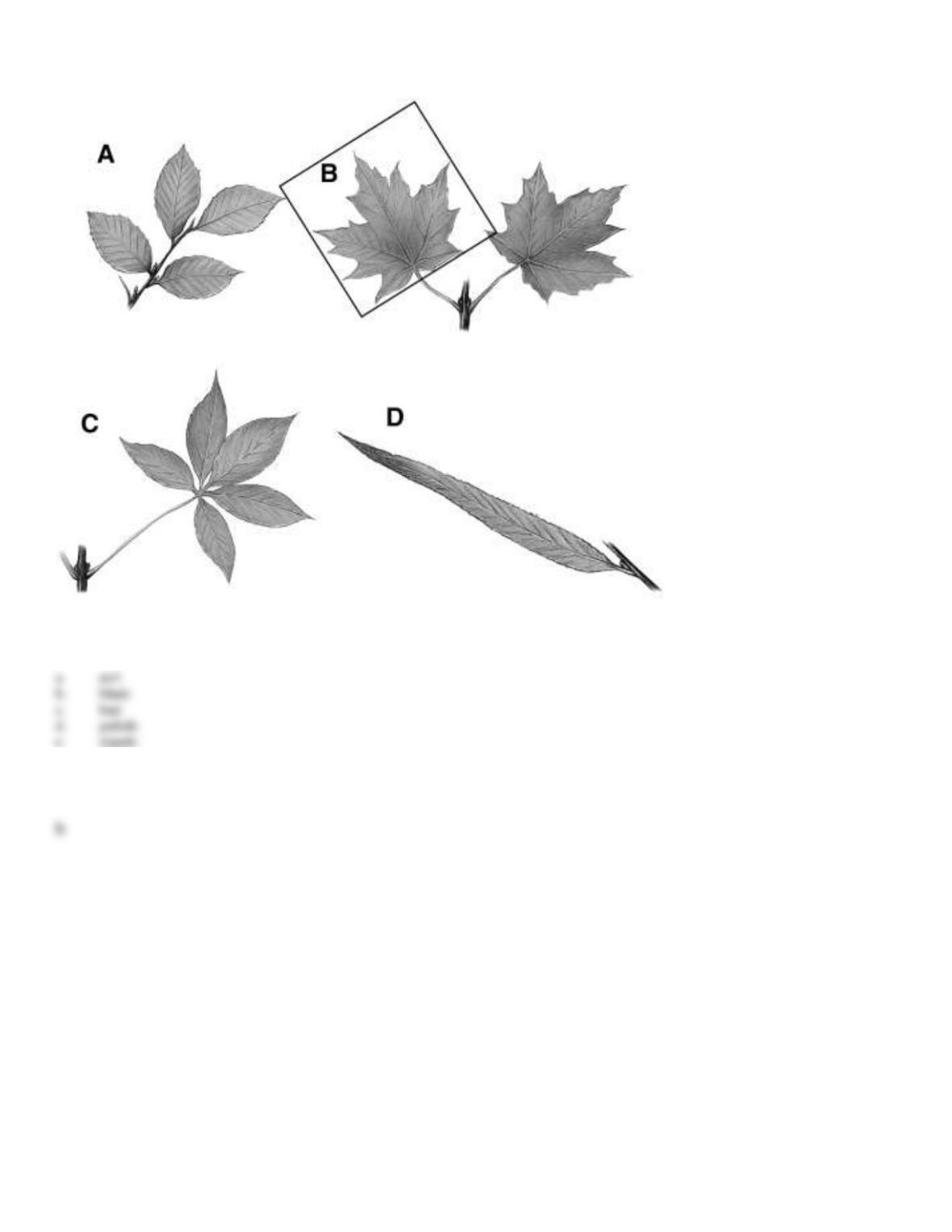
70. Figure 8-1
Refer to Figure 8-1. What is the name of the part of the leaf indicated by the box?
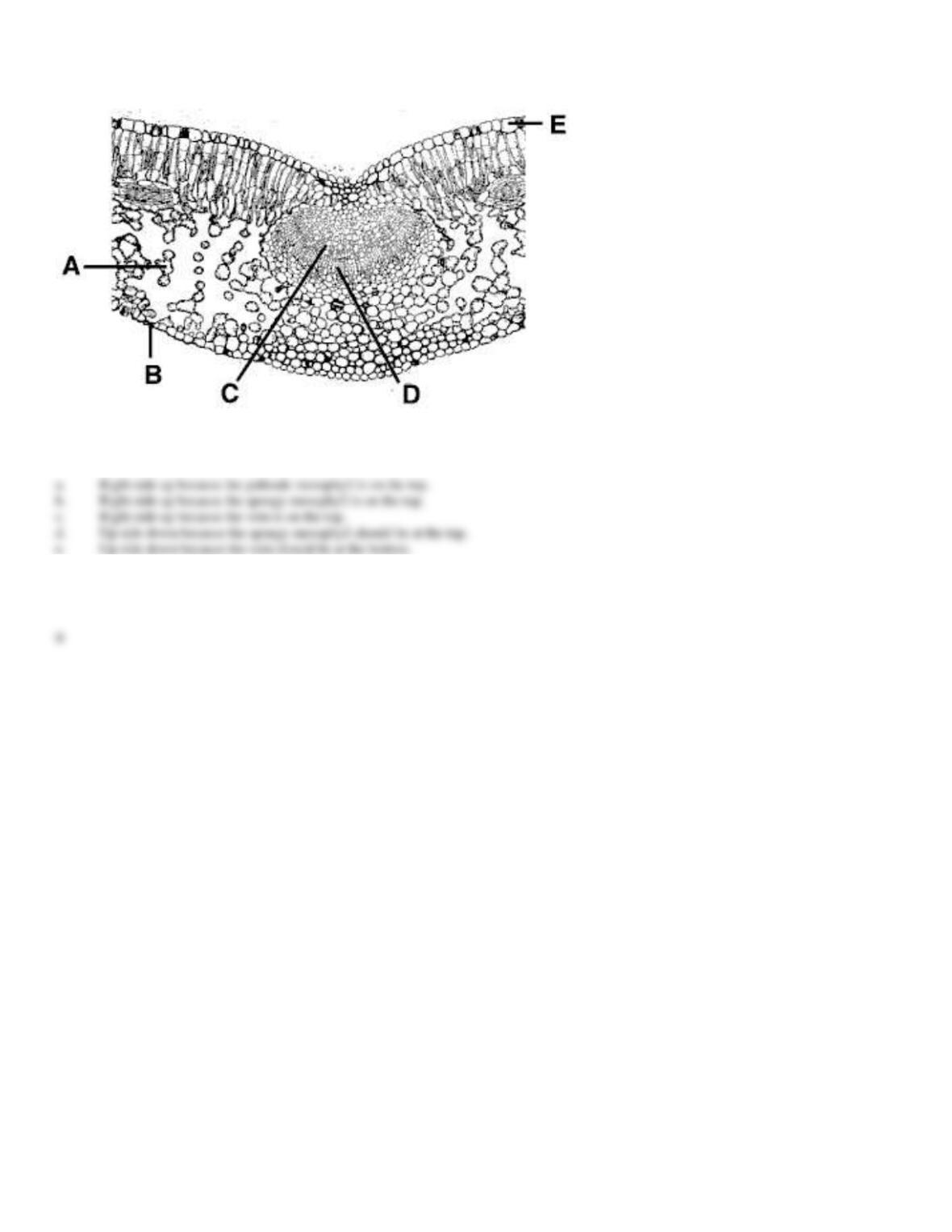
71. Figure 8-2
Refer to Figure 8-2. Is this leaf right side up or upside down? How do you know?
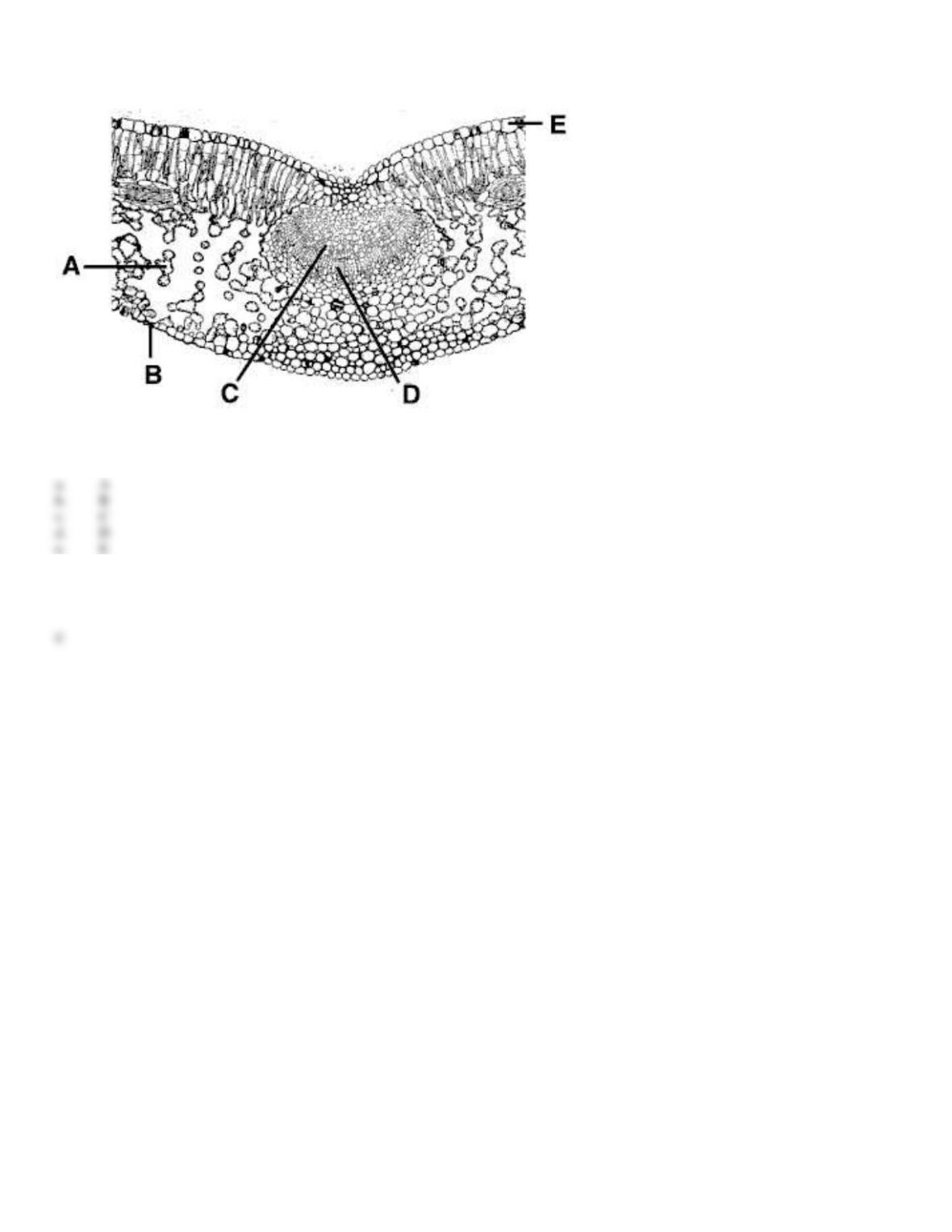
72. Figure 8-2
Refer to Figure 8-2. In which tissue does the transport of water and minerals occur?
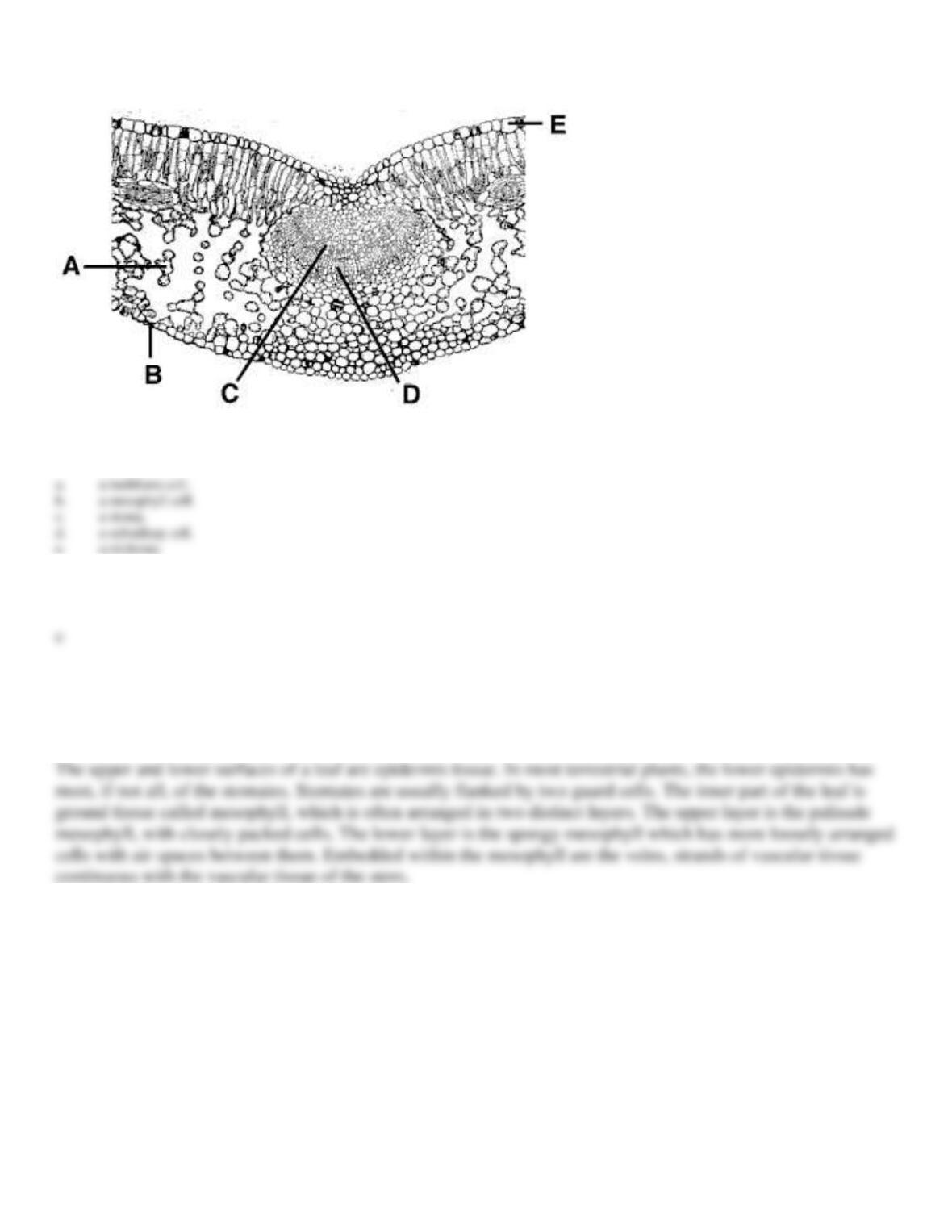
73. Figure 8-2
Refer to Figure 8-2. Label B is pointing to
74. Describe the location of the tissues of a typical green leaf.
75. Since living plant cells are connected to one another by cytoplasmic connections that extend through tiny
holes in the cell walls, does a leaf really need veins for the distribution of materials? Explain your “yes or no”
answer.
76. What is the advantage to a leaf in having palisade mesophyll on the upper half and spongy mesophyll on the
lower half?
77. Since tendrils and “spines” can be either modified leaves or modified stems, how might you determine the
origin of a given specimen?