
44) In C3 photosynthesis, the reactions that require ATP take place in
A) the light reactions alone.
B) the Calvin cycle alone.
C) both the light reactions and the Calvin cycle.
D) neither the light reactions nor the Calvin cycle.
45) The NADPH required for the Calvin cycle comes from
A) reactions initiated in photosystem I.
B) reactions initiated in photosystem II.
C) the citric acid cycle.
D) glycolysis.
E) oxidative phosphorylation.
46) Reactions that consume CO2 take place in
A) the light reactions of photosynthesis only.
B) the Calvin cycle only.
C) the citric acid cycle only.
D) both the light reactions and the Calvin cycle.
E) both the Calvin cycle and the citric acid cycle.
47) Which of the following statements best represents the relationships between the light
reactions and the Calvin cycle?
A) The light reactions provide ATP and NADPH to the Calvin cycle, and the Calvin cycle
returns ADP, ℗i, and NADP+ to the light reactions.
B) The light reactions provide ATP and NADPH to the carbon fixation step of the Calvin cycle,
and the Calvin cycle provides water and electrons to the light reactions.
C) The light reactions supply the Calvin cycle with CO2 to produce sugars, and the Calvin cycle
supplies the light reactions with sugars to produce ATP.
D) The light reactions provide the Calvin cycle with oxygen for carbon fixation, and the Calvin
cycle provides the light reactions with sugars to produce ATP.

48) Photorespiration occurs when rubisco combines RuBP with
A) CO2.
B) O2.
C) glyceraldehyde 3-phosphate.
D) citrate.
E) NADPH.
49) Why are C4 plants able to photosynthesize with no apparent photorespiration?
A) They do not participate in the Calvin cycle.
B) They keep their stomata open most of the time in hot, dry climates, which allows for water
loss to prevent photorespiration.
C) They keep their stomata closed most of the time in hot, dry climates, which conserves water
and oxygen to inhibit photorespiration.
D) They do not use rubisco to fix CO2.
E) They exclude oxygen from their tissues.
50) CAM plants keep stomata closed in daytime, thus reducing loss of water. They can do this
because they
A) fix CO2 into organic acids during the night when temperatures are cooler.
B) fix CO2 into organic acids in the bundle-sheath cells, which do not rely on stomata.
C) fix CO2 into organic acids in the mesophyll cells, which do not rely on stomata.
D) fix CO2 into by combining it with RuBP in the Calvin cycle.
E) obtain CO2 through their roots during the day.
51) Photorespiration lowers the efficiency of photosynthesis by
A) consuming excess carbon dioxide.
B) reducing the amount of water consumed.
C) reducing the amount of sugar produced.
D) producing excess ATP, but less NADPH.
E) inhibiting electron transfers from photosystem II.

52) Compared to C3 plants, C4 plants
A) can continue to fix CO2 even at relatively low CO2 concentrations and high oxygen
concentrations.
B) have higher rates of photorespiration.
C) do not use rubisco for carbon fixation.
D) grow better under cool, moist conditions.
8.2 Art Questions
Figure 8.1
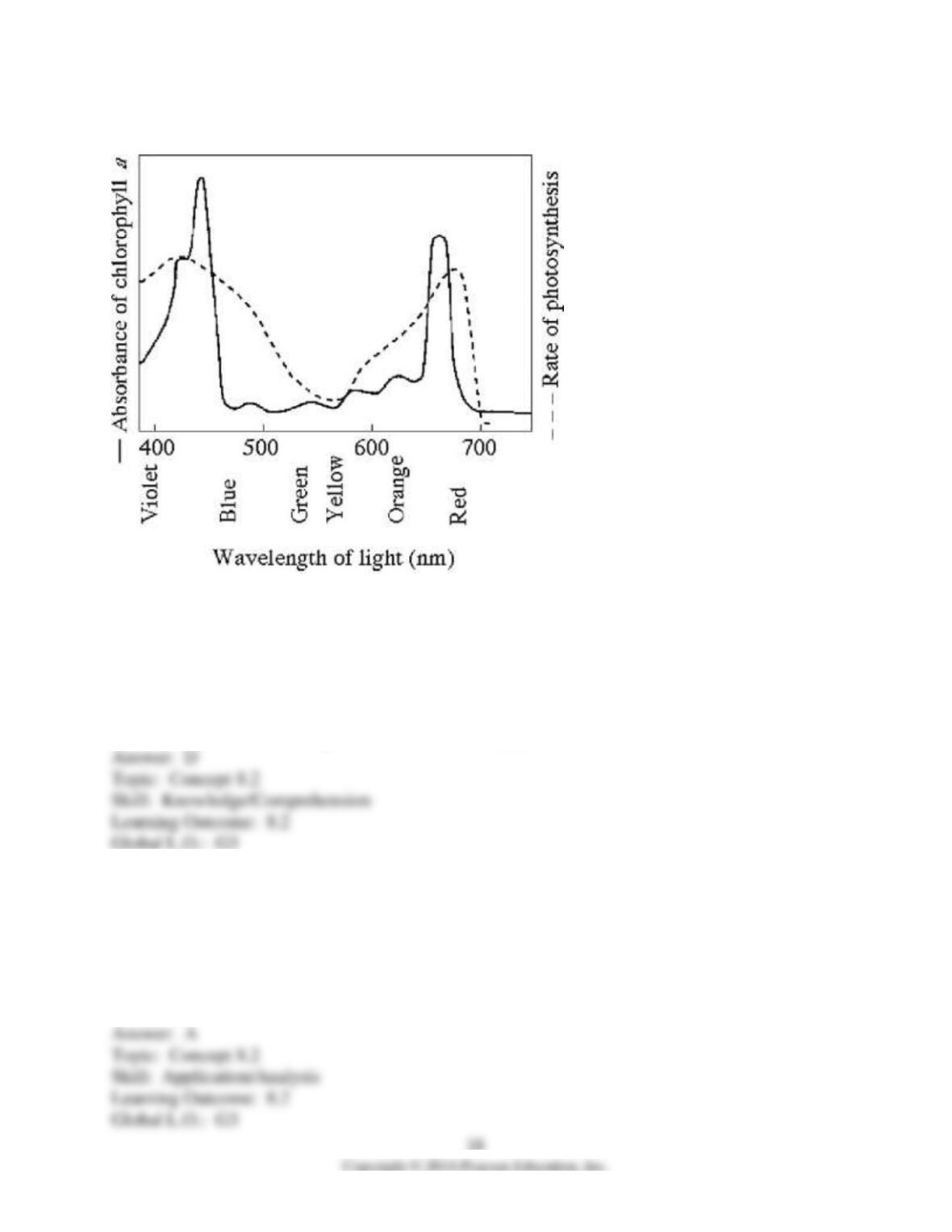
1) Figure 8.1 shows the absorption spectrum for chlorophyll a and the action spectrum for
photosynthesis. Why are they different?
A) Green and yellow wavelengths inhibit the absorption of red and blue wavelengths.
B) Bright sunlight destroys photosynthetic pigments.
C) Oxygen given off during photosynthesis interferes with the absorption of light.
D) Other pigments absorb light in addition to chlorophyll a.
2) Figure 8.1 shows the absorption spectrum for chlorophyll a and the action spectrum for
photosynthesis. What wavelength of light is most effective in driving photosynthesis?
A) 420 nm
B) 450 nm
C) 500 nm
D) 650 nm
E) 700 nm

3) Figure 8.1 shows the absorption spectrum for chlorophyll a and the action spectrum for
photosynthesis. What colors of light are least effective in driving photosynthesis?
A) violet-blue
B) green-yellow
C) yellow-orange
D) orange-red
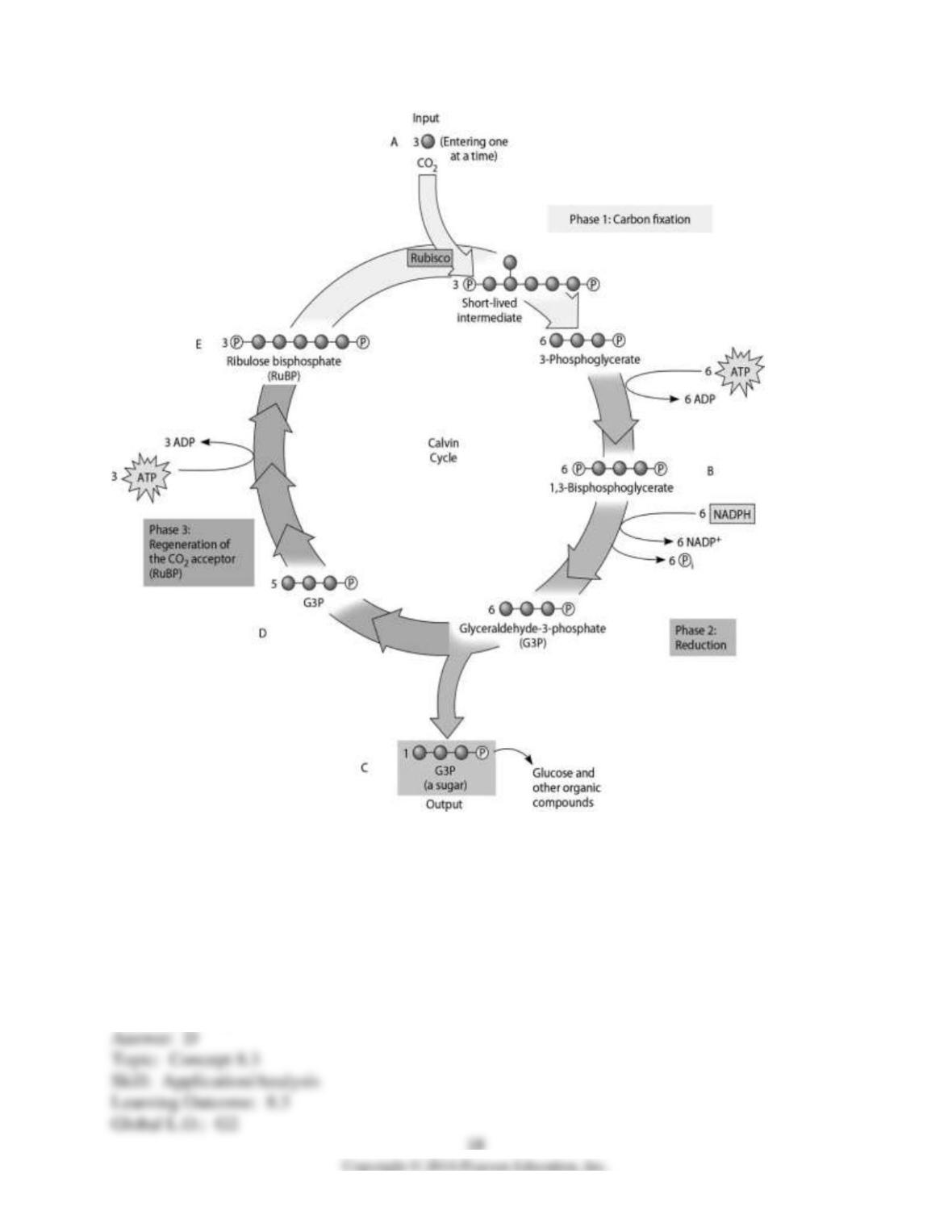
Figure 8.2
4) Use Figure 8.2 and the compounds labeled A, B, C, D, and E to answer the following
question. If ATP used by this plant is labeled with radioactive phosphorus, which molecule or
molecules of the Calvin cycle will be radioactively labeled first?
A) B only
B) B and C only
C) B, C, and D only
D) B and E only
E) B and D only

5) Use Figure 8.2 and the compounds labeled A, B, C, D, and E to answer the following
question. Which molecule(s) of the Calvin cycle is (are) also found in glycolysis?
A) B, C, E, and 3-phosphoglycerate
B) B, C, and E only
C) 3-phosphoglycerate only
D) B, C, D, and 3-phosphoglycerate only
E) E only
6) Use Figure 8.2 and the compounds labeled A, B, C, D, and E to answer the following
question. If the carbon atom of each of the incoming CO2 molecules is labeled with a radioactive
isotope of carbon, which organic molecules of the Calvin cycle will be radioactively labeled after
one cycle?
A) C only
B) B, C, D, and E
C) C, D, and E only
D) B and C only
E) B and D only
7) To identify the molecule that accepts CO2, Calvin and Benson manipulated the carbon-
fixation cycle by either cutting off CO2 or cutting off light from cultures of photosynthetic algae.
They then measured the concentrations of various metabolites immediately following the
manipulation. How would these experiments help identify the CO2 acceptor? Study Figure 8.2 to
help you in determining the correct answer.
A) The CO2 acceptor concentration would decrease when either the CO2 or light is cut off.
B) The CO2 acceptor concentration would increase when either the CO2 or light is cut off.
C) The CO2 acceptor concentration would increase when the CO2 is cut off, but decrease when
the light is cut off.
D) The CO2 acceptor concentration would decrease when the CO2 is cut off, but increase when
the light is cut off.
E) The CO2 acceptor concentration would stay the same regardless of the CO2 or light.

8.3 Scenario Questions
Please use the following information to answer the question(s) below.
Theodor W. Engelmann illuminated a filament of algae with light that passed through a prism,
thus exposing different segments of algae to different wavelengths of light. He added aerobic
bacteria and then noted in which areas the bacteria congregated. He found that the largest groups
were found in the areas illuminated by the red and blue light.
1) What did Engelmann conclude about the congregation of bacteria in the red and blue areas?
A) Bacteria congregated in these areas due to a local increase in temperature generated by
illumination by red and blue light.
B) Bacteria released excess carbon dioxide in these areas.
C) Bacteria congregated in these areas because they are attracted to red and blue light.
D) Bacteria congregated in these areas because they were the areas where the most oxygen was
released by the algae.
E) Bacteria congregated in these areas because green, yellow, and orange light inhibits bacterial
metabolism.
2) An outcome of this experiment was to help determine the relationship between
A) heterotrophic and autotrophic organisms.
B) wavelengths of light and the rate of aerobic respiration.
C) wavelengths of light and the amount of heat released.
D) wavelengths of light and the rate of photosynthesis.
E) the concentration of carbon dioxide and the rate of photosynthesis.

3) What would you predict would happen if you ran the same experiment without passing light
through a prism?
A) The bacteria would congregate toward the middle of the algal filament.
B) The bacteria would be relatively evenly distributed along the algal filament.
C) The number of bacteria present would decrease due to an increase in the carbon dioxide
concentration.
D) The number of bacteria present would increase due to an increase in the carbon dioxide
concentration.
E) The number of bacteria would decrease due to a decrease in the temperature along the length
of the algal filament.
Please use the following information to answer the question(s) below.
A spaceship is designed to support animal life for a multiyear voyage to the outer planets of the
solar system. Plants will be grown to provide oxygen and to recycle carbon dioxide. Because the
spaceship will be too far from the sun for photosynthesis, an artificial light source will be
needed.
4) What wavelengths of light should be used to maximize plant growth with a minimum of
energy expenditure?
A) full-spectrum white light
B) green light
C) a mixture of blue and red light
D) yellow light
E) UV light

5) A gardener is concerned that her greenhouse is getting too hot from too much light and seeks
to shade her plants with colored translucent plastic sheets, the color of which allows passage of
only that wavelength. What color should she use to reduce overall light energy, but still
maximize plant growth?
A) green
B) blue
C) yellow
D) orange
E) white
6) Halobacterium has a photosynthetic membrane that appears purple. Its photosynthetic action
spectrum is the inverse of the action spectrum for green plants. (That is, the Halobacterium
action spectrum has a peak where the green plant action spectrum has a trough.) What
wavelengths of light do the Halobacterium photosynthetic pigments absorb?
A) red and yellow
B) blue, green, and red
C) green and yellow
D) red and green
E) blue and red

8.4 End-of-Chapter Questions
1) The light reactions of photosynthesis supply the Calvin cycle with
A) light energy.
B) C and ATP.
C) O2 and NADPH.
D) ATP and NADPH.
2) Which of the following sequences correctly represents the flow of electrons during
photosynthesis?
A) NADPH → O2 → CO2
B) H2O → NADPH → Calvin cycle
C) H2O → photosystem I → photosystem II
D) NADPH → electron transport chain → O2
3) How is photosynthesis similar in C4 plants and CAM plants?
A) In both cases, electron transport is not used.
B) Both types of plants make sugar without the Calvin cycle.
C) In both cases, rubisco is not used to fix carbon initially.
D) Both types of plants make most of their sugar in the dark.
4) Which of the following statements is a correct distinction between autotrophs and
heterotrophs?
A) Autotrophs, but not heterotrophs, can nourish themselves beginning with CO2 and other
nutrients that are inorganic.
B) Only heterotrophs require chemical compounds from the environment.
C) Cellular respiration is unique to heterotrophs.
D) Only heterotrophs have mitochondria.

5) Which of the following does not occur during the Calvin cycle?
A) carbon fixation
B) oxidation of NADPH
C) release of oxygen
D) regeneration of the CO2 acceptor
6) In mechanism, photophosphorylation is most similar to
A) substrate-level phosphorylation in glycolysis.
B) oxidative phosphorylation in cellular respiration.
C) carbon fixation.
D) reduction of NADP+.
7) Which process is most directly driven by light energy?
A) creation of a pH gradient by pumping protons across the thylakoid membrane
B) reduction of NADP+ molecules
C) removal of electrons from chlorophyll molecules
D) ATP synthesis