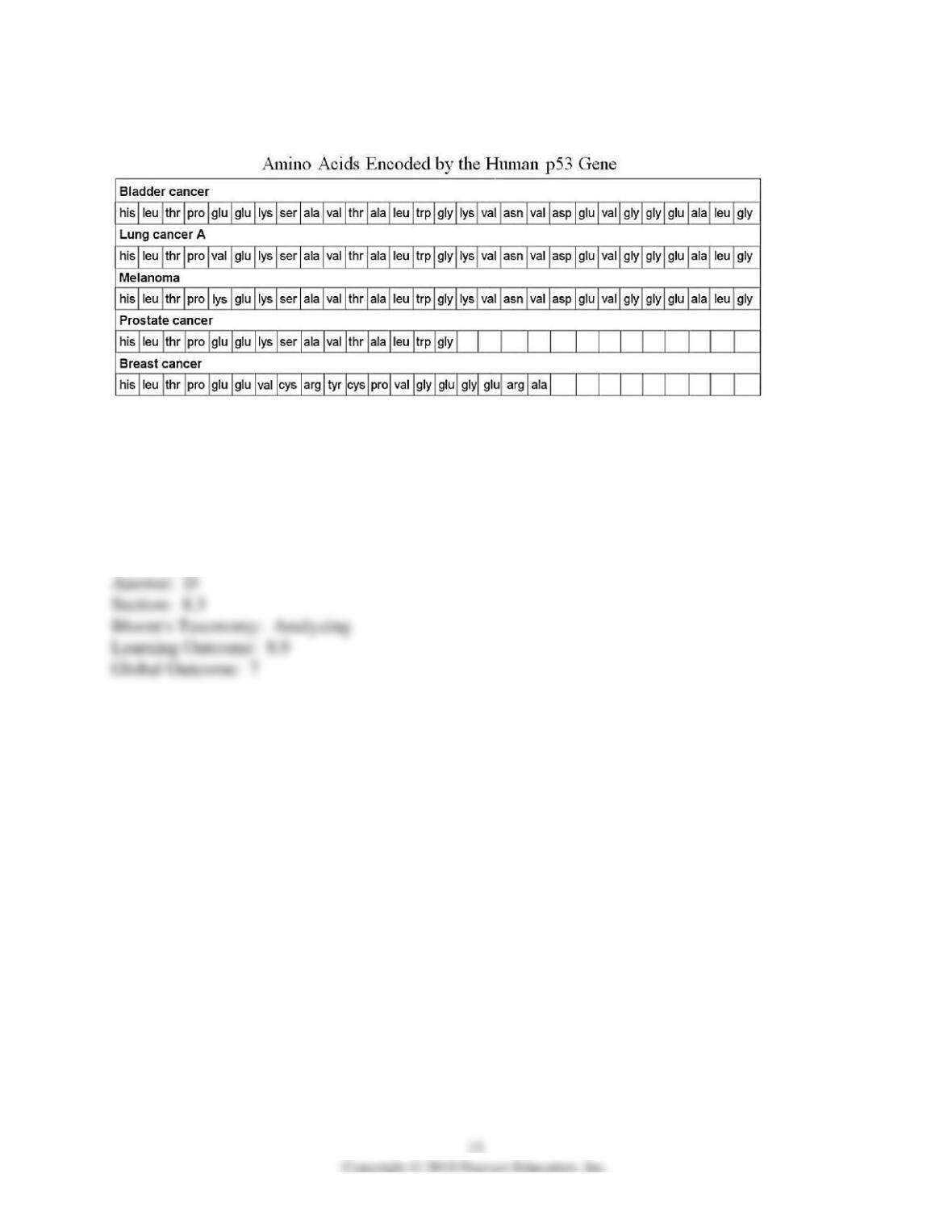
32) Table 8.3
Based on the information in Table 8.3, prostate cancer is probably the result of which kind of
mutation?
A) analog
B) frameshift
C) missense
D) nonsense
E) None of the answers is correct.
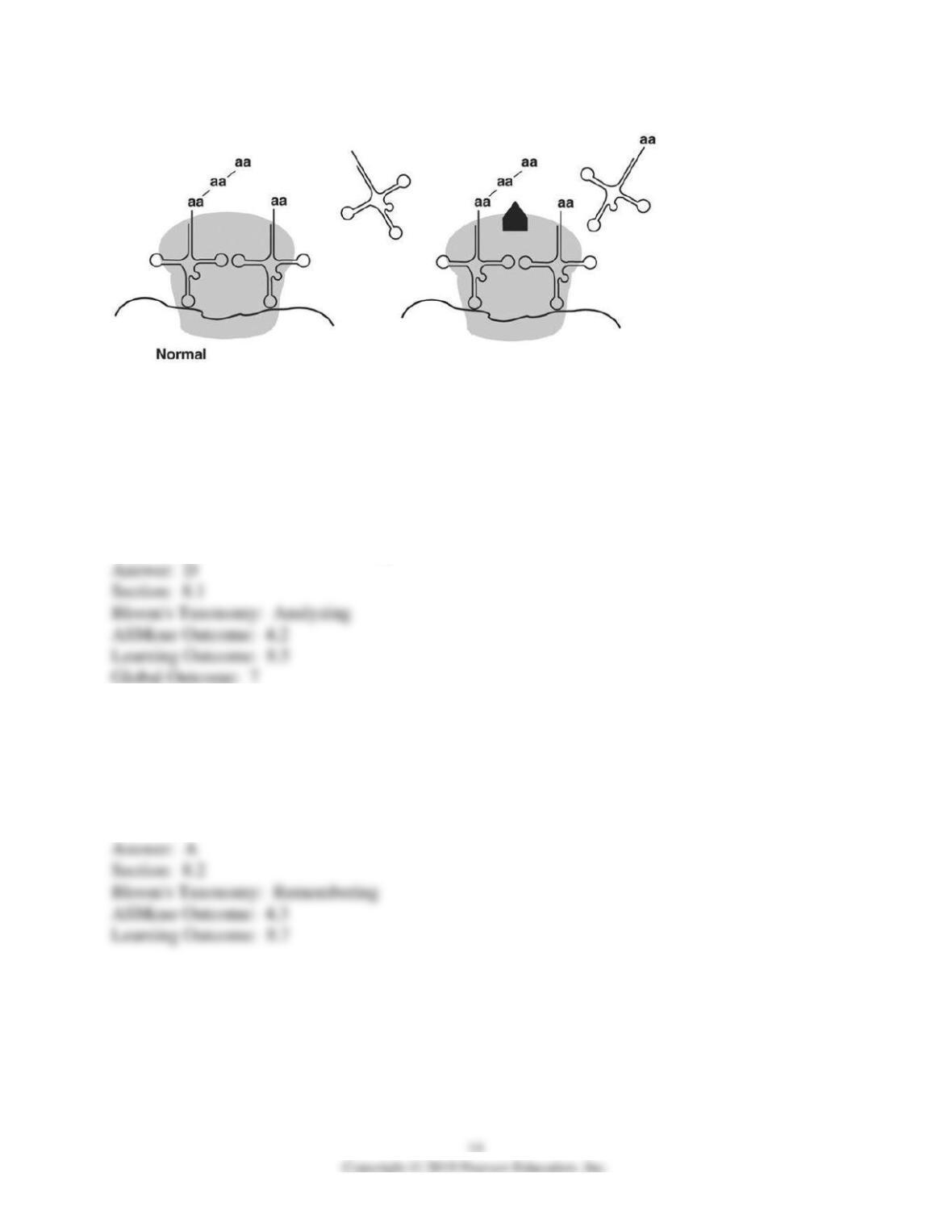
33) Figure 8.4
In Figure 8.4, the antibiotic chloramphenicol binds the 50S large subunit of a ribosome as shown
(the light gray area is the large subunit, while the black shape is the drug). From this information
you can conclude that chloramphenicol
A) prevents transcription in eukaryotes.
B) prevents translation in eukaryotes.
C) prevents transcription in prokaryotes.
D) prevents translation in prokaryotes.
E) prevents mRNA-ribosome binding.
34) The mechanism by which the presence of glucose inhibits the lac operon is
A) catabolite repression.
B) translation.
C) DNA polymerase.
D) repression.
E) induction.
35) If you knew the sequence of nucleotides within a gene, which one of the following could you
determine with the most accuracy?
A) the primary structure of the protein
B) the secondary structure of the protein
C) the tertiary structure of the protein
D) the quaternary structure of the protein
E) The answer cannot be determined based on the information provided.
36) An enzyme that makes covalent bonds between Okazaki fragments in the lagging strand of
DNA being replicated is
A) RNA polymerase.
B) DNA ligase
C) DNA helicase.
D) transposase.
E) SSBP.
37) An enzyme that copies DNA to make a molecule of RNA is
A) RNA polymerase.
B) DNA ligase.
C) DNA helicase.
D) transposase.
E) DNA polymerase.
38) An enzyme that catalyzes the cutting and resealing of DNA, and is translated from insertion
sequences, is
A) RNA polymerase.
B) DNA ligase.
C) DNA helicase.
D) transposase.
E) DNA polymerase.
39) Repair of damaged DNA, in some instances and mechanisms, might be viewed as a race
between an endonuclease and
A) DNA ligase.
B) DNA polymerase.
C) helicase.
D) methylase.
E) primase.
40) The cancer gene ras produces mRNA containing an extra exon that includes a number of
UAA codons. Cancer cells produce ras mRNA missing this exon. This mistake most likely is
due to a mistake by
A) a chemical mutagen.
B) DNA polymerase.
C) photolyases.
D) snRNPs.
E) UV radiation.
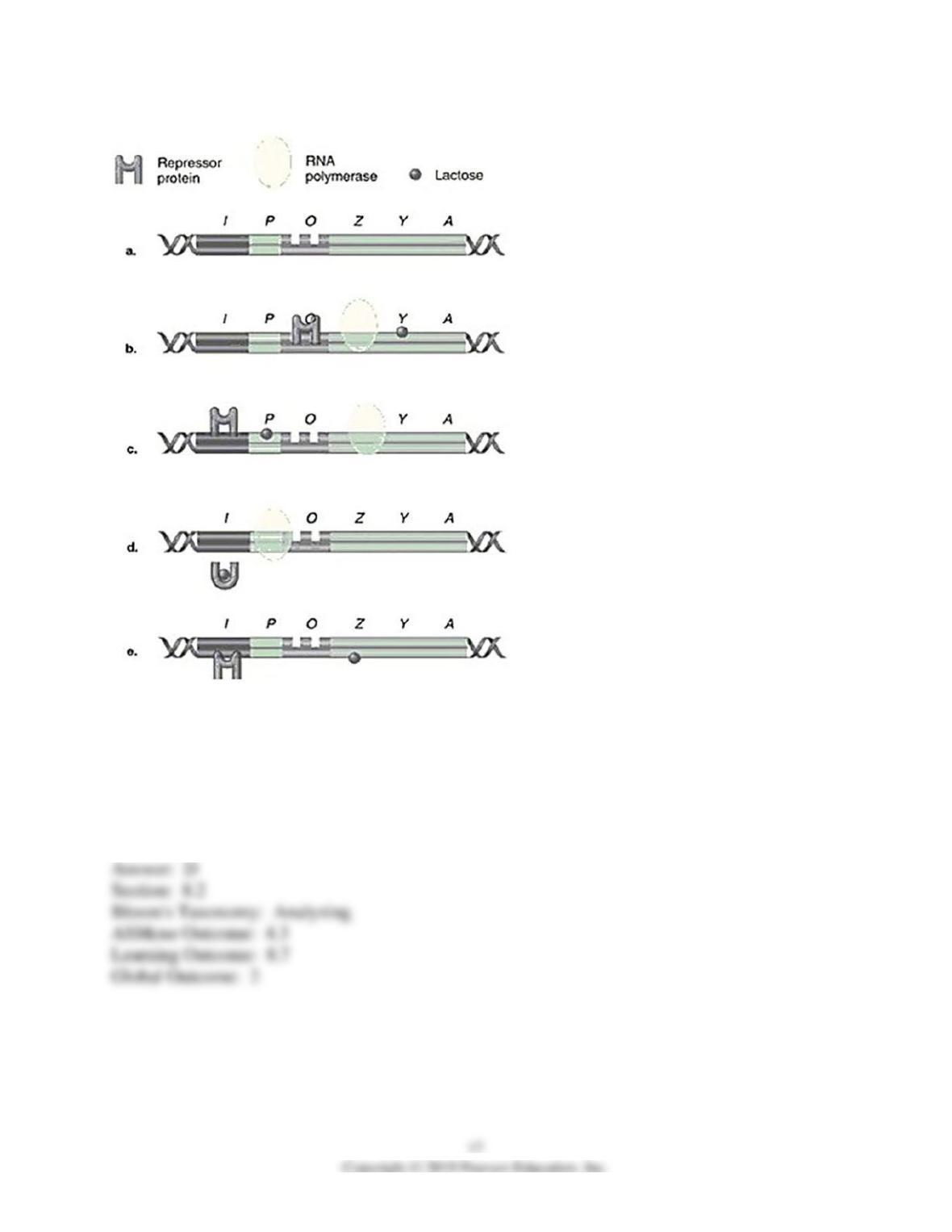
41) Figure 8.5
In Figure 8.5, which model of the lac operon correctly shows RNA polymerase, lactose, and
repressor protein when the structural genes are being transcribed?
A) a
B) b
C) c
D) d
E) e
42) The miRNAs in a cell
A) are found in prokaryotic cells.
B) are a part of the prokaryotic ribosome.
C) are a part of the eukaryotic ribosome.
D) allow different cells to produce different proteins.
E) are responsible for inducing operons.
43) Assume the two E. coli strains shown below are allowed to conjugate.
Hfr: pro+, arg+, his+, lys+, met+, ampicillin-sensitive
F-: pro–, arg–, his–, lys–, met–, ampicillin-resistant
What supplements would you add to glucose minimal salts agar to select for a new recombinant
cell that is lys+, arg+, amp-resistant?
A) ampicillin, lysine, arginine
B) lysine, arginine
C) ampicillin, proline, histidine, methionine
D) proline, histidine, methionine
E) ampicillin, proline, histidine, lysine
44) Protein synthesis in eukaryotes is similar to the process in prokaryotes in that both
eukaryotes and prokaryotes
A) have exons.
B) have introns.
C) require snRNPS.
D) use methionine as the “start” amino acid.
E) use codons to determine polypeptide sequences.
45) When ultraviolet light strikes DNA, it can cause a specific type of damage. How is this
damage best described?
A) Thymine bases on the opposing DNA strands are covalently linked together to form a
thymine dimer.
B) Thymine bases on one strand of DNA, next to each other, are covalently linked together to
form a thymine dimer.
C) Adenine and thymine bases on opposing DNA strands are linked together by hydrogen bonds.
D) Adenine and thymine bases on opposing DNA strands are covalently linked together to form
an AT dimer.
46) The ozone layer of the Earth has been depleted to an extent by human release of certain
chemicals. What type of mutation, caused by the induction of thymine dimer formation, is more
likely to occur in organisms on Earth as a result of this problem?
A) silent mutation
B) nonsense mutation
C) missense mutation
D) frameshift mutation
47) When two genes from two different people are sequenced and aligned, it is discovered that
there are multiple sequence differences in the coding segment DNA level. However, when the
proteins formed by the genes have their amino acids sequenced, there is no difference observed
between the two. What is the most likely explanation for this observation?
A) The mutations are corrected at the protein level after translation has occurred.
B) The mutations lie at locations where they don’t affect protein sequence due to degeneracy of
the genetic code.
C) The mutations are repaired at the mRNA level after transcription has occurred, but before
translation.
D) Mutations at the DNA level are not reflected in proteins produced.
E) RNA processing removes the different segments from the mRNA molecules of each person
prior to translation.
48) Transduction requires a(n) ________ to move DNA from one bacterial cell to another.
A) bacteriophage
B) naked DNA molecule
C) F plasmid
D) transposase enzyme
49) Generalized transduction occurs when a bacteriophage inadvertently packages the wrong
material into one of its newly-formed protein coats. While the source of this material may vary, it
is always:
A) protein.
B) mRNA.
C) DNA.
D) tRNA.
E) miRNA.
50) If generalized transduction is underway, packaging a piece of DNA from an infected
bacterial cell into a bacteriophage protein coat, what is the likely outcome?
A) Lysis of a newly-infected cell as the transducing bacteriophage infects it and multiplies.
B) The virus particle formed in the transduction process isn’t able to correctly infect a new
bacterial cell.
C) A second bacterial cell infected by that transducing bacteriophage will acquire new DNA,
carried by the phage from the original infected cell.
D) The infected bacterial cell will recover and survive, as the packaging of non-bacteriophage
DNA into the protein coat produces nonfunctional virus particles.
8.2 True/False Questions
1) Recombination will always alter a cell’s genotype.
2) Open-reading frames are segments of DNA in which both start and stop codons are found.
3) Bacteria usually contain multiple chromosomes.
4) Mutations that are harmful to cells occur more frequently than those that benefit cells.
5) The miRNAs in a cell inhibit protein synthesis by forming complementary bonds with rRNA.
6) Bacterial cells may contain multiple genomes.
7) Both base substitution and frameshift mutations can result in the formation of premature stop
codons.
8) In the Ames test, any colonies that form on the control plates, in the absence of chemical
being tested, should be the result of spontaneous mutations.
9) Transposition (insertion of a transposon into a DNA sequence) results in the formation of base
substitution mutations in a cell’s DNA.
10) Cell-to-cell contact is required for transduction to occur.
8.3 Essay Questions
1) What is the survival value of the semiconservative replication of DNA?
2) Scientists are concerned that bacteria will be resistant to all antibiotics within the next decade.
Using your knowledge of genetics, describe how bacterial populations can develop drug
resistance in such a short time frame.
3) Explain why the following statement is false: Sexual reproduction is the only mechanism for
genetic change.
4) Could you perform the Ames test with a strain of bacteria that was auxotrophic for something
other than histidine? How would the setup and execution of the experiment change, and why?
5) How might gene expression processes be altered if the genetic code were not degenerate in
nature?