CHAPTER 8
Manipulating Proteins, DNA, and RNA
Questions
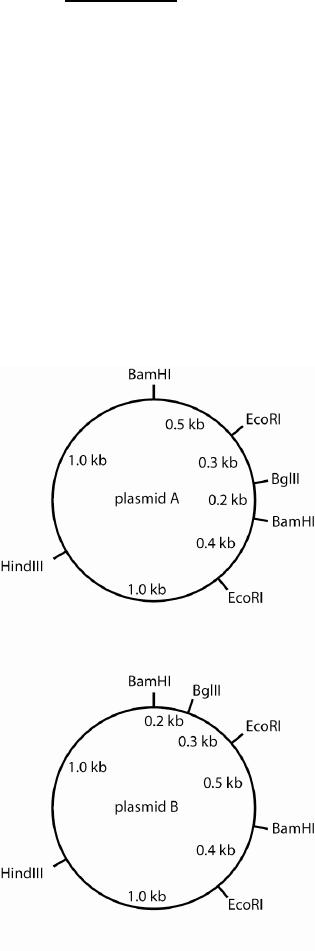
8-1 You have accidentally torn the labels off two tubes, each containing a different
plasmid, and now do not know which plasmid is in which tube. Fortunately, you
have restriction maps for both plasmids, shown in Figure Q8-1. You have the
opportunity to test just one sample from one of your tubes. You have equipment
for agarose gel electrophoresis, a standard set of DNA size markers, and the
necessary restriction enzymes.
A. Outline briefly the series of steps you would perform to determine which
plasmid is in which tube.
B. Which restriction enzyme or combination of restriction enzymes would
you use in this experiment?
Figure Q8-1
8-2 You have sequenced a short piece of DNA and produced the gel shown below:
A. What is the sequence of the DNA, starting from the 5 end?
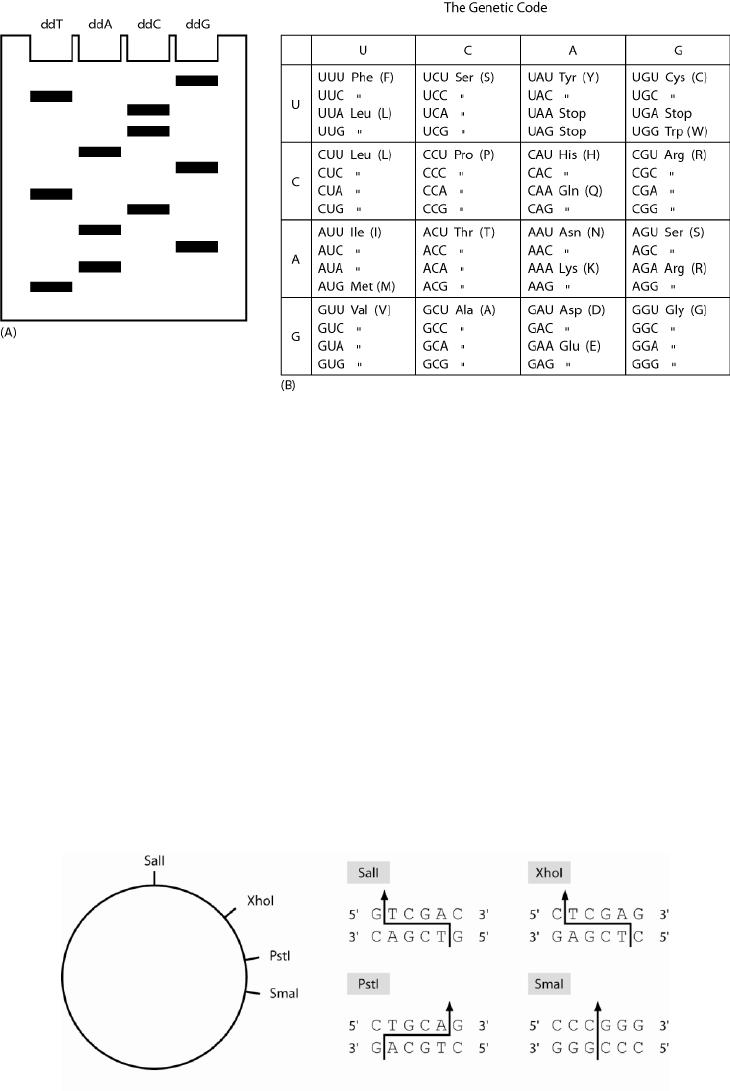
B. If you know that this sequence is from the middle of a protein-coding
cDNA clone, what amino acid sequence can you deduce from this
sequence?
Figure Q8-2
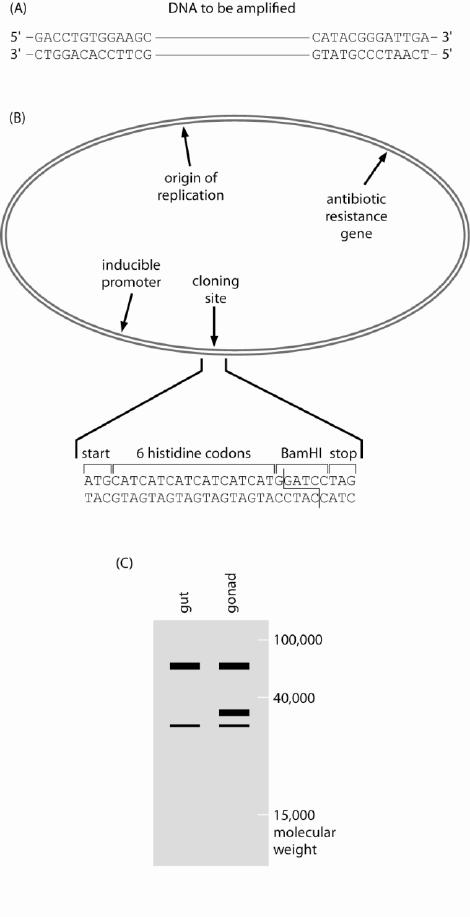
8-3 Figure Q8-3 shows the recognition sequences for the restriction enzymes SalI,
XhoI, PstI, and SmaI and a plasmid with the sites of cleavage for these enzymes
marked.
A. Consider all possible digestion reactions with one or two restriction
enzymes. After which of the digestions can the plasmid form into a circle
again simply by treatment with DNA ligase? Assume that after digestion
any small pieces of DNA are removed, and it is only the larger portion of
plasmid that you are trying to restore to its circular state.
B. After which of the possible digestions can the plasmid be restored to a
circle by first adding DNA polymerase and the four deoxynucleotides,
then treating with DNA ligase? Again assume that you are trying to form
the larger portion of plasmid into a circle again.
Figure Q8-3
8-4 You have an oligonucleotide probe that hybridizes to part of gene A from a
eucaryotic cell. You can use this probe to isolate a corresponding plasmid from a
DNA library harbored by a collection of bacteria. Will a cDNA library or a
genomic DNA library be more appropriate for the following applications?
Explain.
A. You want to study the promoter of a gene A.
B. Gene A encodes a tRNA and you wish to isolate a piece of DNA
containing the full-length sequence of the tRNA.
C. You discover that gene A is alternatively spliced and you want to see
which predicted alternative splice products are actually produced in a cell.
D. You want to find both gene A and the genes located near gene A on the
chromosome.
E. You want to express gene A in bacteria to produce lots of protein A.
F. You want to perform a phylogenetic comparison to find amino acid
sequences important for the function of gene A.
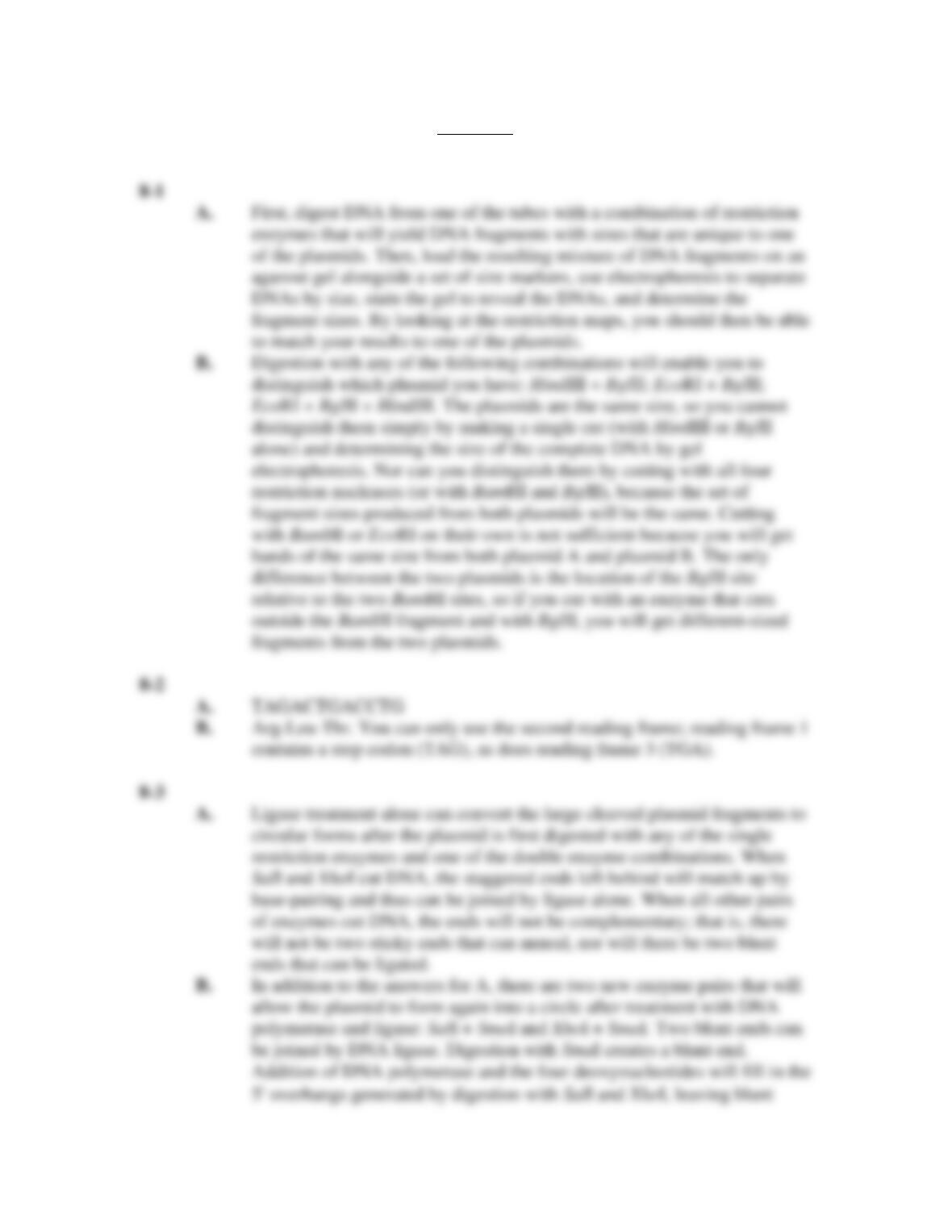
8-5 You want to make an antibody against a C. elegans nematode protein that the
DNA shown in Figure Q8-5A encodes. To do this, you will clone the coding
sequence into a bacterial expression plasmid, overexpress the protein, purify it,
and inject it into a mouse to stimulate the production of antibodies against the
protein.
A. You use polymerase chain reaction (PCR) amplification to amplify the
DNA corresponding to the 1800 base pairs of coding sequence; this
coding sequence lies between the two flanking sequence shown in Figure
Q8-5A. You will then insert the PCR product into the BamHI site of the
expression plasmid shown in Figure Q8-5B. Is it best to use genomic
DNA or cDNA as template in the PCR reaction? What are the sequences
of the two oligonucleotide primers that will allow you to amplify the DNA
by PCR and insert it into the BamHI site? (Remember to indicate the 5
and 3 ends of the primers.)
B. Briefly describe the series of enzymatic treatments you will use to create
the expression plasmid before transferring it into bacterial cells.
C. Once the correct new expression plasmid is in bacterial cells, you induce
high levels of expression of your nematode protein. Briefly describe the
series of steps you will perform to go from the cells containing high levels
of protein to partly purified protein.
D. Several weeks after you inject a mouse with your purified protein, you
sample its blood serum, which contains antibodies. You know from in situ
hybridizations that the mRNA corresponding to your protein is found in
gonad cells but not in gut cells. To test whether the mouse has made
antibodies against your protein, you isolate protein from gonad cells and
from gut cells and perform a Western blot (also known as an immunoblot)
with the mouse serum and a fluorescent second antibody that binds mouse
antibodies. Your result is shown in Figure Q8-5C. Did the mouse make
antibodies against your protein? Does the serum specifically recognize
only one nematode protein? (Illustrate your written answers by labeling
the blot.) What might you do next if you wanted to use antibodies from
this mouse to determine the subcellular location of your protein in fixed
cells?
Figure Q8-5
8-6 Current technologies allow much more facile manipulation and analysis of nucleic
acids than proteins. For example, it is straightforward to generate and purify
thousands of different DNA molecules for a DNA microarray, but difficult to
make an analogous protein microarray. This may reflect fundamental differences
between the two kinds of polymers. Colloquially, we might say that DNA double
helices are all the same, but each protein has its own personality.
A. Compare how the shape of a DNA double helix or protein molecule
depends on the sequence of monomers.
B. Compare the means used to detect a specific DNA molecule in a complex
mixture of other DNAs with that used to detect a specific protein in a
complex protein mixture.
C. Briefly compare the means used to make many copies of a DNA or protein
molecule for biochemical experiments.
D. Can you unambiguously predict an amino acid sequence from a cDNA
sequence? Can you unambiguously predict a cDNA sequence from an
amino acid sequence? Explain.
8-7 You are working in a laboratory, trying to identify how the nematode worm C.
elegans senses and moves toward specific “attractant” chemicals. You examine an
electronic database that compiles mRNA expression profiles of all nematode
genes measured by DNA microarray hybridization experiments, and find that an
unknown gene is transcribed coordinately with several genes known to be
involved in the attractant response. You name this gene Unk1 and set out to learn
what it does.
A. Without doing a single experiment at the lab bench, how can you learn
more about what the Unk1 protein might be doing? How might this
influence your choice of experiments with Unk1?
B. You decide to use reverse genetics to learn more about the function of the
Unk1 gene. What is the simplest first experiment to do, considering that
you are working with nematodes?
C. You decide to look for proteins that bind to Unk1, which may provide
important clues to its function. Briefly describe an approach to find
binding partners.
D. You decide to determine where and when Unk1 is expressed within the
animal, to learn more about how it causes the observed phenotypes.
Describe an approach to monitor spatiotemporal dynamics of Unk1
expression.
8-8 Human babies use the lactase enzyme to metabolize the milk sugar lactose. Most
human adults are lactose-intolerant because this gene is normally turned off in
adults. However, many adults of European descent still express lactase. This
lactase-persistence trait is tightly linked to a SNP called C/T-13910 located near
the lactase gene. Examination of many SNPs flanking the lactase gene provided
evidence that lactase persistence has been subject to very strong positive selective
pressure and became prevalent relatively recently, about 7500 years ago, which is
roughly coincident with the time that dairy farming arose in northern Europe.
A. Much of the supporting genomic evidence comes from the sizes of
haplotype blocks. Are the haplotype blocks surrounding the lactase gene
in lactase-persistent individuals bigger or smaller than the average blocks
found throughout the genome, or of average size? Are the corresponding
haplotype blocks in lactose-intolerant individuals bigger, smaller, or
average?
B. Does the C/T-13910 SNP cause the lactase-persistence trait?
C. Name an experimental technique that can determine if an unknown adult
is lactose-intolerant or lactase-persistent.
D. Is lactase persistence likely to be a dominant trait or a recessive trait?
Answers