
Campbell Biology, 10e (Reece)
Chapter 8 An Introduction to Metabolism
1) Which of the following is true of metabolism in its entirety in all organisms?
A) Metabolism depends on a constant supply of energy from food.
B) Metabolism uses all of an organism’s resources.
C) Metabolism consists of all the energy transformation reactions in an organism.
D) Metabolism manages the increase of entropy in an organism.
2) Which of the following is an example of potential rather than kinetic energy?
A) water rushing over Niagara Falls
B) light flashes emitted by a firefly
C) a molecule of glucose
D) a crawling beetle foraging for food
3) Most cells cannot harness heat to perform work because _____.
A) heat is not a form of energy
B) temperature is usually uniform throughout a cell
C) heat can never be used to do work
D) heat must remain constant during work
4) Which of the following involves a decrease in entropy?
A) condensation reactions
B) reactions that separate monomers
C) depolymerization reactions
D) hydrolysis reactions
5) Which term most precisely describes the cellular process of breaking down large molecules
into smaller ones?
A) catabolism (catabolic pathways)
B) metabolism
C) anabolism (anabolic pathways)
D) dehydration
6) Anabolic pathways _____.
A) are usually highly spontaneous chemical reactions
B) consume energy to build up polymers from monomers
C) release energy as they degrade polymers to monomers
D) consume energy to decrease the entropy of the organism and its environment
7) Which of the following is a statement of the first law of thermodynamics?
A) Energy cannot be created or destroyed.
B) The entropy of the universe is decreasing.
C) The entropy of the universe is constant.
D) Energy cannot be transferred or transformed.
8) For living organisms, which of the following is an important consequence of the first law of
thermodynamics?
A) The energy content of an organism is constant.
B) The organism ultimately must obtain all of the necessary energy for life from its environment.
C) The entropy of an organism decreases with time as the organism grows in complexity.
D) Organisms grow by converting energy into organic matter.
9) Living organisms increase in complexity as they grow, resulting in a decrease in the entropy
of an organism. How does this relate to the second law of thermodynamics?
A) Living organisms do not obey the second law of thermodynamics, which states that entropy
must increase with time.
B) Life obeys the second law of thermodynamics because the decrease in entropy as the
organism grows is exactly balanced by an increase in the entropy of the universe.
C) As a consequence of growing, organisms cause a greater increase in entropy in their
environment than the decrease in entropy associated with their growth.
D) Living organisms are able to transform energy into entropy.
10) Which of the following statements is a logical consequence of the second law of
thermodynamics?
A) If the entropy of a system increases, there must be a corresponding decrease in the entropy of
the universe.
B) If there is an increase in the energy of a system, there must be a corresponding decrease in the
energy of the rest of the universe.
C) Every chemical reaction must increase the total entropy of the universe.
D) Energy can be transferred or transformed, but it cannot be created or destroyed.
11) Which of the following statements is representative of the second law of thermodynamics?
A) Conversion of energy from one form to another is always accompanied by some gain of free
energy.
B) Without an input of energy, organisms would tend toward decreasing entropy.
C) Cells require a constant input of energy to maintain their high level of organization.
D) Every energy transformation by a cell decreases the entropy of the universe.
12) Which of the following types of reactions would decrease the entropy within a cell?
A) anabolic reactions
B) hydrolysis
C) digestion
D) catabolic reactions
13) Biological evolution of life on Earth, from simple prokaryote-like cells to large, multicellular
eukaryotic organisms, _____.
A) has occurred in accordance with the laws of thermodynamics
B) has caused an increase in the entropy of the planet
C) has been made possible by expending Earth’s energy resources
D) has occurred in accordance with the laws of thermodynamics, by expending Earth’s energy
resources and causing an increase in the entropy of the planet
14) The mathematical expression for the change in free energy of a system is ΔG =ΔH – TΔS.
Which of the following is (are) correct?
A) ΔS is the change in enthalpy, a measure of randomness.
B) ΔH is the change in entropy, the energy available to do work.
C) ΔG is the change in free energy.
D) T is the temperature in degrees Celsius.
15) A system at chemical equilibrium _____.
A) consumes energy at a steady rate
B) releases energy at a steady rate
C) has zero kinetic energy
D) can do no work
16) Which of the following is true for all exergonic reactions?
A) The products have more total energy than the reactants.
B) The reaction proceeds with a net release of free energy.
C) The reaction goes only in a forward direction: all reactants will be converted to products, but
no products will be converted to reactants.
D) A net input of energy from the surroundings is required for the reactions to proceed.
17) A chemical reaction that has a positive ΔG is best described as _____.
A) endergonic
B) enthalpic
C) spontaneous
D) exergonic
18) Chemical equilibrium is relatively rare in living cells. An example of a reaction at chemical
equilibrium in a cell would be _____.
A) one in which the free energy at equilibrium is higher than the energy content at any point
away from equilibrium
B) one in which the entropy change in the reaction is just balanced by an opposite entropy
change in the cell’s surroundings
C) an endergonic reaction in an active metabolic pathway where the energy for that reaction is
supplied only by heat from the environment
D) a chemical reaction in which both the reactants and products are not being produced or used
in any active metabolic pathway at that time in the cell
19) Choose the pair of terms that correctly completes this sentence: Catabolism is to anabolism
as _____ is to _____.
A) exergonic; spontaneous
B) exergonic; endergonic
C) free energy; entropy
D) work; energy
20) In solution, why do hydrolysis reactions occur more readily than condensation reactions?
A) Hydrolysis increases entropy and is exergonic.
B) Hydrolysis raises G, or Gibbs free energy.
C) Hydrolysis decreases entropy and is exergonic.
D) Hydrolysis increases entropy and is endergonic.
21) Why is ATP an important molecule in metabolism?
A) Its hydrolysis provides an input of free energy for exergonic reactions.
B) It provides energy coupling between exergonic and endergonic reactions.
C) Its terminal phosphate group contains a strong covalent bond that, when hydrolyzed, releases
free energy.
D) Its terminal phosphate bond has higher energy than the other two phosphate bonds.
22) When 10,000 molecules of ATP are hydrolyzed to ADP and i in a test tube, about half as
much heat is liberated as when a cell hydrolyzes the same amount of ATP. Which of the
following is the best explanation for this observation?
A) Cells are open systems, but a test tube is an isolated system.
B) Cells are less efficient at heat production than nonliving systems.
C) The reaction in cells must be catalyzed by enzymes, but the reaction in a test tube does not
need enzymes.
D) Reactant and product concentrations in the test tube are different from those in the cell.
23) Which of the following is most similar in structure to ATP?
A) a pentose sugar
B) a DNA nucleotide
C) an RNA nucleotide
D) an amino acid with three phosphate groups attached
24) Catabolic pathways _____.
A) combine molecules into more energy-rich molecules
B) supply energy, primarily in the form of ATP, for the cell’s work
C) are endergonic
D) are spontaneous and do not need enzyme catalysis
25) When chemical, transport, or mechanical work is done by an organism, what happens to the
heat generated?
A) It is used to power yet more cellular work.
B) It is used to store energy as more ATP.
C) It is used to generate ADP from nucleotide precursors.
D) It is lost to the environment.
26) When ATP releases some energy, it also releases inorganic phosphate. What happens to the
inorganic phosphate in the cell?
A) It is secreted as waste.
B) It is used only to regenerate more ATP.
C) It may be used to form a phosphorylated intermediate.
D) It enters the nucleus and affects gene expression.
27) A number of systems for pumping ions across membranes are powered by ATP. Such ATP-
powered pumps are often called ATPases, although they do not often hydrolyze ATP unless they
are simultaneously transporting ions. Because small increases in calcium ions in the cytosol can
trigger a number of different intracellular reactions, cells keep the cytosolic calcium
concentration quite low under normal conditions, using ATP-powered calcium pumps. For
example, muscle cells transport calcium from the cytosol into the membranous system called the
sarcoplasmic reticulum (SR). If a resting muscle cell’s cytosol has a free calcium ion
concentration of 10-7 while the concentration in the SR is 10-2, then how is the ATPase acting?
A) ATPase activity must be powering an inflow of calcium from the outside of the cell into the
SR.
B) ATPase activity must be transferring i to the SR to enable this to occur.
C) ATPase activity must be pumping calcium from the cytosol to the SR against the
concentration gradient.
D) ATPase activity must be opening a channel for the calcium ions to diffuse back into the SR
along the concentration gradient.
8
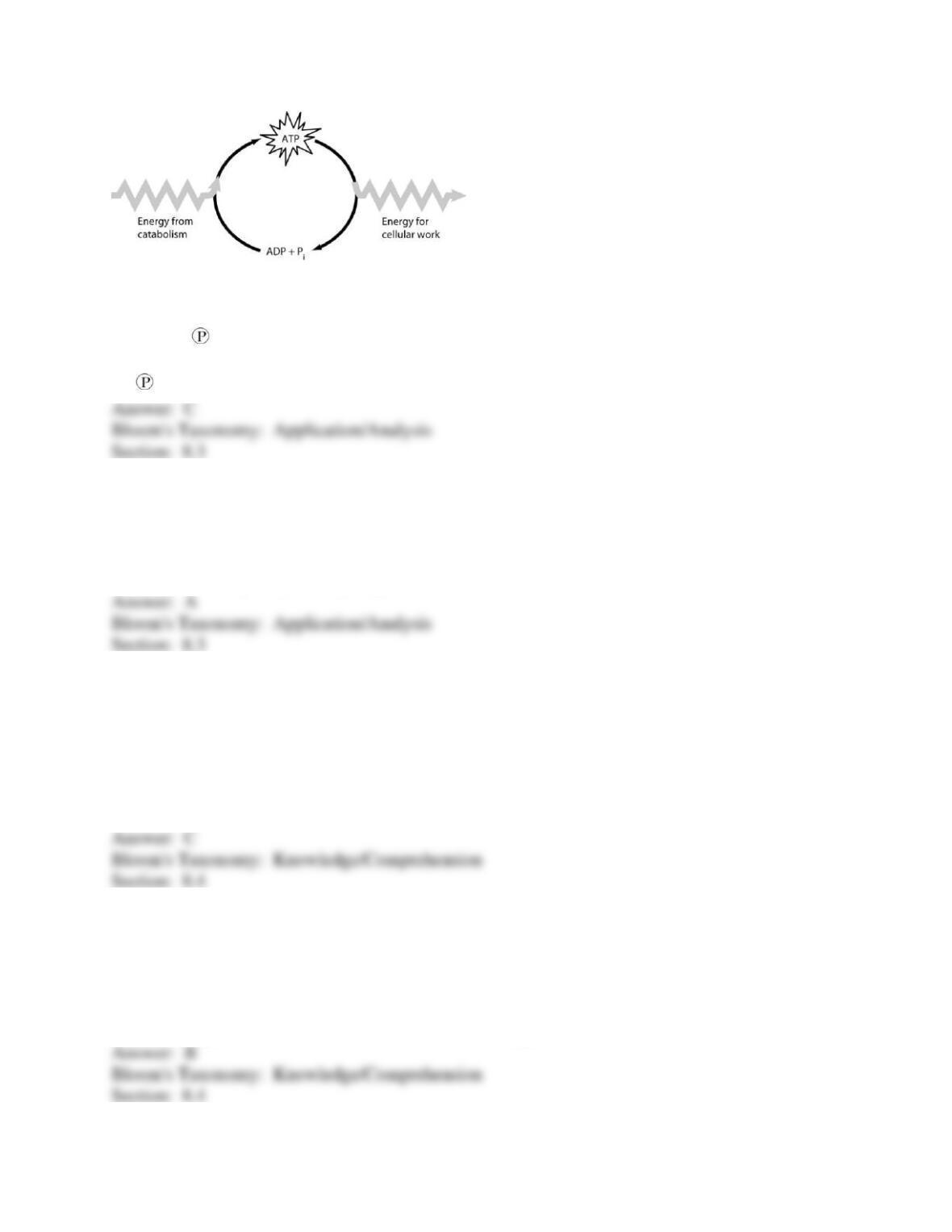
28) Which of the following is the most correct interpretation of the figure?
A) Energy from catabolism can be used directly for performing cellular work.
B) ADP + i are a set of molecules that store energy for catabolism.
C) ATP is a molecule that acts as an intermediary to store energy for cellular work.
D) i acts as a shuttle molecule to move energy from ATP to ADP.
29) How do cells use the ATP cycle shown in the figure?
A) Cells use the cycle to recycle ADP and phosphate.
B) Cells use the cycle to recycle energy released by ATP hydrolysis.
C) Cells use the cycle to recycle ADP, phosphate, and the energy released by ATP hydrolysis.
D) Cells use the cycle primarily to generate heat.
30) Which of the following is true of enzymes?
A) Enzyme function is increased if the 3- D structure or conformation of an enzyme is altered.
B) Enzyme function is independent of physical and chemical environmental factors such as pH
and temperature.
C) Enzymes increase the rate of chemical reaction by lowering activation energy barriers.
D) Enzymes increase the rate of chemical reaction by providing activation energy to the
substrate.
31) Which of the following is true when comparing an uncatalyzed reaction to the same reaction
with a catalyst?
A) The catalyzed reaction will be slower.
B) The catalyzed reaction will have the same ∆G.
C) The catalyzed reaction will have higher activation energy.
D) The catalyzed reaction will consume all of the catalyst.
32) The lock-and-key analogy for enzymes applies to the specificity of enzymes _____.

A) as they form their tertiary and quaternary structure
B) binding to their substrate
C) interacting with water
D) interacting with ions
33) You have discovered an enzyme that can catalyze two different chemical reactions. Which of
the following is most likely to be correct?
A) The enzyme contains α–helices and β-pleated sheets.
B) The enzyme is subject to competitive inhibition and allosteric regulation.
C) Two types of allosteric regulation occur: The binding of one molecule activates the enzyme,
while the binding of a different molecule inhibits it.
D) Either the enzyme has two distinct active sites or the reactants involved in the two reactions
are very similar in size and shape.
34) Reactants capable of interacting to form products in a chemical reaction must first overcome
a thermodynamic barrier known as the reaction’s _____.
A) entropy
B) activation energy
C) equilibrium point
D) free-energy content
35) During a laboratory experiment, you discover that an enzyme-catalyzed reaction has a ∆G of
–20 kcal/mol. If you double the amount of enzyme in the reaction, what will be the ∆G for the
new reaction?
A) -40 kcal/mol
B) -20 kcal/mol
C) 0 kcal/mol
D) +20 kcal/mol

10
36) The active site of an enzyme is the region that _____.
A) binds allosteric regulators of the enzyme
B) is involved in the catalytic reaction of the enzyme
C) binds noncompetitive inhibitors of the enzyme
D) is inhibited by the presence of a coenzyme or a cofactor
37) According to the induced fit hypothesis of enzyme catalysis, _____.
A) the binding of the substrate depends on the shape of the active site
B) some enzymes change their structure when activators bind to the enzyme
C) the binding of the substrate changes the shape of the enzyme’s active site
D) the active site creates a microenvironment ideal for the reaction
38) Increasing the substrate concentration in an enzymatic reaction could overcome which of the
following?
A) the need for a coenzyme
B) allosteric inhibition
C) competitive inhibition
D) insufficient cofactors
39) Zinc, an essential trace element for most organisms, is present in the active site of the
enzyme carboxypeptidase. The zinc most likely functions as _____.
A) a noncompetitive inhibitor of the enzyme
B) an allosteric activator of the enzyme
C) a cofactor necessary for enzyme activity
D) a coenzyme derived from a vitamin
40) A noncompetitive inhibitor decreases the rate of an enzyme reaction by _____.
A) binding at the active site of the enzyme
B) changing the shape of the enzyme’s active site
C) changing the free energy change of the reaction
D) acting as a coenzyme for the reaction
41) You collect data on the effect of pH on the function of the enzyme catalase in human cells.
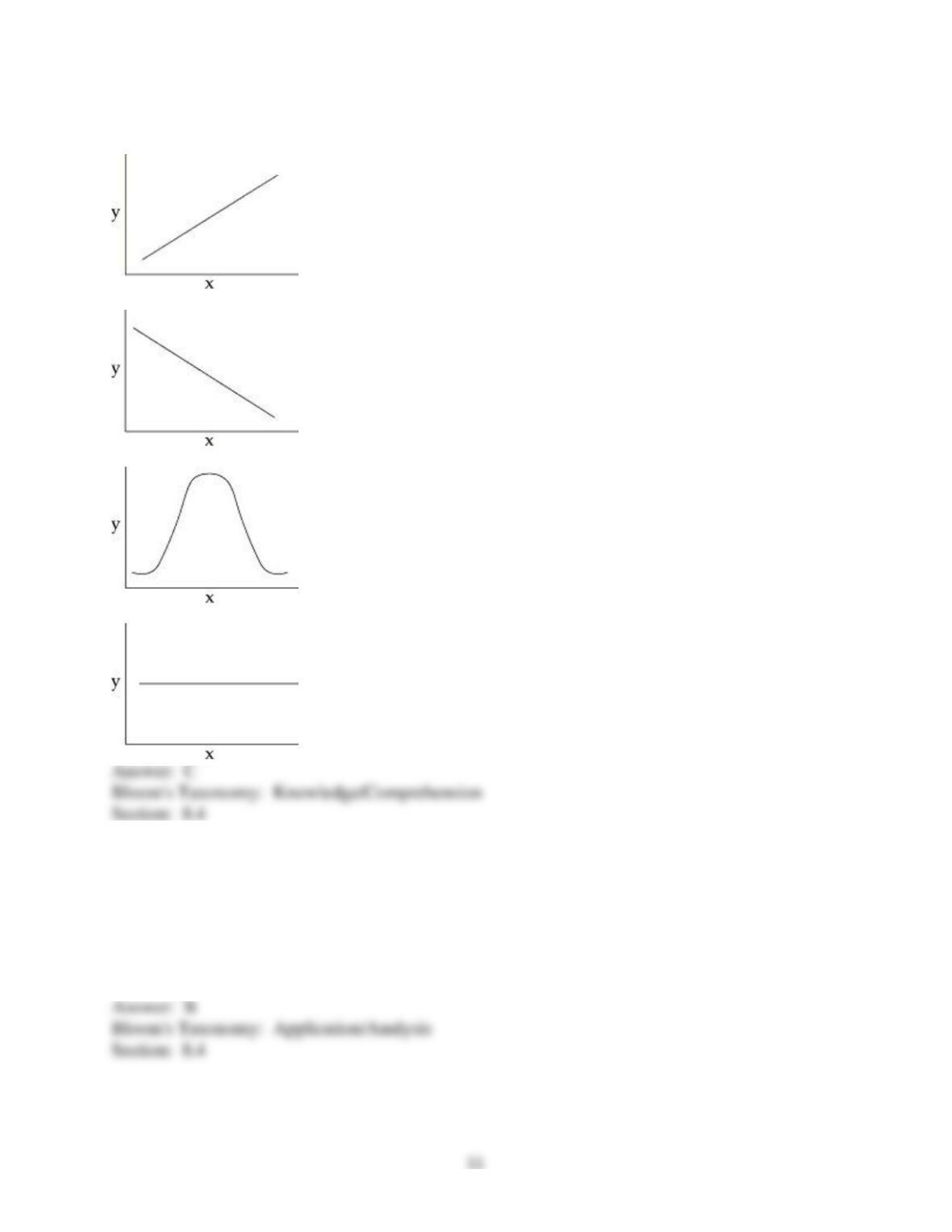
Which of the following graphs would you expect?
A)
B)
C)
D)
42) How might a change of one amino acid at a site, distant from the active site of an enzyme,
alter an enzyme’s substrate specificity?
A) by changing the enzyme’s stability
B) by changing the shape of an enzyme
C) by changing the enzyme’s pH optimum
D) An amino acid change away from the active site cannot alter the enzyme’s substrate
specificity.
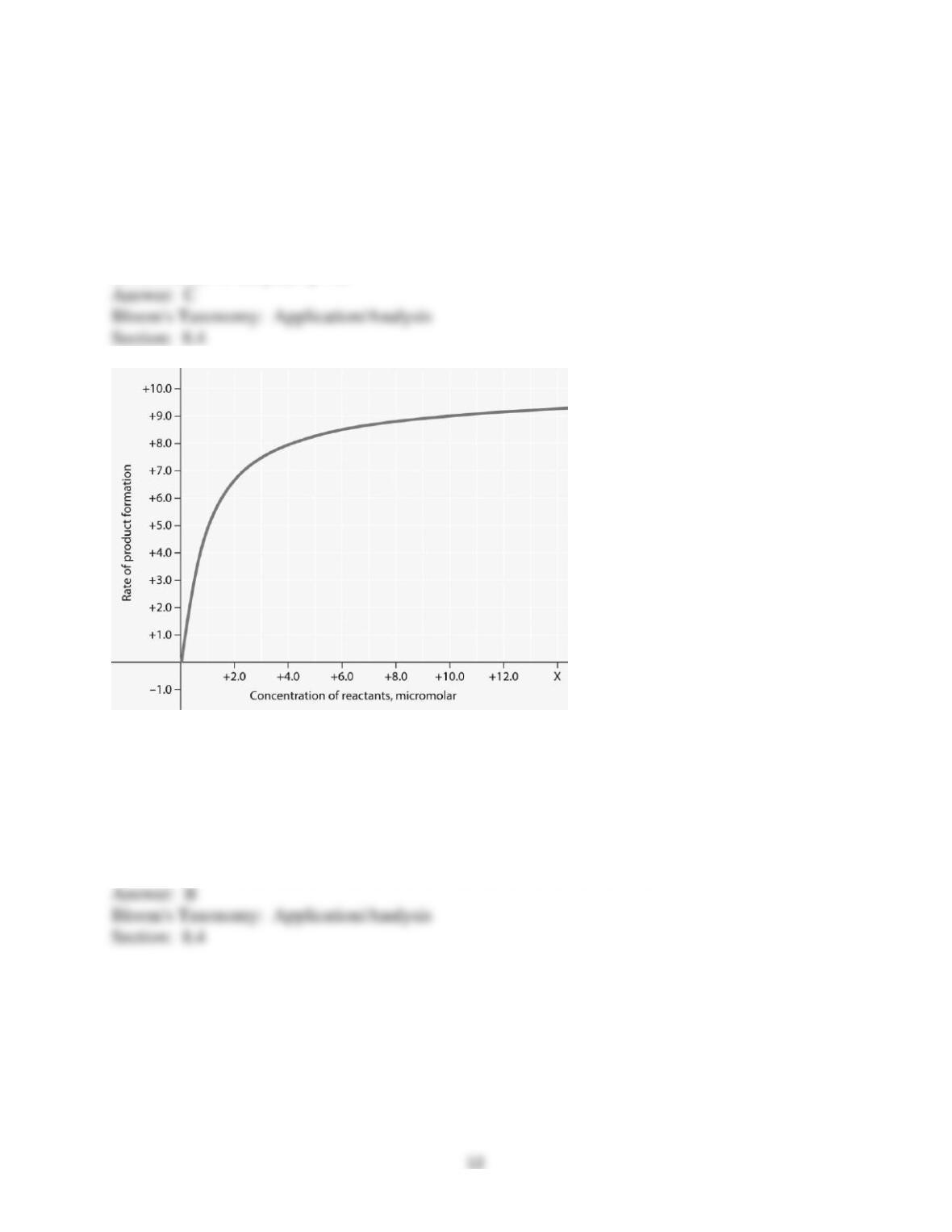
43) For the enzyme- catalyzed reaction shown in the figure, if the initial reactant concentration is
1.0 micromolar, which of these treatments will cause the greatest increase in the rate of the
reaction?
A) doubling the activation energy needed
B) cooling the reaction by 10°C
C) doubling the enzyme concentration
D) increasing the concentration of reactants to 10.0 micromolar, while reducing the
concentration of enzyme by 1/2
Rate of an enzyme-catalyzed reaction as a function of varying reactant
concentration, with the concentration of enzyme constant.
44) In the figure, why does the reaction rate plateau at higher reactant concentrations?
A) Feedback inhibition by product occurs at high reactant concentrations.
B) Most enzyme molecules are occupied by substrate at high reactant concentrations.
C) The reaction nears equilibrium at high reactant concentrations.
D) The rate of the reverse reaction increases with reactant concentration.
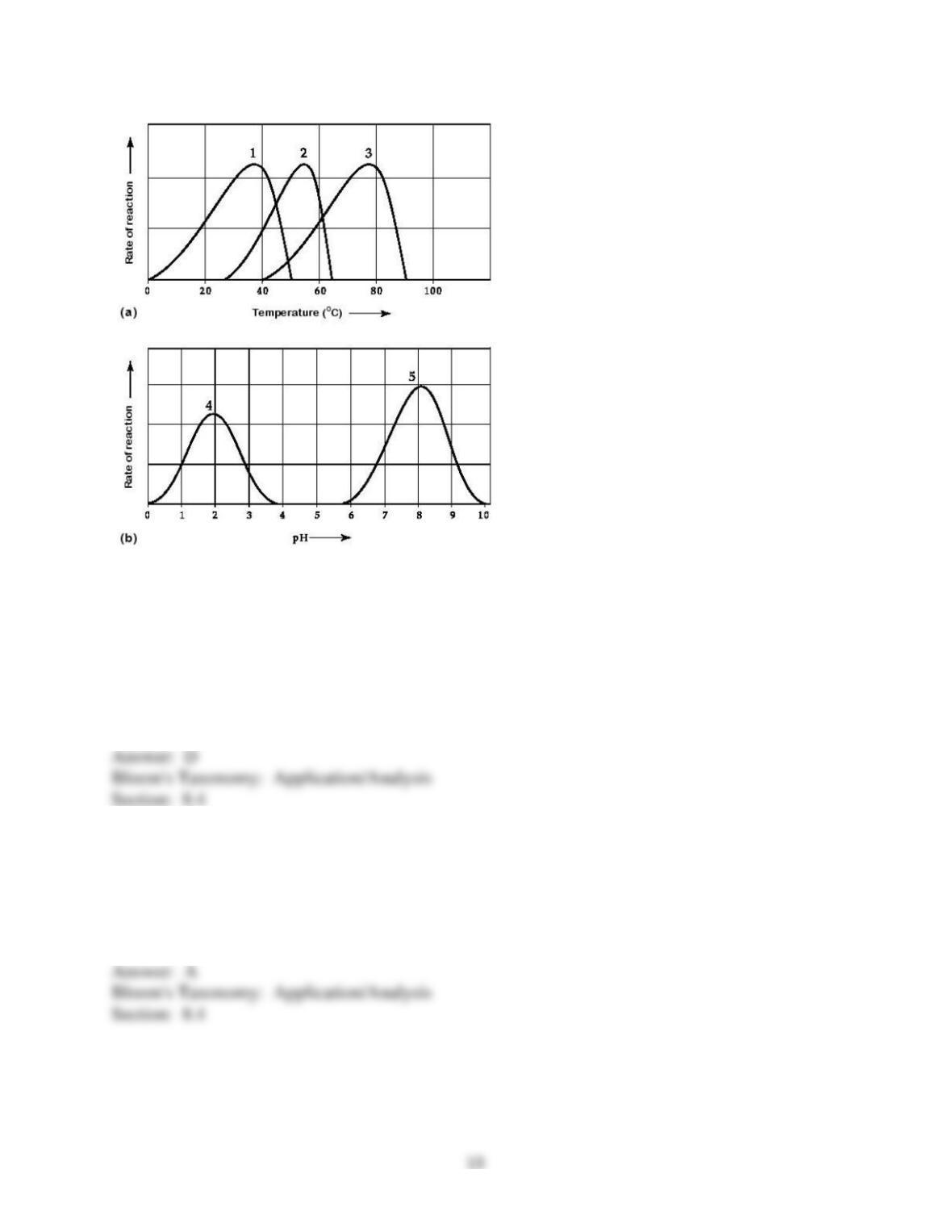
Activity of various enzymes at various temperatures (a) and at various pH (b).
45) Which curves on the graphs may represent the temperature and pH profiles of an enzyme
taken from a bacterium that lives in a mildly alkaline hot springs at temperatures of 70°C or
higher?
A) curves 1 and 5
B) curves 2 and 5
C) curves 3 and 4
D) curves 3 and 5
46) Which temperature and pH profile curves on the graphs were most likely generated from
analysis of an enzyme from a human stomach where conditions are strongly acid?
A) curves 1 and 4
B) curves 1 and 5
C) curves 2 and 4
D) curves 3 and 4
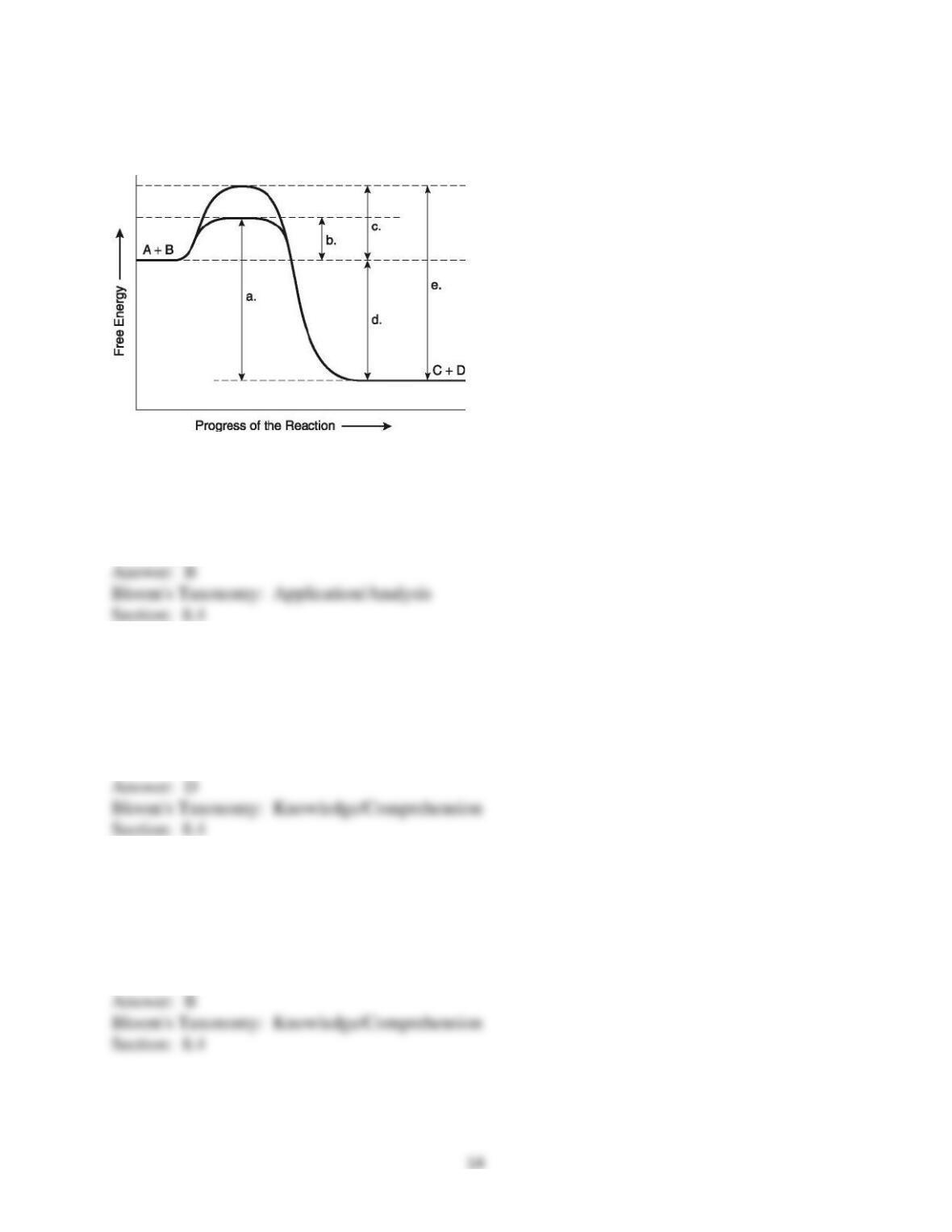
The following questions are based on the reaction A + B ↔ C + D shown in the
accompanying figure.
47) Which of the following terms best describes the forward reaction in the figure?
A) endergonic, ∆G > 0
B) exergonic, ∆G < 0
C) endergonic, ∆G < 0
D) exergonic, ∆G > 0
48) Which of the following in the figure would be the same in either an enzyme-catalyzed or a
noncatalyzed reaction?
A) a
B) b
C) c
D) d
49) Which of the following represents the activation energy required for the enzyme-catalyzed
reaction in the figure?
A) a
B) b
C) c
D) d
Use the following information to answer the questions below.
Succinate dehydrogenase catalyzes the conversion of succinate to fumarate. The reaction is
inhibited by malonic acid, which resembles succinate but cannot be acted upon by succinate
dehydrogenase. Increasing the ratio of succinate to malonic acid reduces the inhibitory effect of
malonic acid.
50) Based on this information, which of the following is correct?
A) Succinate dehydrogenase is the enzyme, and fumarate is the substrate.
B) Succinate dehydrogenase is the enzyme, and malonic acid is the substrate.
C) Succinate is the substrate, and fumarate is the product.
D) Fumarate is the product, and malonic acid is a noncompetitive inhibitor.
51) What is malonic acid’s role with respect to succinate dehydrogenase? Malonic acid _____.
A) is a competitive inhibitor
B) blocks the binding of fumarate
C) is a noncompetitive inhibitor
D) is an allosteric regulator
52) HIV is the virus that causes AIDS. In the mid-1990s, researchers discovered an enzyme in
HIV called protease. Once the enzyme’s structure was known, researchers began looking for
drugs that would fit into the active site and block it. If this strategy for stopping HIV infections
were successful, it would be an example of what phenomenon?
A) vaccination
B) denaturation
C) allosteric regulation
D) competitive inhibition

16
Use the following information to answer the questions below.
A series of enzymes catalyze the reaction X → Y → Z → A. Product A binds to the enzyme that
converts X to Y at a position remote from its active site. This binding decreases the activity of
the enzyme.
53) What is substance X?
A) an allosteric inhibitor
B) a substrate
C) an intermediate
D) the product
54) With respect to the enzyme that converts X to Y, substance A functions as _____.
A) an allosteric inhibitor
B) the substrate
C) an intermediate
D) a competitive inhibitor
55) The mechanism in which the end product of a metabolic pathway inhibits an earlier step in
the pathway is most precisely described as _____.
A) metabolic inhibition
B) feedback inhibition
C) allosteric inhibition
D) noncooperative inhibition
56) You have isolated a previously unstudied protein, identified its complete structure in detail,
and determined that it catalyzes the breakdown of a large substrate. You notice it has two
binding sites. One of these is large, apparently the bonding site for the large substrate; the other
is small, possibly a binding site for a regulatory molecule. What do these findings tell you about
the mechanism of this protein?
A) It is probably a structural protein that is involved in cell-to-cell adhesion.
B) It is probably an enzyme that works through allosteric regulation.
C) It is probably an enzyme that works through competitive inhibition.
D) It is probably a cell membrane transport protein–like an ion channel.
57) Allosteric enzyme regulation is usually associated with _____.
A) feedback inhibition
B) activating activity
C) an enzyme with more than one subunit
D) the need for cofactors
58) Which of the following is an example of cooperativity?
A) the binding of an end product of a metabolic pathway to the first enzyme that acts in the
pathway
B) one enzyme in a metabolic pathway passing its product to act as a substrate for the next
enzyme in the pathway
C) a molecule binding at one unit of a tetramer, allowing faster binding at each of the other three
D) binding of an ATP molecule along with one of the substrate molecules in an active site
59) Besides turning enzymes on or off, what other means does a cell use to control enzymatic
activity?
A) localization of enzymes into specific organelles or membranes
B) exporting enzymes out of the cell
C) connecting enzymes into large aggregates
D) hydrophobic interactions
60) Protein kinases are enzymes that transfer the terminal phosphate from ATP to an amino acid
residue on the target protein. Many are located on the plasma membrane as integral membrane
proteins or peripheral membrane proteins. What purpose may be served by their plasma
membrane localization?
A) ATP is more abundant near the plasma membrane.
B) They can more readily encounter and phosphorylate other membrane proteins.
C) Membrane localization lowers the activation energy of the phosphorylation reaction.
D) They flip back and forth across the membrane to access target proteins on either side.

61) Biological systems use free energy based on empirical data that all organisms require a
constant energy input. The first law of thermodynamics states that energy can be neither created
nor destroyed. For living organisms, which of the following statements is an important
consequence of this first law?
A) The energy content of an organism is constant except for when its cells are dividing.
B) The organism must ultimately obtain all the necessary energy for life from its environment.
C) The entropy of an organism decreases with time as the organism grows in complexity.
D) Organisms are unable to transform energy from the different states in which it can exist.
62) In a biological reaction, succinate dehydrogenase catalyzes the conversion of succinate to
fumarate. The reaction is inhibited by malonic acid, a substance that resembles succinate but
cannot be acted upon by succinate dehydrogenase. Increasing the amount of succinate molecules
to those of malonic acid reduces the inhibitory effect if malonic acid. Select the correct
identification of the molecules described in the reaction.
A) Succinate dehydrogenase is the enzyme, and fumarate is the substrate in the reaction.
B) Succinate dehydrogenase is the enzyme, and malonic acid is the substrate in the reaction.
C) Succinate is the substrate, and fumarate is the product in the reaction.
D) Fumarate is the product, and malonic acid is a noncompetitive inhibitor in the reaction.