58) In a mitochondrion, if the matrix ATP concentration is high and the intermembrane space
proton concentration is too low to generate sufficient proton-motive force, then
A) ATP synthase will increase the rate of ATP synthesis.
B) ATP synthase will synthesize ATP and pump protons into the intermembrane space.
C) ATP synthase will hydrolyze ATP and pump protons into the intermembrane space.
D) ATP synthase will hydrolyze ATP and pump protons into the matrix.
E) ATP synthase will synthesize ATP and pump protons into the matrix.
59) Chemiosmosis is used to synthesize ATP in which of the following?
A) only in mitochondria in animal cells
B) only in bacteria that generate proton gradients across their plasma membranes
C) only in mitochondria and chloroplasts
D) only in mitochondria and bacteria that generate proton gradients across their plasma
membranes
E) in mitochondria, chloroplasts, and bacteria that generate proton gradients across their plasma
membranes
60) In vertebrate animals, brown fat tissue’s color is derived from abundant blood vessels and
capillaries. White fat tissue, on the other hand, is specialized for fat storage and contains
relatively few blood vessels or capillaries. Brown fat cells have a specialized protein that allows
protons to diffuse across the inner mitochondrial membrane. Which of the following might be
the function of the brown fat tissue?
A) to increase the rate of oxidative phosphorylation from its few mitochondria
B) to increase the metabolic rate when it is especially hot
C) to increase the rate of ATP production
D) to regulate temperature by converting most of the energy from NADH oxidation to heat

61) What carbon sources can yeast cells metabolize to make ATP from ADP under anaerobic
conditions?
A) glucose
B) ethanol
C) pyruvate
D) lactic acid
62) Yeast cells with defective mitochondria are incapable of cellular respiration. These cells will
be able to grow by catabolizing which of the following carbon sources for energy?
A) glucose
B) proteins
C) fatty acids
D) pyruvate
63) Which catabolic processes may have been used by cells on ancient Earth before free oxygen
became available?
A) only glycolysis and fermentation
B) only glycolysis and the citric acid cycle
C) only glycolysis and pyruvate oxidation
D) only oxidative phosphorylation, using an electron acceptor other than oxygen
E) glycolysis, pyruvate oxidation, the citric acid cycle, and oxidative phosphorylation, using an
electron acceptor other than oxygen
64) Which of the following occur(s) in the cytosol of a eukaryotic cell?
A) glycolysis and fermentation
B) fermentation and chemiosmosis
C) oxidation of pyruvate to acetyl CoA
D) citric acid cycle
E) oxidative phosphorylation
65) Which of the following occur(s) in mitochondria?
A) glycolysis and fermentation
B) fermentation and chemiosmosis
C) glycolysis and oxidation of pyruvate to acetyl CoA
D) oxidation of pyruvate to acetyl CoA and the citric acid cycle
E) fermentation and oxidative phosphorylation
66) Which metabolic pathway is common to both cellular respiration and fermentation?
A) the oxidation of pyruvate to acetyl CoA
B) the citric acid cycle
C) oxidative phosphorylation
D) glycolysis
E) chemiosmosis
67) Which metabolic pathway requires a proton gradient?
A) the oxidation of pyruvate to acetyl CoA
B) the citric acid cycle
C) oxidative phosphorylation
D) glycolysis
E) fermentation
21
68) Which metabolic pathway generates a proton gradient?
A) the oxidation of pyruvate to acetyl CoA
B) the citric acid cycle
C) chemiosmosis
D) the electron transport chain
E) glycolysis
69) The ATP made during fermentation is generated by which of the following?
A) the electron transport chain
B) substrate-level phosphorylation
C) chemiosmosis
D) oxidative phosphorylation
E) aerobic respiration
70) Yeast cells grown anaerobically can obtain energy by fermentation, which results in the
production of
A) ATP, NADH, and pyruvate.
B) ATP and lactate.
C) ATP, CO2, and lactate.
D) ATP, CO2, and ethanol.
E) ATP, CO2, and acetyl CoA.
71) In alcohol fermentation, NAD+ is regenerated from NADH by
A) oxidation of ethanol to acetaldehyde.
B) oxidation of pyruvate to acetyl CoA.
C) reduction of pyruvate to lactate.
D) reduction of acetaldehyde to ethanol.
E) reduction of acetyl CoA to ethanol.
72) One primary function of both alcohol fermentation and lactic acid fermentation is to
A) reduce NAD+ to NADH.
B) reduce FAD+ to FADH2.
C) oxidize NADH to NAD+.
D) reduce FADH2 to FAD+.
73) Which one of the following is formed by the removal of a carbon (as CO2) from a molecule
of pyruvate?
A) lactate
B) glyceraldehyde-3-phosphate
C) oxaloacetate
D) acetyl CoA
E) citrate
74) Which statement best supports the hypothesis that glycolysis is an ancient metabolic pathway
that originated before the last universal common ancestor of life on Earth?
A) Glycolysis is widespread and is found in the domains Bacteria, Archaea, and Eukarya.
B) Glycolysis neither uses nor requires O2.
C) Glycolysis is found in all eukaryotic cells.
D) The enzymes of glycolysis are found in the cytosol rather than in a membrane-enclosed
organelle.
E) Ancient prokaryotic cells existed long before oxygen was present in Earth’s atmosphere.
75) Why is glycolysis considered to be one of the first metabolic pathways to have evolved?
A) It produces much less ATP than does oxidative phosphorylation.
B) It does not involve organelles or specialized structures, does not require oxygen, and is
present in most organisms.
C) It is found in prokaryotic cells but not in eukaryotic cells.
D) It relies on chemiosmosis, which is a metabolic mechanism present only in prokaryotic cells.
76) When an individual is exercising heavily and the muscle becomes oxygen-deprived, muscle
cells convert pyruvate to lactate. What happens to the lactate in skeletal muscle cells?
A) It is reduced and converted back to pyruvate in muscle cells.
B) It is oxidized to CO2 and water.
C) It is taken to the liver and converted back to pyruvate.
D) It oxidizes FADH2 to FAD+.
E) It is converted to alcohol.
77) A mutation in yeast makes it unable to convert pyruvate to ethanol. How will this mutation
affect these yeast cells?
A) The mutant yeast will produce lactate under anaerobic conditions.
B) The mutant yeast will be unable to grow anaerobically.
C) The mutant yeast will be unable to grow aerobically.
D) The mutant yeast will grow anaerobically only when provided glucose.
E) The mutant yeast will be unable to metabolize glucose.
78) What is the purpose of beta oxidation in respiration?
A) oxidation of glucose
B) oxidation of pyruvate
C) oxidation of proteins
D) oxidation of fatty acids
79) How do the catabolic products of beta oxidation enter into the citric acid cycle?
A) as pyruvate
B) as glyceraldehyde 3-phosphate
C) as CO2
D) as acetyl CoA
E) as glycerol
80) During intense exercise, as skeletal muscle cells switch to fermentation, the human body will
increase its catabolism of
A) fats only.
B) carbohydrates only.
C) proteins only.
D) fats, carbohydrates, and proteins.
E) fats and proteins only.
7.2 Art Questions
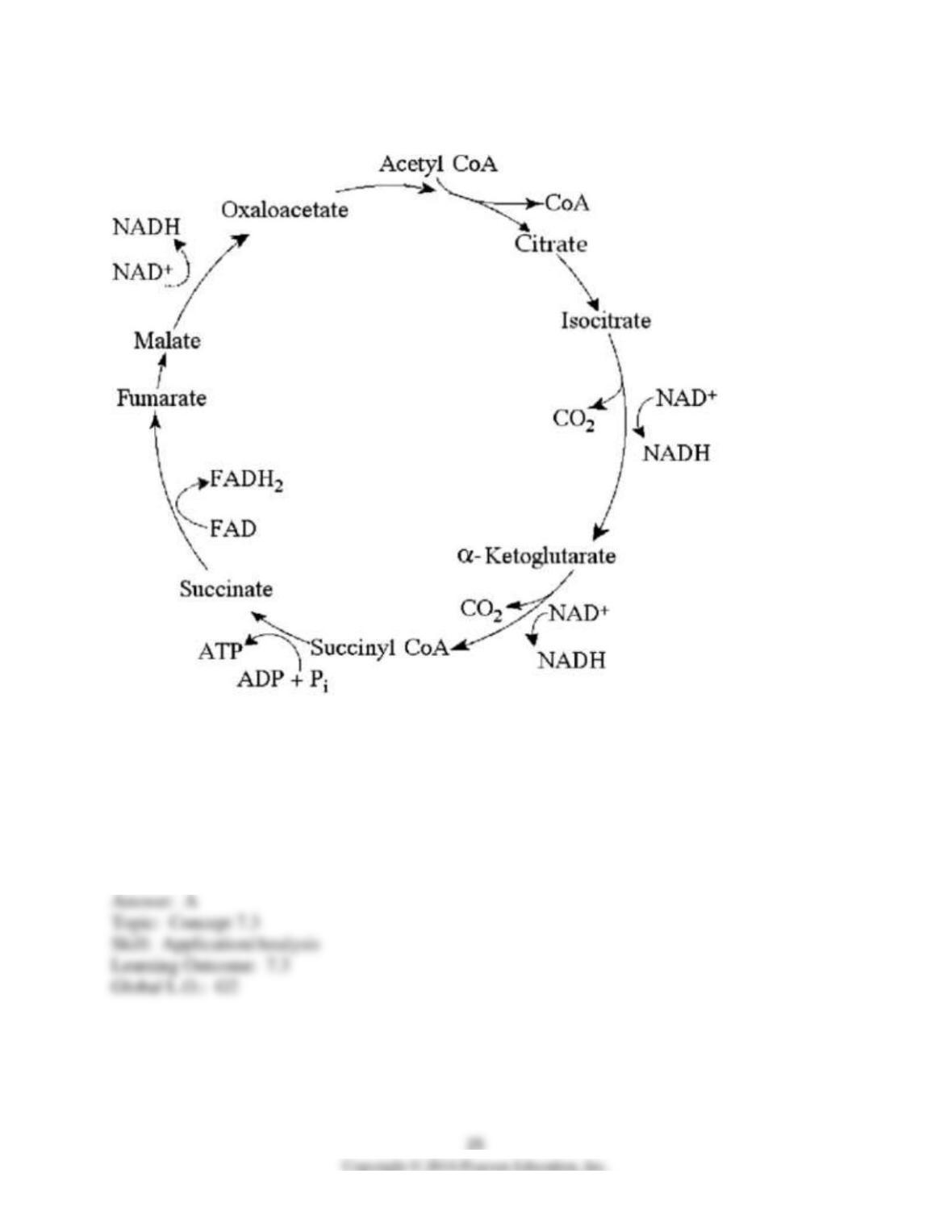
Figure 7.1
1) Starting with one molecule of isocitrate and ending with fumarate, how many ATP molecules
can be made through substrate-level phosphorylation (see Figure 7.1)?
A) 1
B) 2
C) 11
D) 12
E) 24
2) Carbon skeletons for amino acid biosynthesis are supplied by intermediates of the citric acid
cycle. Which intermediate could directly supply the carbon skeleton for synthesis of a five-
carbon amino acid (see Figure 7.1)?
A) succinate
B) malate
C) citrate
D) α-ketoglutarate
E) isocitrate
3) For each mole of glucose (C6H12O6) completely oxidized by cellular respiration, how many
moles of CO2 are released in the citric acid cycle (see Figure 7.1)?
A) 2
B) 3
C) 4
D) 6
E) 12
4) If pyruvate oxidation is blocked, what will happen to the levels of oxaloacetate and citrate in
the citric acid cycle shown in Figure 7.1?
A) There will be no change in the levels of oxaloacetate and citrate.
B) Oxaloacetate will decrease and citrate will accumulate.
C) Oxaloacetate will accumulate and citrate will decrease.
D) Both oxaloacetate and citrate will decrease.
E) Both oxaloacetate and citrate will accumulate.
5) Starting with citrate, which of the following combinations of products would result from three
acetyl CoA molecules entering the citric acid cycle (see Figure 7.1)?
A) 1 ATP, 2 CO2, 3 NADH, and 1 FADH2
B) 2 ATP, 2 CO2, 3 NADH, and 3 FADH2
C) 3 ATP, 3 CO2, 3 NADH, and 3 FADH2
D) 3 ATP, 6 CO2, 9 NADH, and 3 FADH2
E) 36 ATP, 6 CO2, 6 NADH, and 6 FADH2
6) For each molecule of glucose that is metabolized by glycolysis and the citric acid cycle (see
Figure 7.1), what is the total number of NADH + FADH2 molecules produced?
A) 4
B) 5
C) 6
D) 10
E) 12
28
Figure 7.2
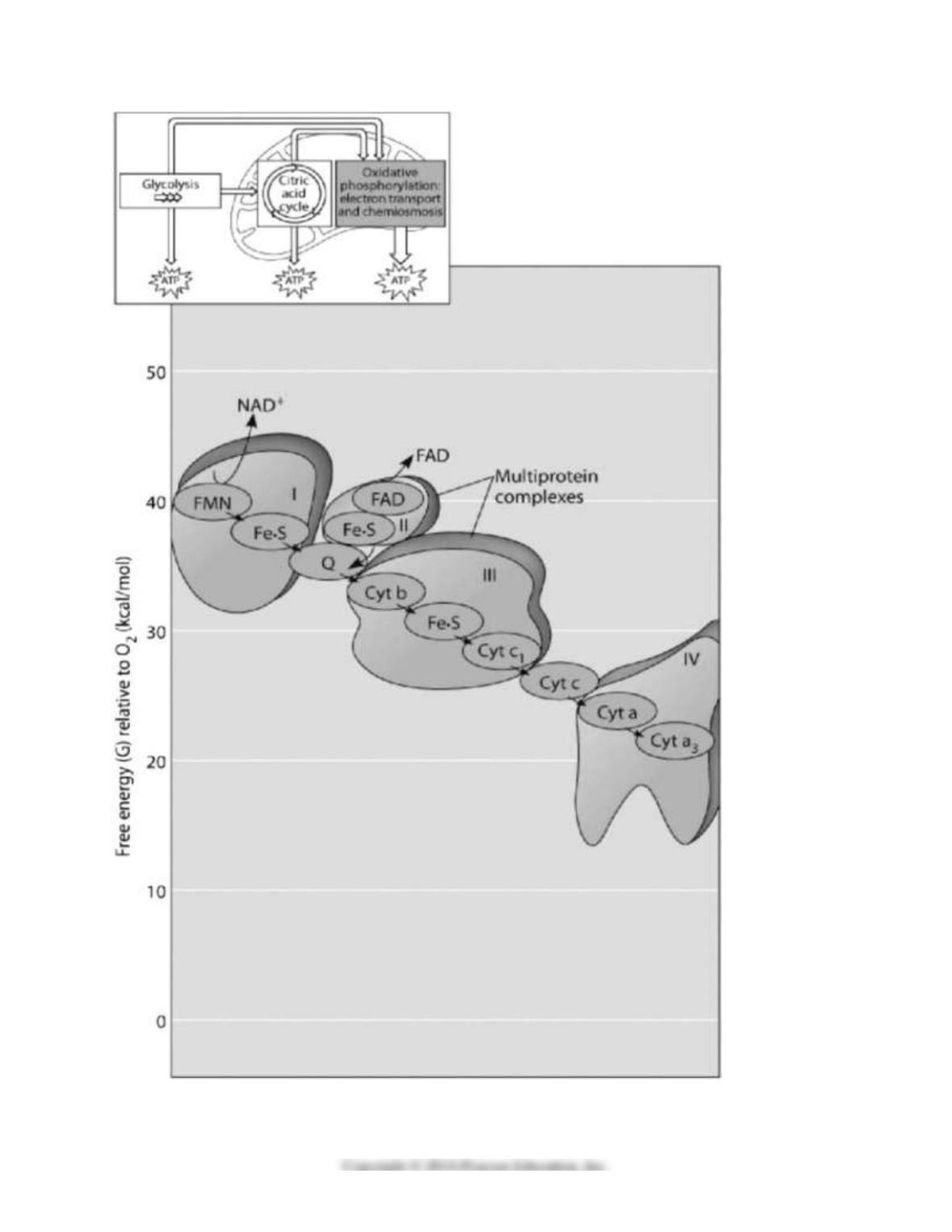
7) Figure 7.2 shows the electron transport chain. Which of the following is initially added to the
chain with the highest free energy?
A) oxygen
B) FADH2
C) NADH
D) CO2
E) water
8) Which of the following is an accurate description of the events that occur along the electron
transport chain depicted in Figure 7.2?
A) ATP is generated directly at three points in the pathway.
B) Electron transfer is directly coupled to chemiosmosis.
C) Each electron transfer between carriers results in oxidation of one carrier and reduction of
another.
D) The potential energy of electrons increases at each step in the pathway.
9) Which of the protein complexes labeled with Roman numerals in Figure 7.2 will transfer
electrons to O2?
A) complex I
B) complex II
C) complex III
D) complex IV
E) All of the complexes can transfer electrons to O2.
10) What happens at the end of the chain in Figure 7.2?
A) Two electrons combine with a proton and a molecule of NAD+.
B) Two electrons combine with a molecule of oxygen and two hydrogen atoms.
C) Four electrons combine with a molecule of oxygen and four protons.
D) Four electrons combine with four hydrogen and two oxygen atoms.
E) One electron combines with a molecule of oxygen and a hydrogen atom.
7.3 Scenario Questions
1) In the presence of oxygen, the three-carbon compound pyruvate can be catabolized in the
citric acid cycle. First, however, the pyruvate (1) loses a carbon, (2) is oxidized to form a two-
carbon compound, which (3) is covalently bound to coenzyme A. These three steps result in the
formation of
A) acetyl CoA, CO2, and ATP.
B) acetyl CoA, FADH2, and CO2.
C) acetyl CoA, NADH, H2, and CO2.
D) acetyl CoA, NADH, H+, and CO2.
E) acetyl CoA, NAD+, ATP, and CO2.
2) An organism is discovered that thrives in both the presence and absence of oxygen in the air.
Curiously, the consumption of sugar increases as oxygen is removed from the organism’s
environment, even though the organism does not gain much weight. This organism
A) is photosynthetic.
B) is a normal member of the animal kingdom.
C) must utilize a molecule other than oxygen to accept electrons from the electron transport
chain.
D) is a facultative anaerobe.
E) is an obligate anaerobe.
3) A man interested in losing weight and increasing his fitness followed a strict diet and exercise
regimen for three months. Body fat analysis indicated that the man had lost 7 kg (about 15
pounds) of fat by following this exercise and diet program. What is the most likely form by
which the fat left his body?
A) It was converted to heat, which was released to the environment.
B) It was released as CO2 and H2O.
C) It was converted to ATP, which weighs much less than fat.
D) It was broken down to amino acids and eliminated from the body.
4) A young dog has never had much energy. He is brought to a veterinarian for help, and she
decides to conduct several diagnostic tests. She discovers that the dog’s mitochondria can use
only fatty acids and amino acids for cellular respiration, and his cells produce more lactate than
normal. Of the following, which is the best explanation of the dog’s condition?
A) His mitochondria lack the transport protein that moves pyruvate across the outer
mitochondrial membrane.
B) His cells cannot transport NADH from glycolysis into the mitochondria.
C) His cells contain something that inhibits oxygen use in his mitochondria.
D) His cells lack an essential enzyme in glycolysis so they cannot produce pyruvate.
E) His cells have a defective electron transport chain, so glucose goes to lactate instead of to
acetyl CoA.
7.4 End-of-Chapter Questions
1) The immediate energy source that drives ATP synthesis by ATP synthase during oxidative
phosphorylation is the
A) oxidation of glucose and other organic compounds.
B) flow of electrons down the electron transport chain.
C) H+ concentration gradient across the membrane holding ATP synthase.
D) transfer of phosphate to ADP.
2) Which metabolic pathway is common to both fermentation and cellular respiration of a
glucose molecule?
A) the citric acid cycle
B) the electron transport chain
C) glycolysis
D) reduction of pyruvate to lactate
3) In mitochondria, exergonic redox reactions
A) are the source of energy driving prokaryotic ATP synthesis.
B) provide the energy that establishes the proton gradient.
C) reduce carbon atoms to carbon dioxide.
D) are coupled via phosphorylated intermediates to endergonic processes.
4) The final electron acceptor of the electron transport chain that functions in aerobic oxidative
phosphorylation is
A) oxygen.
B) water.
C) NAD+.
D) pyruvate.
5) What is the oxidizing agent in the following reaction?
Pyruvate + NADH + H+ → Lactate + NAD+
A) oxygen
B) NADH
C) lactate
D) pyruvate
6) When electrons flow along the electron transport chains of mitochondria, which of the
following changes occurs?
A) The pH of the matrix increases.
B) ATP synthase pumps protons by active transport.
C) The electrons gain free energy.
D) NAD+ is oxidized.
7) Most CO2 from catabolism is released during
A) glycolysis.
B) the citric acid cycle.
C) lactate fermentation.
D) electron transport.