Chapter 7—Plant Organs: Stems Key
1. The main function(s) of stems is/are
2. The growth that takes place at the shoot apical meristem results in ____ growth.
3. Primary growth is an increase in the length of a plant and occurs at
4. Buds are
5. Lateral meristems are
6. The lenticel allows for
7. The vascular bundles of herbaceous eudicot stems are
8. The epidermis
9. The cuticle contains
10. The central cylinder of vascular bundles and pith is called the
11. Sandwiched between the primary xylem and primary phloem of the herbaceous eudicot stem is the
12. The pith is composed of large, thin-walled ____ cells.
13. Which of the following is found in a eudicot stem, but NOT in a monocot stem?
14. Which of the following are shared by both eudicot and monocot stems?
15. In the monocot stem, vascular bundles are surrounded by
16. The vascular bundles of monocot stems are surrounded by bundle sheaths of ____ for support.
17. Monocot stem vascular bundles are arranged
18. The vascular cambium produces
19. The original primary vascular tissues of a woody stem
20. In plants with secondary growth, the “wood” is
21. The tissues and cell types that are included in what we call “bark,” including both inner and outer bark, are
22. Through what tissue do materials move laterally in the woody stem?
23. Which of the following tissues does the periderm replace in the woody plant?
24. The epidermis of a young woody stem
25. Which of the following statements is TRUE?
26. Cork cells protect the stem against
27. Which tissues does the periderm include?
28. Which of the following tissues is the MOST EXTERNAL in the woody plant?
29. Which of the following tissues is the MOST INTERNAL in the woody plant?
30. What is the difference between hardwood and softwood?
31. What is the difference between heartwood and sapwood?
32. The annual rings that form in trees living in the temperate part of the wood are the result of
33. A horizontal underground stem is called a
34. A fleshy underground stem used for carbohydrate storage is a
35. A greatly shortened, upright, underground stem with thick, fleshy storage leaves and a bud is called a
36. How can you tell the difference between a bulb and a corm?
37. Leaf scar and bundle scar refer to the same thing on a twig.
38. Bundle scars are found within leaf scars.
39. Axillary buds are found at internodes.
40. The epidermis in monocot stems has no cuticle, while a cuticle is present in eudicot stems.
41. Pith is the layer of ground tissue between the cortex and the stele.
42. Phloem tissue transports dissolved carbohydrates between the leaves and the roots.
43. In monocot stems, the tissue in which the vascular tissues are embedded is called ground tissue and
performs the same functions as cortex and pith in herbaceous eudicot stems.
44. In monocot stems, the vascular bundles are arranged in a ring toward the periphery of the stem.

45. When a cell in the vascular cambium divides, one daughter cell becomes xylem and the other becomes
phloem.
46. Secondary tissues replace primary tissues in function in woody plants.
47. Unlike the vascular cambium, the cork cambium divides to form new tissues in only one direction.
48. Rays transport materials laterally in the woody stem.
49. Stomata of the stem epidermis are replaced by lenticels in the bark.
50. Heartwood is the younger, light-colored wood closest to the bark of a tree.
51. The age of a tree in the temperate zone can be determined by counting its annual rings.
52. A corm is a fleshy underground stem that grows horizontally.
53. Runners and stolons are the same thing; horizontal aboveground stems.
54. The region of stem between two nodes is called a(n) ____________________.

55. The shoot apical meristem of a woody twig is protected by ____________________.
56. The ____________________ tissue transports water and dissolved minerals.
57. The epidermis of a stem is covered with a thick layer of wax called the ____________________.
58. The ____________________ is the tissue that gives rise to the secondary xylem and secondary phloem.
59. The ____________________ is replaced by the periderm in the woody plant.
60. Radial bands of parenchyma cells found in wood and used for lateral transport are known as
____________________.
61. The circular bands seen in a cross-section of a woody stem are called ____________________.
62. The ____________________ is the nonfunctional part of the xylem located toward the interior of the tree
which is darker in color.
63. A(n) ____________________ is formed when a dead branch becomes surrounded by growing wood.

64. The removal of forest without sufficient replanting is ____________________, and it is one of the greatest
problems facing the world’s forests today.
65. Weak-stemmed plants that climb on other plants for support are called ____________________.
66. ____________________ are loosely arranged areas in the woody stem which allow the exchange of gases to
occur.
67. Fleshy underground stems enlarged for food storage, usually at the ends of rhizomes, are
____________________.
68. Horizontal, aboveground stems that grow on the surface and have long internodes are
____________________.
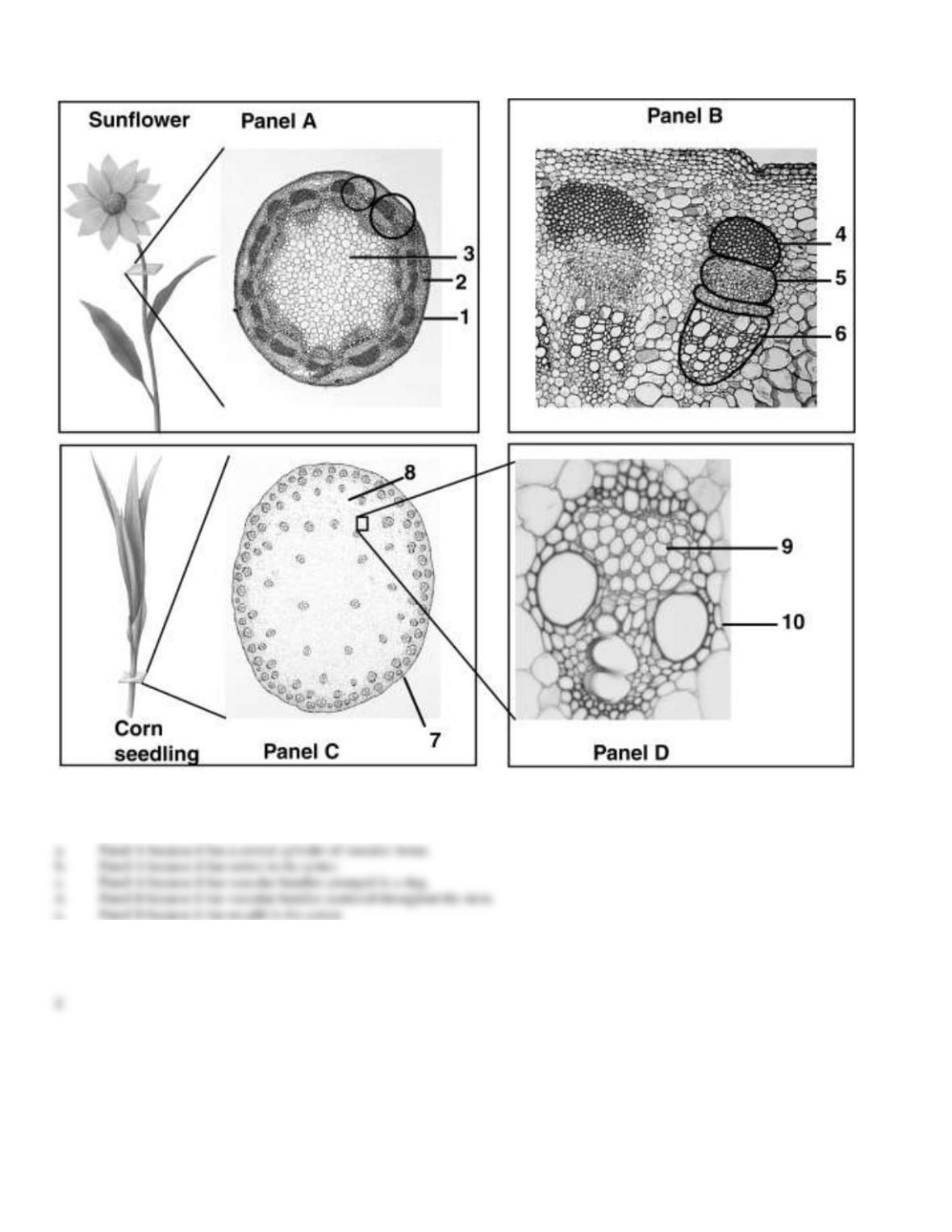
69. Figure 7-1
Refer to Figure 7-1. Which stem is from a eudicot? How can you tell?
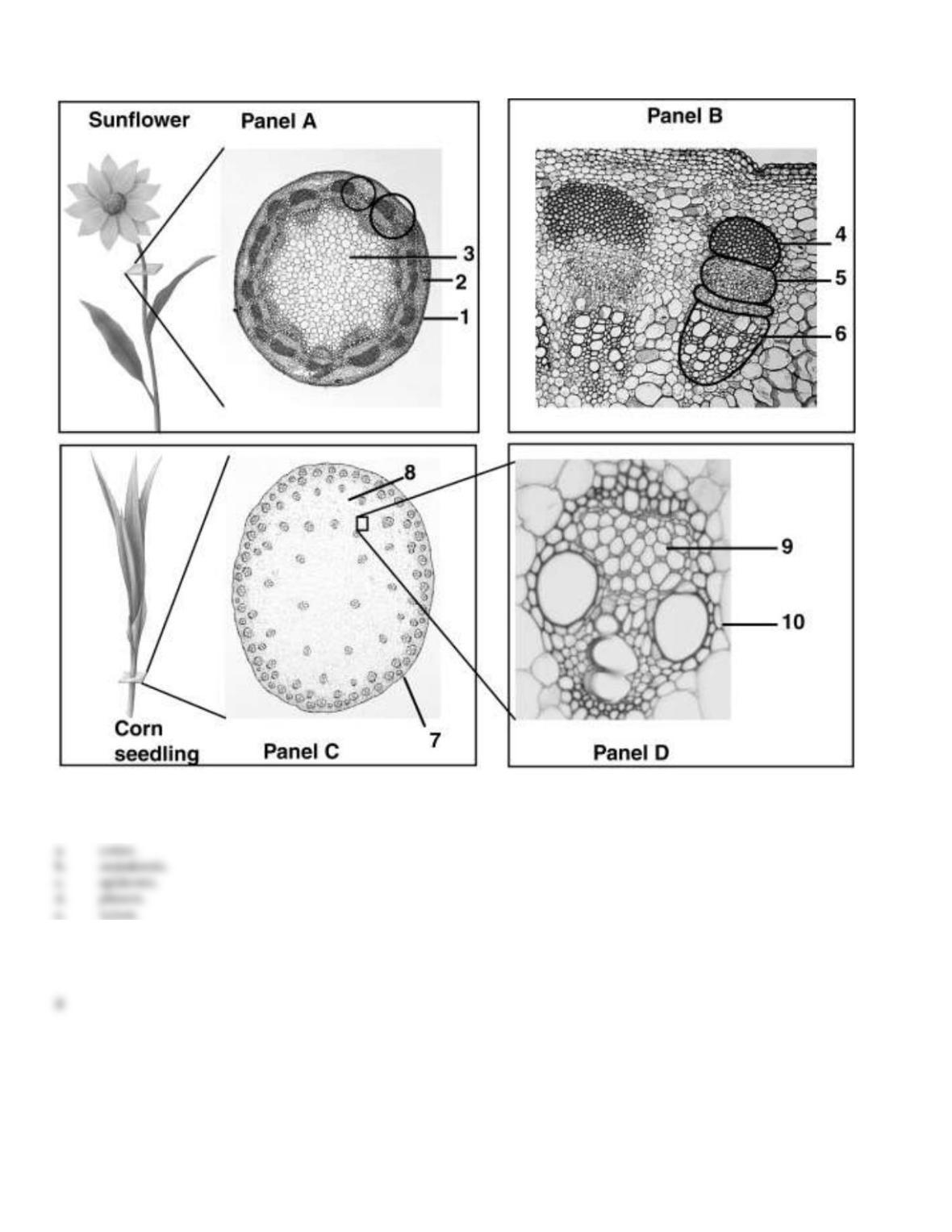
70. Figure 7-1
Refer to Figure 7-1. The tissue indicated by arrow 2 is
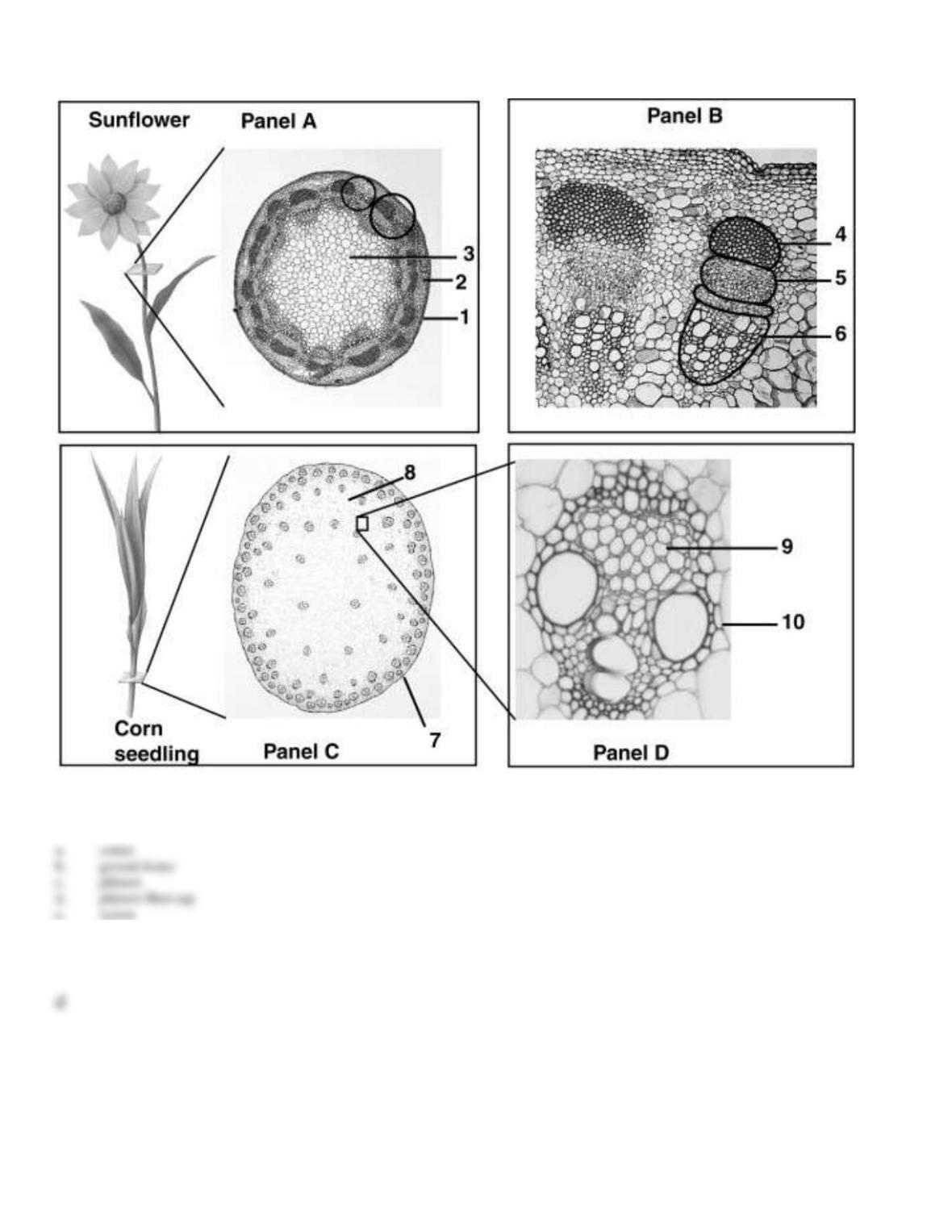
71. Figure 7-1
Refer to Figure 7-1. The tissue indicated by arrow 4 is
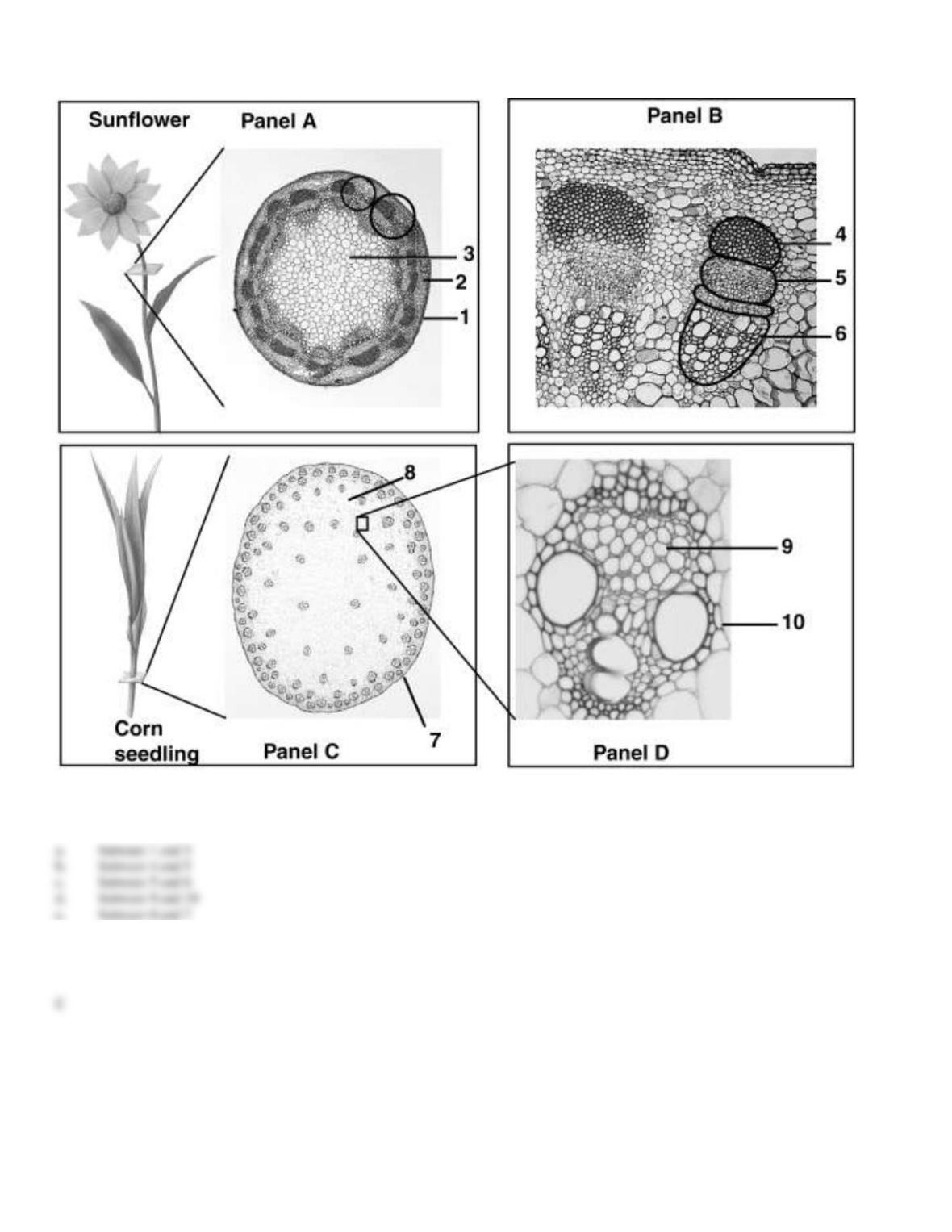
72. Figure 7-1
Refer to Figure 7-1. Where would you find the vascular cambium?
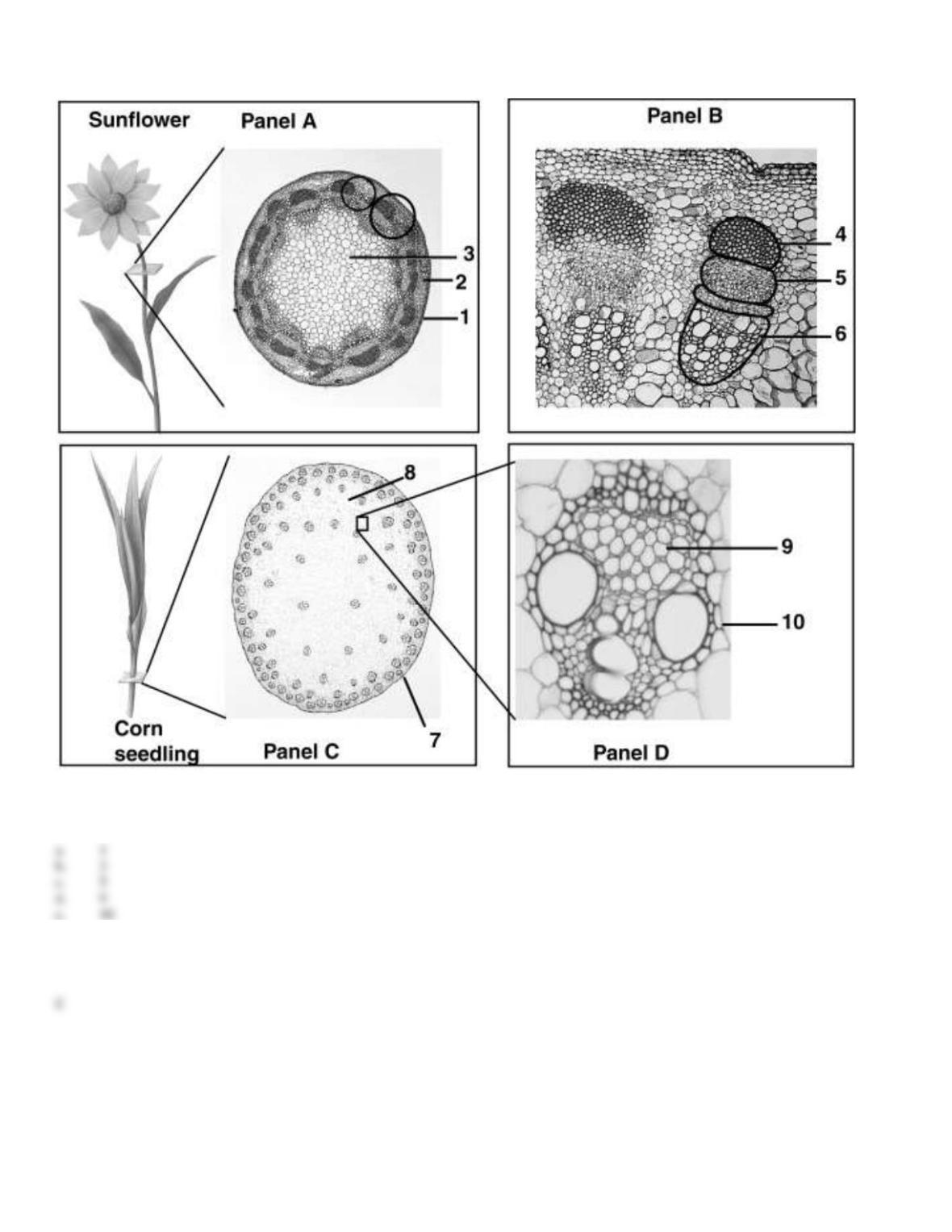
73. Figure 7-1
Refer to Figure 7-1. Which of the following tissues is used for the transport of sugars?
74. Describe the arrangement of the xylem and phloem tissues of an herbaceous eudicot stem.
75. What is the economic importance of wood?
76. What is the ecological importance of wood?
77. Explain how the cork cambium originates in a stem and describe the cells that it produces.
78. If monocots don’t have a vascular cambium, thus incapable of producing wood, have can bamboo and palm
trees get to be so tall?
79. What is the difference between an herbaceous vine and a liana?
80. Compare sexual and asexual reproduction in flowering plants.