Microbiology with Diseases by Body System, 5e (Bauman)
Chapter 7 Microbial Genetics
7.1 Multiple Choice Questions
1) A bacterial genome is typically
A) a single linear piece of DNA.
B) multiple linear pieces of DNA.
C) a linear RNA molecule.
D) a single circular DNA molecule.
E) multiple circular DNA molecules.
2) Which of the following is found at the 5′ end of a DNA strand?
A) a phosphate group
B) a hydrogen bond
C) a hydroxyl group
D) histones
E) a methyl group
3) The bacterial chromosome is
A) usually found in the cytoplasm.
B) found in a nucleoid.
C) found in a nucleus.
D) both circular and found in a nucleoid.
E) both circular and found in a nucleus.
4) Which of the following types of plasmids allows a bacterial cell to kill its competitors?
A) virulence plasmids
B) fertility plasmids
C) bacteriocin plasmids
D) resistance plasmids
E) cryptic plasmids
5) Which of the following is found in both archaeal and eukaryotic genomes?
A) chromatin fibers
B) histones
C) heterochromatin
D) euchromatin
E) nuclear envelope
6) Which of the following statements is TRUE of bacterial plasmids?
A) They are always found in the nucleoid.
B) They can replicate autonomously.
C) They carry genes for essential metabolic functions.
D) They are small circular DNA molecules.
E) They are small circular DNA molecules that can replicate autonomously.
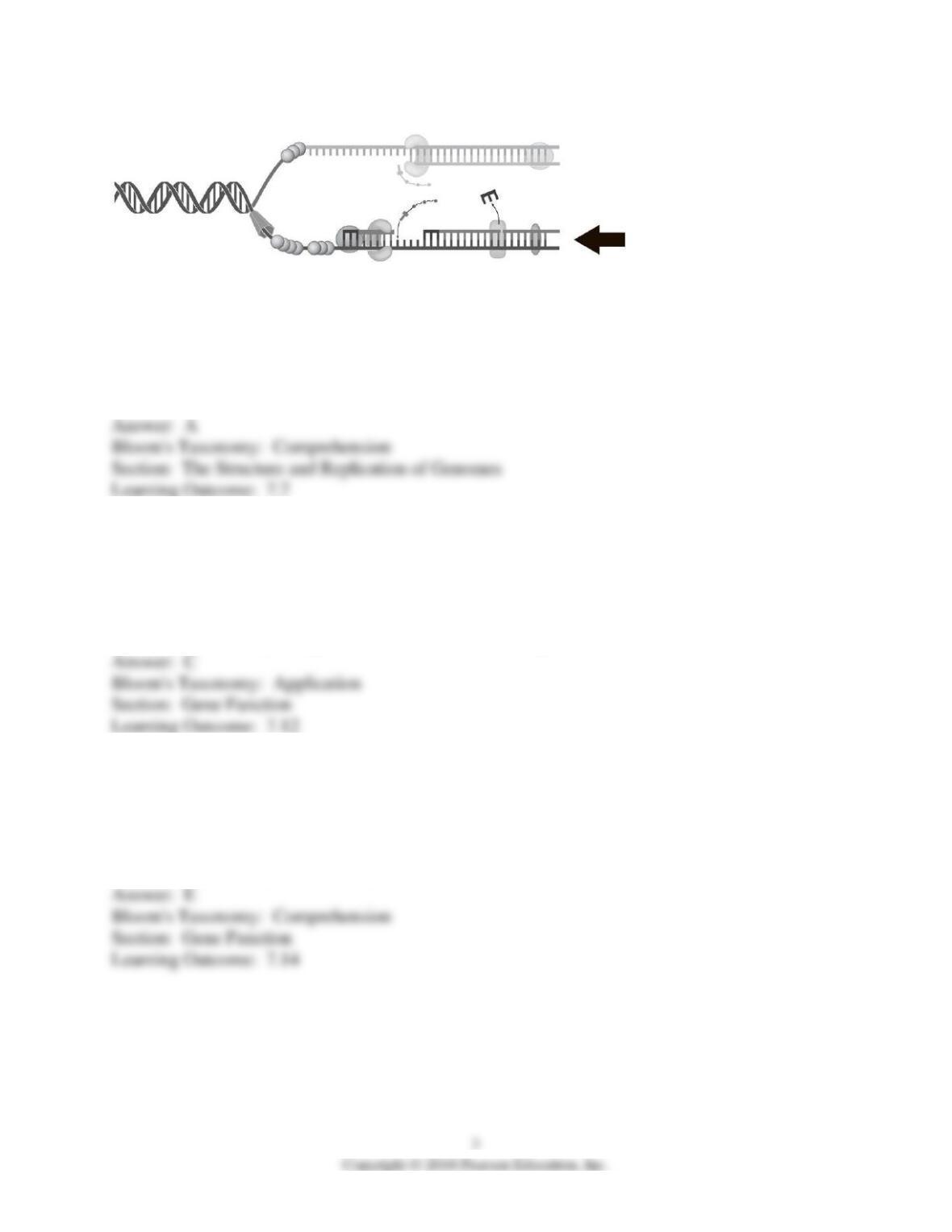
7)
The process indicated by the arrow in Figure 7.1 represents
A) lagging strand synthesis.
B) leading strand synthesis.
C) transcription.
D) translation.
E) recombination.
8) Which of the following statements concerning transcription in bacteria is FALSE?
A) It occurs in the nucleoid region.
B) Sigma factors are parts of RNA polymerase that recognize promoter regions.
C) Different RNA polymerases are required for synthesis of mRNA, rRNA, and tRNA.
D) Termination is either self-induced or due to the presence of Rho protein.
E) There are a variety of sigma factors that affect transcription.
9) Which of the following is involved in translation?
A) rRNA only
B) tRNA only
C) mRNA only
D) both mRNA and tRNA
E) mRNA, rRNA, and tRNA are all involved.
10) Which of the following is a characteristic shared by DNA and RNA polymerases?
A) efficiency of proofreading
B) type of nucleotides used
C) direction of polymerization
D) speed
E) dependence on helicase
11) Typical eukaryotic genomes are composed of ________ chromosomes.
A) multiple linear
B) multiple circular
C) a single circular
D) a single linear
E) both linear and circular
12) DNA is composed of four nucleotides, A, C, G and T. Each codon is composed of three
nucleotides. The number of possible codons is
A) 16.
B) 4.
C) 12.
D) 64.
E) 32.
13) Which of the following is both a codon for an amino acid and a start signal?
A) AAA
B) AUG
C) UAG
D) GAU
E) UGA
14) Amino acids are delivered in their appropriate order by
A) mRNAs.
B) RNA-induced silencing complexes (RISC).
C) ribozymes.
D) rRNAs.
E) tRNAs.
15) During elongation, a charged tRNA first enters the ribosomal ________ site and then moves
into the ________ site.
A) A; E
B) P; A
C) P; E
D) A; P
E) E; A
16) Two bacterial strains have the same genes for metabolizing a carbohydrate, but one is wild-
type for a regulatory inducer while the other does not produce the inducer. Which of the
following statements is CORRECT with regard to the metabolism of the bacteria?
A) The two bacterial strains have the same phenotype.
B) The two bacterial strains have different phenotypes.
C) The genotypes and phenotypes of the two bacterial strains are the same.
D) The two bacterial strains have the same phenotype but have different genotypes.
E) The answer cannot be determined from the information provided.
17) Semiconservative DNA replication means that
A) each daughter DNA molecule is composed of one original strand and one new strand.
B) nucleotides are constantly being recycled as cells make DNA.
C) the cell can proofread its newly synthesized DNA only part of the time.
D) the sequence of a DNA molecule is preserved as it is being replicated.
E) each strand of a double-stranded DNA molecule is replicated differently.
18) Which of the following is NOT a characteristic of Okazaki fragments?
A) They are checked for accuracy by DNA polymerase III.
B) They make up the lagging strand of replicated DNA.
C) They begin with an RNA primer.
D) They are joined together by DNA ligase.
E) They are longer in eukaryotic cells.
19) Which of the following is NOT a characteristic of both DNA and RNA polymerases?
A) directionality of synthesis
B) energy is provided by pyrophosphate
C) hydrogen bonding of complementary nucleotides
D) requirement for an initiation signal
E) requirement for a primer
20) Which of the following processes is involved in the “central dogma” of genetics?
A) translation only
B) transcription only
C) DNA replication only
D) transcription and translation
E) DNA replication and translation
21) Prokaryotic operons typically include a(n) ________ and a(n) ________ with multiple genes.
A) operator; terminator
B) operator; promoter
C) promoter; repressor
D) inducer; repressor
E) CAP-binding site; inducer
22) Which of the following are considered to be frameshift mutations?
A) insertions only
B) inversions only
C) deletions only
D) both inversion and insertions
E) both deletions and insertions
23) If the codon AAA is changed to AAG, it still codes for the amino acid lysine; this is an
example of a
A) silent mutation.
B) nonsense mutation.
C) frameshift mutation.
D) dimer formation.
E) missense mutation.
24) Which of the following causes mutations by creating thymine dimers?
A) nucleotide analogs
B) nitrous acid
C) ultraviolet light
D) benzopyrene
E) gamma rays
25) DNA damage caused by nitrous acid results in ________ mutations.
A) insertion
B) substitution
C) deletion
D) frameshift
E) both insertion and deletion
26) Which of the following DNA repair processes is most likely to introduce mutations into the
repaired DNA?
A) base-excision repair
B) light repair
C) single-strand repair
D) mismatch repair
E) SOS response repair
27) The Ames test demonstrates that a chemical is
A) carcinogenic.
B) carcinogenic in Salmonella.
C) mutagenic in Salmonella.
D) carcinogenic in humans.
E) mutagenic in humans.
28) The horizontal transfer process known as transduction
A) involves a virus.
B) requires a pilus.
C) requires a cell to be “competent.”
D) requires a plasmid.
E) involves a mutagen.
29) Frederick Griffith discovered
A) transformation.
B) transposons.
C) the lac operon.
D) DNA.
E) conjugation.
30) In conjugation, F+ cells
A) serve as recipient cells.
B) contain an F plasmid.
C) do not have conjugation pili.
D) can transfer DNA only to other F+ cells.
E) contain “jumping genes.”
31) Which of the following is required for transposition?
A) F+ plasmid
B) bacteriophage
C) insertion sequence
D) donor cell
E) competence
32) Which of the following is characteristic of prokaryotic genomes but NOT eukaryotic
genomes?
A) histones
B) circular chromosomes
C) linear chromosomes
D) enclosed in a nuclear membrane
E) typically consist of a few to several chromosomes
33) You observe a microbiologist examining two plates and notice the pattern of colonies are
nearly identical with the exception of a few colonies that are absent on one of them. The plates
likely were produced by
A) positive selection culturing.
B) replica plating.
C) pour plating.
D) streak plating.
E) the Ames test.
34) A polypeptide in a wild type microbe contains the sequence Leu-Pro-Tyr-Ser-Pro. A
phenotypic variant of the species has the peptide sequence Leu-Pro-Cys-Ser-Pro. This is an
example of a(n) ________ mutation.
A) nonsense
B) missense
C) silent
D) frameshift
E) inversion
35) Which of the following is NOT involved in the regulation of the lac operon?
A) an inducer
B) a repressor protein
C) an iRNA
D) glucose
E) cyclic AMP
36) Genetic elements known as promoters are initiation points in the process of
A) DNA replication.
B) transcription.
C) translation.
D) mutation repair.
E) transformation.
37) Codons are recognized during
A) translation.
B) transcription.
C) base excision.
D) DNA replication.
E) transduction.
38) The events of ________ are initiated at sequences called origins.
A) DNA replication
B) translation
C) splicing
D) transcription
E) transposition
39) The process of ________ requires the activity of DNA ligase.
A) translation
B) capping
C) transcription
D) DNA replication
E) transduction
40) RNA polymerase is primarily responsible for
A) DNA replication.
B) translation.
C) transcription.
D) transformation.
E) polyadenylation.
41) Which of the following processes occurs in eukaryotes but not prokaryotes?
A) DNA replication
B) capping
C) transcription
D) translation
E) gene regulation
42) The modified amino acid fMet is essential for
A) bacterial translation.
B) bacterial transcription.
C) eukaryotic transcription.
D) eukaryotic translation.
E) eukaryotic mRNA processing.
43) Transfer of random pieces of DNA mediated by phage is known as
A) transformation of competent cells.
B) generalized transduction.
C) conjugation.
D) transposition.
E) specialized transduction.
44) The process of ________ is described as semiconservative.
A) translation
B) transcription
C) mismatch repair
D) transformation
E) DNA replication
45) The effects of a transposition event are equivalent to a(n)
A) nonsense mutation.
B) missense mutation.
C) frameshift mutation.
D) silent mutation.
E) HFR conjugation.
7.2 True/False Questions
1) All eukaryotes are diploid.
2) A chemical is reported to inhibit bacterial replication. Bacterial cells are placed in medium
with all nutrients necessary for replication. The chemical is added to the culture, and after a half
hour an extract of the DNA is prepared. A significant percentage of the DNA is in pieces about
1000 to 2000 bases in length. The results are consistent with the chemical blocking the function
of DNA ligase.
3) The term “semiconservative replication” means that both strands of a DNA molecule are a mix
of newly replicated and original template DNA.
4) Most bacteria have a natural ability to take up DNA from their environment.
5) The structure of DNA explains both its ability to encode genetic information and the way in
6) DNA, which is negatively charged, wraps around positively charged histones as part of the
packaging of eukaryotic chromosomes.
7) In contrast to leading strand synthesis, the lagging strand is synthesized 3′ to 5′, which is why
it is slower.
8) The phenotype of an organism reflects only part of its genotype.
9) In generalized transduction, viruses carry random DNA sequences from one cell to another.
10) Nucleotide analogs cause frameshift mutations.
7.3 Short Answer Questions
1) A(n) (operon/codon/gene) is a specific sequence of nucleotides that codes for a protein or an
RNA molecule.
2) Loosely packed, transcriptionally active regions of a eukaryotic chromosome are called
(euchromatin/heterochromatin/nucleosomes).
3) Transfer of DNA between bacterial cells by viruses is called
(transformation/transduction/conjugation).
4) The phenotype of an organism is its set of (genes/traits/chromosomes).
5) The enzyme responsible for separating the DNA strands during DNA replication is
(topoisomerase/primase/helicase).
6) The chemical 5-bromouracil mimics the chemical structure of thymine, making it a(n)
(analog/nucleotide/precursor) of thymine.
7) A (missense/nonsense/silent) mutation of a gene usually produces a nonfunctional
polypeptide.
8) Except during initiation of translation, transfer RNA molecules carrying amino acids initially
bind to the ribosome at the (P/A/E) site.
9) The (codon/anticodon/loop) of a transfer RNA molecule is complementary to a codon in a
messenger RNA molecule.
10) Nucleotide analog mutagens cause (deletion/frameshift/point) mutations.
11) A(n) (genome/codon/operon) is a set of prokaryotic genes that are regulated and transcribed
as a unit.
12) The (leading/lagging/replicating) strand is the DNA strand that is synthesized continuously
during DNA replication.
13) The full set of genetic instructions of an organism is its (phenotype/genome/genotype).
14) Errors made during replication are primarily corrected by (base-
excision/mismatch/nucleotide-excision) repair.
15) While studying a bacterial strain, a scientist notes a short DNA sequence between inverted
repeats is present in both the chromosome and a plasmid within the cell. This sequence is most
likely a(n) (phage/transposon/F plasmid).
7.4 Essay Questions
1) Describe the basic similarities and differences between DNA replication and transcription.
2) Describe the various types of nucleic acids that are typically found in cells.
3) Bacterial strain A contains a plasmid. Bacterial strain B does not. When the bacteria are
incubated together in a broth culture strain B cells containing the plasmid can be isolated. Devise
an experiment to determine what type of gene transfer process is involved.
4) Compare and contrast the lactose operon with the tryptophan operon.
5) A point mutation can be completely harmless, or it can result in the death of a cell or
organism. Explain why these types of mutations can have such varying effects.