34) Ethylene oxide
A) is a good antiseptic.
B) is not sporicidal.
C) requires high heat to be effective.
D) is a sterilizing agent.
E) is the active chemical in household bleach.
35) All of the following substances are used to preserve foods EXCEPT
A) biguanides.
B) nisin.
C) potassium sorbate.
D) sodium nitrite.
E) calcium propionate.
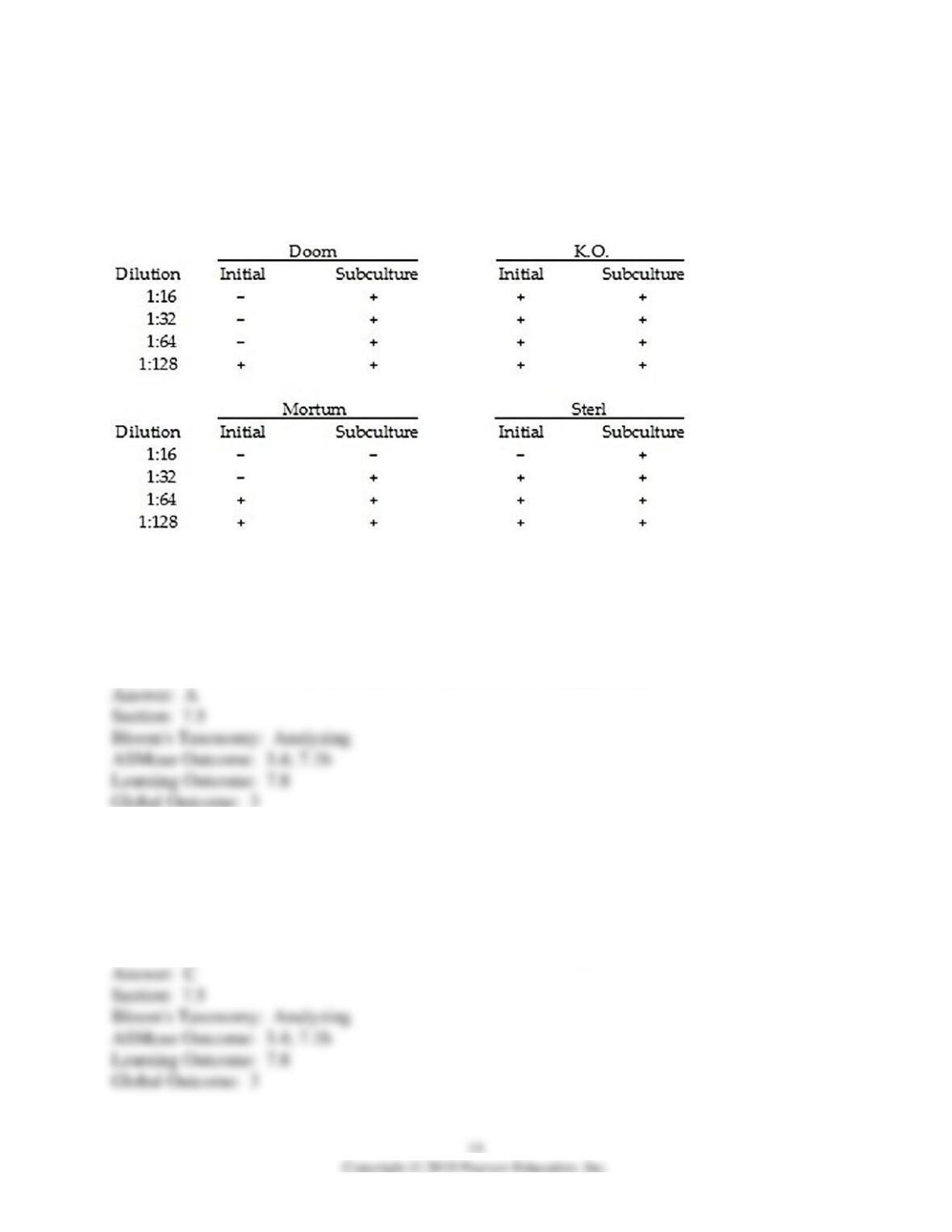
Table 7.3
The following data were obtained by incubating gram-positive bacteria in nutrient medium +
disinfectant for 24 hours, then transferring one loopful to nutrient medium (subculturing). (+ =
growth; – = no growth)
36) In Table 7.3, which disinfectant is the most effective at stopping bacterial growth?
A) Doom
B) K.O.
C) Mortum
D) Sterl
E) The answer cannot be determined based on the information provided.
37) In Table 7.3, which disinfectant was bactericidal?
A) Doom
B) K.O.
C) Mortum
D) Sterl
E) The answer cannot be determined based on the information provided.
38) In Table 7.3, which disinfectant was most effective against Salmonella?
A) Doom
B) K.O.
C) Mortum
D) Sterl
E) The answer cannot be determined based on the information provided.
39) All of the following are effective for destroying prions EXCEPT
A) boiling.
B) incineration.
C) NaOH + autoclaving at 134°C.
D) proteases.
E) None of the answers are correct; each of these will destroy prions.
40) Which of the following pairs is mismatched?
A) ionizing radiation – hydroxyl radicals
B) ozone – takes electrons from substances
C) plasma sterilization – free radicals
D) supercritical fluids – CO2
E) ultraviolet radiation – desiccation
41) All of the following are methods of food preservation EXCEPT
A) desiccation.
B) high pressure.
C) ionizing radiation.
D) microwaves.
E) osmotic pressure.
42) The preservation of beef jerky from microbial growth relies on which method of microbial
control?
A) filtration
B) lyophilization
C) desiccation
D) ionizing radiation
E) supercritical CO2
43) If you were preparing nutrient agar at home and did not have an autoclave, what could you
use to sterilize the nutrient agar?
A) bleach
B) boiling for one hour
C) hydrogen peroxide
D) oven at 121°C for one hour
E) pressure cooker at 121°C for 15 minutes
44) Bone and tendons for transplant are decontaminated by
A) ethylene oxide.
B) glutaraldehyde.
C) peroxygens.
D) plasma sterilization.
E) supercritical fluids.
45) Which one of the following is known to be most resistant to quaternary ammonium
compounds?
A) gram positive bacteria
B) members of the genus Pseudomonas
C) members of the genus Staphylococcus
D) fungi
E) enveloped viruses
46) One advantage of chemical plasma is that it ________ but a disadvantage is ________.
A) can be used to sterilize intricate surgical instruments such as a laproscope; cost
B) cost; difficulty of implementing the procedure
C) can be used for intricate surgical instruments; cannot be used on plastics
D) can be used on many materials; the need for high temperature is damaging to some equipment
E) destroys spores; cannot be used on plastics
47) The most resistant of the bacterial endospores can withstand boiling for up to
A) 10 min.
B) 30 min.
C) 1 hour.
D) 5 hours.
E) 20 hours.
48) HEPA filters are effective because they are designed to remove all airborne particulates,
including microorganisms down to
A) 0.01 micrometers.
B) 0.3 micrometers.
C) 1 micrometer.
D) 10 micrometers.
E) 10 nanometers.
49) A kitchen countertop has a spill of vegetable oil that was wiped up but a film remains. What
should be the next step in disinfecting this surface?
A) 10% bleach
B) spray a disinfectant that contains a heavy metal
C) warm soapy scrub
D) isopropanol
E) chlorhexidine containing solution
50) Which chemical disinfectant can be considered a sterilizing liquid agent when appropriately
applied?
A) quaternary ammonium compounds
B) 70% ethanol
C) sodium benzoate
D) gluteraldehyde
E) ethylene oxide
7.2 True/False Questions
1) Any process that destroys the non-spore forming contaminants on inanimate objects is
sterilization.
2) Desiccation is a reliable form of sterilization.
3) The thermal death time is the time needed to kill all the bacteria in a particular culture at a
certain temperature.
4) Pseudomonas has been found growing in quaternary ammonium compounds (quats).
5) Moist heat destroys organisms by denaturing proteins.
6) Some antimicrobial chemicals are considered to be disinfectants and antiseptics.
7) The pH of the medium has no effect on the activity of the disinfectant being applied.
8) Ultraviolet light (UV) causes irreversible breaks in DNA strands.
9) Autoclaving is the most effective method of moist heat sterilization.
10) Microorganisms placed in high concentrations of salts and sugars undergo lysis.
7.3 Essay Questions
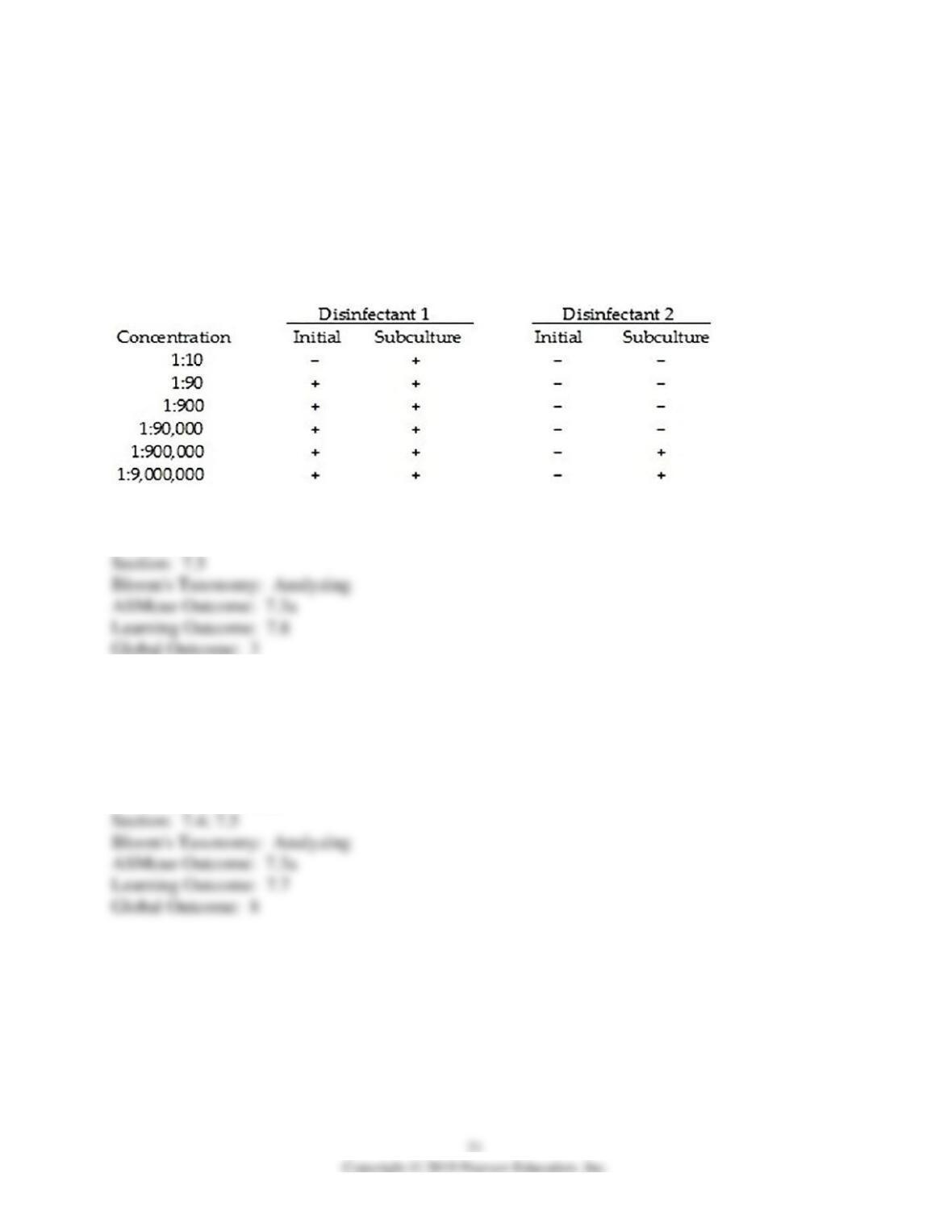
1) Table 7.4
The results below were obtained from a use-dilution test of two disinfectants. Cultures were
inoculated into tubes with varying concentrations of disinfectants and incubated for 24 hours at
20°C, then subcultured in nutrient media without disinfectants.
(+ = growth; – = no growth)
In Table 7.4, what is the minimal bacteriostatic concentration of each disinfectant? Which
compound is bactericidal? At what concentration?
2) Assume that you are responsible for decontaminating materials in a large hospital. How would
you sterilize each of the following? Briefly justify your answers.
a. a mattress used by a patient with bubonic plague
b. intravenous glucose-saline solutions
c. used disposable syringes
d. tissues taken from patients
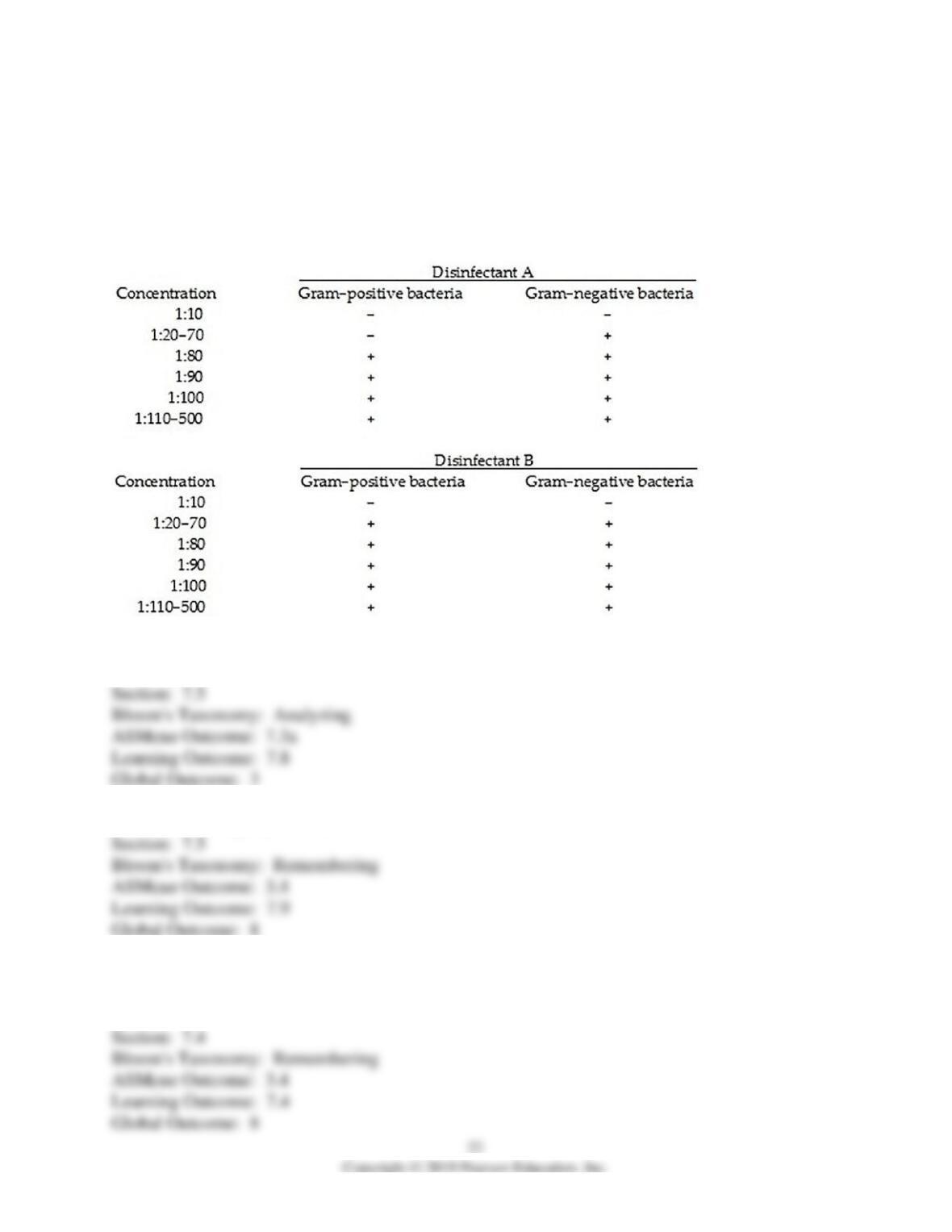
3) Table 7.5
The following results were obtained from a use-dilution test of two disinfectants. Cultures were
inoculated into tubes containing varying concentrations of the disinfectants, incubated for 10
min. at 20°C, and then transferred to growth media without disinfectant.
(+ = growth; – = no growth)
In Table 7.5, which disinfectant is most effective? Against which group of bacteria is
Disinfectant A most effective?
4) How is hydrogen peroxide antimicrobial?
5) Why must most milk sold in the U.S. be refrigerated at all times while evaporated canned milk
and milk in cardboard containers sold in Europe do not need to be refrigerated until they are
opened?
6) What are the advantages of gluteraldehyde compared to formaldehyde?
7) List the microbial targets of disinfecting chemicals and provide one example of a chemical
agent that affects that structure.
8) Explain the set up and expected results of a use-dilution test for an endospore-producing
Clostridium and a solution of chlorhexidine.