
Microbiology with Diseases by Body System, 5e (Bauman)
Chapter 6 Microbial Nutrition and Growth
6.1 Multiple Choice Questions
1) A microorganism grows in the lab on medium containing mineral salts but no organic
compounds. The organism is likely to be a(n)
A) heterotroph.
B) autotroph.
C) chemotroph.
D) chemoheterotroph.
E) The answer cannot be determined from the information provided.
2) A cell that uses an organic carbon source and obtains energy from light would be called a
A) photoheterotroph.
B) lithoautotroph.
C) photoautotroph.
D) chemoheterotroph.
E) chemoautotroph.
3) A(n) ________ organism require(s) oxygen for growth.
A) anaerobic
B) facultative anaerobic
C) aerotolerant
D) obligate aerobic
E) aerotolerant and an anaerobic

4) An aquatic microbe that can grow only near the surface of the water is probably which of the
following?
A) a phototroph
B) a heterotroph
C) a chemotroph
D) a lithotroph
E) an anaerobe
5) The carotenoid pigments of some phototrophs interact with ________ to reduce its toxicity.
A) singlet oxygen (1O2)
B) hydroxyl radical (HO–)
C) peroxide anion (O22-)
D) superoxide radical (O2–)
E) molecular oxygen (O2)
6) The absence of ________ leaves obligate anaerobes susceptible to killing by oxygen.
A) carotenoids
B) superoxide dismutase
C) peroxidase
D) vitamin E
E) catalase
7) A microbe that grows only at the bottom of a tube of thioglycollate medium is probably a(n)
A) obligate aerobe.
B) facultative anaerobe.
C) aerotolerant anaerobe.
D) microaerophile.
E) obligate anaerobe.

8) Nitrogen is a growth-limiting nutrient for many organisms because
A) it is necessary for the biosynthesis of amino acids.
B) it is required for synthesis of nucleotides.
C) it is required for lipid synthesis.
D) only a small number of bacteria are able to extract it from the atmosphere.
E) only a few microbes can extract it from the atmosphere, but all organisms require it for amino
acid and nucleotide synthesis.
9) An organism that requires chemical nutrients which serve as final electron acceptors is a(n)
A) chemotroph.
B) phototroph.
C) lithotroph.
D) autotroph.
E) aerobe.
10) At temperatures higher than the maximum growth temperature for an organism
A) proteins are permanently denatured.
B) membranes become too fluid for proper function.
C) hydrogen bonds within molecules are broken.
D) hydrogen bonds are broken and proteins are permanently denatured.
E) hydrogen bonds are broken, proteins are denatured, and membranes become too fluid.
11) Ted heats some food just to boiling, and stores some of it immediately in a container which
he places in the refrigerator. A week later he takes the food out and finds it has spoiled. The
microbes responsible are probably
A) thermoduric.
B) thermophiles.
C) mesophiles.
D) hyperthermophiles.
E) psychrophiles.

12) In the process of ________, microbes detect the presence and density of other microbes and
modify their metabolic activity in response.
A) quorum sensing
B) antagonism
C) mutualism
D) symbiosis
E) synergy
13) Which of the following organisms would be most likely to contaminate a jar of pickles?
A) a neutrophile
B) a thermophile
C) an acidophile
D) an obligate anaerobe
E) a mesophile
14) Organisms that can grow with or without oxygen present are
A) obligate aerobes.
B) facultative anaerobes.
C) aerotolerant anaerobes.
D) obligate anaerobes.
E) either facultative anaerobes or aerotolerant anaerobes.
15) A fastidious organism might be grown on which of the following types of media?
A) transport media
B) reducing media
C) enriched media
D) differential media
E) selective media

16) Obligate anaerobes may be cultured in the laboratory
A) in a reducing medium.
B) in a standard incubator.
C) in standard Petri plates.
D) on blood agar plates.
E) in standard complex media.
17) Joan wants to discover a microbe capable of degrading an environmental contaminant.
Which of the following culturing methods would be most effective for isolation of such an
organism?
A) cell culture
B) chemostat
C) quorum sensing
D) enrichment culture
E) differential culture
18) A microbiologist inoculates a flask of broth to a concentration of 100 bacterial cells per ml.
The generation time of the species is 1 hour, and there is no lag phase. How long will it be before
the culture contains more than 6,000 cells per ml?
A) 12 hours
B) 6 hours
C) 2 hours
D) 4 hours
E) 10 hours

19) An epidemiologist is investigating a new disease and observes what appear to be bacteria
inside tissue cells in clinical samples from victims. The scientist wants to try to isolate the
bacteria in the lab. What culture conditions are most likely to be successful?
A) culturing on blood agar plates
B) inoculation of EMB plates
C) incubation in an anaerobic culture system
D) inoculation of cell cultures
E) inoculation of a minimal medium broth
20) The events of binary fission are
I. the cell doubles in size
II. the DNA is replicated
III. the cell forms a septum
IV. the cell separates from its offspring
The CORRECT order of these events is
A) I, III, II, IV.
B) II, III, I, IV.
C) IV, I, III, II.
D) II, I, III, IV.
E) I, II, IV, III.
21) MacConkey agar plates represent ________ medium.
A) a minimal
B) a selective
C) a differential
D) both a differential and a selective
E) both a minimal and a selective

22) Which of the following methods provides information about the number of living cells in a
sample of bacterial culture?
A) serial dilution and viable plate count
B) membrane filtration
C) a Petroff-Hauser counting chamber
D) flow cytometry
E) a Coulter counter
23) The growth of bacterial cultures is best described as
A) arithmetic growth.
B) lag growth.
C) logarithmic growth.
D) cell division.
E) replication.
24) A ________ is used in industrial microbiology to produce microbial products that are only
synthesized during log phase growth.
A) Coulter counter
B) broth culture
C) spectrophotometer
D) pour plate
E) chemostat
25) The ________ of a population is the time it takes for the cells to double in number.
A) binary fission
B) exponential growth
C) generation time
D) arithmetic growth
E) log phase

26) Which of the following is an indirect method for estimating the number of microbes in a
sample?
A) viable plate counts
B) turbidity
C) Coulter counter
D) MPN
E) membrane filtration
27) During which growth phase are bacteria more susceptible to antimicrobial drugs?
A) lag phase
B) log phase
C) stationary phase
D) death phase
E) The susceptibility is the same for all phases.
28) The use of salt and sugar in preserving various types of foods is an application of which of
the following concepts?
A) nitrogen fixation
B) osmotic pressure
C) pH
D) hydrostatic pressure
E) quorum sensing
29) A clinical sample labeled as “sputum” was collected from
A) the skin.
B) the blood.
C) the central nervous system.
D) a piece of tissue.
E) the lungs.

30) Pure cultures are often obtained by isolating
A) streaks.
B) broths.
C) CFUs (colony forming units).
D) inoculums.
E) specimens.
31) ________ are complex communities of various types of microbes that adhere to surfaces.
A) Aggregates
B) Colonies
C) Isolates
D) Biofilms
E) Media
32) The ________ method provides an estimate of the CFUs (colony-forming units) in a sample.
A) Coulter-counter
B) viable plate-count
C) streak-plate
D) turbidity
E) direct microscopic-count
33) Blood agar plates are an example of ________ medium.
A) differential
B) selective
C) reducing
D) defined
E) transport

34) Reducing medium is used to isolate ________ microbes.
A) fastidious
B) obligate aerobic
C) autotrophic
D) obligate anaerobic
E) intracellular parasitic
35) The Most Probable Number (MPN) method is used
A) to estimate numbers of cells in samples with a high density of bacterial cells.
B) when samples contain obligate anaerobes.
C) to estimate numbers of cells in samples with a low density of bacterial cells.
D) to isolate autotrophic bacteria.
E) to determine the generation time of bacterial isolates.
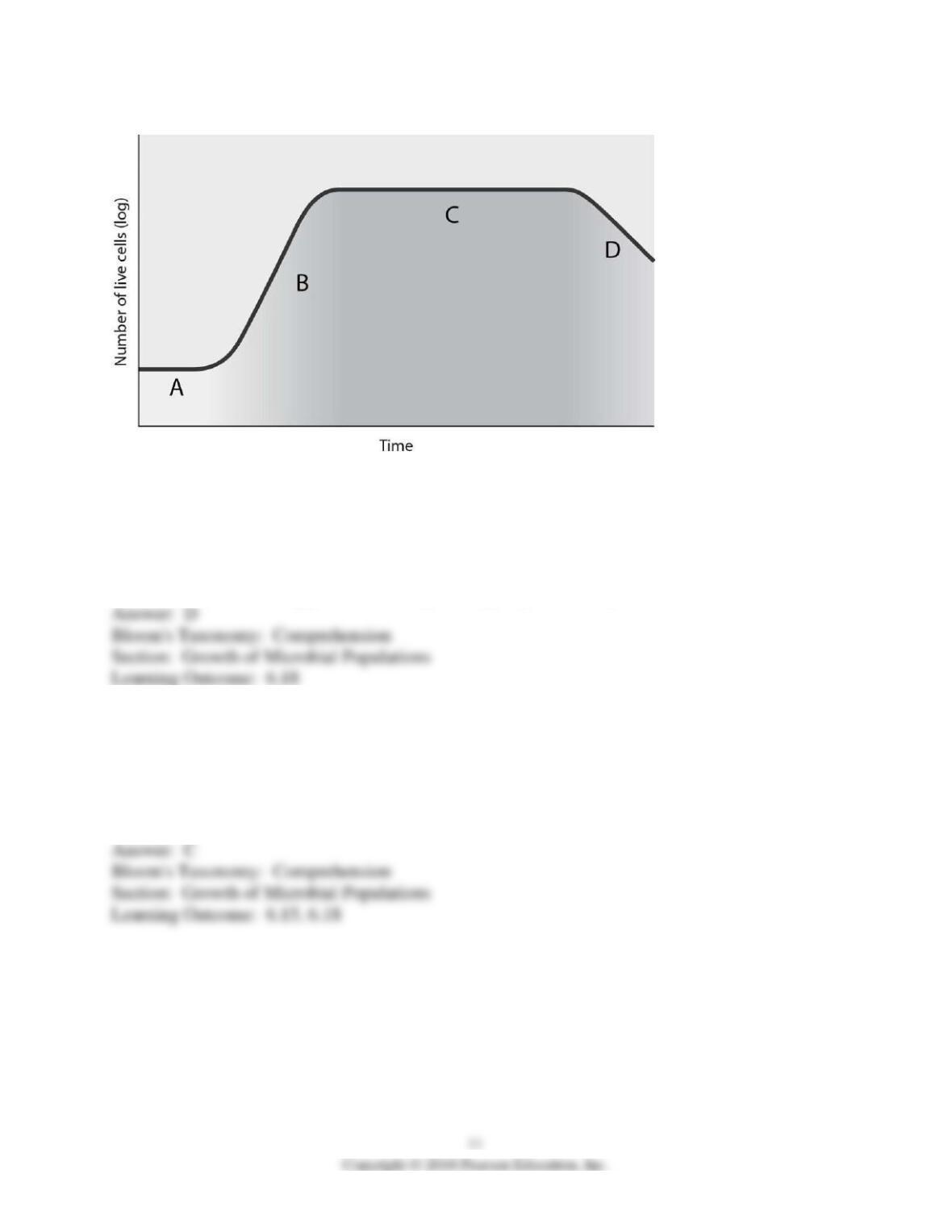
36)
Which of the following statements is CORRECT regarding Figure 6.1?
A) Cells are actively growing only during the stage represented by B.
B) No cells are reproducing during the stage represented by D.
C) Cells are most susceptible to antibiotics during the stage represented by A.
D) Cells are alive but not reproducing during the stage represented by A.
E) No new cells are being produced during the stage represented by C.
37) The generation time of bacterial cells is shortest during the ________ phase.
A) death
B) lag
C) log
D) stationary
E) longitudinal

38) When cells are metabolically active but not dividing, they are in the ________ phase.
A) stationary
B) log
C) lag
D) death
E) exponential
39) Rates of cell production and cell death are approximately equal during the ________ phase
of growth.
A) lag
B) log
C) death
D) stationary
E) intermediate
40) Creating conditions in the laboratory that promote the growth of some microbes while
inhibiting the growth of others is called
A) complex culturing.
B) reducing conditions.
C) enrichment culturing.
D) transport conditions.
E) differential culturing.
41) A laboratory recipe lists sucrose, an ammonia compound, calcium salts and a buffer as the
ingredients for a microbiologic medium. These are added to water and autoclaved. What type of
medium does this protocol produce?
A) defined agar
B) defined broth
C) complex broth
D) reducing agar
E) complex enrichment broth

42) A capnophile is a microorganism that thrives in conditions of high
A) carbon dioxide levels.
B) hydrostatic pressure.
C) oxygen levels.
D) pH.
E) salt concentration.
43) A microorganism found living under conditions of high ________ is a barophile.
A) pH values
B) oxygen concentrations
C) hydrostatic pressure
D) carbon dioxide levels
E) salt concentrations
44) Microaerophiles are microbes that grow best at low
A) carbon dioxide levels.
B) pH values.
C) hydrostatic pressure.
D) oxygen levels.
E) salt concentrations.
45) A 0.1 ml sample of a log phase culture contains 10,000 bacterial cells/ml. It is added to 9.9
ml of fresh culture medium broth. Assume a generation time of 30 minutes, and no limiting
nutrients. How many bacteria will be present in the entire broth culture after five hours?
A) 3.2 × 10⁴
B) 5.0 × 10⁵
C) 1.02 × 10⁶
D) 6.0 × 10⁶
E) 2.56 × 10⁷

6.2 True/False Questions
1) Photoheterotrophs use carbon dioxide as their sole carbon source.
2) Atmospheric nitrogen gas (N2) is produced in the process known as nitrogen fixation.
3) Thermoduric mesophiles are often responsible for spoilage of improperly canned foods.
4) Serial dilution can be used in combination with pour plates as a method for isolating pure
cultures.
5) The only effective way to store bacterial cultures for short periods of time is to arrest their
metabolism by freezing.
6) Quorum sensing is involved in the development and propagation of a biofilm.
7) Streak plates are a useful way to obtain CFUs.

8) Agar is a useful compound in the microbiology lab because it is an excellent nutrient for
bacteria.
9) Enrichment culturing may require use of controlled environmental conditions.
10) Flow cytometry makes use of fluorescence to count microbes.
6.3 Short Answer Questions
1) A(n) (autotroph/lithotroph/organotroph) uses inorganic molecules as electron donors.
2) Organisms that require organic sources of carbon and energy are called
(chemoheterotrophs/chemoautotrophs/autotrophs).
3) The (peroxide/superoxide/hydroxyl) radical is formed during the incomplete reduction of O2
during electron transport in aerobes.
4) The (maximum/optimum/selective) growth temperature is the temperature at which an
organism exhibits the highest growth rate.

5) The preferred method for long term storage of bacteria is
(freezing/refrigeration/lyophilization).
6) Alkalinophiles can survive in water up to pH (11.5/10/7.0).
7) Some organisms use vitamins as (oxidizers/antioxidants/peroxidases) to be able to live as
aerobes.
8) A(n) (culture/specimen/inoculum) is a sample of microorganisms introduced into a growth
medium.
9) A pure culture is composed of cells that arise from a single (cell/inoculum/sample).
10) Culturing of intracellular parasites generally requires (enrichment/cell culture/low oxygen)
conditions.
11) A sample placed into fresh medium is initially in the (lag/log/stationary) phase of microbial
growth in most instances.
12) A growth curve plots the (concentration/number/percentage) of viable organisms in a
growing population over time.
13) A (Coulter/Petroff-Hauser chamber/spectrophotometer) counter is used to count cells on a
light microscope.
14) A clinical sample from a mucus membrane is usually collected as a (biopsy/needle/swab)
specimen.
15) A (Coulter counter/cytometer/spectrophotometer) can measure changes in the turbidity of a
bacterial culture.
1) A new prokaryote is recovered from a remote saline hot spring. Design a set of experiments to
determine whether the organism is thermophilic or thermoduric, halophilic or halotolerant.
2) Explain how temperature and pH levels can influence microbial infections in the human body.
3) Compare and contrast the streak-plate method of isolation with the pour-plate method of
isolation.
4) Genetic methods of detecting microorganisms reveal that the number of bacterial species in
nature exceeds previous estimates by several orders of magnitude. In human mouths, for
example, it is estimated that 500-700 microbial species are normally present. Explain why
previous estimates were low.
5) Explain the similarities and differences between direct and indirect methods of measuring
microbial growth, and give examples of each.