Chapter 6—Plant Organs: Roots Key
1. A root arising from some plant part other than a root is termed
2. Root systems are adapted to acquire water in different ways. In one root system, one main root very deeply
into the soil in order to obtain deep, underground water. This type of root is
3. Which of the following is NOT a function performed by a root?
4. The main function(s) of roots is/are
5. Biennials are plants that live ____ years.
6. What is the primary function of the root cap?
7. What is/are the function(s) of the root hairs?
8. Root hairs are part of the
9. Lateral (branch) roots typically arise in the

10. The large intercellular spaces in root cortex serve to
11. Which of the following would be found in large quantities in cortex cells?
12. The column of vascular tissues in eudicot roots is the
13. What tissue(s) would you find in the stele of a eudicot root?
14. Which tissue has a Casparian strip?
15. If a Casparian strip failed to form during development, what function would be lost from the root?
16. Monocot roots
17. The root vascular cambium is located
18. Epiphytes, like some orchids, have many
19. Bulbs and corms use ____ to pull themselves more deeply into the soil.
20. Aerial “breathing” roots are called
21. Mycorrhizae are mutually beneficial relationships between
22. Rhizobium bacteria help plants to acquire
23. Natural root grafts
24. A taproot system consists of one main root with many smaller lateral roots growing out of it.
25. Soil erosion is a serious national and international problem.
26. The root cap’s primary function is the absorption of water and minerals.

27. Root epidermis usually secretes a thick cuticle.
28. Most water enters roots by wicking along the cell walls, rather than entering cells.
29. Most of the sugar stored by the root is stored in the cortex.
30. Pericycle cells remain capable of cell division and contribute to the formation of the vascular cambium.
31. The Casparian strip controls the movement of minerals through the epidermis.
32. In the symplastic pathway for water movement, water moves through the cell walls.
33. Phloem forms the center of eudicot roots, with xylem patches between “arms” of phloem.
34. Monocot roots cannot be distinguished from eudicot roots based on internal structure.
35. Woody eudicots and gymnosperms have roots with secondary growth.
36. Root nodules are swellings on certain roots and contain nitrogen-fixing bacteria.

37. Suckers are roots that develop from branches and grow down to the soil to support the plant.
38. A mutually beneficial relationship between plant roots and bacteria help the plant acquire more nitrogen.
39. Plants known as ____________________ store large quantities of carbohydrates in taproots during the
summer, then use these reserves to produce new foliage in the spring.
40. Root hairs develop from ____________________ cells.
41. ____________________ increase the root’s absorbing ability by thousands of times.
42. Casparian strips are found in ____________________ cells.
43. The special inner layer of root cortex cells which have waterproof walls to force incoming soil water and
nutrients to pass through the cells’ cytoplasm is called a(n) ____________________.
44. The root cortex consists of ____________________ tissue.
45. The conversion of rangeland to desert is called ____________________.

46. Cells of the ____________________ tissue are the large diameter cells that are found at the center of the
eudicot root.
47. Monocot roots have ____________________ tissue at the center of the stele that is absent from eudicots.
48. The ____________________ is the vascular tissue that conducts dissolved sugar.
49. Lateral roots are formed from cell division in the ____________________.
50. The tissue that gives rise to the secondary xylem and phloem is the ____________________.
51. Parasitic plants called ____________________, such as mistletoe, have roots modified to penetrate a host’s
tissues and absorb nutrients.
52. What specialized roots are found in plants producing bulbs or corms, which pull these structures deeper into
the soil? ____________________
53. Mycorrhizae are mutually beneficial associations between roots and soil ____________________.
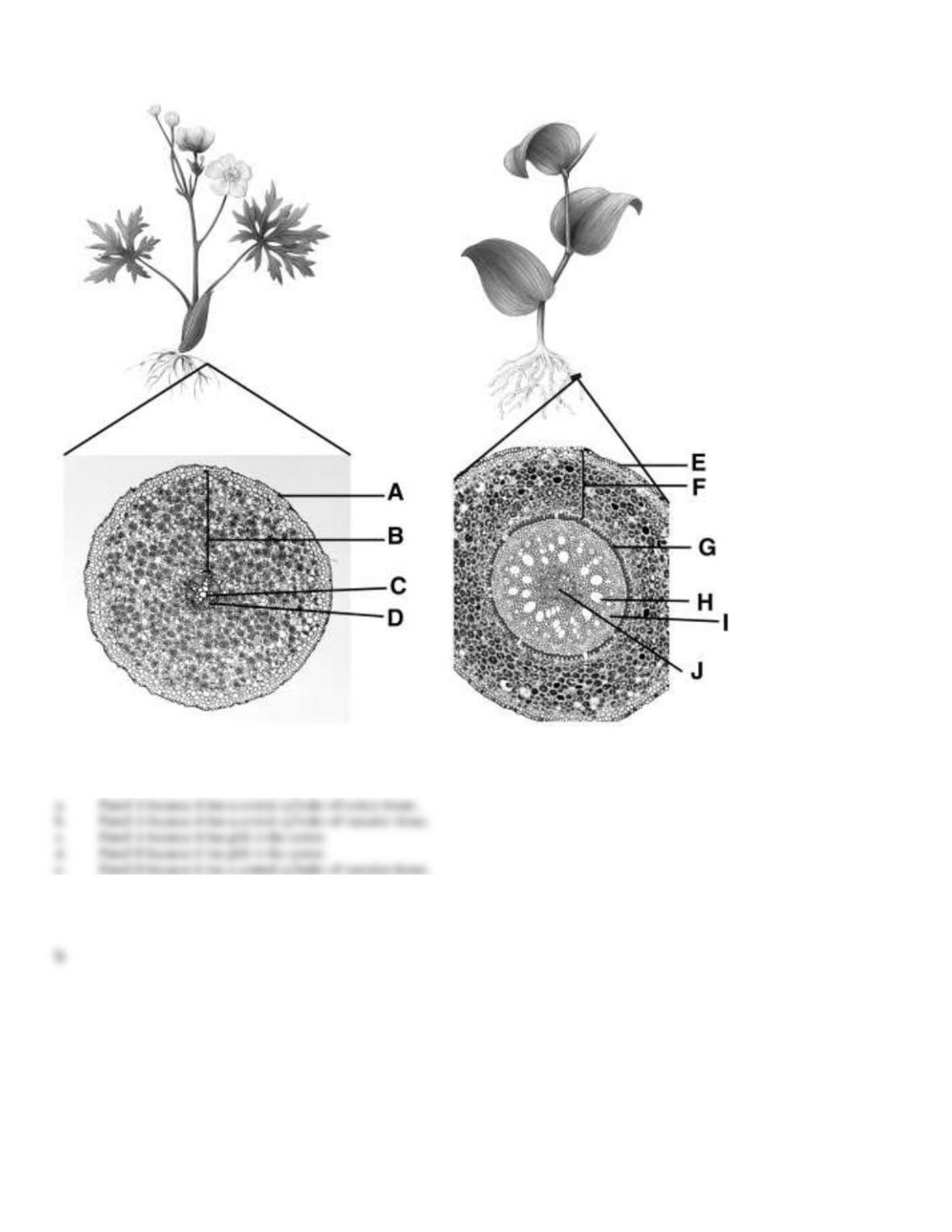
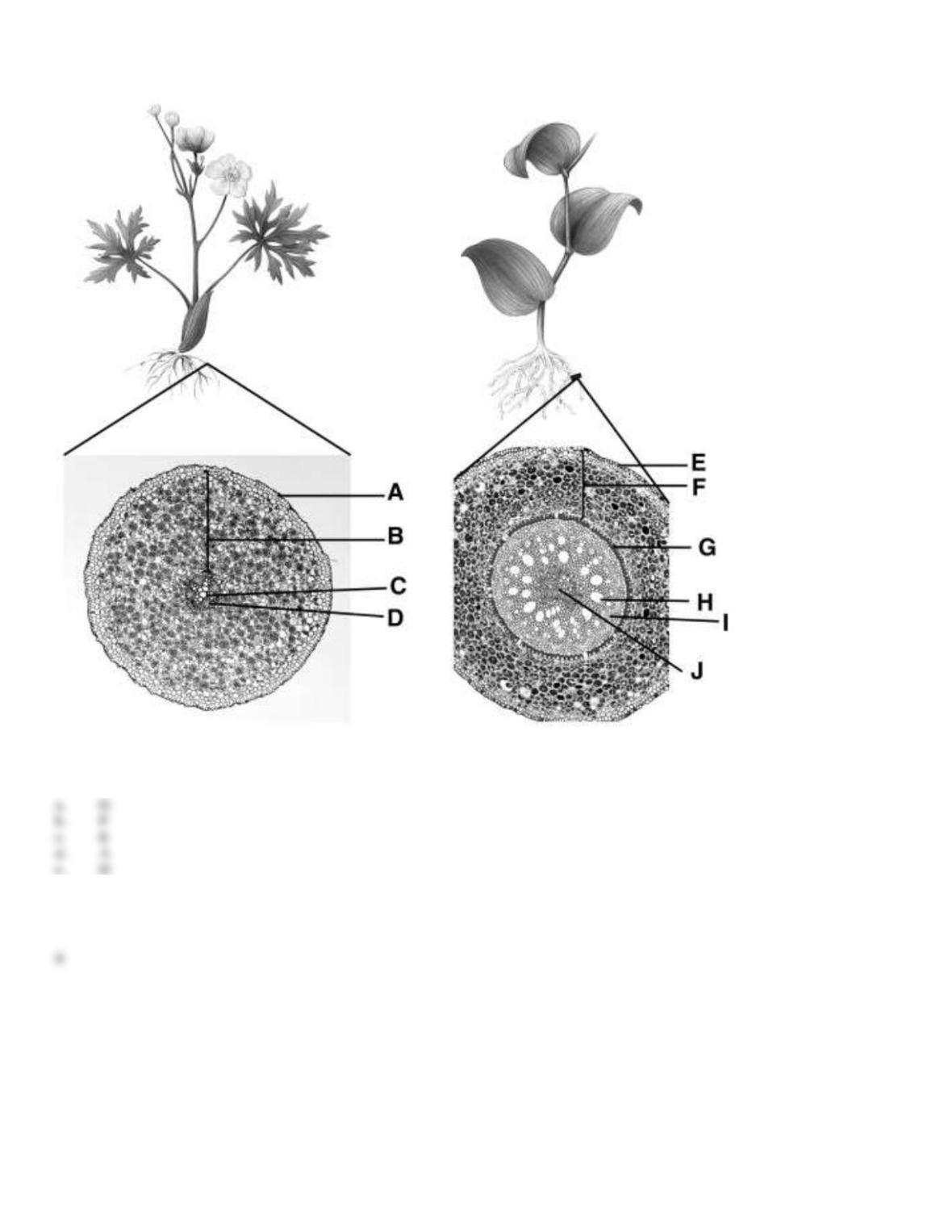
54. Figure 6-1
Refer to Figure 6-1. Which root is from a eudicot? How can you tell?
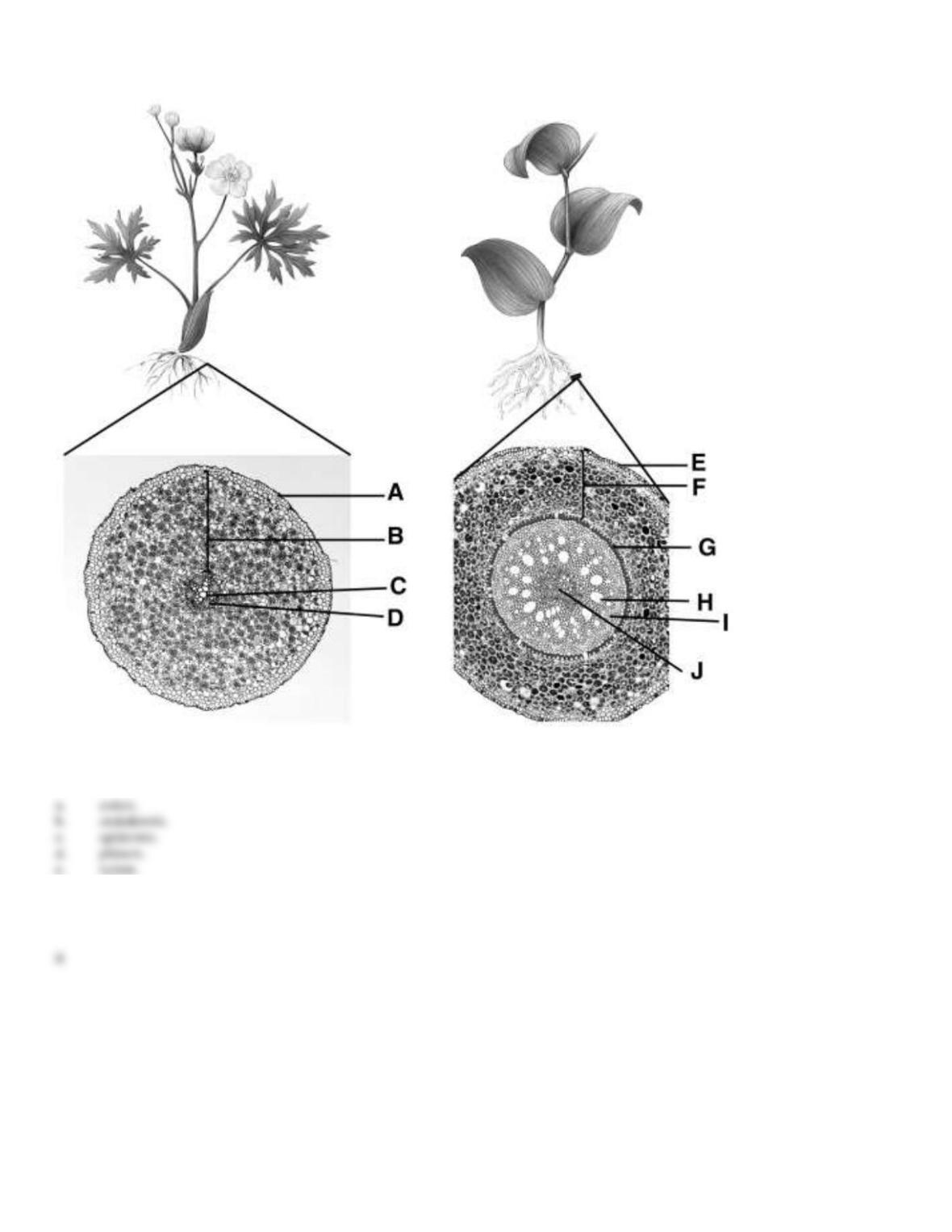
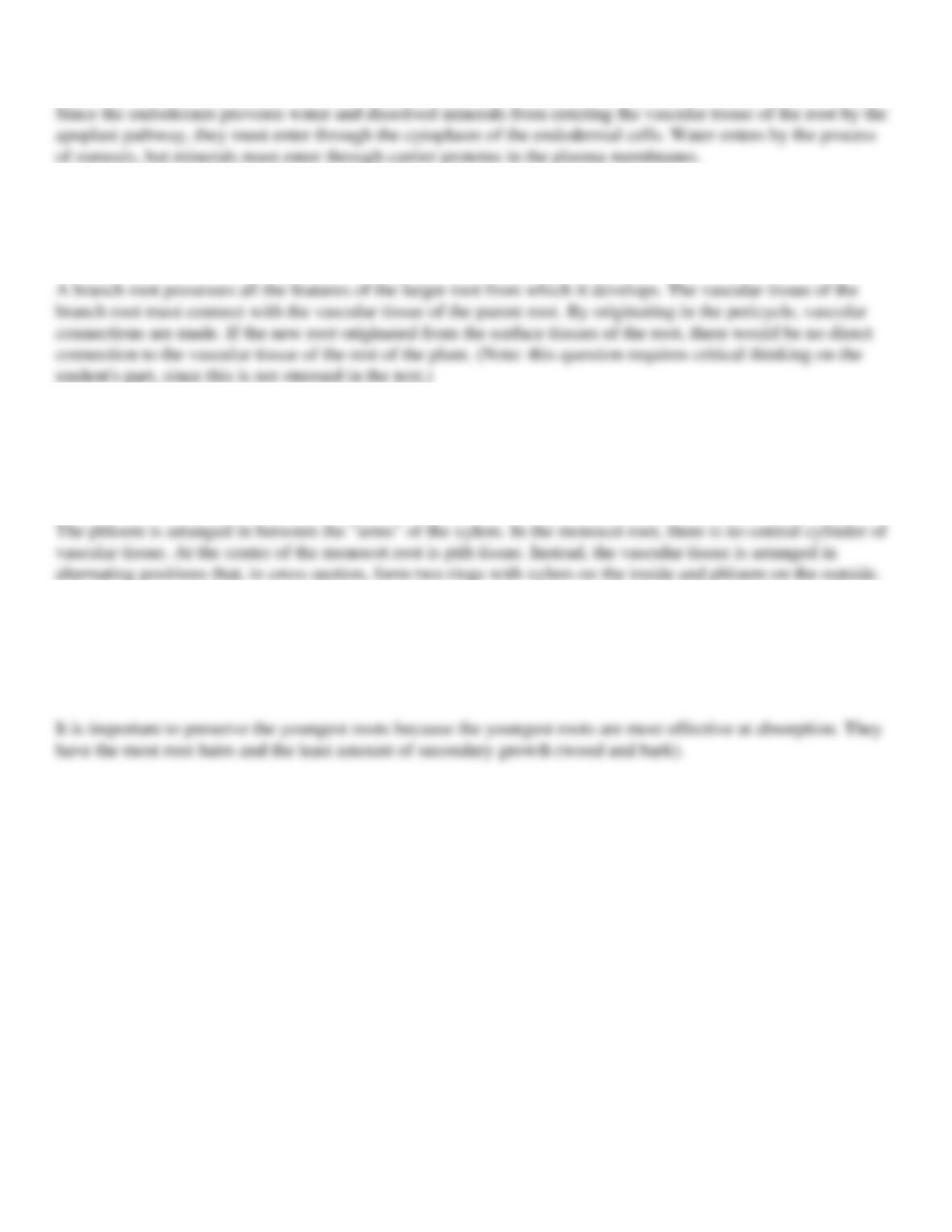
55. Figure 6-1
Refer to Figure 6-1. The tissue indicated by arrow 2 is
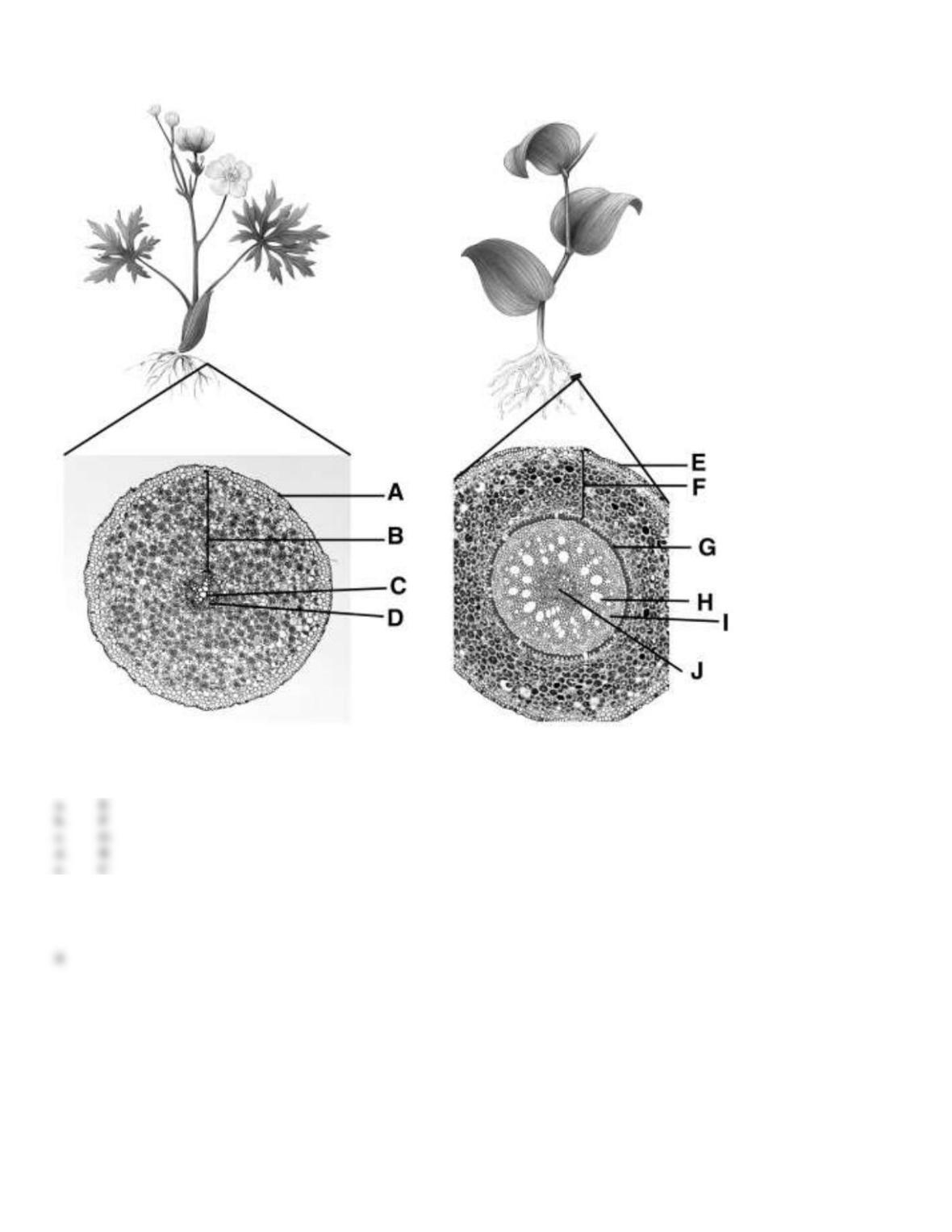
56. Figure 6-1
Refer to Exhibit 6-1. From which tissue do root hairs arise?
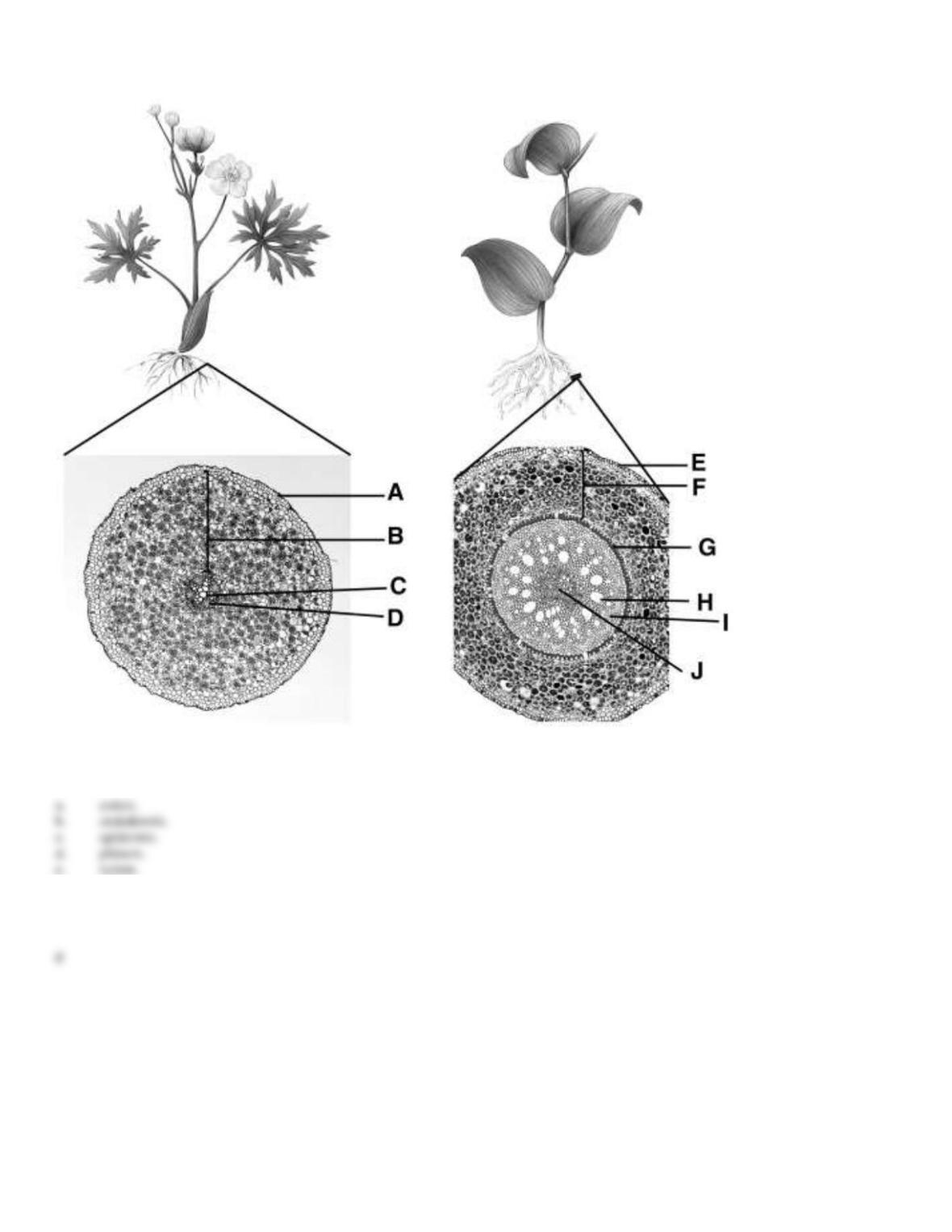
57. Figure 6-1
Refer to Figure 6-1. This tissue indicated by arrow 8 is
58. Figure 6-1
Refer to Exhibit 6-1. Which tissue has a Casparian strip?
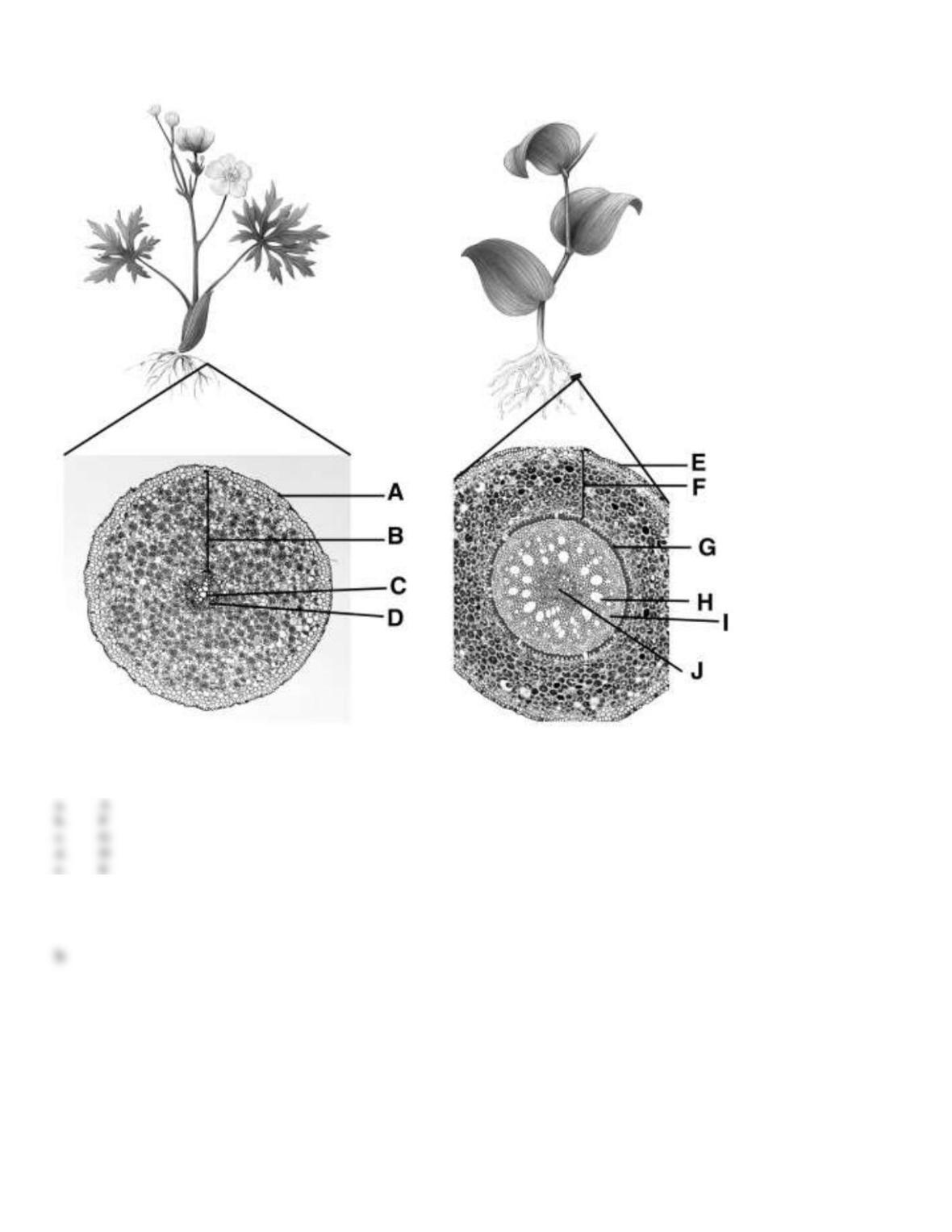
59. Figure 6-1
Refer to Exhibit 6-1. Which tissue is used to store starch?
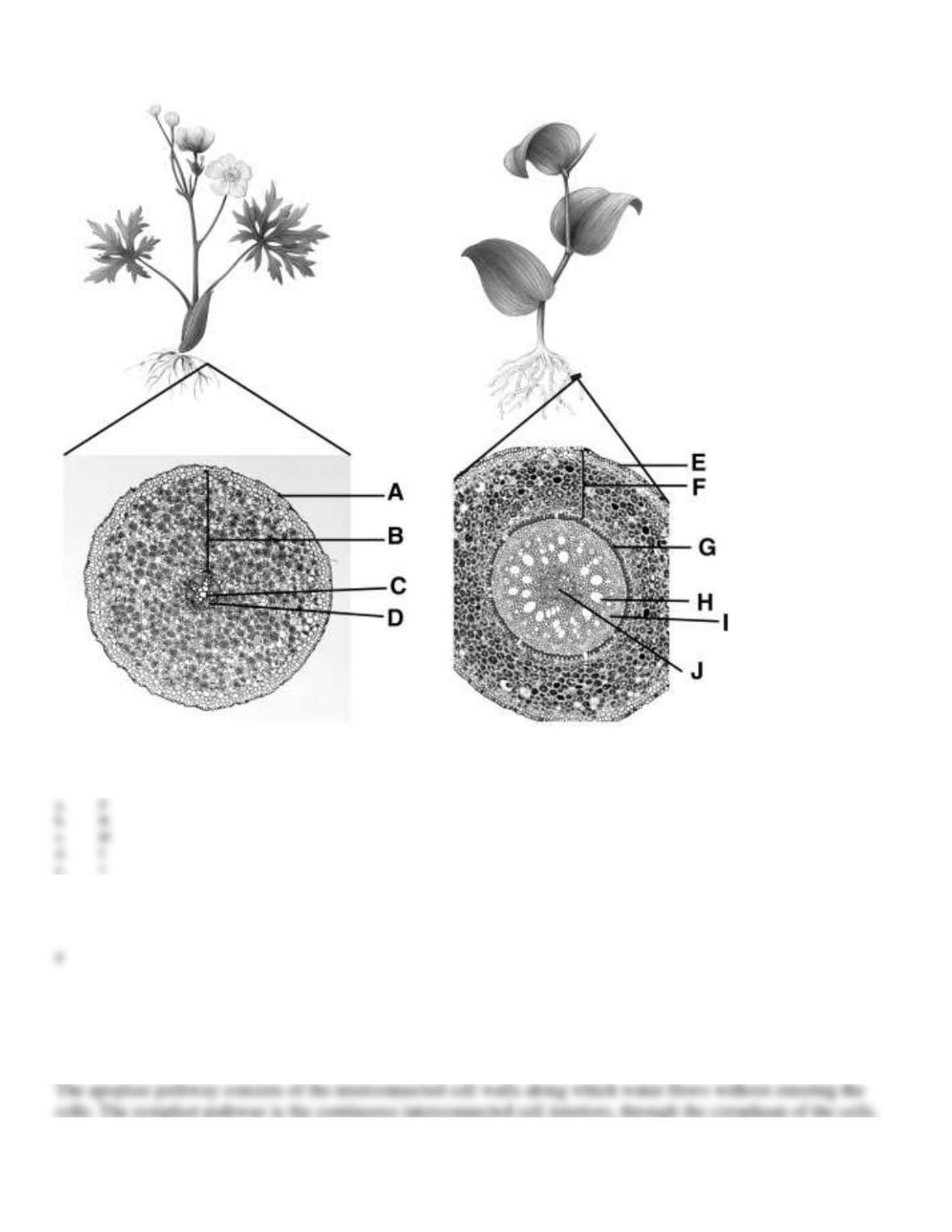
60. Figure 6-1
Refer to Exhibit 6-1. What tissue is the pith?
61. Distinguish between the apoplast and the symplast pathways.
62. How does the way water enters endodermal cells differ from the way minerals enter?
63. Why must branch roots originate internally instead of at the surface?
64. Contrast the arrangement of the vascular tissues in a eudicot root to that of a monocot root.
In the eudicot root, all of the xylem is clustered together at the center of the stele producing a star-type pattern.
65. Why is it very important to preserve as many of the young roots as possible when you are doing
transplanting?