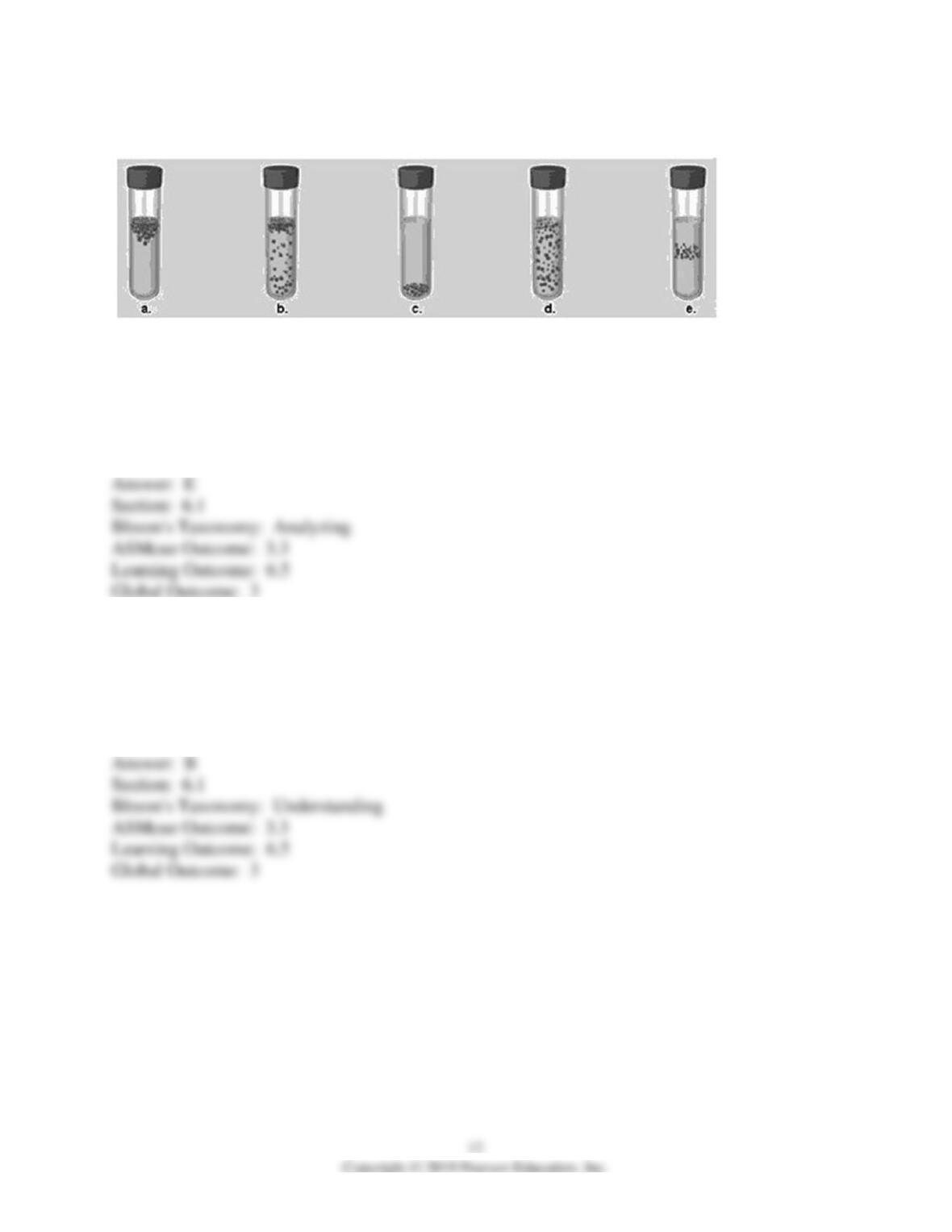
Figure 6.3
34) In Figure 6.3, which tube shows the expected growth pattern for a microaerophile?
A) a
B) b
C) c
D) d
E) e
35) In Figure 6.3, which tube shows the expected growth pattern for a facultative anaerobe?
A) a
B) b
C) c
D) d
E) e
36) In one hospital, Pseudomonas aeruginosa serotype 10 infected the biliary tract of 10 percent
of 1300 patients who underwent gastrointestinal endoscopic procedures. After each use,
endoscopes were washed with an automatic reprocessor that flushed detergent and
glutaraldehyde through the endoscopes, followed by a tap water rinse. P. aeruginosa serotype 10
was not isolated from the detergent, glutaraldehyde, or tap water. What was the source of the
infections?
A) bacterial cell walls in the water
B) a biofilm in the reprocessor
C) contaminated disinfectant
D) fecal contamination of the bile ducts
E) None of the answers is correct.
Table 6.1
Three different culture media are shown below.
Medium A Medium B Medium C
Na2HPO4 Yeast extract Glucose
KH2PO4 Beef extract Peptone
MgSO4 KH2PO4 (NH4)2SO4
CaCl2 MgSO4 KH2PO2
NaHCO3 (NH4)2SO4 Na2HPO4
37) For the three types of media in Table 6.1, which medium (or media) is/are chemically
defined?
A) A
B) B
C) C
D) A and B
E) A and C
38) In Table, 6.1, in which medium (or media) would an autotroph grow but a heterotroph could
not?
A) A
B) B
C) C
D) A and B
E) A and C
39) Assume you inoculated 100 cells, with a generation time of 20 minutes, into 100 ml of
nutrient broth. You then inoculated 100 cells of the same species into 200 ml of nutrient broth.
After incubation for 3 hours, you can reasonably expect to have
A) more cells in the 100 ml.
B) more cells in the 200 ml.
C) the same number of cells in both.
D) The answer cannot be determined based on the information provided.
40) The source of nutrients in nutrient agar is
A) agar.
B) gelatin.
C) peptone and beef extract.
D) peptone and NaCl.
E) agar and NaCl.
15
41) Which enzyme catalyzes the reaction: O2– + O2– + 2H+ → H2O2 + O2?
A) catalase
B) oxidase
C) peroxidase
D) superoxide dismutase
42) Which enzyme catalyzes the following reaction? 2H2O2 → 2H2O + O2
A) catalase
B) oxidase
C) peroxidase
D) superoxide dismutase
43) Which enzyme catalyzes the reaction: H2O2 + 2H+ → 2H2O?
A) catalase
B) oxidase
C) peroxidase
D) superoxide dismutase
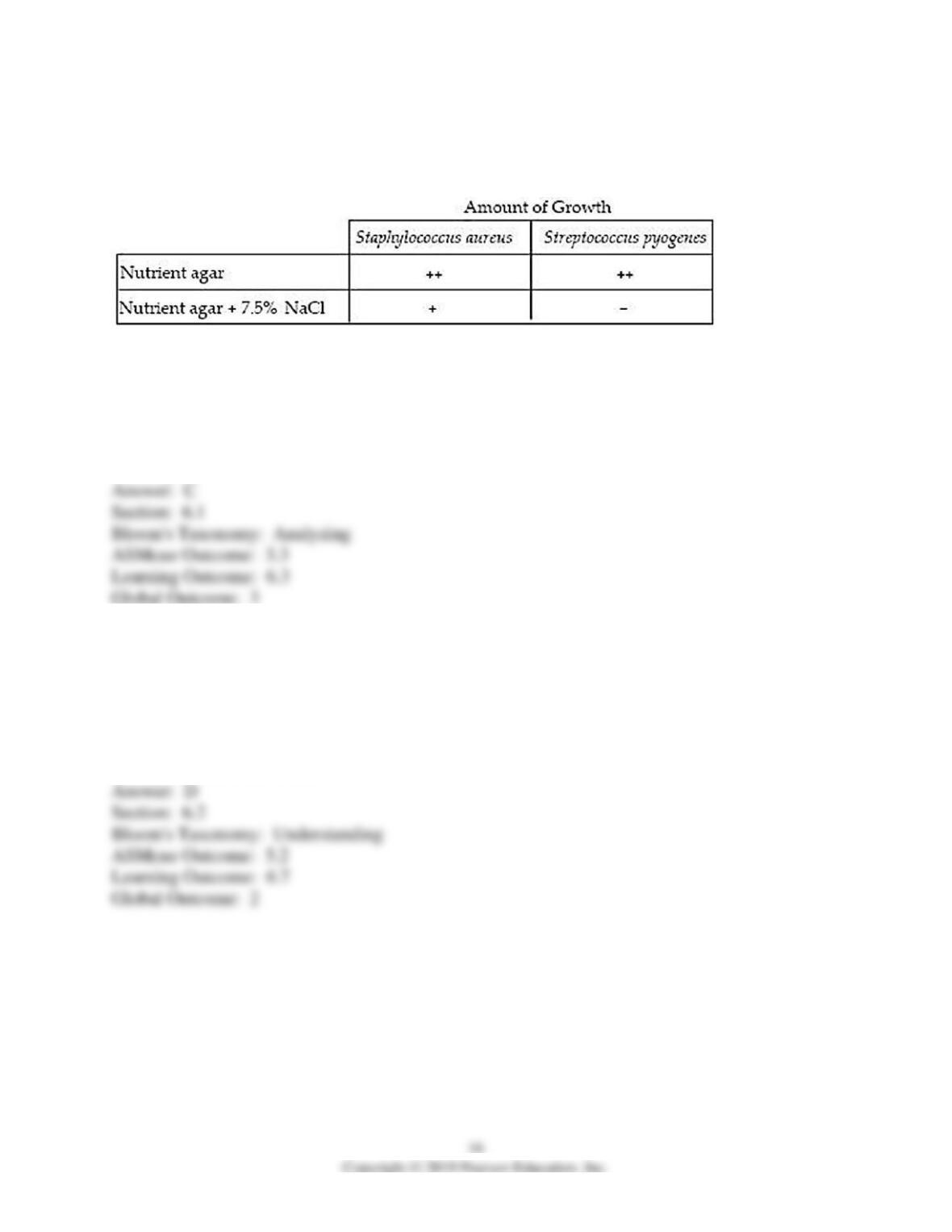
44) Table 6.2
The following data show growth of two bacteria on different media.
The data in Table 6.2 indicate that S. aureus is a(n)
A) mesophile.
B) facultative anaerobe.
C) facultative halophile.
D) aerobe.
E) halophile.
45) Patients with indwelling catheters (long-term tubes inserted into body orifices for drainage,
such as through the urethra and into the urinary bladder) are susceptible to infections because
A) injected solutions are contaminated.
B) their immune systems are weakened.
C) infections can be transmitted from other people.
D) biofilms develop on catheters.
E) bacteria cause infections.
46) A sample of well water is tested for its bacterial content in a plate count assay. A one-
milliliter sample of the water is diluted in a 1:10 dilution series. One milliliter of the fourth
dilution tube is plated in a pour plate. After incubation, the plate has 83 colonies, indicating that
the original water sample contained
A) 83 cells per milliliter.
B) 830 cells per milliliter.
C) 8,300 cells per milliliter.
D) 83,000 cells per milliliter.
E) 830,000 cells per milliliter.
47) A sample of ocean water is tested for its bacterial content in a plate count assay. A one-
milliliter sample of the water is diluted in a 1:10 dilution series. 0.1 milliliter of the second
dilution tube is plated in a pour plate. After incubation, the plate has 191 colonies, indicating that
the original water sample contained
A) 191 cells per milliliter.
B) 1,910 cells per milliliter.
C) 19,100 cells per milliliter.
D) 191,000 cells per milliliter.
E) 1,910,000 cells per milliliter.
48) A sample of raw, unpasteurized milk is tested for its bacterial content in a plate count assay.
A one-milliliter sample of the milk is diluted in a 1:10 dilution series. One milliliter of the third
dilution tube is plated in a pour plate. After incubation, the plate has approximately 500 colonies,
indicating that the original milk sample contained
A) 500 cells per milliliter.
B) 5,000 cells per milliliter.
C) 50,000 cells per milliliter.
D) 500,000 cells per milliliter.
E) The answer cannot be determined reliably with the information given.
49) The U.S. Food and Drug Administration convention when performing pour or spread plate
counts is to count only plates with ________ colonies.
A) 1 to 10
B) 50 to 100
C) 500 or more
D) 25 to 250
E) 30 to 300
50) The ________ method is used to indirectly measure microbial growth of filamentous bacteria
and molds.
A) metabolic activity
B) dry weight
C) pour plate
D) spread plate
E) turbidity measurement
6.2 True/False Questions
1) An isolated colony on a streak plate contains millions (or even billions) of identical cells all
arising from one initial cell.
2) Bacterial growth refers to an increase in the numbers of cells in a bacterial culture.
3) Pure cultures can easily be obtained on streak plates, even if the desired bacteria are present in
very low concentrations in the initial culture broth.
4) Gelatin is used as a solidifying agent in microbiological media since few bacteria can degrade
it.
5) When cultivating anaerobic organisms in the laboratory setting, a candle jar is sufficient for
the vast majority of organisms.
6) Most pathogenic bacteria are thermophiles.
7) In performing a ten-fold dilutions series from a sample containing 10,000 bacteria per
milliliter, the fourth tube in the dilution series will have 10 cells per milliliter.
8) In measuring turbidity of a culture in indirect measurement of bacterial growth, absorbance
and transmittance are identical and interchangeable values.
9) Filtration methods, followed by growth of the bacteria trapped on the filters in growth media,
are used to count bacteria present in very low concentrations, such as in lakes and streams.
10) Nitrogen-fixing bacteria, such as cyanobacteria, can use atmospheric nitrogen (N2) for their
nitrogen source.
6.3 Essay Questions
1) A patient with a heart pacemaker received antibiotic therapy for streptococcal bacteremia
(bacteria in the blood). One month later, he was treated for recurrence of the bacteremia. When
he returned six weeks later, again with bacteremia, the physician recommended replacing the
pacemaker. Why did this cure his condition?
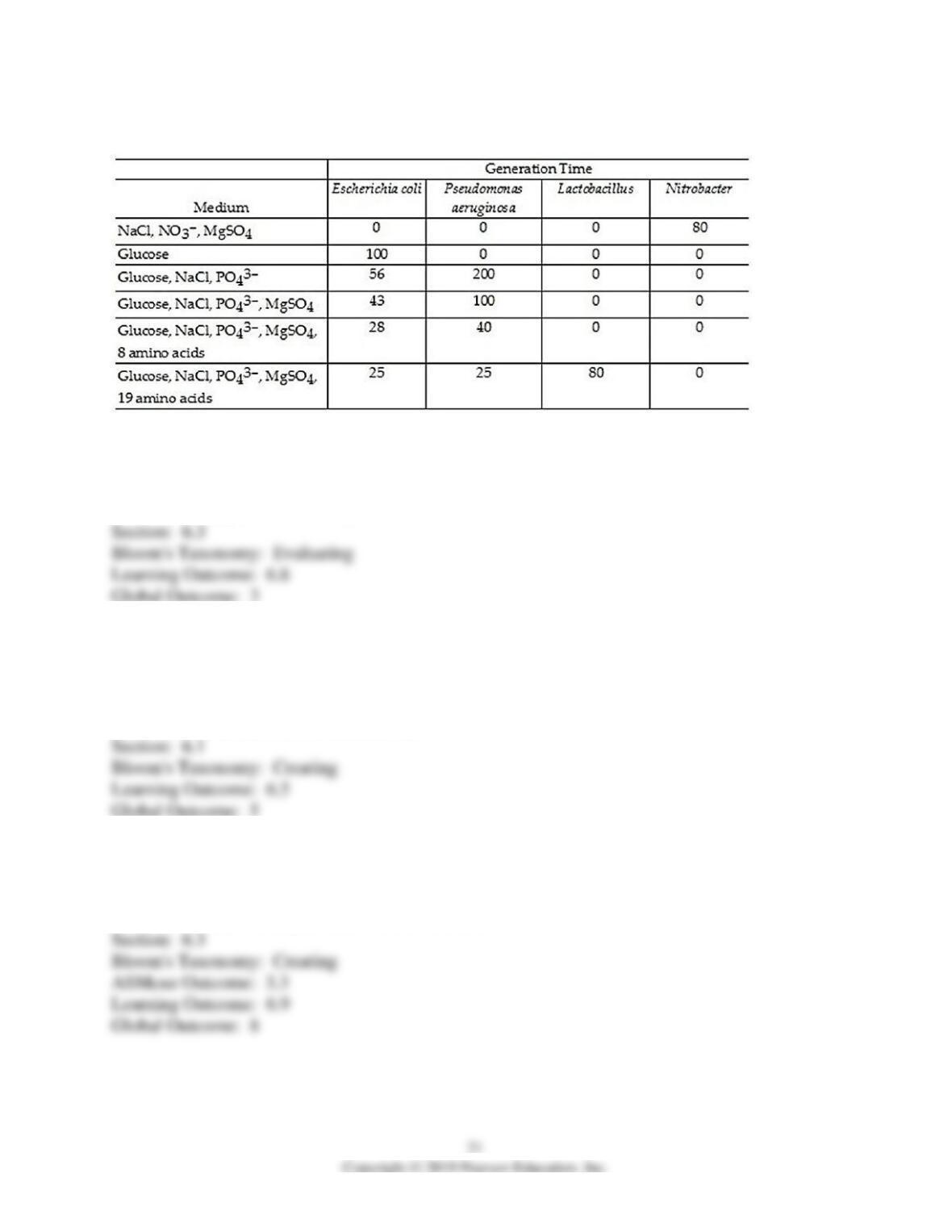
2) Table 6.3
Bacterial generation times for four different bacterial species were calculated in the media listed
in Table 6.3. All media were prepared with pure distilled water and incubated aerobically in the
light. Compare and contrast the growth requirements of the four bacteria listed above. Which of
the media, if any, are chemically defined?
3) An extreme-weather event has knocked out power in your community. Even with rebuilding
efforts, it appears that it could be 6 months or longer before power is restored. Since you have a
background in microbiology, the people you know are asking you for possible ways of
storing/preserving their food safely without electricity. What advice can you give them, and why
would you make those recommendations?
4) You are tasked with attempting to culture microbes in the lab that were initially obtained from
samples taken in and near the Arctic circle, in areas of extreme cold and either very long or very
short days, depending on the time of year. How would you begin to try to grow these microbes in
the lab, and why would you choose those methods?
5) As part of an experiment where absorbance values are measured using a spectrophotometer,
you are taking readings of your sample every 20 minutes. The non-motile microbe you’re testing
has a generation time of roughly 20 minutes at an incubation temperature right around room
temperature. Things start out fine, with the expected results — as time goes by at the correct
incubation temperature, absorbance starts to rise as the medium starts to become more cloudy
with growing microorganisms. But roughly 2 hours into the process, you notice that the
absorbance levels flatten out, and then start to decrease unexpectedly. What is most likely taking
place in your experiment?