CHAPTER 6
How Cells Read the Genome: From DNA to Protein
Questions
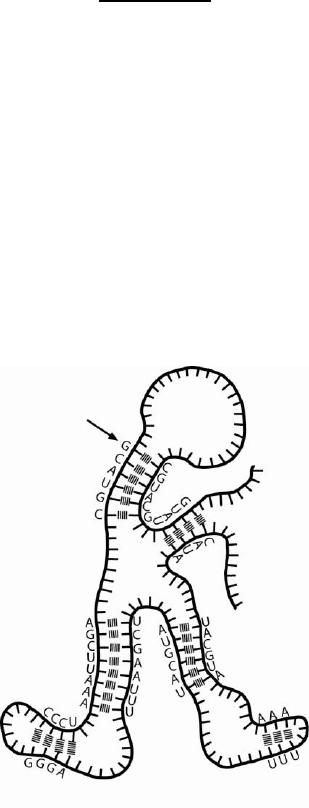
6-1 Consider an RNA molecule that forms part of an RNP. On the basis of an
alignment of the nucleotide sequence of this RNA from several species and a
computer algorithm that predicts secondary structure in RNA molecules, you
hypothesize that the RNA folds and forms conventional base-pair interactions as
shown in Figure Q6-1. To test this structural hypothesis, you make many mutated
forms of the RNA that contain one or two base changes. You test to see whether
each mutant RNA is functional or defective. For example, your results lead you to
conclude that the G indicated by the arrow pairs with the C as shown. Describe a
set of three mutants and explain the phenotypes that would support your
conclusion.
Figure Q6-1
6-2 Cells have several mechanisms to prevent the production and accumulation of
truncated protein fragments. To illustrate why these fragments can be deleterious,
consider a transcriptional activator protein called Groovy that binds to an
enhancer element upstream of the Zippy gene. Groovy has a DNA-binding
domain at its N-terminus and a domain that binds a histone-modifying enzyme at
its C-terminus.
A. If a cell makes substantial amounts of an N-terminal fragment of Groovy,
containing the DNA-binding domain, what is likely to happen to
transcription of the Zippy gene?
B. If, in addition to the N-terminal fragment of Groovy, a cell also makes an
equal amount of the full-length protein, what is likely to happen to
transcription of the Zippy gene?
C. Consider two cell lines or strains that each have a fully functional allele of
the Groovy gene on one copy of chromosome 3. On the second copy of
chromosome 3, strain 1 lacks a second Groovy allele whereas strain 2
contains the Groovy allele that codes for the N-terminal fragment
described in part A. If strain 1 and strain 2 have different amounts of
Zippy mRNA, which do you expect to have more Zippy mRNA? Explain.
D. Strain 3 encodes the same N-terminal Groovy fragment as strain 2, except
that the gene in strain 2 contains a deletion of some Groovy coding
sequence and strain 3 has a single base-pair change that converts a lysine
codon (AAA) to a stop codon (UAA). You find that strain 3 produces the
same amount of Zippy mRNA as strain 1. Can you explain why?
6-3 More than 90% of mammalian genes encode proteins and fewer than 10%
produce RNA as their final product.
A. Your friend says this means that most RNA in cells is mRNA, not rRNA.
Do you agree? Explain.
B. You want to separate the mRNA from other RNA molecules, taking
advantage of the ability of RNA to hybridize to a complementary DNA
strand. Describe a strategy to purify mRNA from other RNAs.
6-4 Consider a pre-mRNA that is 12,700 nucleotides long and contains seven 100-
base exons separated by 2000-base introns. It seems like an overwhelming task
for the splicing machinery to find the exons buried in the intron sequences and to
splice them properly, without skipping any exons. Explain how this is
accomplished.
6-5 Alignment of the nucleotide sequences of orthologous genes from different
organisms can suggest which amino acids are important for the function of a
protein. Consider the alignment of cDNA sequences shown in Figure Q6-5A,
taken from the middle of a gene that has been highly conserved during evolution.
Can you deduce the reading frame of this segment of cDNA? (You can consult
the genetic code provided in Figure Q6-5B.
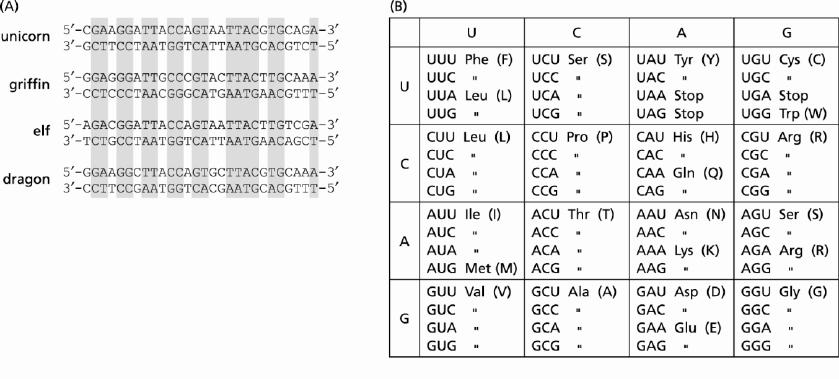
Figure Q6-5
6-6 You measure the stability of your favorite protein kinase and find that half of the
protein is degraded every 10 minutes. You suspect that your protein is subjected
to ubiquitin-mediated proteolysis, so you partly purify the protein, run a gel,
transfer to a membrane, and probe with an antibody against ubiquitin. You do not
detect any ubiquitin attached to your protein, even though control experiments
demonstrate that your protein is present on the membrane and the anti-ubiquitin
antibody successfully detects another ubiquitylated protein.
A. Does this mean that your protein is not ubiquitylated? Explain.
B. Your advisor suggests that you perform additional experiments to block
ubiquitin-mediated degradation and then see whether your protein is
ubiquitylated under these conditions. Describe one way to accomplish this
task.
6-7 For quality control in protein translation, there are two time delays in the correct
positioning of incoming charged tRNAs on the ribosome. The first is a delay in
the hydrolysis of GTP by EF-Tu after it brings a charged tRNA to the ribosome.
The second is a delay before the amino acid carried by the tRNA moves into
position at the active site of the ribosome. Both of these delays are longer for an
incorrect tRNA than for a correct one. But what if one of these delays were the
same length of time for correct and incorrect tRNAs? Consider whether a fixed
delay can still increase accuracy.
A. Assume that the affinity of binding between the mRNA–ribosome
complex and the tRNAs in question are described by Kd values of 0.3 M
and 3 M. Which Kd is for the correct tRNA?
B. Recall that Kd = koff/kon. In general, kon values do not change as much as
koff values. Assume that kon is 1 M–1 sec–1 for both correct and incorrect
tRNA binding to the mRNA–ribosome complex. Calculate the koff for the
correct and incorrect tRNAs. What do you expect will happen during a
delay of 1 second?
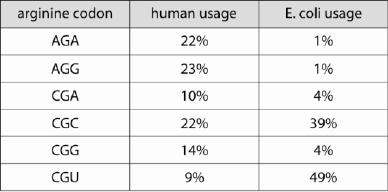
6-8 You want to purify large amounts of a human tumor suppressor protein called
Tusup for biochemical studies. The easiest and cheapest way to achieve this is to
place the Tusup gene in an expression plasmid in the bacteria E. coli.
A. Unfortunately, you find that the bacteria produce only a small amount of
Tusup. Even worse, they produce far more N-terminal fragments than full-
length Tusup proteins. Your advisor notes that your protein has many
arginine codons and this may cause a problem. You peruse the literature
on codon usage in bacterial and human genes and discover that human
genes have a bias for the various arginine codons that differs from that of
E. coli genes, as shown in Table Q6-8. Why might this different codon
usage limit the production of full-length Tusup protein? How might you
remedy the problem?
B. The remedy you proposed in A worked wonderfully, so the bacteria
express large amounts of full-length Tusup protein. However, you find
that the protein is insoluble because it is misfolded and aggregated inside
the bacterial cells. What proteins could you overexpress in E. coli to help
the overexpressed Tusup proteins fold and to prevent their aggregation?
Table Q6-8
Answers