Microbiology: An Introduction, 13e (Tortora et al.)
Chapter 6 Microbial Growth
6.1 Multiple-Choice Questions
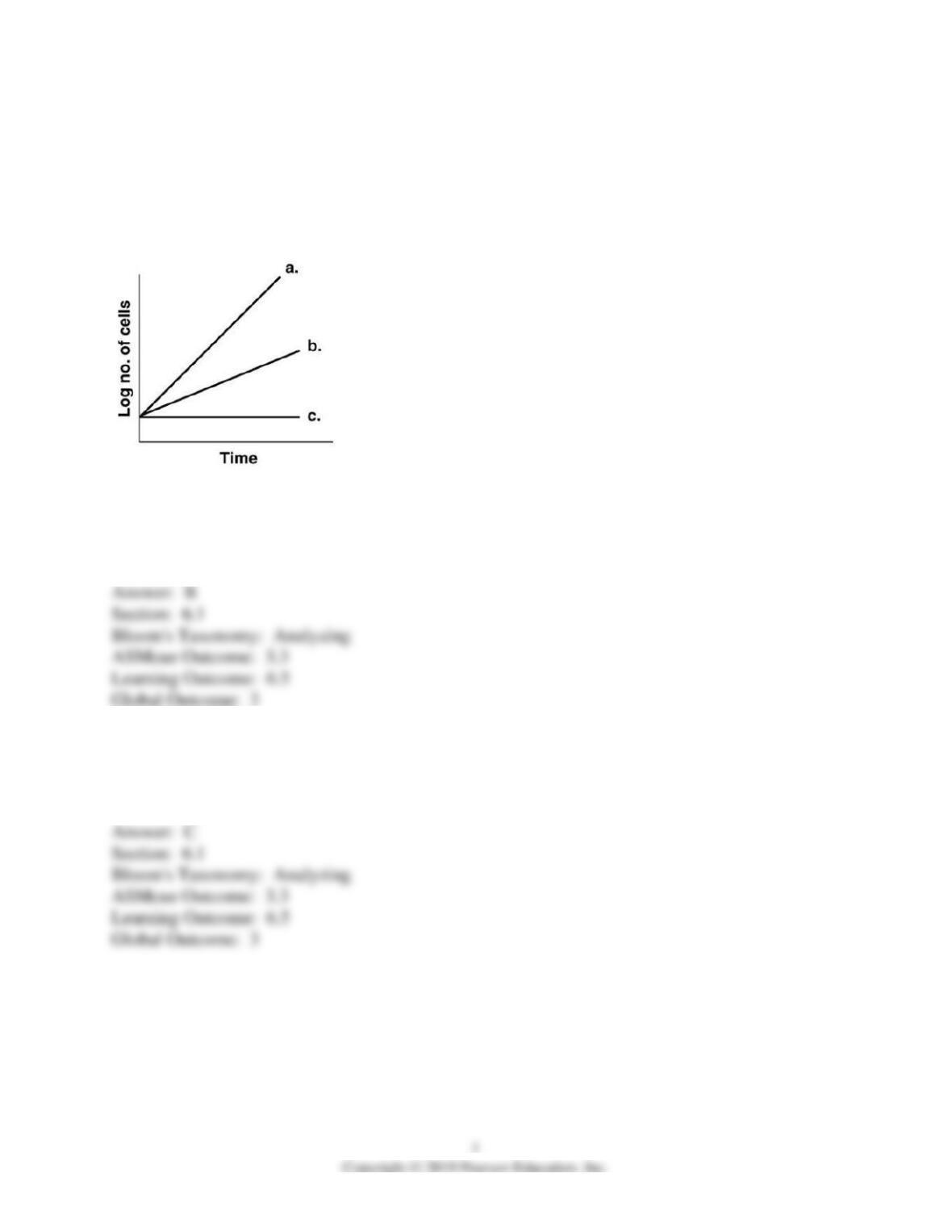
Figure 6.1
1) Figure 6.1, which line best depicts a facultative anaerobe in the absence of O2?
A) a
B) b
C) c
2) In Figure 6.1, which line best depicts an obligate anaerobe in the presence of O2?
A) a
B) b
C) c
3) In Figure 6.1, which line shows the growth of an obligate aerobe incubated anaerobically?
A) a
B) b
C) c
4) In Figure 6.1, which line best illustrates the growth of a facultative anaerobe incubated
aerobically?
A) a
B) b
C) c
5) In Figure 6.1, which line best depicts a psychrotroph incubated at 0°C?
A) a
B) b
C) c
6) If cells are grown in media containing amino acids labeled with radioactive nitrogen (15N),
most of the radioactivity will be found in the cells’
A) DNA.
B) proteins.
C) phospholipids.
D) DNA and proteins.
E) DNA and phospholipids.
7) Which of the following elements is NOT correctly matched with its cellular function?
A) nitrogen – needed for amino acid synthesis
B) phosphorus – incorporated into nucleic acids
C) sulfur – used for synthesis of thiamin and biotin
D) magnesium and potassium – required as cofactors for enzymes
E) phosphorus – used for production of carbohydrates.
8) Pathogenic bacteria isolated from the respiratory or intestinal tracts of humans are
A) strict aerobes that grow best in candle jars.
B) capnophiles that grow best in carbon dioxide incubators.
C) facultative anaerobes that require reducing media for growth.
D) strict aerobes that grow best in reducing media.
E) capnophiles that prefer highly oxygenated growth conditions.
9) The biosafety level (BSL) for most introductory microbiology laboratories is
A) BSL-1.
B) BSL-2.
C) BSL-3.
D) BSL-4.
10) The biosafety level (BSL) for a clinical microbiology laboratory working with potentially
airborne pathogens, such as tuberculosis bacteria, is
A) BSL-1.
B) BSL-2.
C) BSL-3.
D) BSL-4.
11) A sample of milk is tested for its bacterial content in a plate count assay. A one-milliliter
sample of the milk is diluted in a 1:10 dilution series. One milliliter of the third dilution tube is
plated in a pour plate. After incubation, the plate has 54 colonies, indicating that the original
milk sample contained
A) 54 cells per milliliter.
B) 540 cells per milliliter.
C) 5,400 cells per milliliter.
D) 54,000 cells per milliliter.
E) 540,000 cells per milliliter.
12) The addition of which of the following to a culture medium will neutralize acids?
A) buffers
B) sugars
C) pH
D) heat
E) carbon
13) Salts and sugars work to preserve foods by creating a
A) depletion of nutrients.
B) hypotonic environment.
C) lower osmotic pressure.
D) hypertonic environment.
E) lower pH.
14) The term aerotolerant anaerobe refers to an organism that
A) does not use oxygen but tolerates it.
B) is killed by oxygen.
C) tolerates normal atmospheric nitrogen gas levels.
D) requires less oxygen than is present in air.
E) requires more oxygen than is present in air.
15) Which of the following is an advantage of the standard plate count?
A) can readily count cells that form aggregates
B) determines the number of viable cells
C) can be performed on very dilute samples, such as lake water
D) provides immediate results
E) can be used to count heat-sensitive bacteria
16) Which of the following is an advantage of the direct microscopic count?
A) can readily count organisms that are motile
B) can easily distinguish live from dead cells
C) requires no incubation time
D) sample volume is unknown
E) requires a large number of cells
17) Most bacteria reproduce by
A) aerial hyphae.
B) fragmentation.
C) mitosis.
D) binary fission.
E) budding.
18) Thirty-six colonies grew in nutrient agar from 1.0 ml of undiluted sample in a standard plate
count. How many viable and culturable cells were in the original sample?
A) 4 per milliliter
B) 9 per milliliter
C) 18 per milliliter
D) 36 per milliliter
E) 72 per milliliter
Figure 6.2
19) Figure 6.2 shows a typical bacterial growth curve with the y-axis indicating the log of the
number of bacteria and the x-axis indicating time in culture. In the figure, which section (or
sections) shows a growth phase where the number of cells dying equals the number of cells
dividing?
A) a
B) b
C) c
D) d
E) a and c
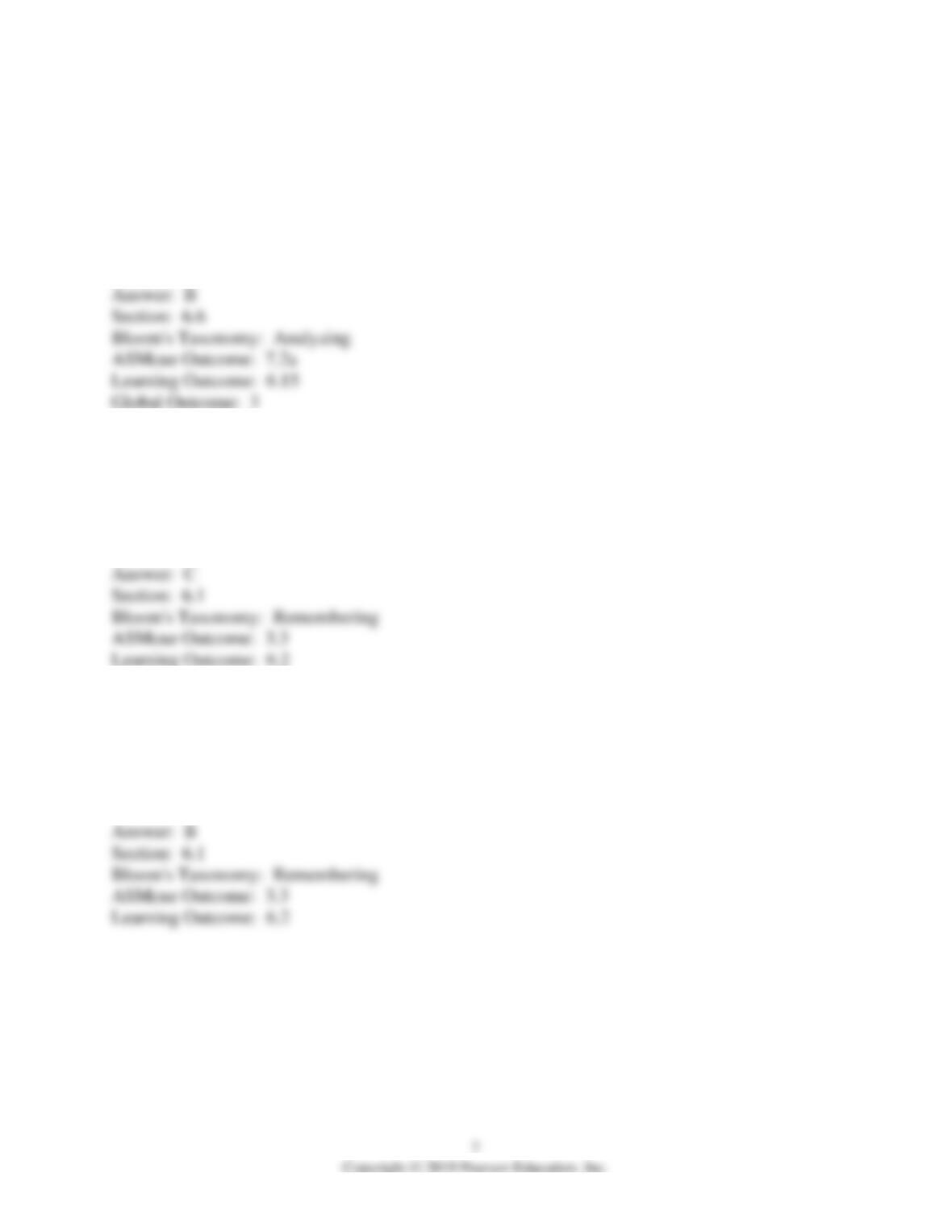
20) Figure 6.2 shows a typical bacterial growth curve with the y-axis indicating the log of the
number of bacteria and the x-axis indicating time in culture. In the figure, which sections of the
graph illustrate a logarithmic change in cell numbers?
A) a and c
B) b and d
C) a and b
D) c and d
E) a and d
21) Most bacteria grow best at pH
A) 1.
B) 5.
C) 7.
D) 9.
E) 14.
22) Most fungi grow best at pH
A) 1.
B) 5.
C) 7.
D) 9.
E) 14.
23) Consider a culture medium on which only gram-positive organisms such as Staphylococcus
aureus colonies can grow due to an elevated NaCl level. A yellow halo surrounds the growth,
indicating the bacterium fermented a sugar in the medium, decreasing the pH as a result and
changing the color of a pH indicator chemical. This type of medium would be referred to as a(n)
A) selective medium.
B) differential medium.
C) enrichment culture.
D) selective and differential medium.
E) differential and enrichment culture.
24) A culture medium consisting of agar, peptone, and beef heart is a
A) chemically defined medium.
B) complex medium.
C) selective medium.
D) differential medium.
E) reducing medium.
25) Which of the following pairs of microbe classification terms and optimal growth
temperatures is mismatched?
A) psychrotroph – growth at 20-30°C
B) thermophile – growth at 37°C
C) mesophile – growth at 25-40°C
D) psychrophile – growth at 15°C
E) hyperthermophiles – growth at greater than 80°C
26) During which growth phase will gram-positive bacteria be most susceptible to penicillin?
A) lag phase
B) log phase
C) death phase
D) stationary phase
E) The culture is equally susceptible during all phases.
27) Which of the following is the best definition of generation time?
A) the length of time needed for lag phase
B) the length of time needed for a cell to divide
C) the minimum rate of doubling
D) the duration of log phase
E) the time needed for nuclear division
28) Which of the following is NOT a direct method to measure microbial growth?
A) direct microscopic count
B) standard plate count
C) filtration on a support membrane followed by incubation on medium
D) metabolic activity
E) most probable number (MPN)
29) Which group of microorganisms is most likely to spoil a freshwater trout preserved with
salt?
A) psychrophiles
B) facultative halophiles
C) anaerobes
D) thermophiles
E) hyperthermophiles
30) Which of the following is an organic growth factor?
A) glucose
B) vitamin B1
C) peptone
D) Mg+2
E) H2O
31) Which of the following is an example of a metabolic activity that could be used to measure
microbial growth?
A) standard plate count
B) glucose consumption
C) direct microscopic count
D) turbidity
E) most probable number (MPN)
32) An experiment began with 4 cells in log phase and ended with 128 cells. How many
generations did the cells go through?
A) 64
B) 32
C) 6
D) 5
E) 4
33) Three cells with generation times of 60 minutes are inoculated into a culture medium.
Assuming no lag phase takes place, how many cells are there after 5 hours?
A) 900
B) 180
C) 96
D) 32
E) 15