48) A noncompetitive inhibitor decreases the rate of an enzymatic reaction by
A) binding to the active site of the enzyme.
B) changing the ∆G for the reaction.
C) changing the shape of the enzyme active site.
D) decreasing the activation energy required for the reaction.
49) In experimental tests of enzyme evolution, a gene encoding an enzyme was subjected to
multiple cycles of random mutagenesis and selection for altered substrate specificity. The
resulting enzyme had altered substrate specificity and multiple amino acid changes. Where in the
enzyme would you expect these amino acid changes to be located?
A) only in or near the active site
B) only in the hydrophobic interior of the folded protein
C) only at surface sites distant from the active site
D) in or near the active site and at surface sites distant from the active site
50) Alteration of an amino acid at a site distant from the active site of an enzyme may alter the
substrate specificity of the enzyme by
A) changing the optimum pH for the enzyme.
B) changing the intracellular location of the enzyme.
C) changing the binding site for an allosteric regulator.
D) changing the conformation of the enzyme.
51) The mechanism by which the end product of a metabolic pathway inhibits an earlier step in
the pathway is most precisely described as
A) metabolic inhibition.
B) noncooperative inhibition.
C) irreversible inhibition.
D) feedback inhibition.
52) Cooperativity is a form of allosteric activation in which
A) the product of a metabolic pathway serves as a competitive inhibitor of an early enzyme in
the pathway.
B) all of the enzymes in a metabolic pathway are contained within a single multienzyme
complex.
C) completion of one step in a metabolic pathway is required before a subsequent step can occur.
D) binding of a substrate molecule to one active site in a multisubunit enzyme stimulates the
binding of substrate molecules to the active sites of other subunits.
53) Which of the following is an example of cooperativity?
A) binding of an ATP molecule along with another substrate in an active site
B) binding of a molecule to one subunit of a tetramer, which promotes faster binding to each of
the other three subunits
C) the product of one enzyme in a metabolic pathway serving as the substrate for the next
enzyme in the pathway
D) binding of the end product of a metabolic pathway to the enzyme that catalyzes the first step
in the pathway
54) In addition to regulating enzymes with activators and inhibitors, cells also regulate enzyme
activity by
A) restricting enzymes to specific organelles or membranes.
B) limiting the availability of substrates.
C) covalently bonding enzymes into large aggregates.
D) secreting enzymes out of the cell.
6.2 Art Questions
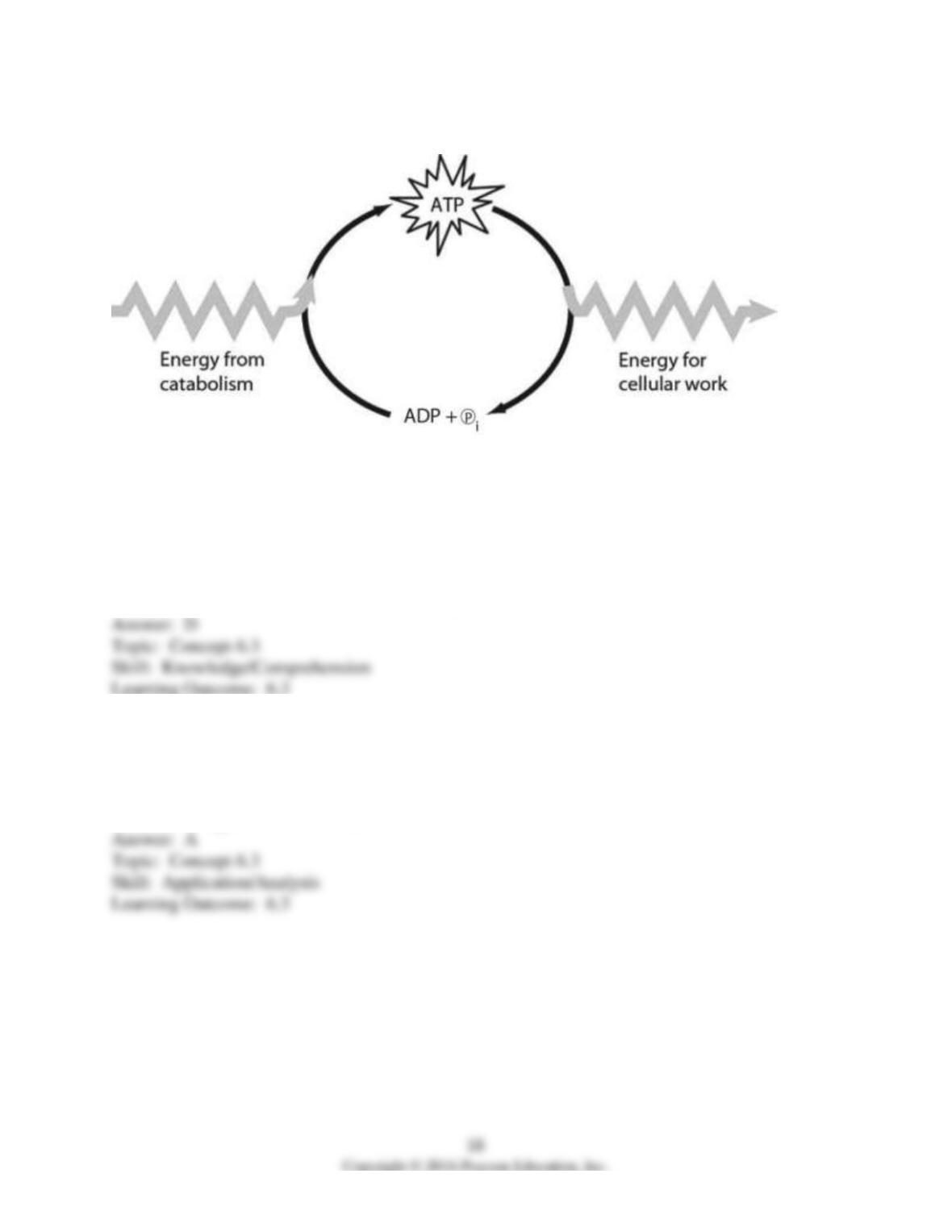
Figure 6.1
1) Which of the following is the most correct interpretation of Figure 6.1?
A) Inorganic phosphate is created from organic phosphate.
B) Energy from catabolism can be used directly for performing cellular work.
C) ADP + ℗i are a set of molecules that store energy for catabolism.
D) ATP is a molecule that acts as an intermediary to store energy for cellular work.
E) ℗i acts as a shuttle molecule to move energy from ATP to ADP.
2) Cells use the ATP cycle shown in Figure 6.1 to
A) recycle ADP and phosphate.
B) recycle energy released by ATP hydrolysis.
C) recycle the energy used for cellular work.
D) move energy from ATP to ADP.
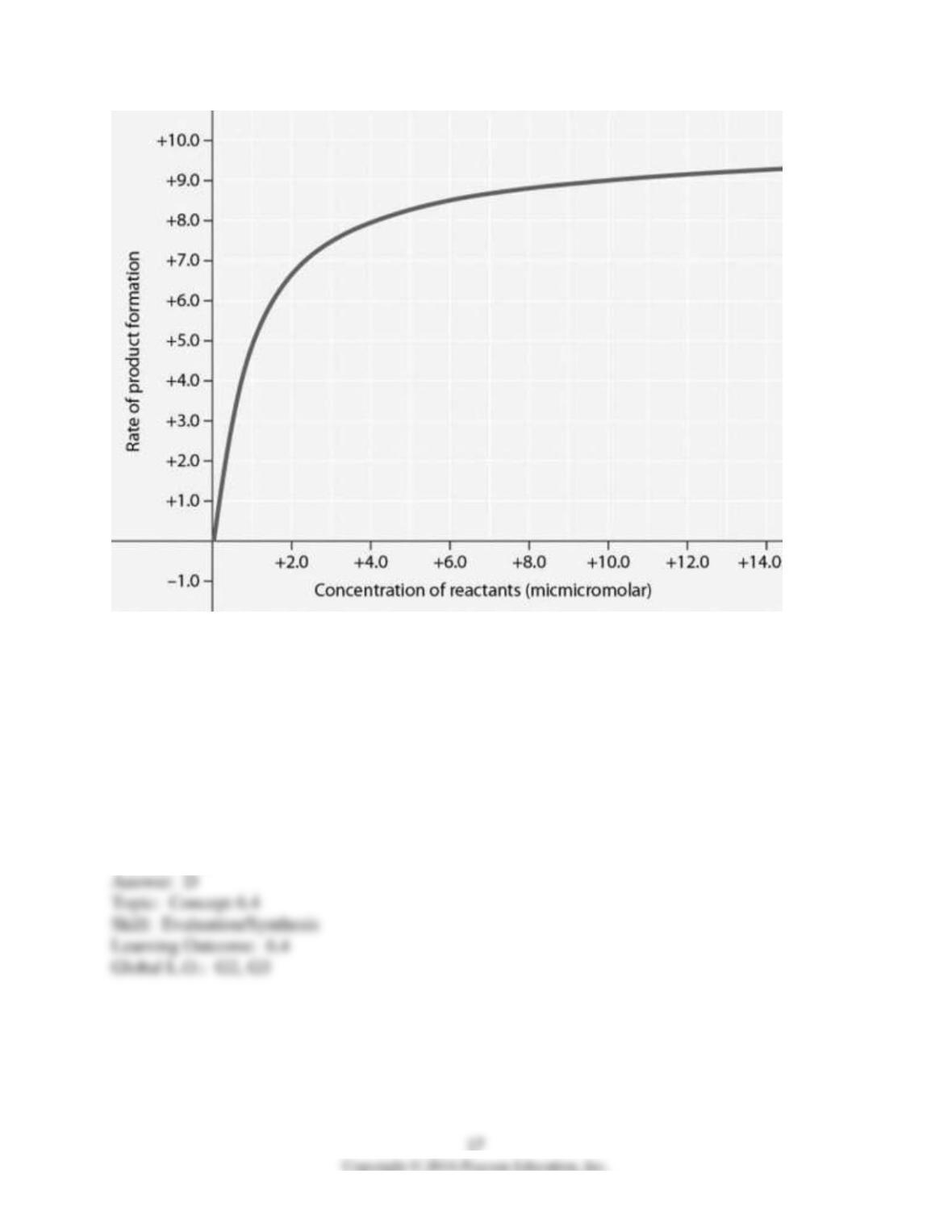
Figure 6.2 Rate of an enzyme-catalyzed reaction as a function of varying reactant
concentration, with the concentration of enzyme held constant.
3) For the enzyme-catalyzed reaction shown in Figure 6.2, which of these treatments will cause
the greatest increase in the rate of the reaction if the initial reactant concentration is 1.0
micromolar?
A) doubling the activation energy needed
B) cooling the reaction by 10°C
C) doubling the concentration of the reactants to 2.0 micromolar
D) doubling the enzyme concentration
E) increasing the concentration of reactants to 10.0 micromolar, while reducing the concentration
of enzyme by half
4) In Figure 6.2, why does the reaction rate plateau at higher reactant concentrations?
A) Feedback inhibition by product occurs at high reactant concentrations.
B) Most enzyme molecules are occupied by substrate at high reactant concentrations.
C) The reaction nears equilibrium at high reactant concentrations.
D) The activation energy for the reaction increases with reactant concentration.
E) The rate of the reverse reaction increases with reactant concentration.
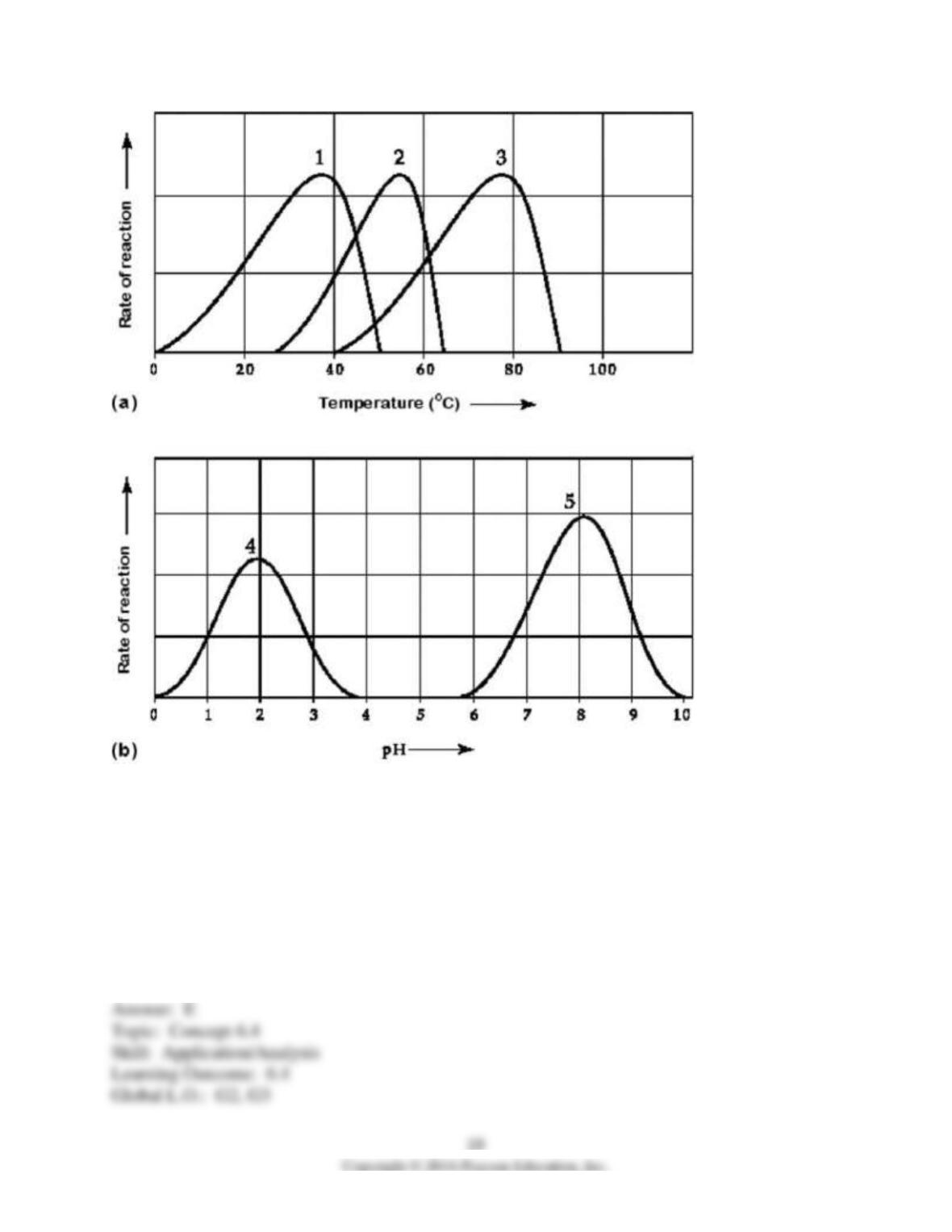
Figure 6.3 Activity of various enzymes (a) at various temperatures and (b) at various pH.
5) Which curves on the graphs in Figure 6.3 may represent the temperature and pH profiles of an
enzyme taken from a bacterium that lives in a mildly alkaline hot spring at temperatures of 70°C
or higher?
A) curves 1 and 5
B) curves 2 and 4
C) curves 2 and 5
D) curves 3 and 4
E) curves 3 and 5
6) Which temperature and pH profile curves on the graphs in Figure 6.3 were most likely
generated from analysis of an enzyme from a human stomach, where conditions are strongly
acid?
A) curves 1 and 4
B) curves 1 and 5
C) curves 2 and 4
D) curves 2 and 5
E) curves 3 and 4
The following question(s) are based on the reaction A + B ↔ C + D shown in Figure 6.4.
Figure 6.4
7) Which of the following best describes the forward reaction in Figure 6.4?
A) endergonic, ∆G > 0
B) exergonic, ∆G < 0
C) endergonic, ∆G < 0
D) exergonic, ∆G > 0
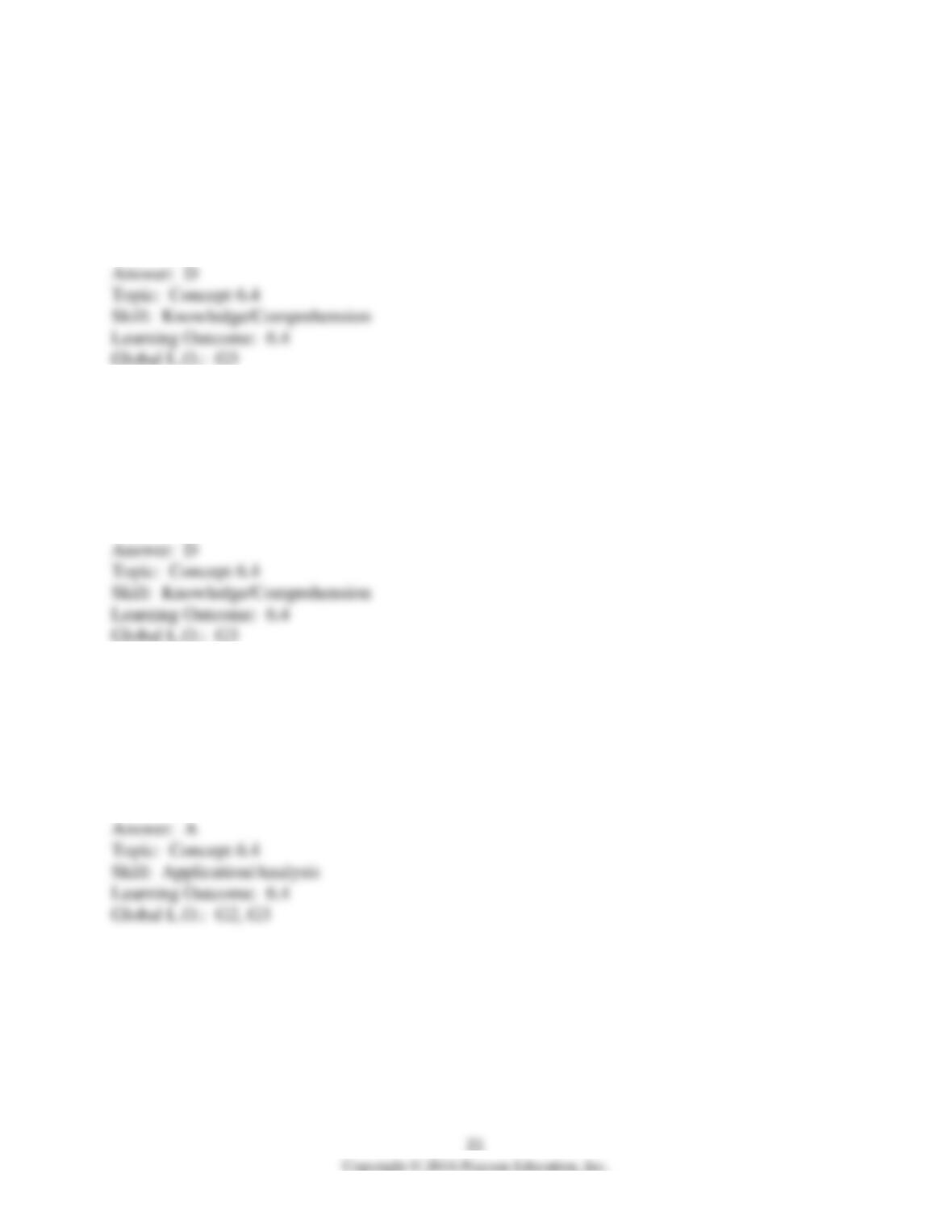
8) Which of the following represents the ΔG of the reaction in Figure 6.4?
A) a
B) b
C) c
D) d
E) e
9) Which of the following in Figure 6.4 would be the same in either an enzyme-catalyzed or a
noncatalyzed reaction?
A) a
B) b
C) c
D) d
E) e
10) Which of the following represents the activation energy needed for the enzyme-catalyzed
reverse reaction, C + D → A + B, in Figure 6.4?
A) a
B) b
C) c
D) d
E) e
11) Which of the following represents the difference between the free-energy content of the
reactants and the free-energy content of the products in Figure 6.4?
A) a
B) b
C) c
D) d
E) e
12) Which of the following represents the activation energy required for the enzyme-catalyzed
reaction in Figure 6.4?
A) a
B) b
C) c
D) d
E) e
13) Which of the following represents the activation energy required for a noncatalyzed reaction
in Figure 6.4?
A) a
B) b
C) c
D) d
E) e
14) Which of the following represents the activation energy needed for the noncatalyzed reverse
reaction, C + D → A + B, in Figure 6.4?
A) a
B) b
C) c
D) d
E) e
6.3 Scenario Questions
1) Chemical equilibrium is relatively rare in living cells. Which of the following could be an
example of a reaction at chemical equilibrium in a cell?
A) a chemical reaction in which the free energy at equilibrium is higher than the free-energy
content at any point away from equilibrium
B) a chemical reaction in which neither the reactants nor the products are being produced or used
in any other active metabolic pathway at that time in the cell
C) an endergonic reaction in an active metabolic pathway in which the energy for that reaction is
supplied only by heat from the environment
D) Chemical equilibrium is not possible under any circumstances in a living cell.
Please use the following information to answer the question(s) below.
Succinate dehydrogenase catalyzes the conversion of succinate to fumarate. The reaction is
inhibited by malonic acid, which resembles succinate but cannot be acted upon by succinate
dehydrogenase. Increasing the ratio of succinate to malonic acid reduces the inhibitory effect of
malonic acid.
2) Based on this information, which of the following is correct?
A) Succinate dehydrogenase is the enzyme, and fumarate is the substrate.
B) Succinate dehydrogenase is the enzyme, and malonic acid is the substrate.
C) Succinate is the substrate, and fumarate is the product.
D) Fumarate is the product, and malonic acid is a noncompetitive inhibitor.
E) Malonic acid is the product, and fumarate is a competitive inhibitor.
3) What is the role of malonic acid with respect to succinate dehydrogenase?
A) It is a noncompetitive inhibitor.
B) It is a competitive inhibitor.
C) It blocks the binding of fumarate.
D) It is an allosteric regulator.
Please use the following information to answer the question(s) below.
A series of enzymes catalyze the reactions illustrated in the following metabolic pathway: X →
Y → Z → A. Product A binds to the enzyme that converts X to Y at a position remote from its
active site. This binding decreases the activity of the enzyme.
4) What is substance X?
A) a coenzyme
B) an allosteric inhibitor
C) an intermediate
D) a substrate
5) With respect to the enzyme that converts X to Y, substance A functions as
A) a coenzyme.
B) an allosteric inhibitor.
C) the substrate.
D) an intermediate.
E) a competitive inhibitor.
6.4 End-of-Chapter Questions
1) Choose the pair of terms that correctly completes this sentence: Catabolism is to anabolism as
________ is to ________.
A) exergonic; spontaneous
B) exergonic; endergonic
C) free energy; entropy
D) work; energy
2) Most cells cannot harness heat to perform work because
A) heat does not involve a transfer of energy.
B) cells do not have much heat; they are relatively cool.
C) temperature is usually uniform throughout a cell.
D) heat can never be used to do work.
3) Which of the following metabolic processes can occur without a net influx of energy from
some other process?
A) ADP + <IMG/>i → ATP + H2O
B) C6H12O6 + 6 O2 → 6 CO2 + 6 H2O
C) 6 CO2 + 6 H2O → C6H12O6 + 6 O2
D) amino acids → protein
4) If an enzyme in solution is saturated with substrate, the most effective way to obtain a faster
yield of products is to
A) add more of the enzyme.
B) heat the solution to 90°C.
C) add more substrate.
D) add an allosteric inhibitor.
5) Some bacteria are metabolically active in hot springs because
A) they are able to maintain a lower internal temperature.
B) high temperatures make catalysis unnecessary.
C) their enzymes have high optimal temperatures.
D) their enzymes are completely insensitive to temperature.
6) If an enzyme is added to a solution in which its substrate and product are in equilibrium, what
will occur?
A) Additional product will be formed.
B) The reaction will change from endergonic to exergonic.
C) The free energy of the system will change.
D) Nothing; the reaction will stay at equilibrium.