
Campbell Biology, 10e (Reece)
Chapter 50 Sensory and Motor Mechanisms
1) When the mammalian brain compares the actual temperature of the body to the preferred
temperature of the body, which general component is being used?
A) sensor
B) effector
C) integrator
2) A behavioral physiologist is studying the homeostatic control of blood pH. In a trial, a lizard
runs on a treadmill for a set amount of time and the blood pH is measured. The blood pH drops
as carbon dioxide is released into the bloodstream. Which component of the homeostatic
feedback system is responsible for deciding if the blood pH is far enough from normal that a
response is necessary?
A) effector
B) sensor
C) integrator
D) assimilator
3) The eleven pairs of appendages projecting from the rostral area of star-nosed moles are _____.
A) chemosensory structures
B) tactile structures
C) olfactory structures
D) gustatory structures
4) The correct sequence of sensory processing is _____.
A) sensory adaptation → stimulus reception → sensory transduction → sensory perception
B) stimulus reception → sensory transduction → sensory perception → sensory adaptation
C) sensory perception → stimulus reception → sensory transduction → sensory adaptation
D) stimulus reception → sensory perception → sensory adaptation → sensory transduction

5) Artificial electrical stimulation of a human’s capsaicin-sensitive neurons would likely produce
the sensation of _____.
A) cold temperature
B) hot temperature
C) tactile stimulus
D) deep pressure
6) Artificial electrical stimulation of a human’s menthol-sensitive neurons would likely produce
the sensation of _____.
A) cold temperature
B) hot temperature
C) odor of pepper
D) deep pressure
7) Stimuli alter the activity of excitable sensory cells and generate action potentials via _____.
A) integration
B) transmission
C) transduction
D) amplification
8) Immediately after putting on a shirt, your skin might feel itchy. However, this perception soon
fades due to _____.
A) sensory adaptation
B) accommodation
C) reduced motor unit recruitment
D) reduced receptor amplification
9) A given photon of light may trigger an action potential with thousands of times more energy
because the signal strength is amplified by _____.
A) the receptor
B) a G protein
C) a signal transduction pathway
D) triggering several receptors at once
10) Although some sharks close their eyes just before they bite, their bites are on target.
Researchers have noted that sharks often misdirect their bites at metal objects and that they can
find batteries buried under sand. This evidence suggests that sharks keep track of their prey
during the split second before they bite in the same way that a _____.
A) rattlesnake finds a mouse in its burrow
B) male silkworm moth locates a mate
C) bat finds moths in the dark
D) platypus locates its prey in a muddy river
11) Which type of receptor would you expect to be most abundant in the antennae of a moth?
A) thermoreceptors
B) mechanoreceptors
C) chemoreceptors
D) electroreceptors
12) The middle ear converts _____.
A) air pressure waves to fluid pressure waves
B) fluid pressure waves to air pressure waves
C) air pressure waves to nerve impulses
D) fluid pressure waves to nerve impulses
13) Statocysts contain cells that are _____.
A) mechanoreceptors used to detect orientation relative to gravity
B) chemoreceptors used in selecting migration routes
C) photoreceptors used in setting biological rhythms
D) thermoreceptors used in prey detection
14) During an auditory transduction, ion flow varies across the _____.
A) tectorial membrane
B) round-window membrane
C) hair cell membrane
D) basilar membrane
15) Dizziness is a perceived sensation that can occur when _____.
A) the hair cells in the cochlea move more than their normal limits
B) moving fluid in the semicircular canals encounters a stationary cupula
C) rods and cones provide information that does not correspond with information received by
cochlear hair cells
D) the basilar membrane makes physical contact with the tectorial membrane
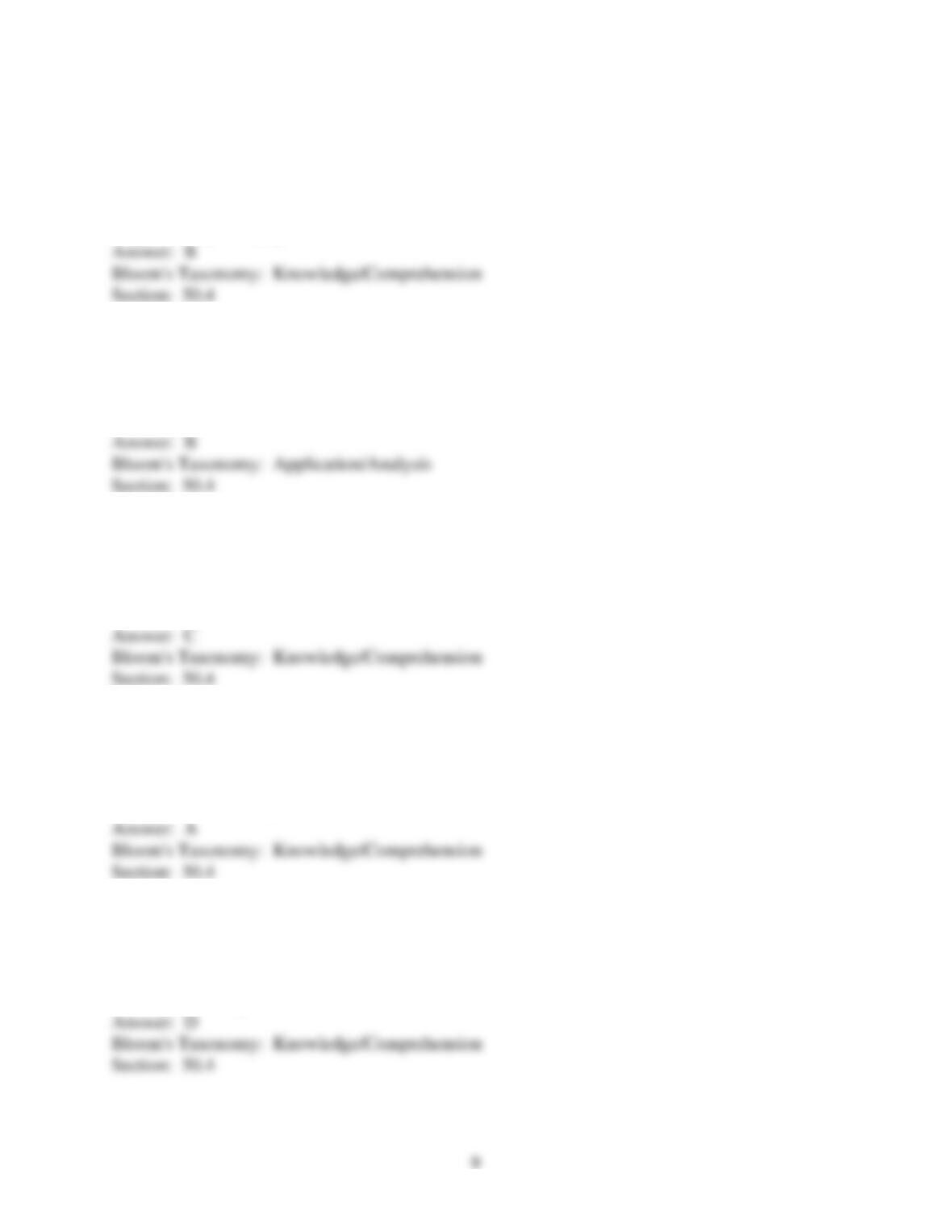
16) The structure diagrammed in the figure is the _____.
A) neuromast
B) statocyst
C) ommatidium
D) olfactory bulb

17) A person able to hear only high-frequency sounds would probably have which of the
following structural problems in the ear?
A) The tympanum is damaged because of chronic ear infections.
B) The basilar membrane is stiffened along its entire length.
C) The ear ossicles are abnormally thickened.
D) All of these problems could result in inability to detect low-frequency sound.
18) Partial or complete loss of hearing (deafness) can be caused by damage to the _____.
I) axons of the neurons associated with each hair cell that carry information to the brain
II) hair cells (the sensory receptors) in the cochlea
III) tympanic membrane, or eardrum
A) only II
B) only III
C) only I and II
D) I, II, and III
19) The cochlea _____.
I) amplifies sound vibrations
II) collects sound pressure waves
III) detects the frequency of sounds
A) only I
B) only II
C) only III
D) only II and III
20) Elephants hear sounds that are too low for humans to hear. This sensitivity is primarily due
to the differences in the _____.
A) arrangement and shape of the ossicles
B) flexibility of the basilar membrane in the cochlea
C) size and flexibility of the tympanic membrane (eardrum)
D) size and shape of the outer ear

21) Hair cells in the vertebrate ear are responsible for transducing sound pressure waves. Ion
channels in the hair cell membrane open when _____.
A) a chemical ligand binds to the ion channel
B) light is absorbed by a molecule in the membrane
C) the cell membrane reaches a threshold voltage
D) the membrane is distorted mechanically
22) If you experimentally reduce the concentration of K+ in the extracellular fluid surrounding
hair cells in the inner ear, the result would be like which of the following?
A) decreasing the volume of sound reaching the hair cells
B) increasing the volume of sound reaching the hair cells
C) decreasing the frequency of sound reaching the hair cells
D) increasing the frequency of sound reaching the hair cells
23) It can be very difficult to select an angle for sneaking up to a grasshopper to catch it because
grasshoppers have _____.
A) excellent hearing for detecting predators
B) compound eyes with multiple ommatidia
C) eyes with multiple fovea
D) a camera-like eye with multiple fovea
24) Compared to viewing a distant object, a human viewing an object held within five
centimeters of the eye requires a lens that _____.
A) has been flattened, as a result of contraction of the ciliary muscles
B) has been made more spherical, as a result of contraction of the ciliary muscles
C) has been flattened, as a result of relaxation of the ciliary muscles
D) has been made more spherical, as a result of relaxation of the ciliary muscles

25) Sensory transduction of light in the vertebrate retina is accomplished by _____.
A) ganglion cells
B) amacrine cells
C) bipolar cells
D) rods and cones
26) Lateral inhibition via amacrine cells in the mammalian retina _____.
A) underlies habituation of vision
B) enhances visual contrast
C) prevents bleaching in bright light
D) recycles neurotransmitter molecules
27) The blind spot in the human retina is the location that has the collected axons of _____.
A) ganglion cells
B) bipolar cells
C) primary visual cortex
D) lateral geniculate nuclei
28) Corneal surgery is now routinely performed to change the shape of the cornea and improve
vision. This surgery is beneficial because it _____.
A) improves the circulation of nutrients to the eye
B) improves the focusing of light onto the retina
C) decreases the amount of light entering the eye
D) increases the sensitivity of the photoreceptors
29) Rods exposed to light will _____.
A) depolarize due to the opening of sodium channels
B) hyperpolarize due to the closing of sodium channels
C) depolarize due to the opening of potassium channels
D) hyperpolarize due to the closing of potassium channels

30) What structures would neurobiologists look for if they are interested in determining if an
animal can see in color?
A) opsins
B) electroreceptors
C) pupil
D) lens
31) How could you genetically modify an animal so that it would distinguish more shades of
green?
A) Induce genes to produce a greater number of cone cells in the fovea.
B) Introduce genes for different opsins that respond in the green region of the spectrum.
C) Introduce genes to produce green fluid in the eyeball, because green fluids will not absorb
green light.
D) Induce increased production of cGMP to increase opening of cGMP-gated sodium channels.
32) Which sensory distinction is NOT encoded by a difference in neuron identity?
A) red and green
B) loud and faint
C) salty and sweet
D) spicy and cool
33) Tastes and smells are distinct kinds of environmental information in that _____.
A) neural projections from taste receptors reach different parts of the brain than the neural
projections from olfactory receptors
B) the single area of the cerebral cortex that receives smell and taste signals can distinguish
tastes and smells by the pattern of action potentials received
C) tastant molecules are airborne, whereas odorant molecules are dissolved in fluids
D) distinguishing tastant molecules requires learning, whereas smell discrimination is an innate
process
34) Most of the chemosensory neurons arising in the nasal cavity have axonal projections that
terminate in the _____.
A) gustatory complex
B) olfactory bulb
C) occipital lobe
D) posterior pituitary gland
35) Umami perception would be stimulated by _____.
A) chocolate milk
B) a slice or roast beef
C) acidic orange juice
D) salt water
36) The olfactory bulbs are located in the _____.
A) nasal cavity
B) anterior pituitary gland
C) brain
D) brainstem
37) Which of the following sensory receptors is correctly paired with its category?
A) hair cell — mechanoreceptor
B) muscle spindle — electromagnetic receptor
C) taste receptor — mechanoreceptor
D) rod — chemoreceptor
38) The umami receptor in the sense of taste detects _____.
A) glucose
B) potassium ions
C) hydrogen ions
D) monosodium glutamate

39) Experiments with genetically altered mice showed that the mice would consume abnormally
high amounts of bitter-tasting compounds in water after their _____.
A) hormone receptors for digestive hormones were reduced or eliminated, showing that bitter
tastes are reinforced by digestive responses
B) salt-taste cells were altered to express receptors for bitter tastants, suggesting that animals
have unregulated salt appetites
C) visual sense was reduced or eliminated, suggesting that mice learn visual cues about bitter
tastes
D) sweet-taste cells were altered to express receptors for bitter tastants, suggesting that the
sensation of taste depends only on which taste cell is stimulated
40) Two students studying physiology taste a known “bitter” substance, and both report sensing
bitterness. They then sample another substance. Student A reports sensing both a bitter taste and
a salty taste, but student B reports only a salty taste. What is the most logical explanation?
A) Student A had an allergic reaction to the food, causing him to perceive the food as being
bitter.
B) Student A has normal “bitter” taste buds; student B has defective “bitter” taste buds that result
in lower sensitivity to bitterness.
C) Student A has a protein receptor capable of detecting a bitter molecule found in that
substance, whereas student B lacks that particular protein receptor.
D) Student A has normal saliva, whereas student B’s saliva is more alkaline than normal.
41) Which of the following are present in high densities in both smooth and skeletal muscle
cells?
I) cilia
II) mitochondria
III) nuclei
IV) endoplasmic reticulum
A) only I and II
B) only II and IV
C) only III and IV
D) only I, II, and III
42) The contraction of skeletal muscles is based on _____.
A) myosin filaments coiling up to become shorter
B) actin and myosin filaments both coiling up to become shorter
C) actin cross-bridges binding to myosin and transitioning from a high-energy to a low-energy
state
D) myosin cross-bridges binding to actin and transitioning from a high-energy to a low-energy
state
43) Compared to oxidative skeletal muscle fibers, those classified as glycolytic typically have
_____.
A) a higher concentration of myoglobin
B) a higher density of mitochondria
C) a smaller diameter
D) less resistance to fatigue
44) Myasthenia gravis is a form of muscle paralysis in which _____.
A) motor neurons lose their myelination and the ability to rapidly fire action potentials
B) acetylcholine receptors are destroyed by an overactive immune system
C) ATP production becomes uncoupled from mitochondrial electron transport
D) troponin molecules become unable to bind calcium ions
45) A skeletal muscle deprived of adequate ATP supplies will _____.
A) immediately relax
B) enter a state where actin and myosin are unable to separate
C) fire many more action potentials than usual and enter a state of “rigor”
D) sequester all free calcium ions into the sarcoplasmic reticulum

46) Most of the ATP supplies for a skeletal muscle undergoing one hour of sustained exercise
come from _____.
A) creatine phosphate
B) glycolysis
C) substrate phosphorylation
D) oxidative phosphorylation
47) The “motor unit” in vertebrate skeletal muscle refers to _____.
A) one actin binding site and its myosin partner
B) one sarcomere and all of its actin and myosin filaments
C) one myofibril and all of its sarcomeres
D) one motor neuron and all of the muscle fibers on which it has synapses
48) The muscles of a recently deceased human can remain in a contracted state, termed rigor
mortis, for several hours, due to the lack of _____.
A) ATP needed to break actin-myosin bonds
B) calcium ions needed to bind to troponin
C) oxygen supplies needed for myoglobin
D) sodium ions needed to fire action potentials
49) Which of the following is the correct sequence that describes the excitation and contraction
of a skeletal muscle fiber?
1. Tropomyosin shifts and unblocks the cross-bridge binding sites.
2. Calcium is released and binds to the troponin complex.
3. Transverse tubules depolarize the sarcoplasmic reticulum.
4. The thin filaments are ratcheted across the thick filaments by the heads of the myosin
molecules using energy from ATP.
5. An action potential in a motor neuron causes the axon to release acetylcholine, which
depolarizes the muscle cell membrane.
A) 1 → 2 → 3 → 4 → 5
B) 2 → 1 → 3 → 5 → 4
C) 2 → 3 → 4 → 1 → 5
D) 5 → 3 → 2 → 1 → 4

50) Action potentials in the heart move from one contractile cell to the next via _____.
A) chemical synapses using acetylcholine
B) chemical synapses using norepinephrine
C) electrical synapses using gap junctions
D) non-myelinated motor neurons
51) What would happen to people exposed to a chemical warfare agent that blocked
acetylcholine from binding to muscle receptors?
A) Action potentials would be continuously generated, causing convulsive muscle contractions.
B) Muscle contractions would be prevented, causing paralysis.
C) Muscle contractions could still occur, but relaxation of the muscle would be impaired.
D) Action potentials would be continuously generated, causing convulsive muscle
contractions; muscle contractions would then be prevented, causing paralysis.
52) When an action potential from a motor neuron arrives at the neuromuscular junction (NMJ),
a series of events occurs that leads to muscle contraction. Which of the following events will
occur last (that is, after all of the others)?
A) acetylcholine (ACh) release
B) conformational change in troponin
C) depolarization of the muscle cell
D) release of Ca2+ from the sarcoplasmic reticulum
53) A patient is hospitalized with muscle spasms caused by failure of back muscles to relax after
contraction. Which of the following would be most likely to help?
A) Inject calcium into the muscle cell, because it is not being released from the sarcoplasmic
reticulum.
B) Induce tropomycin and troponin to bind to the myosin binding sites on actin.
C) Increase the amount of acetylcholine at the synapses between motor neurons and muscle cells.
D) Depolarize the motor neurons to send an action potential to the muscle cells.

Use the following information to answer the question(s) below.
“Marine cone snails from the genus Conus are estimated to consist of up to 700 species. These
predatory molluscs have devised an efficient venom apparatus that allows them to successfully
capture polychaete worms, other molluscs, or in some cases fish as their primary food sources.
… conotoxins from Australian species of Conus … have the capacity to inhibit specifically the
nicotinic acetylcholine receptors in higher animals.” (B. G. Livett, K. R. Gayler, and Z. Khalil.
2004. Drugs from the sea: Conopeptides as potential therapeutics. Current Medicinal Chemistry
11:1715-23.)
54) Refer to the paragraph above on the venom of marine core snails. This particular conotoxin
inhibits acetylcholine receptors that are located _____.
A) along the motor neuron axon
B) on motor neuron dendrites
C) on the presynaptic membrane of the neuromuscular junction
D) on the postsynaptic membrane, on the muscle cell
55) Refer to the paragraph above on the venom of marine core snails. What is the adaptive value
of this toxin?
I) It would cause muscle spasms in the prey.
II) It would result in paralysis of the skeletal muscle of the prey.
III) It would stimulate digestive tract smooth muscle to cause nausea and vomiting of the prey.
A) only I
B) only II
C) only III
D) only I and II
56) An endoskeleton is the primary body support for the _____.
A) annelids, including earthworms
B) insects, including beetles
C) cartilaginous fishes, including sharks
D) bivalves, including clams
57) A ball-and-socket joint connects _____.
A) the radius to the ulna
B) the radius to the humerus
C) the ulna to the humerus
D) the humerus to the scapula
58) Among these choices, the most energetically efficient locomotion per unit mass is likely
_____.
A) running by a 50-gram rodent
B) running by a 40-kilogram ungulate
C) flying by a 100-gram bird
D) swimming by a 100-kilogram tuna (bony fish)
59) The hydrostatic skeleton of the earthworm allows it to move around in its environment by
_____.
A) walking on its limbs
B) swimming with its setae
C) using peristaltic contractions of its circular and longitudinal muscles
D) alternating contractions and relaxations of its flagella
60) Chitin is a major component of the _____.
A) skeleton of mammals
B) hydrostatic skeletons of earthworms
C) exoskeleton of insects
D) body hairs of mammals