CHAPTER 5
DNA, Replication, Repair, and Recombination
Questions
5-1 The mutation rate is about 1 mutation per 109 nucleotides per cell division in most
organisms, from E. coli bacteria through nematode worms up to humans. You
aspire to develop an improved superorganism with a reduced mutation rate.
Through a clever genetic screen, you isolate a mutant strain of E. coli that suffers
only about 1 mutation per 1012 nucleotides per cell division. You imagine that this
superorganism will have superior survival and proliferation properties, and might
take over the world. A colleague suggests you do the following experiment: Put a
gene encoding yellow fluorescent protein (YFP) in the original strain and a gene
encoding cyan fluorescent protein (CFP) in the mutant strain. Start with a single
cell from each strain and allow those cells to proliferate under optimal conditions
for a month. Then mix equal numbers of cells from each strain together so that
50% of the cells are yellow and 50% are cyan, and split the mixture into two
parts. Culture “Mix 1” in rich growth medium for four weeks, diluting the cells
and adding fresh medium every two days. Culture “Mix 2” in a similar way,
except add excess salt during the first week, add copper during the second week,
grow at an elevated temperature during the third week, and reduce the nutrients in
the medium during the fourth week. Finally, examine the ratio of yellow to cyan
cells in the mixes. You find that 55% of the cells in Mix 1 are cyan, but only 40%
of the cells in Mix 2 are cyan. Explain these observations. Suggest a reason why
the mutation rate is 10-9 in all wild-type organisms tested.
5-2 A pregnant mouse is exposed to high levels of a chemical. Many of the mice in
her litter are deformed, but when they are interbred with each other, all their
offspring are normal. For each of the statements below, explain why it is a likely
or an unlikely explanation of the observations.
A. The mother mouse’s germ cells were mutated.
B. In the deformed mice, germ cells but not somatic cells were mutated.
C. The toxic chemical affects development but is not mutagenic.
D. In the deformed mice, somatic cells but not germ cells were mutated.
5-3 Imagine that you join a laboratory that has established a technique for examining
DNA replication in a cellular extract. To the cellular protein extract, you simply
add nucleotides, a small amount of radiolabeled 32P-dGTP to aid visualization of
the synthesized DNA, and a 4000-base-pair linear double-stranded DNA molecule
that contains an origin of replication in the middle. After allowing the reaction to
proceed for 30 minutes at 30°C, you boil the mixture to denature the proteins and
the DNA strands, separate the components on an acrylamide gel, and detect the
radiolabeled DNA products. This complete reaction is shown in lane 2 on the gel
in Figure Q5-3.
A. You perform the assay by yourself for the first time late on a Friday night,
and no one else is in lab. The tube labeled “nucleotide mixture” has only
enough for a single reaction, but you find a tube with a label that reads
“dATP, dTTP, dGTP, dCTP” and you use this in a second reaction. You
find the first reaction looks like lane 2 and the second reaction looks like
lane 3. Why was no DNA synthesized in the second reaction?
B. Your lab partner has recently isolated several mutant strains that can
replicate their DNA and proliferate normally at 30°C but exhibit no DNA
replication when grown at 40°C. He calls these mutants tsr1 through tsr4,
for Temperature Sensitive Replication. The wild-type strain replicates
efficiently at both temperatures. You believe that you can use the
biochemical assay of cell extracts to identify which genes are defective in
the new mutants. First you grow wild-type cells and tsr1 cells at 40°C,
make the extracts, incubate the DNA replication reaction at 40°C, and
detect the products on a gel. You observe the pattern shown in lanes 4 and
5. You are so excited by the results, you run to your lab partner and tell
him that you know what enzyme is defective. He is delighted by your
results but says that there are two different enzymes that can account for
your results. What are they?
C. Heartened by your initial success in narrowing down the identity of the
defective genes in the new mutants, you test the mutants called tsr2, tsr3,
and tsr4. You find they all give the pattern shown in lane 6: they fail to
make detectable DNA products. Name two of the several proteins that,
when defective, might yield the pattern in lane 6.
D. To explore these mutants further, you mix the extracts together. You find
that tsr2 plus tsr3 gives a wild-type pattern shown in lane 7, but tsr2 plus
tsr4 still gives the mutant pattern in lane 8. What is the simplest
explanation for these results?
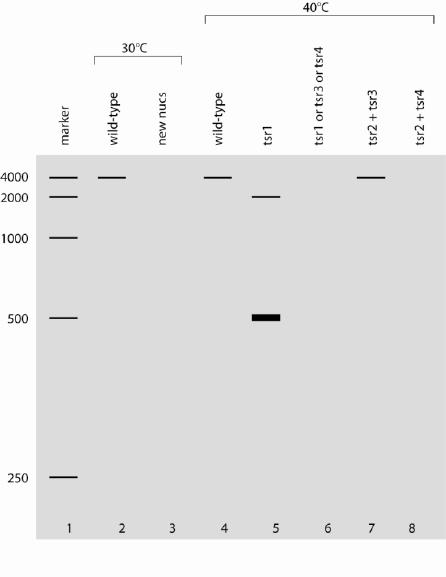
Figure Q5-3
5-4 Strand-directed mismatch repair occurs soon after the passage of a replication
fork to repair mismatched base pairs and preferentially restore the original
sequence. How does the repair system know which is the original sequence and
which is the new, mutated sequence? To identify the newly synthesized strand,
procaryotes take advantage of the transient absence of methylation. Eucaryotes
cannot use hemimethylation as a clue and instead use single-stranded DNA nicks
to identify the newly synthesized strand. Consider a 1 kb stretch of double-
stranded DNA before replication, with its “top” strand and “bottom” strand. To
convince yourself that replication generates a new “bottom” strand and a new
“top” strand that both contain nicks (transiently), draw a replication bubble that
started in the middle of the DNA and extends almost to the edge. Show the origin
of replication, the replication fork(s), the leading and lagging strands, and the 5’
and 3’ ends of all DNA fragments.
5-5 Yeast cells that are heterozygous for the ADE2 gene are useful for following the
distribution of alleles after meiosis. The meiotic products in yeast are called
spores, and are analogous to sperm and eggs. All four spores derived from
meiosis in a single cell are packaged together as a tetrad, and they can be
separated under the microscope and deposited at specific locations on an agar pad.
When the agar pad is placed on appropriate medium in a Petri dish, a colony of
cells grows from each spore. Colonies that have wild-type ADE2 are white and
those that have mutant ade2 are red. Most tetrads give two white and two red
colonies, as would be expected from simple Mendelian genetics.
A. Sometimes a tetrad yields three white and one red spore colony, or vice
versa. What is the name for the phenomenon that causes this pattern, and
how does it arise?
B. When certain yeast mutants are sent through meiosis, a few of the spore
colonies exhibit sectoring. A sectored colony has about half red cells and
half white cells. Consider all of the enzymatic steps in homologous
recombination. What part of homologous recombination is defective in
these “PMS” (for Post-Meiotic Segregation) mutants?
C. Mutations in human homologs of the yeast PMS genes contribute to the
development of some cancers, as a result of their effects on mitotic DNA
replication. Why do you think this is?
5-6 Chromosomal DNA sequences are maintained and replicated with such high
fidelity that the sequence of the human genome is changed by only about three
nucleotides each time a cell divides. You mention this astonishing fact to your
grandfather, who has just read an article in the newspaper about human genetics.
He exclaims that this seems to be a very high mutation rate because changing the
function of three proteins every time a cell divides should quickly lead to a
defective individual. Explain the mistake in your grandfather’s reasoning.
5-7 The bacterium E. coli replicates its genome in about 20 minutes under ideal
growth conditions. Surprisingly, the fruit fly Drosophila can replicate its genome
in only 3 minutes. How can this be? For each statement below, indicate whether it
is true and whether it can explain the difference in the duration of replication.
A. The Drosophila genome is smaller than the E. coli genome.
B. Eucaryotic DNA polymerase synthesizes DNA at a much faster rate than
procaryotic DNA polymerase.
C. The nuclear membrane keeps the Drosophila DNA concentrated in one
place in the cell.
D. Drosophila DNA contains more origins of replication than E. coli DNA.
E. Eucaryotes have more than one kind of DNA polymerase.
5-8 Some retrotransposons and retroviruses integrate preferentially into regions of the
chromosome that are (a) packaged in euchromatin and (b) located outside the
regions of genes that encode the amino acid sequences of proteins. Why might
these mobile genetic elements have evolved this strategy?
Answers