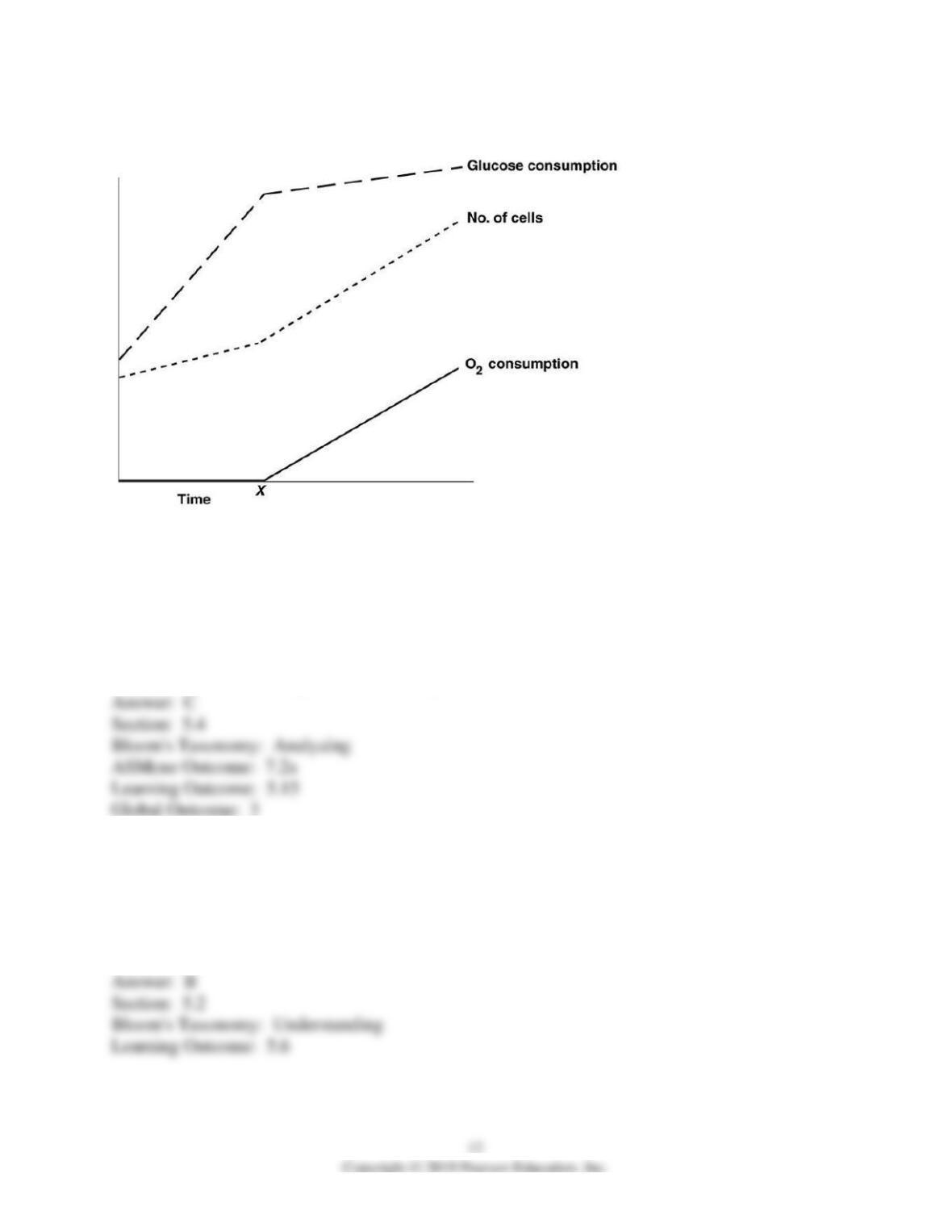
33) Figure 5.6
The rates of O2 and glucose consumption by a bacterial culture are shown in Figure 5.6. Assume
a bacterial culture was grown in a glucose medium without O2. Then O2 was added at the time
marked X. The data indicate that
A) these bacteria don’t use O2.
B) these bacteria get more energy anaerobically.
C) aerobic metabolism is more efficient than fermentation.
D) these bacteria cannot grow anaerobically.
34) An enzyme, citrate synthase, in the Krebs cycle is inhibited by ATP. This is an example of
all of the following EXCEPT
A) allosteric inhibition.
B) competitive inhibition.
C) feedback inhibition.
D) noncompetitive inhibition.
35) If a cell is starved for ATP, which of the following pathways would most likely be shut
down?
A) Krebs cycle
B) glycolysis
C) pentose phosphate pathway
D) Krebs cycle and glycolysis
36) Which of the following statements regarding the glycolysis pathway is FALSE?
A) Two pyruvate molecules are generated.
B) Four ATP molecules are generated via substrate-level phosphorylation.
C) Two NADH molecules are generated.
D) One molecule of ATP is expended.
E) Two molecules of water are generated.
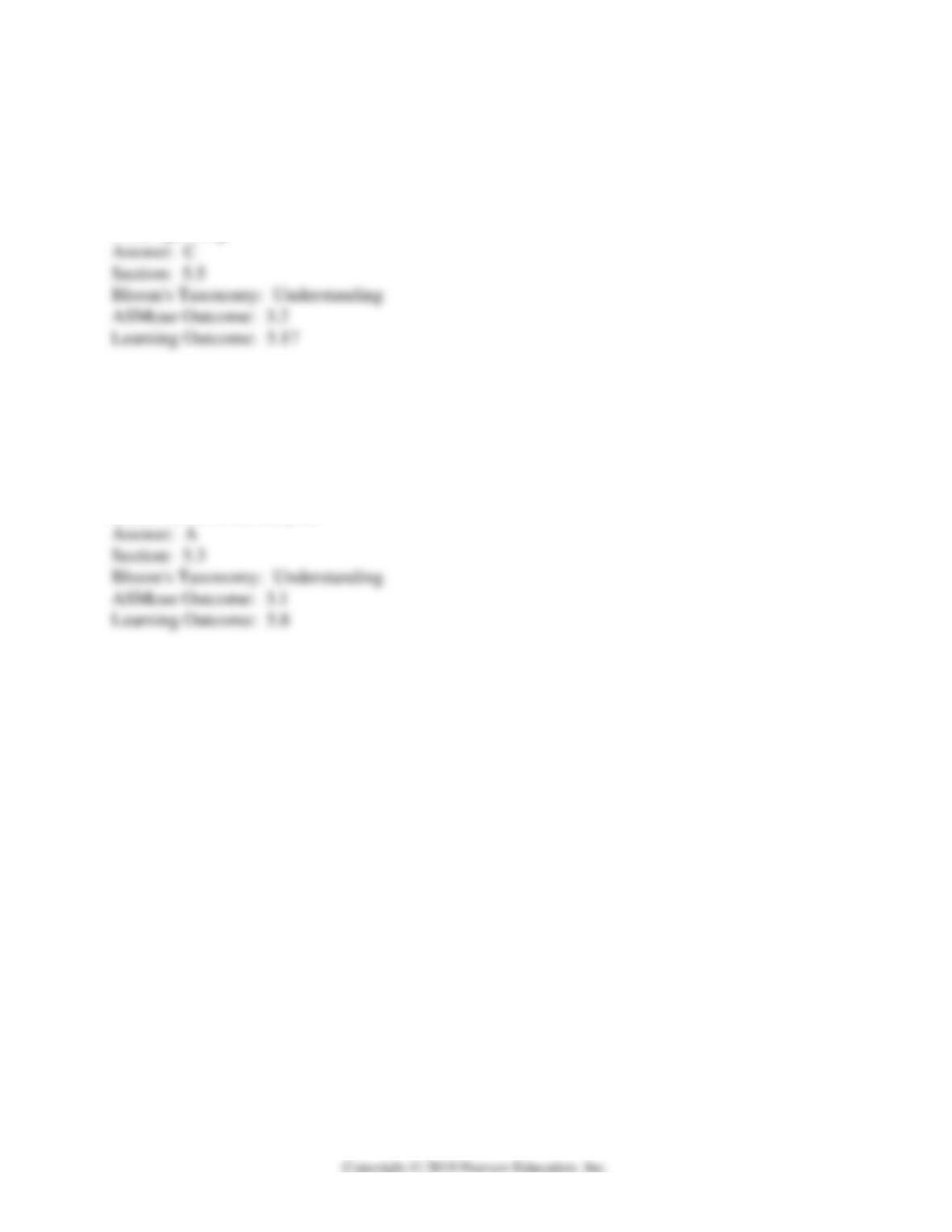
37) Figure 5.7
The graph at the left in Figure 5.7 shows the reaction rate for an enzyme at its optimum
temperature. Which graph shows enzyme activity at a higher temperature?
A) a
B) b
C) c
D) d
14
38) A bacterial culture grown in a glucose-peptide medium causes the pH to increase. The
bacteria are most likely
A) fermenting the glucose.
B) oxidizing the glucose.
C) using the peptides.
D) not growing.
39) Gallionella bacteria can get energy from the reaction Fe2+ → Fe3+. This reaction is an
example of
A) oxidation.
B) reduction.
C) fermentation.
D) photophosphorylation.
E) the Calvin-Benson cycle.
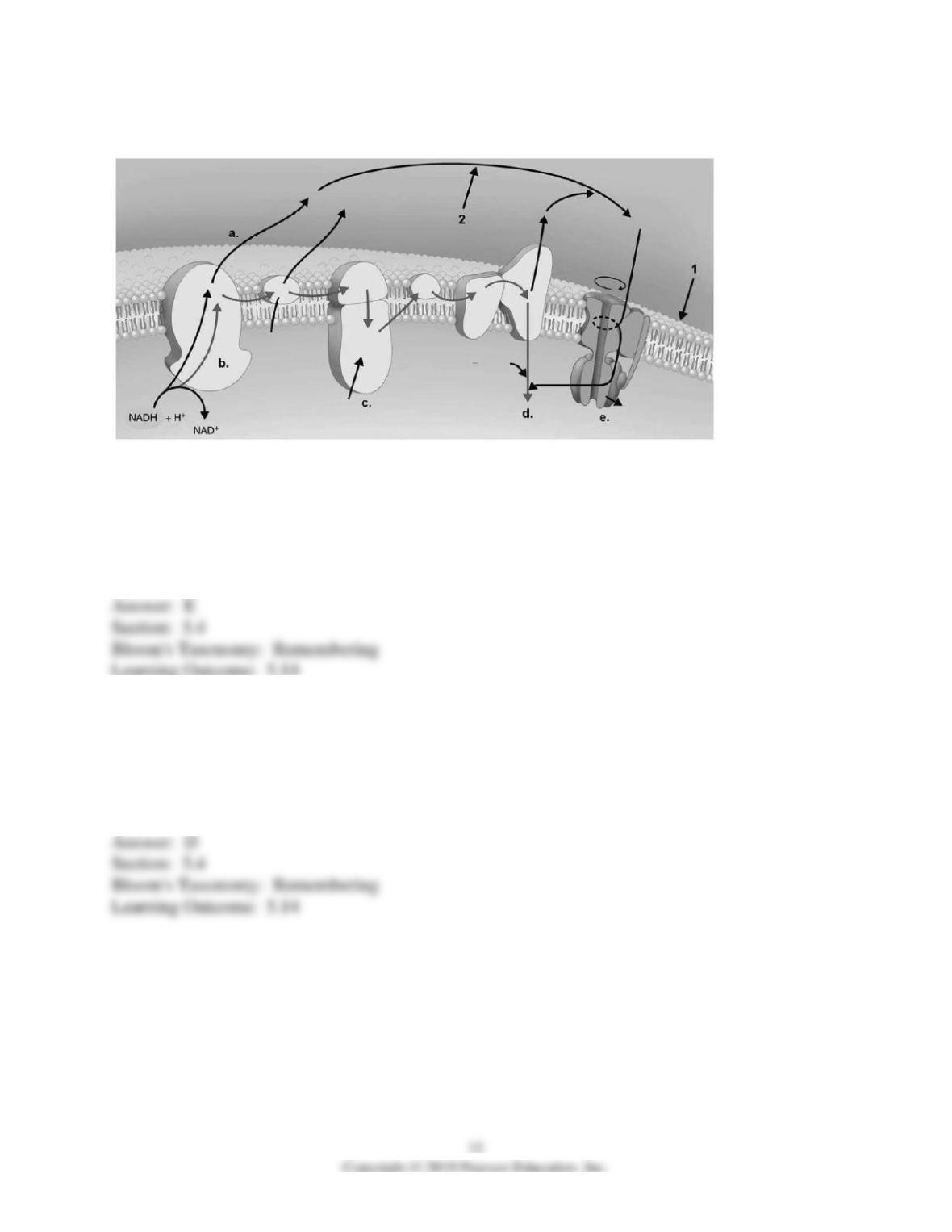
Figure 5.8
40) In Figure 5.8, where is ATP produced?
A) a
B) b
C) c
D) d
E) e
41) Refer to Figure 5.8. In aerobic respiration, where is water formed?
A) a
B) b
C) c
D) d
E) e
42) In Figure 5.8, the structure labeled “1” is
A) NAD+.
B) ATP synthase.
C) a plasma membrane.
D) a cell wall.
E) cytoplasm.
43) In Figure 5.8, the path labeled “2” is the flow of
A) electrons.
B) protons.
C) energy.
D) water.
E) glucose.
44) What is the most acidic place in Figure 5.8?
A) a
B) b
C) c
D) d
E) e
45) A urease test is used to identify Mycobacterium tuberculosis because
A) urease is a sign of tuberculosis.
B) M. tuberculosis produces urease.
C) urea accumulates during tuberculosis.
D) some bacteria reduce nitrate ion.
E) M. bovis can cause tuberculosis.
46) Researchers are developing a ribozyme that cleaves the HIV genome. This pharmaceutical
agent could be described as
A) an RNA molecule capable of catalysis.
B) a hydrolase.
C) a genetic transposable element.
D) a protease inhibitor.
E) a competitive inhibitor for reverse transcriptase.
47) Which statements correspond to amphibolic pathways?
1. Anabolic and catabolic reactions are joined through common intermediate.
2. They are shared metabolic pathways.
3. Feedback inhibition can help regulate rates of reactions.
4. Both types of reactions are necessary but do not occur simultaneously.
A) 1 only
B) 1, 2, 3
C) 1, 2, 3, 4
D) 2, 4
E) 2, 3, 4
48) Why do eukaryotes generate only about 36 ATP per glucose in aerobic respiration but
prokaryotes may generate about 38 ATP?
A) eukaryotes have a less efficient electron transport system.
B) eukaryotes do not transport as much hydrogen across the mitochondrial membrane as
prokaryotes do across the cytoplasmic membrane.
C) eukaryotes must shuttle pyruvate across the mitochondrial membrane by active transport.
D) eukaryotes do not completely oxidize glucose in their respiration reactions.
E) prokaryotes possess an alternate to the Krebs cycle that generates more reduced
electron.carriers.
49) In non-cyclic photophosphorylation, excited electrons ultimately
A) return to chlorophyll.
B) are used to form water.
C) combine with hydrogen ions and NADP+ to produce NADPH.
D) flow through ATP synthase.
E) generate light within the spectrum of green wavelengths.
50) Insert non-labeled graph from page 150- replica created and inserted below
The graph shows the normal reaction rate of an enzyme and the reaction rate when a competitive
inhibitor is present. Which description below explains the appearance of the graph?
A) As the substrate concentration increases, the activity of the enzyme decreases.
B) As the substrate concentration increases, the effect of the inhibitor was overcome and enzyme
activity was restored.
C) As the enzyme concentration increased, the effect of the inhibitor was overcome and enzyme
activity was restored.
D) As the enzyme concentration increased, the effect of the inhibitor was more pronounced.
E) As the competitive inhibitor concentration decreased, the reaction rate also decreased.
5.2 True/False Questions
1) Catabolic reactions are generally degradative and hydrolytic.
2) The pentose phosphate pathway can be characterized as an anabolic pathway.
3) In general, ATP is generated in catabolic pathways and expended in anabolic pathways.
4) An apoenzyme that loses its coenzyme subunit will be non-functional.
5) The use of enzymes is necessary to increase the activation energy requirements of a chemical
reaction.
6) Glycolysis is utilized by cells in both respiration and fermentation.
7) Carbon fixation occurs during the light-independent phase of photosynthesis.
8) Both respiration and photosynthesis require the use of an electron transport chain.
9) Both respiration and photosynthesis use water molecules for the donation of hydrogen ions.
10) Once an enzyme has converted substrates into products, the active site reverts back to its
original form.
5.3 Essay Questions
1) Compare and contrast photophosphorylation and oxidative phosphorylation.
2) Rhodopseudomonas is an anaerobic photoautotroph that uses organic compounds as an
electron donor. It is also capable of chemoheterotrophic metabolism. Diagram the metabolic
pathways of this bacterium.
3) Differentiate the following two laboratory tests: starch hydrolysis and starch fermentation.
4) Streptococcus lacks an electron transport chain. How does this bacterium reoxidize NADH?
Where is the NADH formed?
5) You look in the refrigerator and find some orange drink you had forgotten was there. The
drink now has an “off” taste and bubbles. What is the most likely explanation for the changes in
the drink?
6) Explain the overall purpose of metabolic pathways.
7) Summarize energy production in cells in a single sentence.