Chapter 5 Microbial Metabolism
5.1 Multiple Choice Questions
1) Which of the following statements concerning cellular metabolism is FALSE?
A) Energy obtained from nutrients or light is stored in the bonds of ATP.
B) Enzymes are used in both catabolic and anabolic reactions.
C) Macromolecules are converted into cell structures via catabolism.
D) The goal of metabolism is reproduction of the organism.
E) ATP is used in the formation of macromolecules.
2) Anabolic reactions may be characterized as
A) exergonic.
B) breaking large molecules into smaller molecules.
C) forming large molecules from smaller molecules.
D) producing ATP.
E) breaking large molecules into smaller molecules to produce ATP.
3) Which of the following statements concerning reduction reactions is FALSE?
A) An electron acceptor gains an electron.
B) They are coupled with oxidation reactions.
C) They frequently involve electron carrier molecules.
D) An electron acceptor becomes more positively charged.
E) A molecule gains a hydrogen atom.
4) The molecule that an enzyme acts upon is known as its
A) substrate.
B) coenzyme.
C) apoenzyme.
D) product.
E) catalyst.
5) Which of the following statements concerning enzymes is FALSE?
A) They are usually, but not always, proteins.
B) They always function best at 37°C.
C) They can be denatured if the pH of their environment is too high or too low.
D) They form a temporary intermediate compound with a substrate.
E) They can be used to catalyze a chemical reaction over and over again.
6) Sulfanilamide is an antimicrobial drug that mimics the shape of an important substrate for a
particular bacterial enzyme, thereby inhibiting the enzyme. This type of inhibition is known as
A) allosteric inhibition.
B) competitive inhibition.
C) allosteric activation.
D) noncompetitive inhibition.
E) feedback inhibition.
7) Which of the following produces NADPH?
A) the pentose phosphate pathway only
B) the Calvin-Benson cycle only
C) the Embden-Meyerhof pathway only
D) both the Embden-Meyerhof and Calvin-Benson cycle pathways
E) both the pentose phosphate and Entner-Doudoroff pathways
8) Which of the following statements concerning glycolysis is TRUE?
A) It produces ATP by oxidative phosphorylation.
B) It occurs in the cell membranes of bacteria.
C) It requires the input of ATP and produces ATP.
D) It is an alternative to fermentation.
E) It involves ribulose 5-phosphate as an intermediate.
9) Many vitamins are important ________ of enzymes.
A) protein cofactors
B) coenzymes
C) allosteric inhibitors
D) competitive inhibitors
E) activators
10) Pyruvic acid is a product of
A) the Krebs cycle.
B) fermentation.
C) glycolysis.
D) the pentose phosphate pathway.
E) both fermentation and the Krebs cycle.
11) All of the following are forms of oxidation EXCEPT
A) loss of an electron.
B) loss of hydrogen atom.
C) a dehydrogenation event.
D) substrate-level phosphorylation.
E) gain of an oxygen atom and its electrons.
12) Which of the following can be the final electron acceptor in anaerobic respiration in
bacteria?
A) nitrate only
B) pyruvic acid only
C) sulfate only
D) both nitrate and sulfate
E) nitrate, pyruvic acid, and sulfate
13) Which of the following is a non-protein carrier found in some electron transport chains?
A) flavoproteins
B) metal-containing proteins
C) ribozymes
D) cytochromes
E) ubiquinones
14) A phosphate group is transferred from an organic compound to ADP during
A) oxidative phosphorylation.
B) substrate-level phosphorylation.
C) beta-oxidation.
D) photophosphorylation.
E) anabolic reactions.
15) Which of the following is a by-product of the catabolism of proteins?
A) lactic acid
B) acetyl-CoA
C) proteases
D) ammonia
E) carbon dioxide
16) Which of the following is an active enzyme?
A) apoenzyme
B) cofactor
C) coenzyme
D) holoenzyme
E) subtrate
17) Which of the following is/are common to chemiosmosis and the light-dependent reactions
of photosynthesis?
A) reduction of NADP+ only
B) electron transport only
C) a proton gradient only
D) both electron transport and a proton gradient
E) electron transport, a proton gradient, and reduction of NADP+
18) Which of the following is a fermentation product useful in the manufacture of cheese?
A) acetic acid
B) ammonia
C) ethanol
D) lactic acid
E) pyruvic acid
19) How many ATP molecules can theoretically be produced from the NADH generated by the
catabolism of a molecule of glucose during aerobic respiration?
A) 34
B) 30
C) 38
D) 36
E) 4
20) The various types of chlorophyll differ in the
A) amount of light they can absorb.
B) amount of ATP they produce.
C) number of electrons they release.
D) amount of oxygen they utilize.
E) wavelengths of light they absorb.
21) Which of the following metabolic processes is commonly used to identify bacteria?
A) carbohydrate fermentation
B) lipid catabolism
C) Krebs cycle products
D) lipid synthesis
E) pentose phosphate pathway products
22) Beta-oxidation of fatty acids produces a substrate of the
A) pentose phosphate pathway.
B) protein synthesis pathways.
C) Embden-Meyerhof pathway.
D) Krebs cycle.
E) Calvin-Benson cycle.
23) Which of the following is associated with the Calvin-Benson cycle?
A) acetyl-CoA
B) TMAO
C) RuBP
D) FADH2
E) PABA
24) What is the major product of the Calvin-Benson cycle that can then be used to form
glucose?
A) CO2
B) ATP
C) RuBP
D) glyceraldehyde 3-phosphate
E) NADPH
25) Chemical reactions that can proceed toward either anabolism or catabolism are called
A) glycolytic.
B) light-independent.
C) synthetic.
D) cyclic.
E) amphibolic.
26) If a cell reverses the process of beta-oxidation, which of the following molecules will it
make?
A) glycerol
B) amino acids
C) fatty acids
D) nucleotides
E) starch
27) When a cell forms an amino acid by adding an amine group derived from ammonia to a
precursor metabolite, this process is called
A) amination.
B) transamination.
C) reduction.
D) polymerization.
E) deamination.
28) The conversion of amino acids to carbohydrates is an example of
A) amination.
B) gluconeogenesis.
C) substrate-level phosphorylation.
D) beta-oxidation.
E) electron transport.
29) Noncyclic photophosphorylation produces
A) ATP only.
B) oxygen.
C) NADPH only.
D) ATP and NADPH.
E) water and ATP.
30) The metabolic processes called fermentation
A) produce substrates for the Krebs cycle.
B) are alternatives for the pentose phosphate pathway.
C) use an organic molecule as a final electron acceptor.
D) occur only when oxygen is readily available.
E) produce substrates for glycolysis.
31) Which of the following is TRUE concerning the structure and function of enzymes?
A) All enzymes bind cofactors necessary for their function.
B) An apoenzyme is a combination of a cofactor bound to a holoenzyme.
C) Enzymes can function at a wide range of pH.
D) Competitive inhibition of an enzyme occurs when an inhibitor binds to an allosteric site on
the enzyme.
E) After an enzyme has catalyzed a reaction, it resumes its original shape and can interact with
a new substrate molecule.
32) Bacteriochlorophyll a absorbs ________ light.
A) 350 nm, ultraviolet
B) 425 nm, violet
C) 660 nm, red
D) both 425 & 660 nm (violet and red)
E) all visible
33) Where is the majority of ATP generated in prokaryotic cells?
A) in the cytoplasmic membrane
B) in the cytosol
C) in the thylakoids
D) in the inner mitochondrial membrane
E) on ribosomes
34) The conversion of pyruvic acid to acetyl-CoA can be described as ________, because a
molecule of CO2 is produced as a by-product.
A) decarboxylation
B) amination
C) respiration
D) oxidation
E) phosphorylation
35) Although glycolysis requires an input of ATP, this pathway results in a net gain of two
ATP; therefore it is a(n) ________ pathway.
A) exergonic
B) endergonic
C) oxidative
D) reductive
E) neither exergonic nor endergonic
36) Enzymes known as lyases participate in ________ reactions.
A) anabolic
B) catabolic
C) both anabolic and catabolic
D) neither anabolic nor catabolic
E) oxidation-reduction
37) The reactions of photosynthesis take place in the ________ of prokaryotes.
A) thylakoids
B) cytoplasm
C) nucleoid
D) cristae
E) outer membrane
38) During the synthesis of acetyl-CoA from pyruvic acid, ________ is produced.
A) ATP
B) NADH
C) FADH2
D) H2O
E) acetic acid
39) During reactions catalyzed by oxidoreductases an electron donor is
A) oxidized.
B) reduced.
C) synthesized.
D) degraded.
E) unaltered.
40) Hydrolases are generally involved in ________ reactions.
A) anabolic
B) catabolic
C) both anabolic and catabolic
D) neither anabolic nor catabolic
E) oxidation-reduction
41) Reactions involving ligases are typically ________ reactions.
A) anabolic
B) catabolic
C) both anabolic and catabolic
D) neither anabolic nor catabolic
E) exergonic
42) Substrate-level phosphorylation occurs during which of the following stage(s) of glucose
catabolism?
A) formation of acetyl-CoA
B) lysis stage of glycolysis
C) energy-conservation stage of glycolysis
D) Krebs cycle
E) formation of acetyl-CoA and the Krebs cycle
43) The production of NADH takes place during the ________ stage(s) of glycolysis.
A) energy-conservation
B) energy-investment
C) lysis
D) lysis and energy-investment
E) energy-investment and energy-conservation
44) Glycolysis begins with a(n) ________ stage(s).
A) energy-conservation
B) lysis
C) energy-investment
D) lysis and energy-conservation
E) energy-investment and conservation
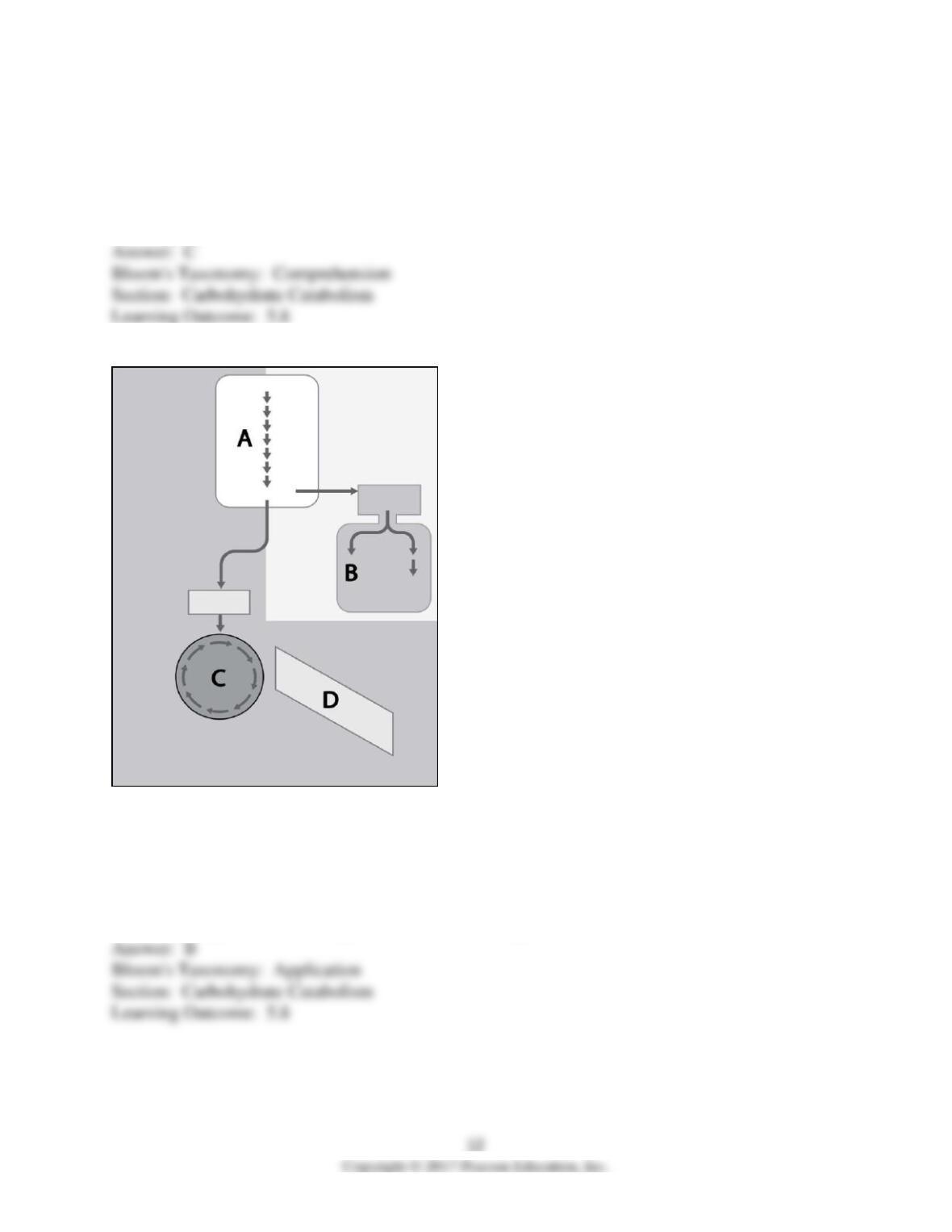
45)
Identify the processes of glucose metabolism represented in Figure 5.1.
A) A = electron transport chain, B = Krebs cycle, C = glycolysis, D = fermentation
B) A = glycolysis, B = fermentation, C = Krebs cycle, D = electron transport chain
C) A = fermentation, B = glycolysis, C = Krebs cycle, D = electron transport chain
D) A = glycolysis, B = Krebs cycle, C = fermentation, D = electron transport chain
E) A = glycolysis, B = Krebs cycle, C = electron transport chain, D = fermentation
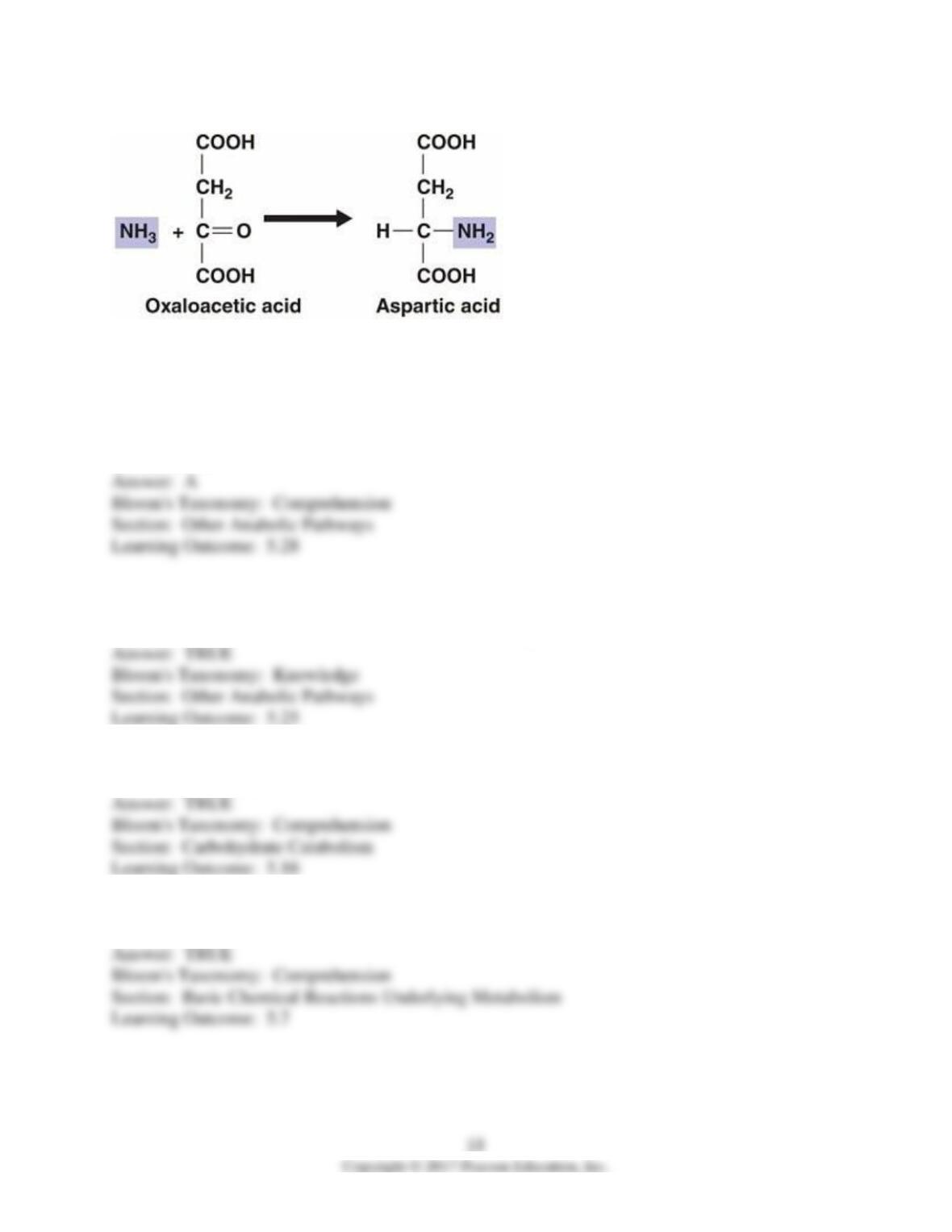
46)
The process illustrated in the figure above is an example of a(n) ________ reaction.
A) amination
B) reduction
C) oxidation
D) transamination
E) transferase
5.2 True/False Questions
1) Reactions that are both catabolic and anabolic are amphibolic.
2) The ability to utilize different metabolites for cellular respiration is one method for
identifying bacteria.
3) Accumulation of a metabolic pathway product may result in decreased activity of the
pathway enzymes.
4) As the concentration of substrate increases, the activity of the enzyme decreases.
5) All substrates for ribozymes are RNA molecules.
6) During chemiosmosis, electrons are pumped across a membrane to produce ATP.
7) Some photosynthetic bacteria use chlorophylls other than chlorophyll a.
8) All the precursors of amino acids are intermediates of glycolytic and fermentation pathways.
9) Essential amino acids are amino acids that cannot be synthesized by an organism and so
must be provided as nutrients.
10) The pentose phosphate pathway generates all the necessary precursors for nucleotide
biosynthesis.
5.3 Short Answer Questions
1) The conversion of phosphoenol pyruvic acid (PEP) to pyruvic acid results in the production
of an ATP. This reaction is an example of (substrate-level/oxidative/reductive)
phosphorylation.
2) Another term for a protein catalyst is a(n) (enzyme/ribozyme).
3) A(n) (oxidation/reduction/transport) reaction is one in which a molecule accepts an electron.
4) The (activation /inhibition/saturation) point of an enzyme is reached when all active sites
have bound substrate molecules.
5) When a noncompetitive inhibitor molecule binds to a(n) (active/allosteric/substrate) site on
an enzyme, the shape of the active site changes so that the substrate molecules can no longer
bind.
6) Beta-oxidation of fatty acids produces (acetic acid/acetyl-CoA/glycerol).
7) Electrons are transferred in the Krebs cycle in the form of (oxygen/hydrogen) atoms to
NAD+ and FAD.
8) The purpose of electron transport is to create a proton (concentration/gradient/pump) across
a membrane that can then be used to make ATP.
9) Anaerobic respiration involves the use of molecules other than oxygen as the final electron
(acceptor/donor) in an electron transport chain.
10) Laboratory fermentation tests often include a pH indicator because many bacteria produce
(O2/bases/acids) as they ferment carbohydrates.
11) Amino acids are converted to substrates of the Krebs cycle by (beta-
oxidation/deamination/transamination).
12) Some bacteria use (acetyl-CoA/DHAP/TMAO) as a final electron receptor, resulting in a
detectable odor.
13) Anoxygenic photosynthesis typically results in the production of (oxygen/sulfur/ammonia)
as a waste product.
14) Cells can use (active/allosteric/substrate) sites to regulate enzyme activity and thereby
control their metabolism.
15) Significant amounts of the NADPH required for the Calvin-Benson cycle are produced
during the (cyclic/noncyclic) photophosphorylation reactions of photosynthesis.
16) Only Photosystem I is required for (anoxygenic/cyclic/noncyclic) photophosphorylation to
occur.
5.4 Essay Questions
1) Describe the mechanism of feedback inhibition and the role this process plays in controlling
enzyme activity.
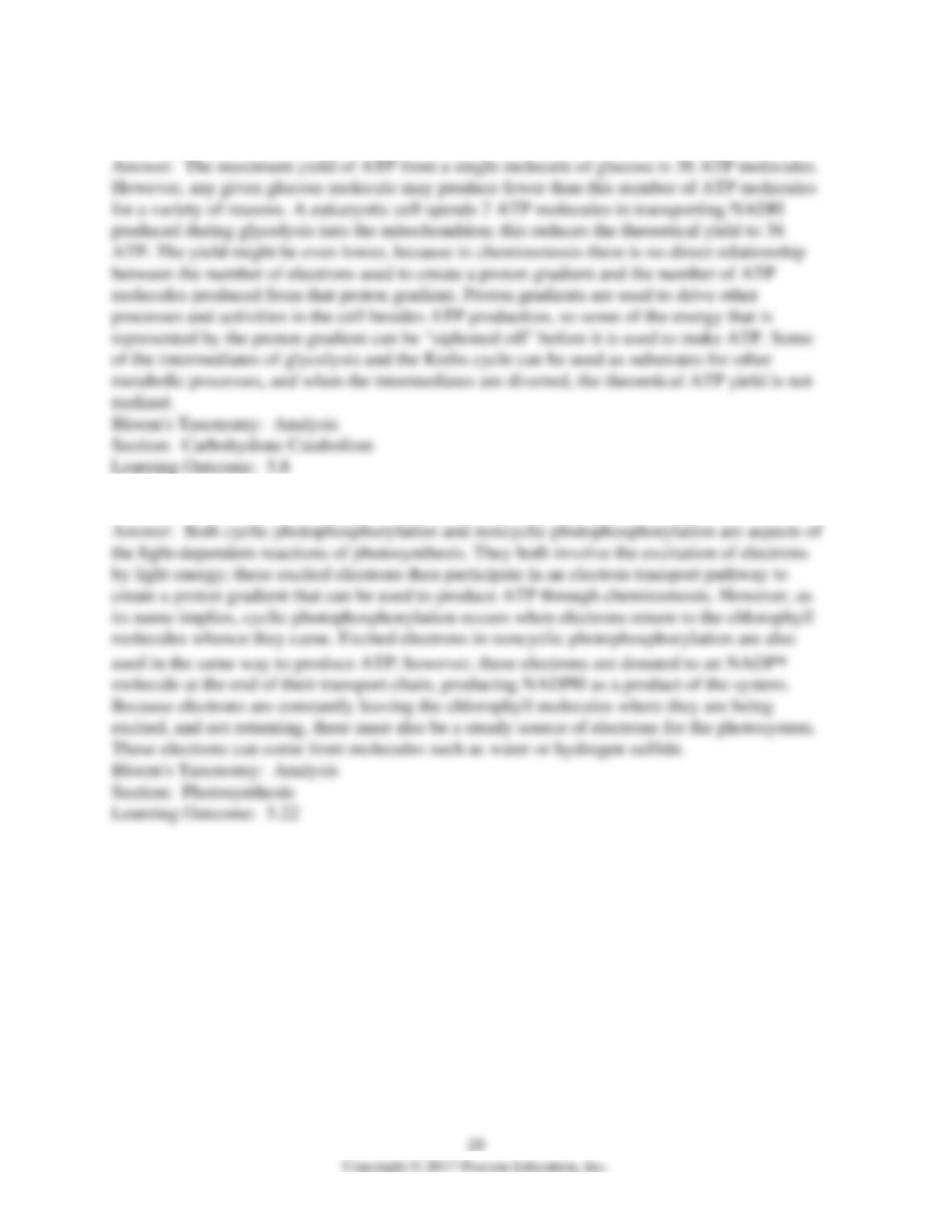
2) The discussion of carbohydrate catabolism includes some of the many metabolic variations
microbes are capable of. Devise a set of biochemical tests to identify the Gram-negative
bacteria mentioned. Assume you can detect various organic compounds. Prepare a dichotomous
key of your identification scheme.
3) Explain why the ATP yield from processes such as cellular respiration is generally given as a
theoretical number.
4) Compare and contrast cyclic and noncyclic photophosphorylation.
5) Discuss the interrelationships between anabolic and catabolic pathways. Provide specific
examples in your answer.