Campbell Biology, 10e (Reece)
Chapter 5 The Structure and Function of Large Biological Molecules
1) Which of these classes of biological molecules does NOT include polymers?
A) lipids
B) carbohydrates
C) proteins
D) nucleic acids
2) Which of the following is NOT a polymer?
A) glucose
B) starch
C) cellulose
D) DNA
3) How many molecules of water are used to completely hydrolyze a polymer that is 11
monomers long?
A) 12
B) 11
C) 10
D) 9
4) Which of the following best summarizes the relationship between dehydration reactions and
hydrolysis?
A) Dehydration reactions assemble polymers; hydrolysis reactions break polymers apart.
B) Dehydration reactions eliminate water from membranes; hydrolysis reactions add water to
membranes.
C) Dehydration reactions and hydrolysis reactions assemble polymers from monomers.
D) Hydrolysis reactions create polymers and dehydration reactions create monomers.
5) The molecular formula for glucose is C6H12O6. What would be the molecular formula for a
molecule made by linking three glucose molecules together by dehydration reactions?
A) C18H36O18
B) C18H32O16
C) C6H10O5
D) C18H30O15
6) What is the difference between an aldose sugar and a ketose sugar?
A) the number of carbons
B) the position of the hydroxyl groups
C) the position of the carbonyl group
D) One is a ring form, the other is a linear chain/
7) What is the major structural difference between starch and glycogen?
A) the types of monosaccharide subunits in the molecules
B) the type of glycosidic linkages in the molecule
C) whether glucose is in the α or β form
D) the amount of branching that occurs in the molecule
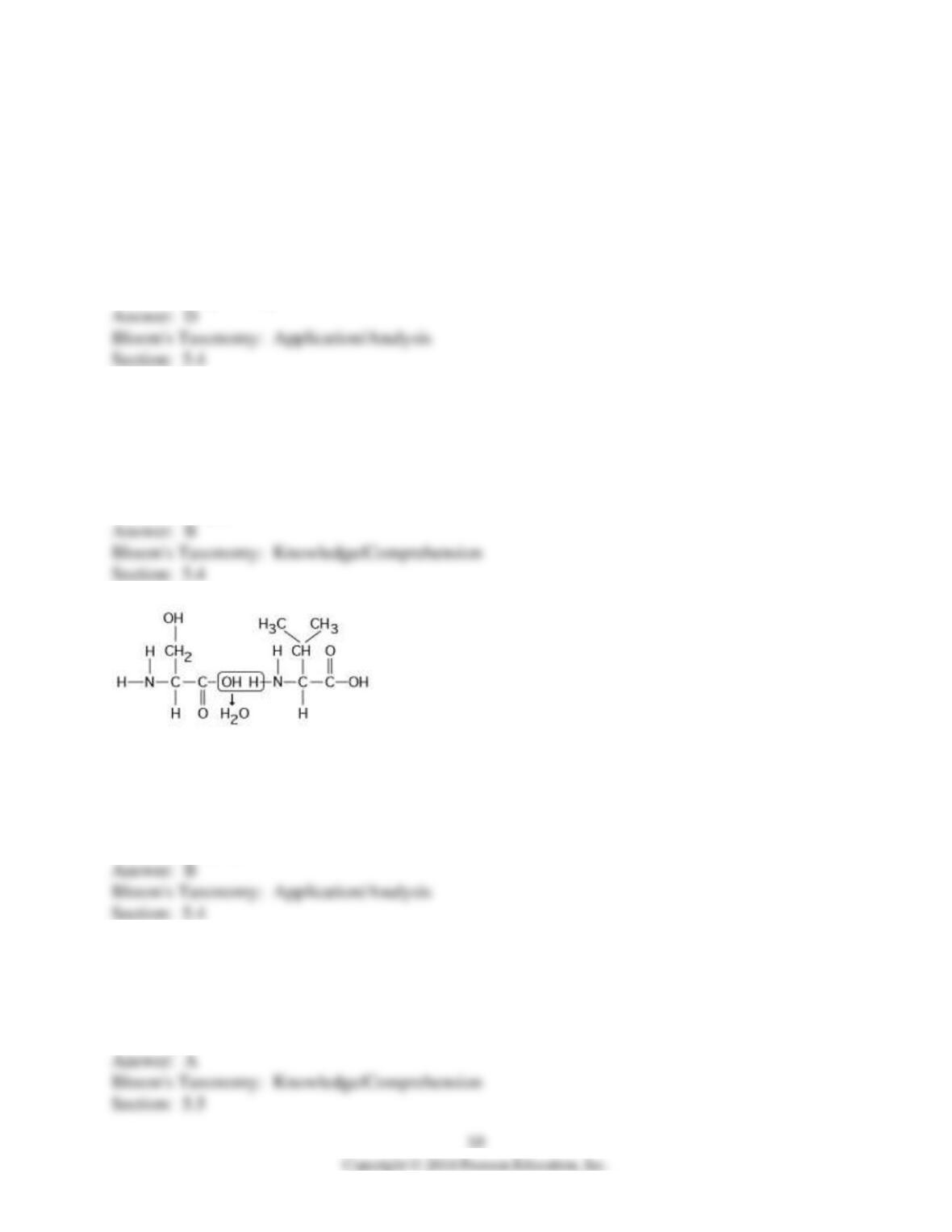
8) Which polysaccharide is an important component in the structure of many animals and fungi?
A) chitin
B) cellulose
C) amylopectin
D) amylose
9) What does the term insoluble fiber refer to on food packages?
A) cellulose
B) polypeptides
C) starch
D) amylopectin
10) A molecule with the chemical formula C6H12O6 is probably a _____.
A) fatty acid
B) polysaccharide
C) nucleic acid
D) monosaccharide
11) Lactose, a sugar in milk, is composed of one glucose molecule joined by a glycosidic linkage
to one galactose molecule. How is lactose classified?
A) as a hexose
B) as a monosaccharide
C) as a disaccharide
D) as a polysaccharide
12) Starch and cellulose _____.
A) are polymers of glucose
B) are cis-trans isomers of each other
C) are used for energy storage in plants
D) are structural components of the plant cell wall
13) Humans can digest starch but not cellulose because _____.
A) humans have enzymes that can hydrolyze the α–glycosidic linkages of starch but not the β–
glycosidic linkages of cellulose
B) starch monomers are joined by covalent bonds and cellulose monomers are joined by ionic
bonds
C) the monomer of starch is glucose, while the monomer of cellulose is galactose
D) the monomer of starch is fructose, while the monomer of cellulose is glucose
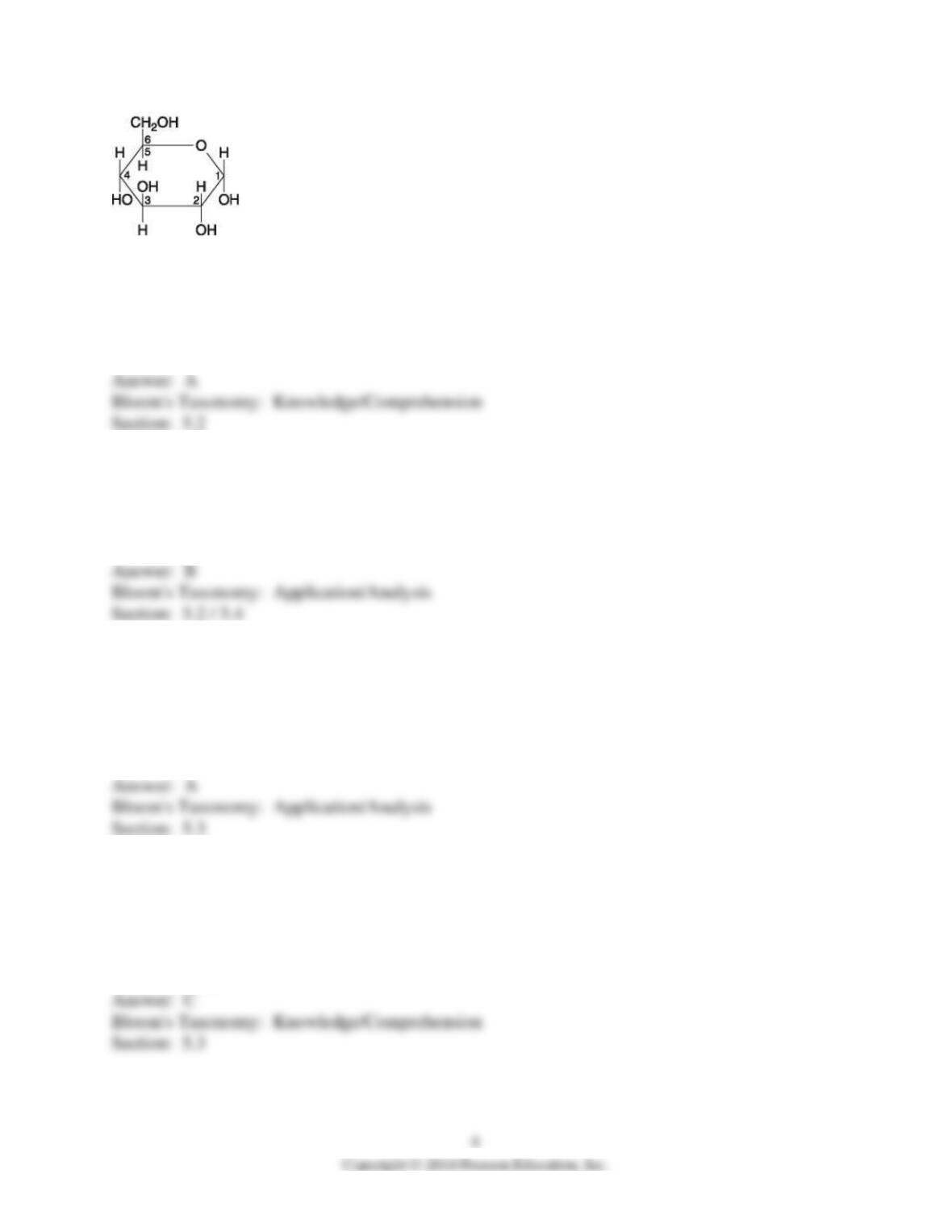
14) The molecule shown in the accompanying figure is _____.
A) a hexose
B) a pentose
C) fructose
D) maltose
15) A glycosidic linkage is analogous to which of the following in proteins?
A) an amino group
B) a peptide bond
C) a disulfide bond
D) a β-pleated sheet
16) Cooking oil and gasoline (a hydrocarbon) are not amphipathic molecules because they
_____.
A) do not have a polar or charged region
B) do not have a nonpolar region
C) have hydrophobic and hydrophilic regions
D) are highly reduced molecules
17) How do phospholipids interact with water molecules?
A) The polar heads avoid water; the nonpolar tails attract water (because water is polar and
opposites attract).
B) Phospholipids do not interact with water because water is polar and lipids are nonpolar.
C) The polar heads interact with water; the nonpolar tails do not.
D) Phospholipids dissolve in water.
18) Phospholipids and triglycerides both _____.
A) contain serine or some other organic compound
B) have three fatty acids
C) have a glycerol backbone
D) have a phosphate
19) Which of the following is the best explanation for why vegetable oil is a liquid at room
temperature while animal fats are solid?
A) Vegetable oil has more double bonds than animal fats.
B) Vegetable oil has fewer double bonds than animal fats.
C) Animal fats have no amphipathic character.
D) Vegetable oil has longer fatty-acid tails than animal fats have.
20) Which of the following statements is FALSE? Saturated fats _____.
A) are more common in animals than in plants
B) have many double bonds in the carbon chains of their fatty acids
C) usually solidify at room temperature
D) contain more hydrogen than unsaturated fats that consist of the same number of carbon atoms
21) Lipids _____.
A) are insoluble in water
B) are made from glycerol, fatty acids, and nitrogen
C) contain less energy than proteins and carbohydrates
D) are made by dehydration reactions
22) The label on a container of margarine lists “hydrogenated vegetable oil” as the major
ingredient. Hydrogenated vegetable oil _____.
A) is solid at room temperature
B) has more “kinks” in the fatty acid chains
C) has fewer trans fatty acids
D) is less likely to clog arteries
23) Saturated fatty acids _____.
A) have double bonds between carbon atoms of the fatty acids
B) are the principal molecules in lard and butter
C) are usually liquid at room temperature
D) are usually produced by plants
24) Steroids are considered to be lipids because they _____.
A) are essential components of cell membranes
B) are not soluble in water
C) are made of fatty acids
D) contribute to atherosclerosis
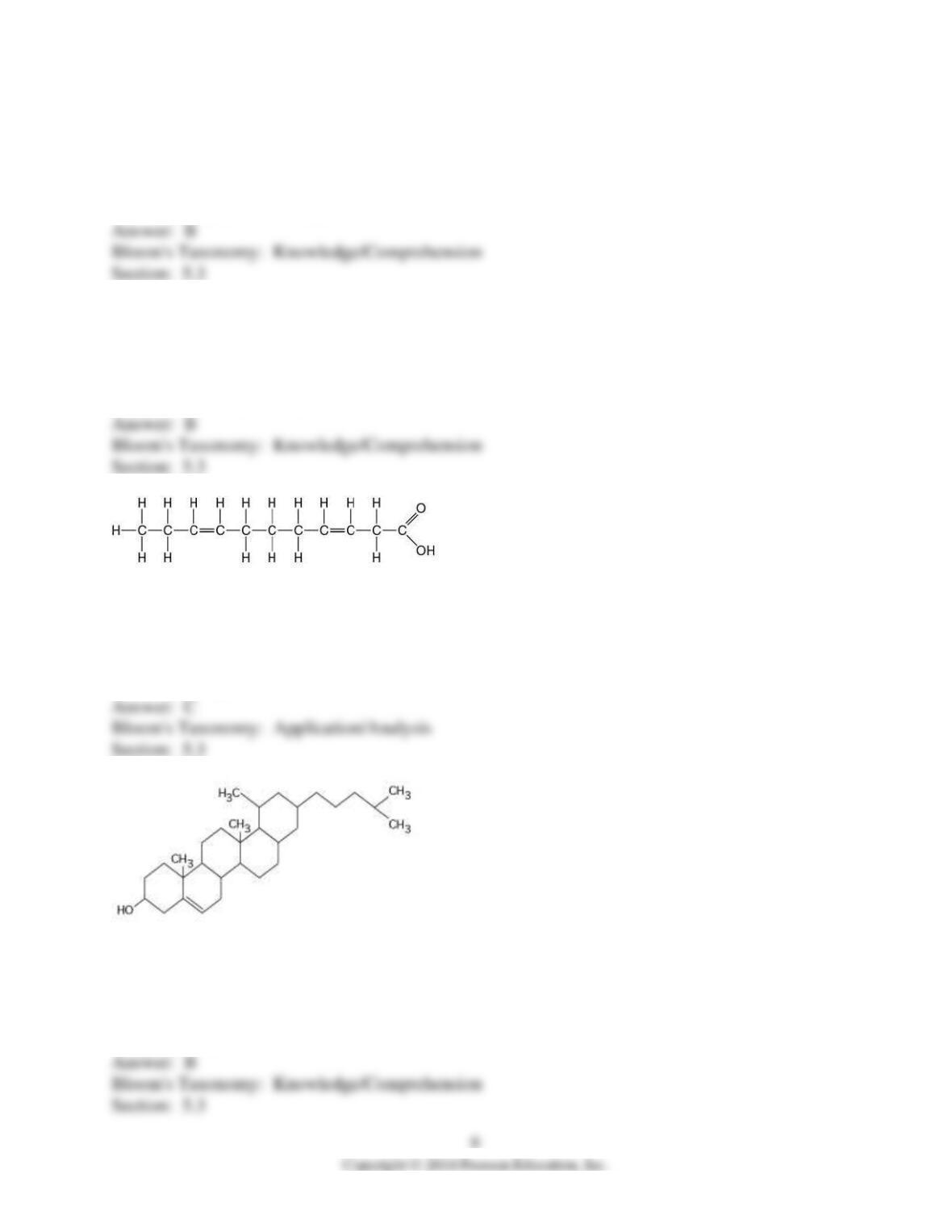
25) The molecule illustrated in the accompanying figure _____.
A) is a saturated fatty acid.
B) stores genetic information.
C) will be liquid at room temperature.
D) is a carbohydrate.
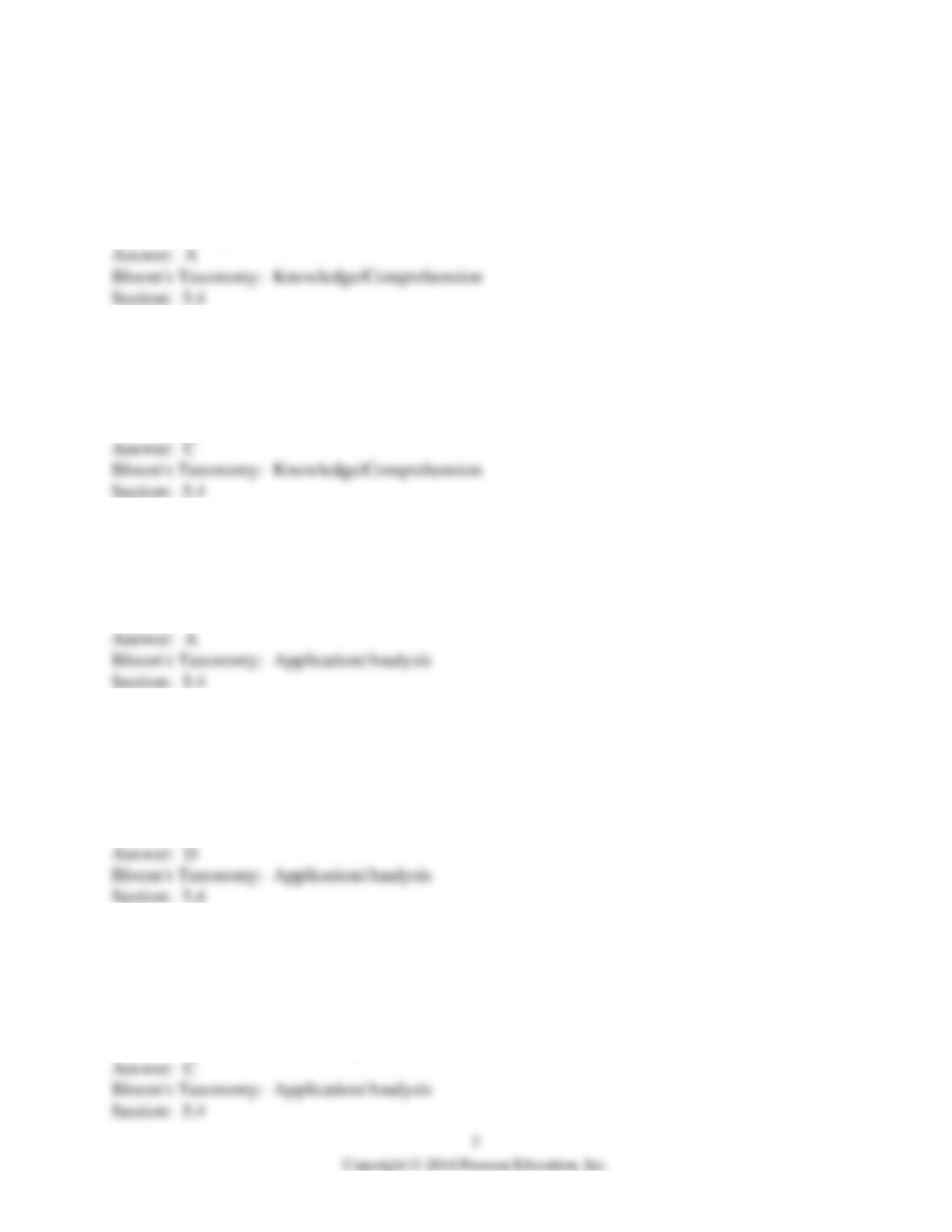
26) The molecule shown the accompanying figure is a _____.
A) fatty acid
B) steroid
C) protein
D) phospholipid
27) Which one of the following is NOT a component of each monomer used to make proteins?
A) a phosphorus atom, P
B) an amino functional group, NH2
C) a side chain, R
D) a carboxyl group, COOH
28) What component of amino acid structure varies among different amino acids?
A) the long carbon-hydrogen tails of the molecule
B) the presence of a central C atom
C) the components of the R-group
D) the glycerol molecule that forms the backbone of the amino acid
29) You disrupt all hydrogen bonds in a protein. What level of structure will be preserved?
A) primary structure
B) secondary structure
C) tertiary structure
D) quaternary structure
30) Which of the following is the strongest evidence that protein structure and function are
correlated?
A) Proteins function best at certain temperatures.
B) Proteins have four distinct levels of structure and many functions.
C) Enzymes tend to be globular in shape.
D) Denatured (unfolded) proteins do not function normally.
31) You have just sequenced a new protein found in mice and observe that sulfur-containing
cysteine residues occur at regular intervals. What is the significance of this finding?
A) Cysteine residues are required for the formation of α–helices and β-pleated sheets.
B) It will be important to include cysteine in the diet of the mice.
C) Cysteine residues are involved in disulfide bridges that help form tertiary structure.
D) Cysteine causes bends, or angles, to occur in the tertiary structure of proteins.
Use the following information when answering the corresponding question(s).
Rhodopsins are light-sensitive molecules composed of a protein (opsin) and retinal (derivative of
vitamin A). Opsin is a membrane protein with several α-helical segments that loop back and
forth through the plasma membrane. There are two classes of rhodopsins. According to Oded
Beje, one class has relatively slow dynamics (a photocycle of approximately 0.5 second) and is
well suited for light detection. The second class has faster dynamics (a photocycle of
approximately 0.02 seconds) and is well suited for chemiosmosis: pumping of protons or
chloride ions across cell membranes. Oded Beje was the first, in September 2000, to report on a
rhodopsin (proteorhodopsin) found in the domain Bacteria. [SOURCE: O. Beje et al., Science
289 (2000): 1902.]
32) Proteorhodopsin consists of a single polypeptide chain. What is the highest level of structure
found in this protein?
A) primary
B) secondary
C) tertiary
D) quaternary
33) All of the following contain amino acids EXCEPT _____.
A) hemoglobin
B) cholesterol
C) enzymes
D) insulin
34) Which level of protein structure do the α–helix and the β-pleated sheet represent?
A) primary
B) secondary
C) tertiary
D) quaternary
35) The tertiary structure of a protein is the _____.
A) order in which amino acids are joined in a polypeptide chain
B) unique three-dimensional shape of the fully folded polypeptide
C) organization of a polypeptide chain into an α–helix or β-pleated sheet
D) overall protein structure resulting from the aggregation of two or more polypeptide subunits
36) The R-group, or side chain, of the amino acid serine is –CH2-OH. The R-group, or side
chain, of the amino acid leucine is –CH2–CH-(CH3)2. Where would you expect to find these
amino acids in a globular protein in aqueous solution?
A) Serine would be in the interior, and leucine would be on the exterior of the globular protein.
B) Leucine would be in the interior, and serine would be on the exterior of the globular protein.
C) Serine and leucine would both be in the interior of the globular protein.
D) Serine and leucine would both be on the exterior of the globular protein.
37) Misfolding of polypeptides is a serious problem in cells. Which of the following diseases are
associated with an accumulation of misfolded polypeptides?
A) Alzheimer’s only
B) Parkinson’s only
C) diabetes mellitus only
D) Alzheimer’s and Parkinson’s only
38) Changing a single amino acid in a protein consisting of 325 amino acids would _____.
A) alter the primary structure of the protein but not its tertiary structure or function
B) cause the tertiary structure of the protein to unfold
C) always alter the biological activity or function of the protein
D) always alter the primary structure of the protein, sometimes alter the tertiary structure of the
protein, and sometimes affect its biological activity
39) Normal hemoglobin is a tetramer, consisting of two molecules of β hemoglobin and two
molecules of α hemoglobin. In sickle-cell disease, as a result of a single amino acid change, the
mutant hemoglobin tetramers associate with each other and assemble into large fibers. Based on
this information alone, we can conclude that sickle-cell hemoglobin exhibits _____.
A) only altered primary structure
B) only altered tertiary structure
C) only altered quaternary structure
D) altered primary structure and altered quaternary structure; the secondary and tertiary
structures may or may not be altered
40) What is the term used for a protein molecule that assists in the proper folding of other
proteins?
A) tertiary protein
B) chaperonin
C) renaturing protein
D) denaturing protein
41) The chemical reaction illustrated in the accompanying figure _____.
A) is a hydrolysis reaction
B) results in a peptide bond
C) joins two fatty acids together
D) links two polymers to form a monomer
42) Nucleic acids are polymers made up of which of the following monomers?
A) nucleotides
B) sugars
C) amino acids
D) nitrogenous bases
43) Which of the following includes all of the pyrimidines found in RNA and DNA?
A) cytosine and uracil
B) cytosine and thymine
C) cytosine, uracil, and thymine
D) cytosine, uracil, and guanine
44) When nucleotides polymerize to form a nucleic acid _____.
A) a covalent bond forms between the sugar of one nucleotide and the phosphate of a second
B) a hydrogen bond forms between the sugar of one nucleotide and the phosphate of a second
C) covalent bonds form between the bases of two nucleotides
D) hydrogen bonds form between the bases of two nucleotides
45) Which of the following statements about the 5′ end of a polynucleotide strand of RNA is
correct?
A) The end has a hydroxyl group attached to the number 5 carbon of ribose.
B) The end has a phosphate group attached to the number 5 carbon of ribose.
C) The end has phosphate attached to the number 5 carbon of the nitrogenous base.
D) The end has a carboxyl group attached to the number 5 carbon of ribose.
46) One of the primary functions of RNA molecules is to _____.
A) transmit genetic information to offspring
B) function in the synthesis of proteins
C) make a copy of itself, thus ensuring genetic continuity
D) act as a pattern or blueprint to form DNA
47) If 14C-labeled uracil is added to the growth medium of cells, what macromolecules will be
labeled?
A) DNA
B) RNA
C) both DNA and RNA
D) proteins
48) Which of the following descriptions best fits the class of molecules known as nucleotides?
A) a nitrogenous base and a phosphate group
B) a nitrogenous base and a sugar
C) a nitrogenous base, a phosphate group, and a sugar
D) a sugar and a purine or pyrimidine
49) If a DNA sample were composed of 10% thymine, what would be the percentage of
guanine?
A) 10
B) 40
C) 80
D) It is impossible to tell from the information given.
50) Which of the following statements best summarizes the differences between DNA and RNA?
A) DNA encodes hereditary information, whereas RNA does not.
B) The bases in DNA contain sugars, whereas the bases in RNA do not contain sugar.
C) DNA nucleotides contain a different sugar than RNA nucleotides.
D) DNA contains the base uracil, whereas RNA contains the base thymine.
51) If one strand of a DNA molecule has the sequence of bases 5’ATTGCA3′, the other
complementary strand would have the sequence _____.
A) 5’TAACGT3′
B) 5’TGCAAT3′
C) 3’UAACGU5′
D) 5’UGCAAU3′
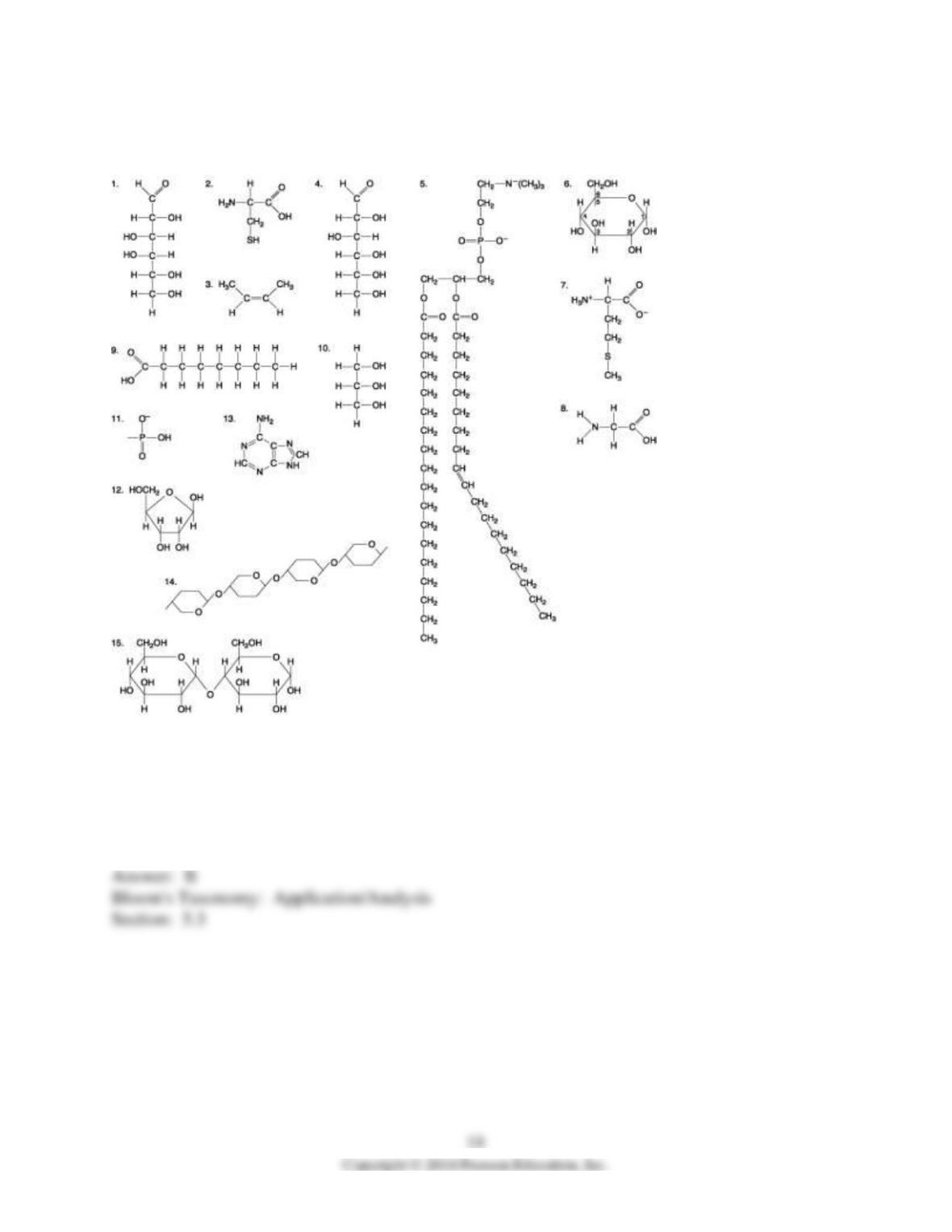
The following questions are based on the 15 molecules illustrated in the accompanying figure.
Each molecule may be used once, more than once, or not at all.
52) Which molecule has both hydrophilic and hydrophobic properties and is found in plasma
membranes?
A) 1
B) 5
C) 12
D) 14
53) Which of the following combinations of molecules illustrated could be linked to form a
nucleotide?
A) 1, 2, and 11
B) 3, 7, and 8
C) 5, 9, and 10
D) 11, 12, and 13
54) Which molecule is a saturated fatty acid?
A) 1
B) 5
C) 8
D) 9
55) Which of the following molecules is a purine nitrogenous base?
A) 2
B) 5
C) 12
D) 13
56) Which of the following molecules act as building blocks (monomers) of polypeptides?
A) 1, 4, and 6
B) 2, 7, and 8
C) 7, 8, and 13
D) 11, 12, and 13
57) Which of the following pairs of molecules could be joined together by a peptide bond in a
dehydration reaction?
A) 2 and 3
B) 7 and 8
C) 8 and 9
D) 12 and 13
58) A fat (or triacylglycerol) would be formed as a result of a dehydration reaction between
_____.
A) one molecule of 9 and three molecules of 10
B) three molecules of 9 and one molecule of 10
C) one molecule of 5 and three molecules of 9
D) one molecule of 5 and three molecules of 10
59) Which of the following molecules is the pentose sugar found in RNA?
A) 1
B) 6
C) 12
D) 13
60) A new organism is discovered in the forests of Costa Rica. Scientists there determine that the
polypeptide sequence of hemoglobin from the new organism has 72 amino acid differences from
humans, 65 differences from a gibbon, 49 differences from a rat, and 5 differences from a frog.
These data suggest that the new organism is more closely related to _____.
A) humans than to frogs
B) frogs than to humans
C) rats than to frogs
D) gibbons than to rats
61) Absorbance at Various pH Levels
Time (sec)
pH 4
pH 5
pH 6
pH 7
pH 8
pH 9
20
0.003
0.025
0.055
0.146
0.005
0.004
40
0.009
0.109
0.152
0.300
0.015
0.008
60
0.012
0.195
0.255
0.432
0.038
0.010
80
0.020
0.215
0.341
0.552
0.065
0.012
100
0.023
0.333
0.413
0.659
0.081
0.013
120
0.025
0.360
0.478
0.755
0.090
0.013
The accompanying table represents the results of an experiment where the effects of pH buffers
on an enzyme found in saliva (amylase) were studied. A spectrophotometer set at 500nm was
used to measure absorbance at the various pH levels every 20 sec for 2 min. The higher
absorbance values would indicate greater enzyme activity. All experiments were conducted at
the same temperature.
Which statement correctly identifies the result that the optimum pH for amylase function is 7?
A) The pH with the lowest absorbance values would indicate the optimum pH for amylase since
this pH does not affect the structure or function of the protein.
B) The pH with the highest absorbance values would indicate the optimum pH for amylase since
this pH does not affect the structure or function of the protein.
C) At pH 9, the enzyme is denatured and will lose its function, but not its structure.
D) At pH 4, the structure of the enzyme will be altered, and the enzyme would not be able to
catalyze the reaction.