
46) Which of the following nations has become a world leader in the establishment of zoned
reserves?
A) Costa Rica
B) Canada
C) China
D) United States
E) Mexico
47) Which of the following best explains the reduction in human population growth rates over
the past four decades?
A) education on global famine
B) improved worldwide health care
C) voluntary reduction of family size
D) improved sanitary conditions in the world’s hospitals
E) reduction of casualties of war
48) Which statement is true with regard to current human population growth?
A) It is at a zero growth rate.
B) Its rate of increase continues to grow at an exponential rate.
C) Its rate of growth is slowing.
D) Its rate of growth is increasing.
E) There is no scientific prediction that can be made about human population growth.

49) The typical ecological footprint for a person in the United States is 8 global hectares (gha).
How would you estimate the number of Earths required to support the entire population of the
United States?
A) Multiply the typical U.S. ecological footprint by the number of people who live there, and
divide by the total global hectares of biologically productive land.
B) Multiply the typical U.S. ecological footprint by the effective population size of the United
States, and divide by the total global hectares of biologically productive land.
C) Take the difference between the typical U.S. ecological footprint and the 1.7 gha sustainable
ecological footprint, and multiply this difference by the number of people who live in the United
States.
D) Take the difference between the typical U.S. ecological footprint and the 1.7 gha sustainable
ecological footprint, and multiply this difference by the total global hectares of biologically
productive land.
50) The main goal of sustainable development is to
A) involve more countries in conservation efforts.
B) use only natural resources in the construction of new buildings.
C) use natural resources such that they do not decline over time.
D) reevaluate and re-implement management plans over time.
51) Which of the following best illustrates human efforts to improve environmental
sustainability?
A) rerouting major highways around cities to avoid traffic congestion
B) increasing our reliance on renewable sources of energy
C) upgrading computers every few years to improve performance
D) converting automobiles from gasoline to natural gas as a new source of fuel

52) Which of the following best illustrates the sustainable use of a resource?
A) Coal mines in West Virginia remove the tops of mountains to extract large amounts of coal.
B) Fishing industries improve their methods and now remove more than 90% of the fish in a
region.
C) Huge windmills in Texas are able to capture 50% of the wind energy in a specific region.
D) Corporations are converting their company automobiles from gasoline to natural gas, which is
a less expensive fossil fuel.
53) The concept of sustainable development emphasizes
A) the needs of future generations.
B) trade between all nations of the world.
C) the importance of developing the arts.
D) the fastest ways to economic prosperity.
E) the need for national government action.
54) Which of the following is the most sustainable source of energy?
A) natural gas used to heat homes
B) gasoline used to run cars
C) solar panels on rooftops
D) a coal power plant

43.2 Art Questions
1)
Figure 43.1
Figure 43.1 shows five patches that can potentially serve as quail habitat. Each patch contains
four plots, and the types of cover that are available in each plot are listed in each row of the
patch. Assuming that only one quail can occupy a plot where all cover requirements are met,
what is the maximum number of quail that could inhabit all of the patches?
A) 1
B) 2
C) 4
D) 6
E) 9
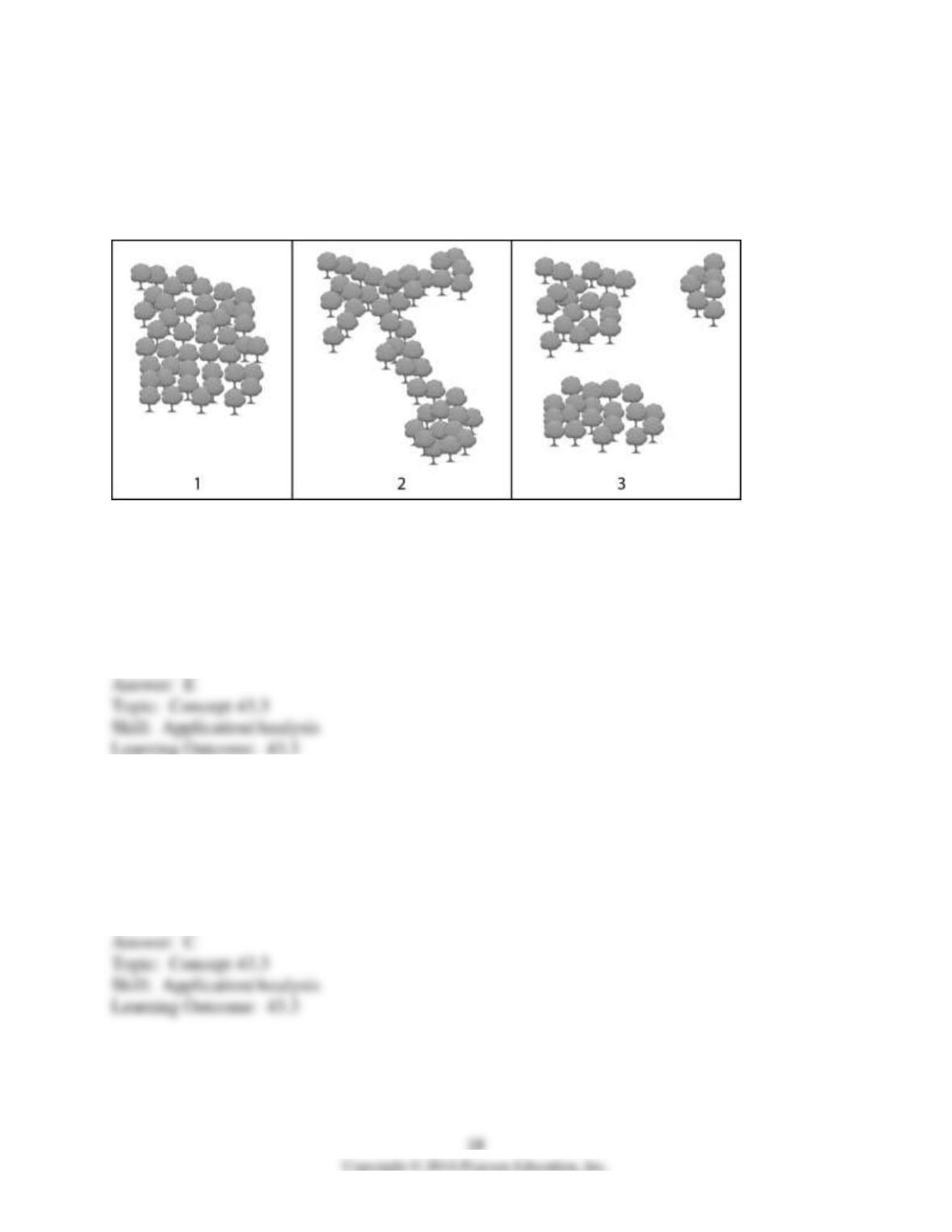
Please use the following information to answer the question(s) below.
Three forest areas are being considered for a conservation reserve. Each area contains the same
number of trees and is the same cumulative size. The area surrounding the forest patches is a mix
of agricultural land and residential homes.
2) Which area(s) would be most suitable for conserving amphibians, which are highly
susceptible to a pathogenic (disease-causing) chytrid fungus?
A) 1 and 2
B) 2 and 3
C) 1 only
D) 2 only
E) 3 only
3) Which area(s) would be able to support the most scarlet tanagers, a bird species that is
restricted to forest interior habitat?
A) 1 and 2
B) 2 and 3
C) 1 only
D) 2 only
E) 3 only

4) The American lady butterfly (Vanessa virginiensis) inhabits only forest edges and does not
disperse well across unsuitable habitat. Which of the following area(s) would support the highest
numbers of this butterfly?
A) 1 and 2
B) 2 and 3
C) 1 only
D) 2 only
E) 3 only
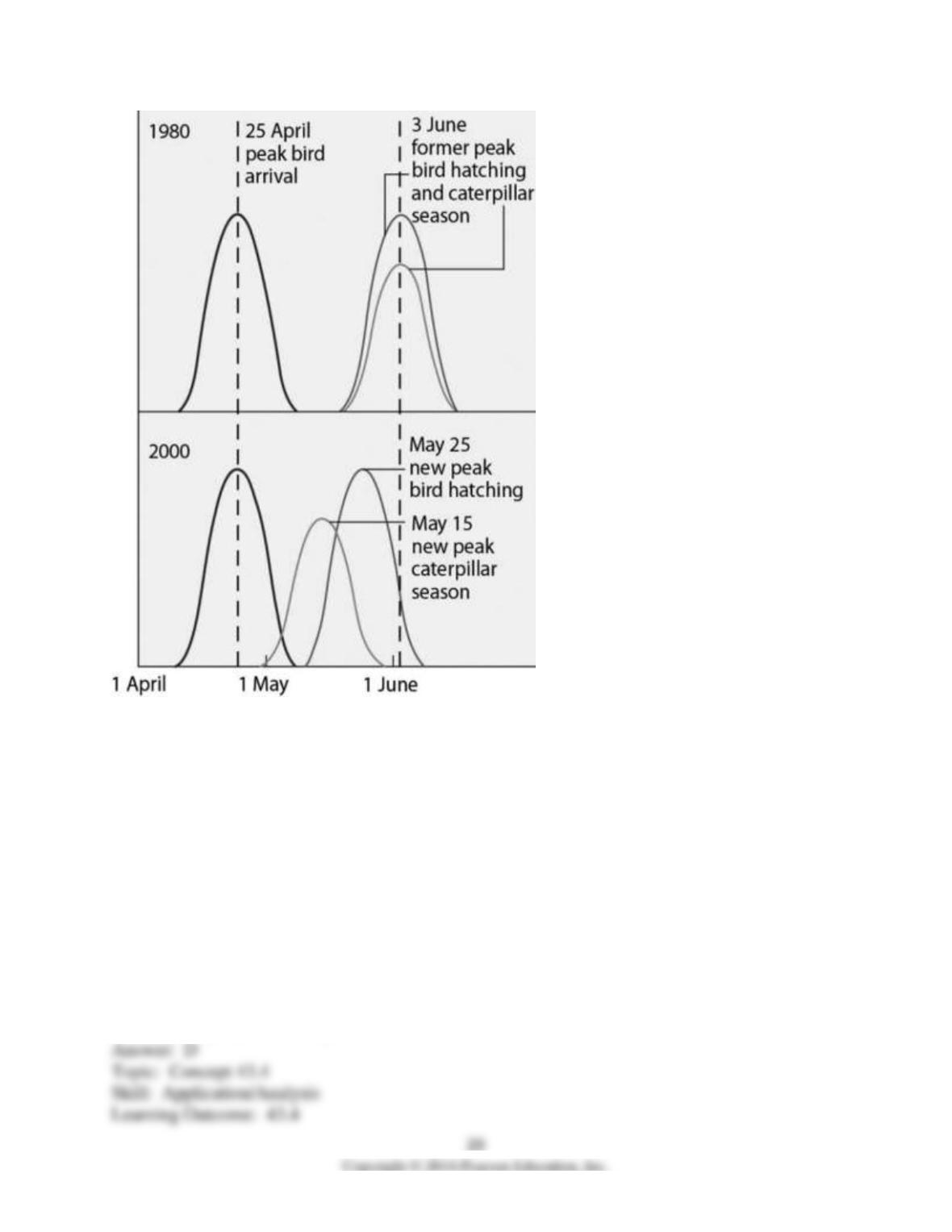
Figure 43.3
Use the graph in Figure 43.3 and the information provided in the paragraph below to answer the
following questions.
Flycatcher birds that migrate from Africa to Europe feed their nestlings a diet that is almost
exclusively moth caterpillars. The graph in Figure 43.3 shows the mean (peak) dates of bird
arrival, bird hatching, and caterpillar season for the years 1980 and 2000.
5) The shift in the peak of caterpillar season is most likely due to
A) pesticide use.
B) earlier migration returns of flycatchers.
C) an innate change in the biological clock of the caterpillars.
D) global warming.
E) acid precipitation in Europe.

6) Why were ecologists concerned about the shift in the peak caterpillar season from June 3,
1980 to May 15, 2000?
A) The caterpillars would have eaten much of the foliage of the trees where flycatchers would
have nested, rendering their nests more open to predation.
B) The earlier hatching of caterpillars would compete with other insect larval forms that the
flycatchers would also use to feed their young.
C) The flycatcher nestlings in 2000 would miss the peak caterpillar season and might not be as
well fed, leading to population reductions.
D) The flycatchers would have to migrate sooner to match their brood-rearing to the time of peak
caterpillar season.
43.3 Scenario Questions
1) Suppose you attend a town meeting at which some experts tell the audience that they have
performed a cost-benefit analysis of a proposed transit system that would probably reduce
overall air pollution and fossil fuel consumption. The analysis, however, reveals that ticket prices
will not cover the cost of operating the system when fuel, wages, and equipment are taken into
account. As a biologist, you know that if ecosystem services had been included in the analysis
the experts might have arrived at a different answer. Why are ecosystem services rarely included
in economic analyses?
A) People take them for granted because we generally do not pay for them.
B) They are not worth much and would not greatly change the cost-benefit analysis.
C) There are too many variables to include in ecosystem services, making their calculation
impossible.
D) Ecosystem services only take into account abiotic factors that affect local environments.
2) Your friend is wary of environmentalists’ claims that climate change could lead to major
biological change on Earth. Which of the following statements should you use to support the
biological predictions associated with climate change?
A) We know that atmospheric carbon dioxide has increased over the past 150 years.
B) Through measurements and observations, we know that CO2 levels and temperature
fluctuations are directly correlated, even in prehistoric times.
C) Hundreds of organisms have already shifted in distribution as a result of warming that has
occurred over the last 100 years.
D) Sea levels will likely fall, displacing as much as 50% of the world’s human population.

Please use the following information to answer the question(s) below.
The contamination of soils with heavy metals has become more common as a result of the
burning of fossil fuels, industrial activities, and agricultural fertilizer application. These heavy
metals can be toxic depending on the concentrations that accumulate in an organism. A scientist
hypothesizes that biological magnification of heavy metals in fragment-dwelling, insect-eating
birds should be greater in forest fragments with relatively more edge habitat because edge–
dwelling bird species may forage for insects in contaminated areas outside of the forest. Forest
fragments with more interior habitat would not have as much biological magnification because
insect-eating interior bird species would have less exposure to insects that contain heavy metals.
3) To test this hypothesis, the scientist conducts an experiment. Which of the following designs
would be most informative?
A) Locate a single forest fragment with equal amounts of edge and interior habitat, then sample
the blood of insect-eating birds at regular distances along a path across the widest point of the
fragment.
B) Locate several forest fragments of similar sizes but different shapes, then sample the blood of
insect-eating birds at regular distances along a 100-m path in each fragment.
C) Locate several forest fragment of different sizes but similar shapes, then sample the blood of
insect-eating birds at regular distances along a path across the widest point of each fragment.
D) Locate several forest fragments of similar sizes and shapes, then sample the blood of insect-
eating birds at regular distances along a 100-m path in each fragment.
4) The scientist wishes to summarize the data in a way that can be compared to other studies on
biological magnification of heavy metals in insect-eating birds that live in other forest fragments.
What is the best way for the scientist to summarize the data for comparative purposes?
A) Calculate the mean concentration of heavy metals measured in the birds that were found in a
fragment.
B) Calculate the mean concentration of heavy metals measured in the birds that were found in a
fragment and divide by the size of the fragment.
C) Calculate the sum total concentrations of heavy metals across all the birds found in a
fragment.
D) Calculate the sum total concentrations of heavy metals across all the birds found in a
fragment, and divide by the size of the fragment.

5) How should the scientist draw a graph of the data to best address the hypothesis?
A) Plot the heavy metal concentration on the y-axis and the relative amount of edge habitat on
the x-axis.
B) Plot the total amount of edge habitat on the y-axis and the total amount of interior habitat on
the x-axis.
C) Plot the number of birds on the y-axis and the size of the fragment on the x-axis.
D) Plot the density of insects on the y-axis and the total amount of edge habitat on the x-axis.
6) The scientist finds that the heavy metal concentration in the insect-eating birds of a fragment
does not depend on the relative amount of edge habitat of that fragment. Which of the following
describes how experimental error may have influenced the results?
A) The density of birds is higher in edge habitat compared to interior habitat.
B) The forest fragments studied were too small, and there was no true interior habitat for birds to
live in.
C) The insects eaten by both edge and interior birds do not differ in heavy metal concentration.
D) Heavy metals deposited from atmospheric pollution are equal across the landscape.

43.4 End-of-Chapter Questions
1) One characteristic that distinguishes a population in an extinction vortex from most other
populations is that
A) it it is a rare, top-level predator.
B) its effective population size is much lower than its total population size.
C) its genetic diversity is very low.
D) it is not well adapted to edge conditions.
2) The main cause of the increase in the amount of CO2 in Earth’s atmosphere over the past 150
years is
A) increased worldwide primary production.
B) increased worldwide standing crop.
C) an increase in the amount of infrared radiation absorbed by the atmosphere.
D) the burning of larger amounts of wood and fossil fuels.
3) What is the single greatest threat to biodiversity?
A) overharvesting of commercially important species
B) habitat alteration, fragmentation, and destruction
C) introduced species that compete with native species
D) pollution of Earth’s air, water, and soil
4) Which of the following is a consequence of biological magnification?
A) Toxic chemicals in the environment pose greater risk to top-level predators than to primary
consumers.
B) Populations of top-level predators are generally smaller than populations of primary
consumers.
C) The biomass of producers in an ecosystem is generally higher than the biomass of primary
consumers.
D) Only a small portion of the energy captured by producers is transferred to consumers.

5) Which of the following strategies would most rapidly increase the genetic diversity of a
population in an extinction vortex?
A) Establish a reserve that protects the population’s habitat.
B) Introduce new individuals transported from other populations of the same species.
C) Sterilize the least fit individuals in the population.
D) Control populations of the endangered population’s predators and competitors.
6) Of the following statements about protected areas that have been established to preserve
biodiversity, which one is not correct?
A) About 25% of Earth’s land area is now protected.
B) National parks are one of many types of protected areas.
C) Management of a protected area should be coordinated with management of the land
surrounding the area.
D) It is especially important to protect biodiversity hot spots.