
57) In Japan, seaweed and seagrass bed reconstruction includes constructing suitable seafloor
habitat, transplanting seaweeds and seagrasses from natural beds using artificial substrates, and
hand seeding. Which of the following correctly classifies the techniques by the major restoration
strategies?
A) biological augmentation—transplanting seaweeds and seagrasses, hand seeding
B) biological augmentation—hand seeding and constructing seafloor habitat
C) bioremediation—constructing seafloor habitat and using artificial substrates
D) bioremediation—transplanting seaweeds and seagrasses, hand seeding
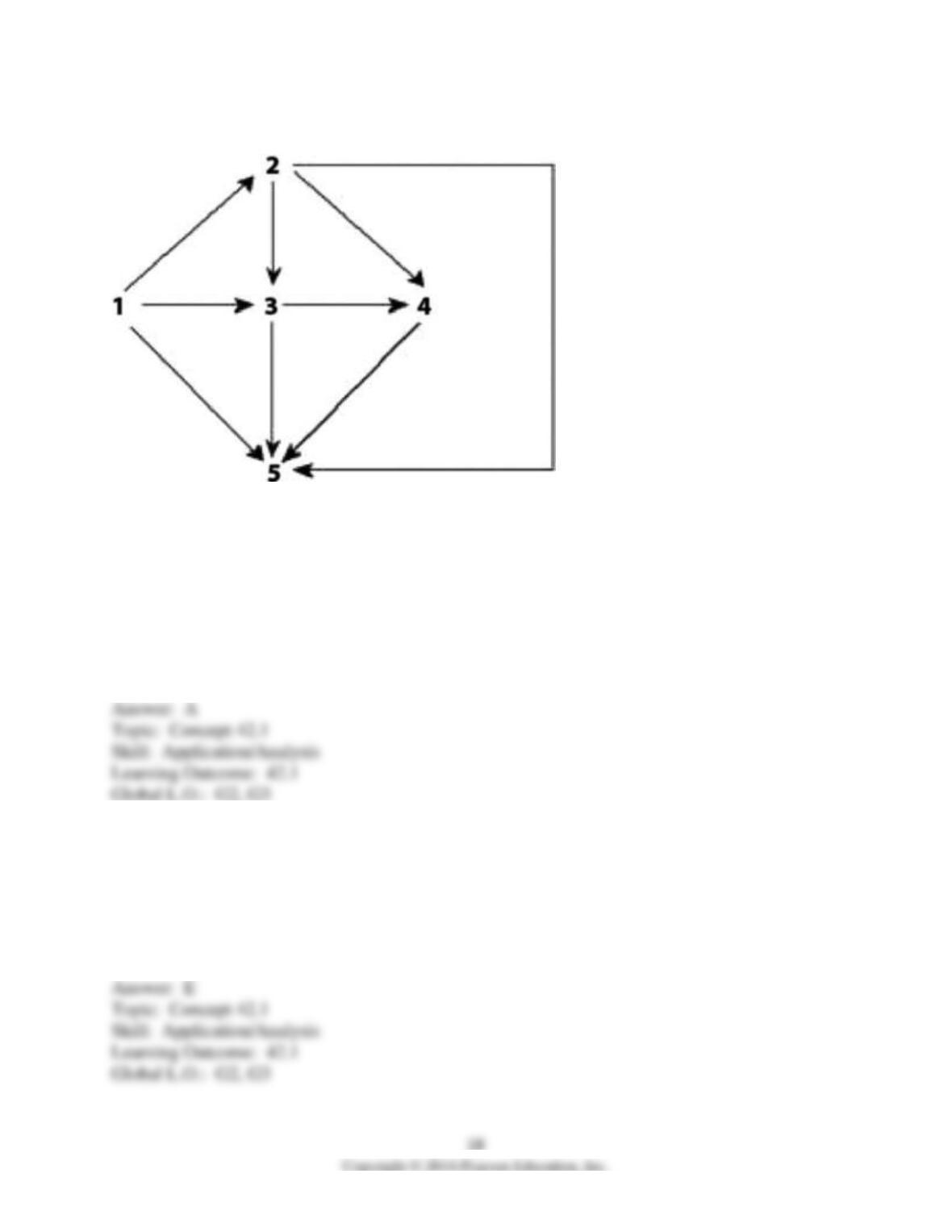
42.2 Art Questions
Figure 42.1 Food web for a particular terrestrial ecosystem (arrows represent energy flow
and numbers represent species)
1) Examine the food web for a particular terrestrial ecosystem in Figure 42.1. Which species is
autotrophic?
A) 1
B) 2
C) 3
D) 4
E) 5
2) Examine the food web for a particular terrestrial ecosystem in Figure 42.1. Which species is
most likely a decomposer in this food web?
A) 1
B) 2
C) 3
D) 4
E) 5

3) Examine the food web for a particular terrestrial ecosystem in Figure 42.1. Species C is toxic
to predators. Which species is most likely to benefit from being a mimic of C?
A) 1
B) 2
C) 3
D) 4
E) 5
4) Examine the food web for a particular terrestrial ecosystem in Figure 42.1. Which pair of
species acquire energy from more than one trophic level?
A) 1 and 2
B) 1 and 4
C) 2 and 3
D) 3 and 4
E) 3 and 5
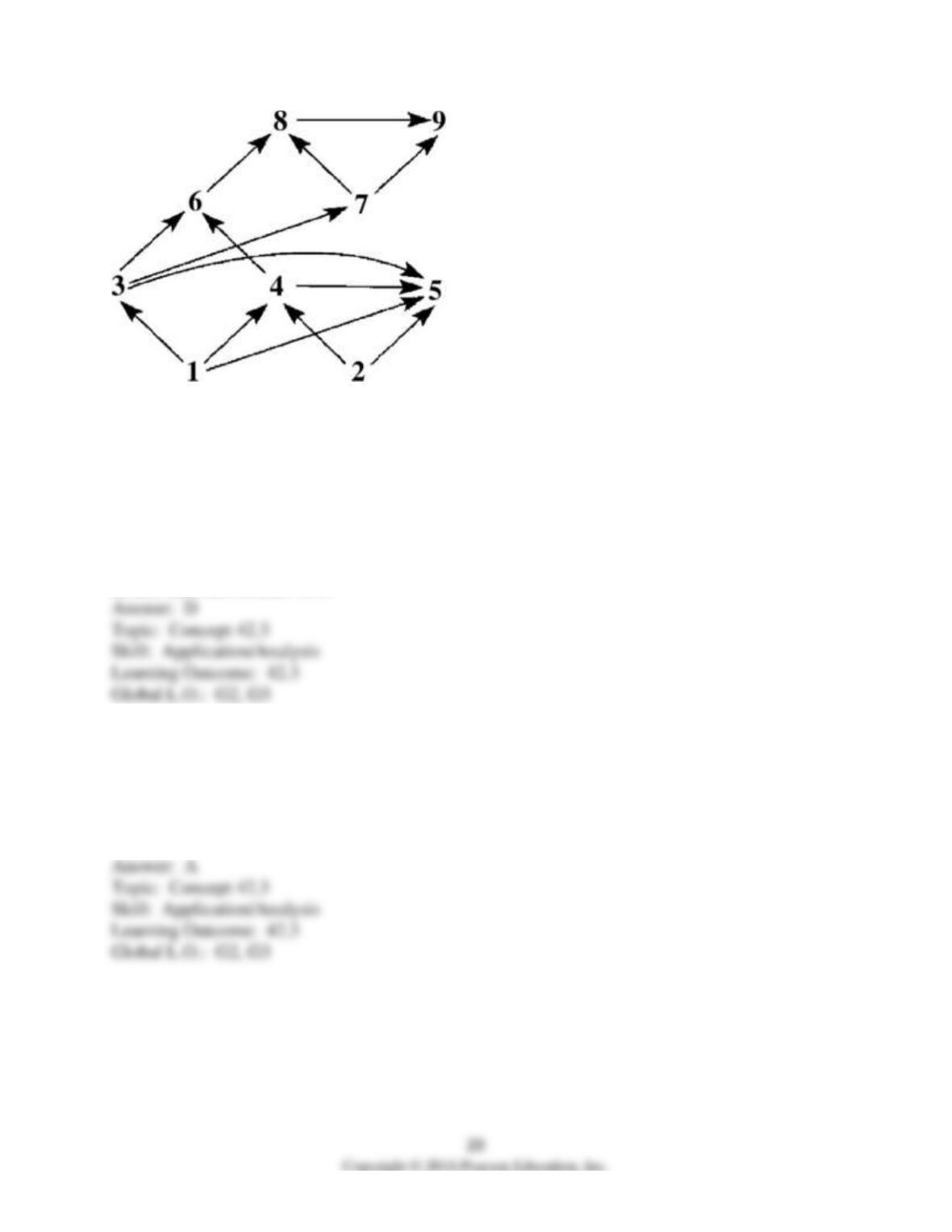
Figure 42.2 Diagram of a food web (arrows represent energy flow and numbers represent
species)
5) If Figure 42.2 represents a terrestrial food web, the combined biomass of 3 + 4 would
probably be
A) greater than the biomass of 1.
B) less than the biomass of 8.
C) greater than the biomass of 2.
D) less than the biomass of 1 + 2.
E) less than the biomass of 6.
6) If Figure 42.2 represents a marine food web, the smallest organism might be
A) 1.
B) 6.
C) 3.
D) 9.
E) 5.
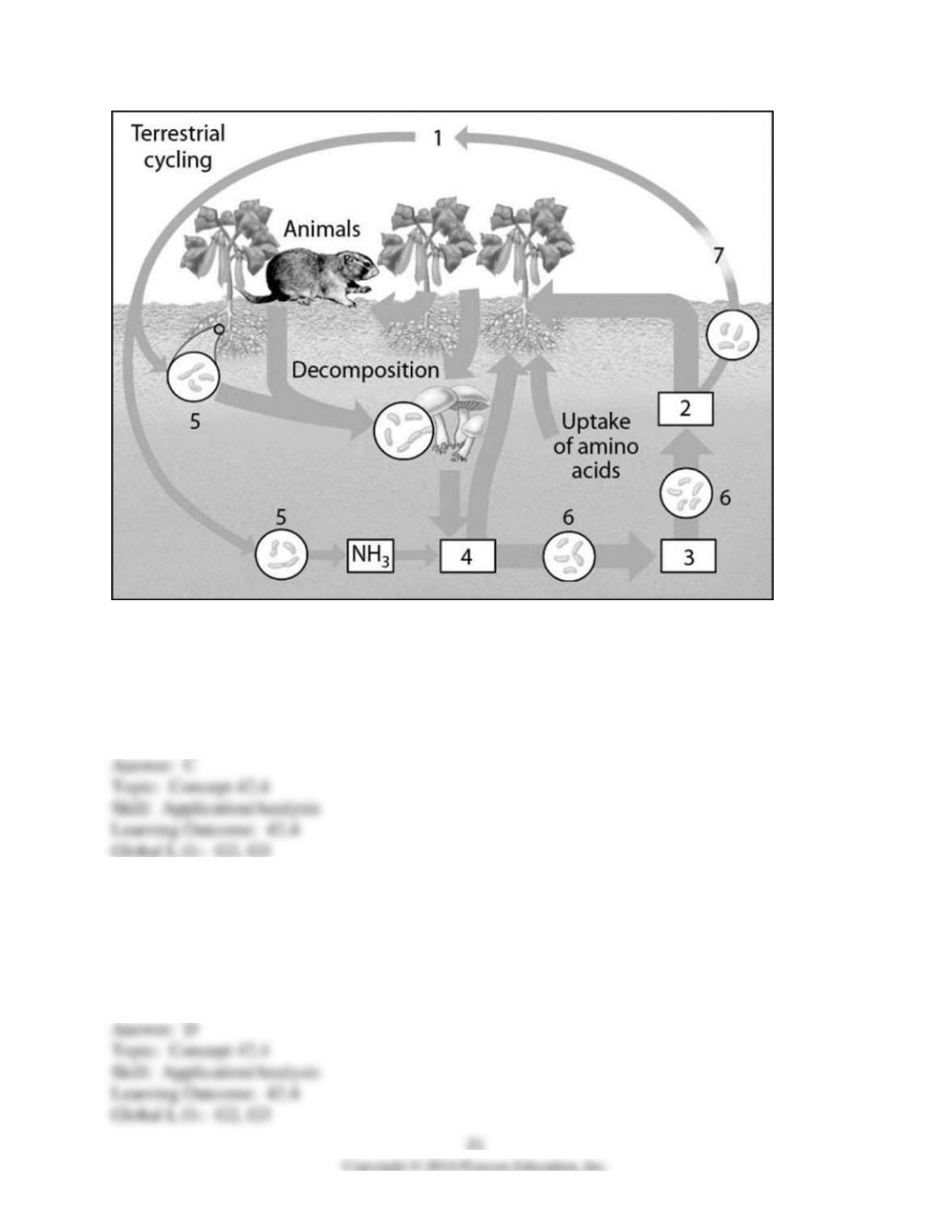
Figure 42.3
7) In the diagram of the nitrogen cycle in Figure 42.3, which number represents nitrite (NO2)?
A) 1
B) 2
C) 3
D) 4
8) In the diagram of the nitrogen cycle in Figure 42.3, which number represents the ammonium
ion (NH4+)?
A) 1
B) 2
C) 3
D) 4

9) In the diagram of the nitrogen cycle in Figure 42.3, which number represents nitrogen-fixing
bacteria?
A) 5
B) 6
C) 7
D) 1
10) In the diagram of the nitrogen cycle in Figure 42.3, which number represents nitrifying
bacteria?
A) 5
B) 6
C) 7
D) 3

42.3 Scenario Questions
1) As big as it is, the ocean is nutrient-limited. If you wanted to investigate this, one reasonable
approach would be to
A) follow whale migrations in order to determine where most nutrients are located.
B) observe Southern Ocean (Antarctic Ocean) productivity from year to year to see if it changes.
C) experimentally enrich some areas of the ocean and compare their productivity to that of
untreated areas.
D) compare nutrient concentrations between the photic zone and the benthic zone in various
marine locations.
E) contrast nutrient uptake by autotrophs in marine locations that are different temperatures.
2) A porcupine eats 3,000 J of plant material. Of this, 2,100 J are indigestible and are eliminated
as feces, 800 J are used in cellular respiration, and 100 J are used for growth and reproduction.
What is the approximate production efficiency of this animal?
A) 0.03%
B) 3%
C) 11%
D) 27%
E) 33%

3) Suppose you are studying the nitrogen cycling in a pond ecosystem over the course of a
month. While you are collecting data, a flock of 100 migrating Canada geese lands and spends
the night. How could you account for the effect of this event on the pond’s nitrogen cycling?
A) Find out how much nitrogen is consumed in plant material by a Canada goose over about a
12-hour period, multiply this number by 100, and add that amount to the total nitrogen in the
ecosystem.
B) Find out how much nitrogen is eliminated by a Canada goose over about a 12-hour period,
multiply this number by 100, and subtract that amount from the total nitrogen in the ecosystem.
C) Find out how much nitrogen is consumed and eliminated by a Canada goose over about a 12-
hour period and multiply this number by 100; enter the net value of nitrogen associated with the
goose visitation into the nitrogen budget of the ecosystem.
D) Do nothing. The Canada geese visitation to the lake would have a negligible impact on the
nitrogen budget of the pond.
E) Put a net over the pond so that no more migrating flocks can land on the pond and alter the
nitrogen balance of the pond.
Please use the following information to answer the question(s) below.
Starting with the European settlers, humans have introduced earthworms from Europe and Asia
into North American forests. These introductions continue through the transport of soil that
contains non-native earthworms, such as during construction, and through the release of non-
native earthworms used for fishing. The effects of non-native earthworms are especially large in
forests that did not have any native earthworms. For example, forests of the Great Lakes region
did not previously have earthworms until humans introduced them. When non-native earthworms
are introduced, the thick layer of leaf litter disappears quickly, thereby altering biogeochemical
cycles.
4) Which of the following correctly traces a carbon molecule in a Great Lakes forest that is
invaded with non-native earthworms?
A) leaf litter → earthworm → soil → trees
B) trees → leaf litter → earthworm → atmosphere
C) bird → earthworm → soil → trees
D) earthworm → fungi → leaf litter → trees

5) Predict the fate of a phosphorus atom after a non-native earthworm consumes leaf litter in a
forest.
A) It becomes incorporated into the earthworm as an energy-storing molecule.
B) It is excreted as ammonium.
C) It is released during cellular respiration as PO43-.
D) It is weathered into rocks.
6) You conduct an experiment to compare the nitrogen cycle in soils with and without non-native
earthworms. Predict the results of your experiment.
A) The soils with earthworms will have a faster rate of nitrogen fixation.
B) The soils with earthworms will have a faster rate of ammonification.
C) The soils with earthworms will have a slower rate of denitrification.
D) The soils with earthworms will have a slower rate of nitrification.
Please use the following information to answer the question(s) below.
The tundra biome is rapidly changing as a result of global warming. Studying the energy budget
of the tundra can help scientists to evaluate the magnitude of these changes. In a randomly
selected square meter of tundra, the amount of plant biomass is 200 g. The amount of new plant
biomass added in a year is 100 g. In the same square meter, the total biomass added in a year is
15 g. A grasshopper that eats 1 g of plant biomass is able to use 0.15 g of that biomass for
growth. The grasshopper cannot assimilate 50% of the plant’s biomass.
7) The 100 g of new plant biomass is the
A) net ecosystem production.
B) gross primary production.
C) standing crop.
D) secondary production.
E) net primary production.

8) If the total amount of energy from light converted into chemical energy in this square meter of
tundra is 200 g, what is the amount of autotrophic respiration?
A) 200 g
B) 100 g
C) 85 g
D) 15 g
E) 0.5 g
9) What is the amount of secondary production described in this scenario?
A) 100 g
B) 85 g
C) 15 g
D) 1 g
E) 0.15 g
10) What is the production efficiency of the grasshopper?
A) 70%
B) 50%
C) 30%
D) 15%
11) What is the net ecosystem production of this square meter of tundra?
A) 100 g
B) 85 g
C) 15 g
D) 1 g
E) 0.15 g

12) What is the maximum biomass of grasshoppers that could be supported by this square meter
of tundra (i.e., if grasshoppers ate all of the existing vegetation)?
A) 100 g
B) 50 g
C) 20 g
D) 15 g
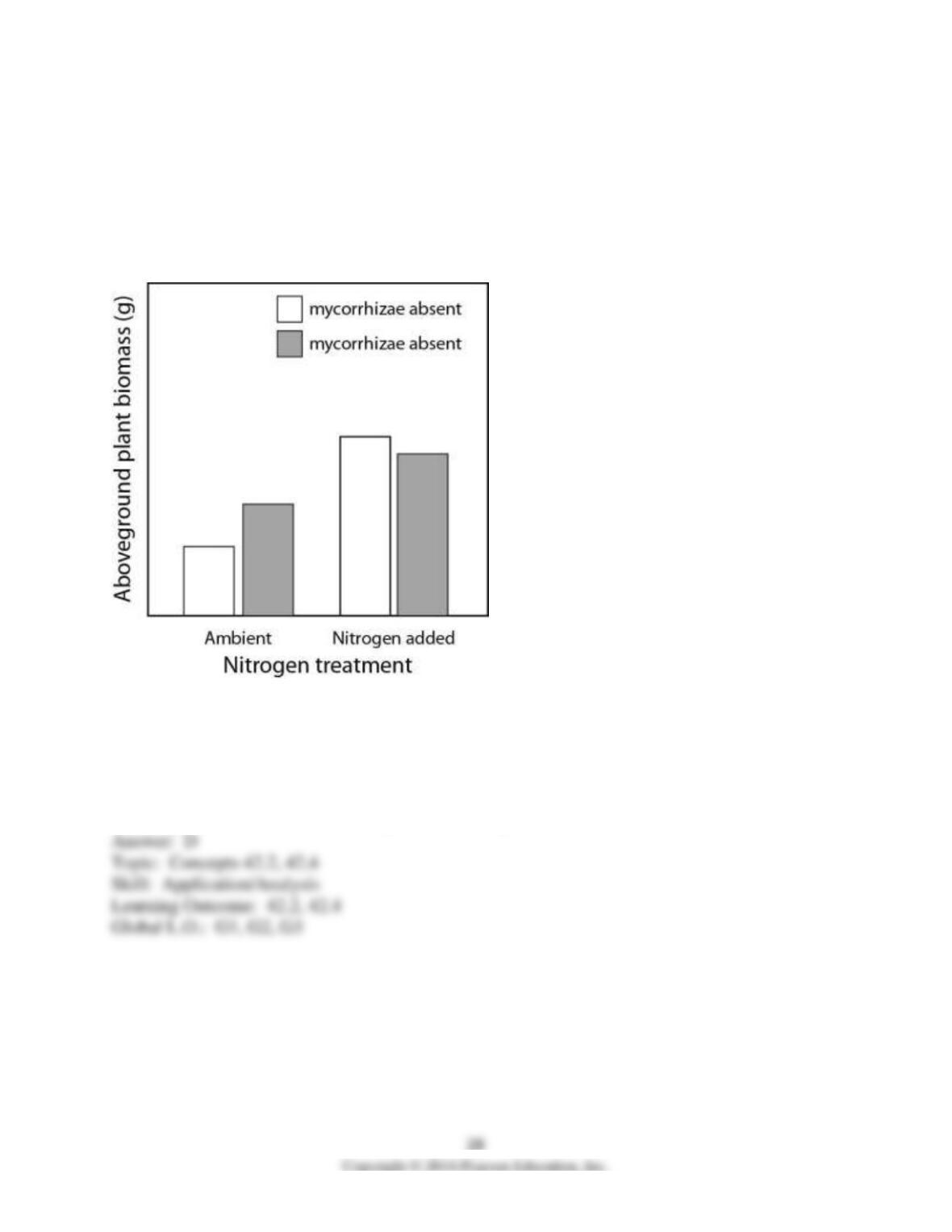
Please use the following information to answer the question(s) below.
A scientist conducts an experiment to quantify the effect of mycorrhizae and soil nitrogen levels
on plant growth in a grassland. The experiment has four treatments: (1) Mycorrhizae present and
ambient levels of nitrogen, (2) mycorrhizae present and nitrogen added, (3) mycorrhizae absent
and ambient levels of nitrogen, and (3) mycorrhizae absent and nitrogen added. After four
weeks, the scientist removes the aboveground plant material for weighing.
Figure 42.4.
13) Figure 42.4 shows the results of the experiment. What is (are) the independent variable(s)?
A) nitrogen treatment only
B) biomass of aboveground plant biomass only
C) presence and absence of mycorrhizae
D) nitrogen treatment and whether mycorrhizae are present

14) What is the dependent variable in the experiment shown in Figure 42.4?
A) net primary productivity
B) gross primary productivity
C) net secondary productivity
D) standing crop
15) What conclusion is best supported by Figure 42.4?
A) In the ambient condition, plants are limited by nitrogen even when mycorrhizae are present.
B) Interactions with mycorrhizae allow for the highest primary production levels regardless of
nitrogen level.
C) Interactions with mycorrhizae are always mutualistic.
D) Mycorrhizae should be added to restore successfully grasslands with high soil nitrogen.
42.4 End-of-Chapter Questions
1) Which of the following organisms is incorrectly paired with its trophic level?
A) cyanobacterium—primary producer
B) grasshopper—primary consumer
C) zooplankton—primary producer
D) fungus—detritivore
2) Which of these ecosystems has the lowest net primary production per square meter?
A) a salt marsh
B) an open ocean
C) a coral reef
D) a tropical rain forest

3) The discipline that applies ecological principles to returning degraded ecosystems to a more
natural state is known as
A) restoration ecology.
B) thermodynamics.
C) eutrophication.
D) biogeochemistry.
4) Nitrifying bacteria participate in the nitrogen cycle mainly by
A) converting nitrogen gas to ammonia.
B) releasing ammonium from organic compounds, thus returning it to the soil.
C) converting ammonium to nitrate, which plants absorb.
D) incorporating nitrogen into amino acids and organic compounds.
5) Which of the following has the greatest effect on the rate of chemical cycling in an
ecosystem?
A) the rate of decomposition in the ecosystem
B) the production efficiency of the ecosystem’s consumers
C) the trophic efficiency of the ecosystem
D) the location of the nutrient reservoirs in the ecosystem
6) The Hubbard Brook watershed deforestation experiment yielded all of the following results
except:
A) Most minerals were recycled within a forest ecosystem.
B) Calcium levels remained high in the soil of deforested areas.
C) Deforestation increased water runoff.
D) The nitrate concentration in waters draining the deforested area became dangerously high.

7) Which of the following would be considered an example of bioremediation?
A) adding nitrogen-fixing microorganisms to a degraded ecosystem to increase nitrogen
availability
B) using a bulldozer to regrade a strip mine
C) reconfiguring the channel of a river
D) adding seeds of a chromium-accumulating plant to soil contaminated by chromium
8) If you applied a fungicide to a cornfield, what would you expect to happen to the rate of
decomposition and net ecosystem production (NEP)?
A) Both decomposition rate and NEP would decrease.
B) Neither would change.
C) Decomposition rate would increase and NEP would decrease.
D) Decomposition rate would decrease and NEP would increase.