
37) Zoonotic disease
A) is caused by suborganismal pathogens such as viruses, viroids, and prions only.
B) is caused by pathogens that are transferred from other animals to humans by direct contact or
by means of a vector.
C) can only be spread from animals to humans through direct contact.
D) can only be transferred from animals to humans by means of an intermediate host.
E) is too specific to study at the community level, and studies of zoonotic pathogens are
relegated to organismal biology.
38) Which of the following studies would shed light on the mechanism of spread of H5N1 from
Asia to North America?
A) Perform cloacal or saliva smears of migrating waterfowl to monitor whether any infected
birds show up in Alaska.
B) Test fecal samples for H5N1 in Asian pet birds that live near domestic poultry farms in Asia.
C) Locate and destroy birds infected with H5N1 in Asian open-air poultry markets.
D) Record the incidence of H5N1 in domestic poultry farms in Asia.
39) Why is a pathogen generally more virulent in a new habitat?
A) More pathogens tend to immigrate into newer habitats.
B) Intermediate host species are more motile and transport pathogens to new areas.
C) Pathogens evolve more efficient forms of reproduction in new environments.
D) Hosts in new environments have not had a chance to become resistant to the pathogen
through natural selection.
E) New environments are almost always smaller in area, so that transmission of pathogens is
easily accomplished between hosts.

40) In terms of community ecology, why are pathogens often more virulent now than before?
A) More new pathogens have recently evolved.
B) Host organisms have become more susceptible because of weakened immune systems.
C) Human activities are transporting pathogens into new habitats (or communities) at an
unprecedented rate.
D) Medicines for treating pathogenic disease are in short supply.
E) Sequencing of genes in pathogenic organisms is particularly difficult.
41) The oak tree pathogen Phytophthora ramorum has migrated 800 km in 15 years. West Nile
virus spread from New York State to 46 other states in 5 years. The difference in the rate of
spread is probably related to
A) the lethality of each pathogen.
B) the mobility of their hosts.
C) the fact that viruses are very small.
D) innate resistance.
E) dormancy viability.
41.2 Art Questions
Please use the following information to answer the question(s) below.
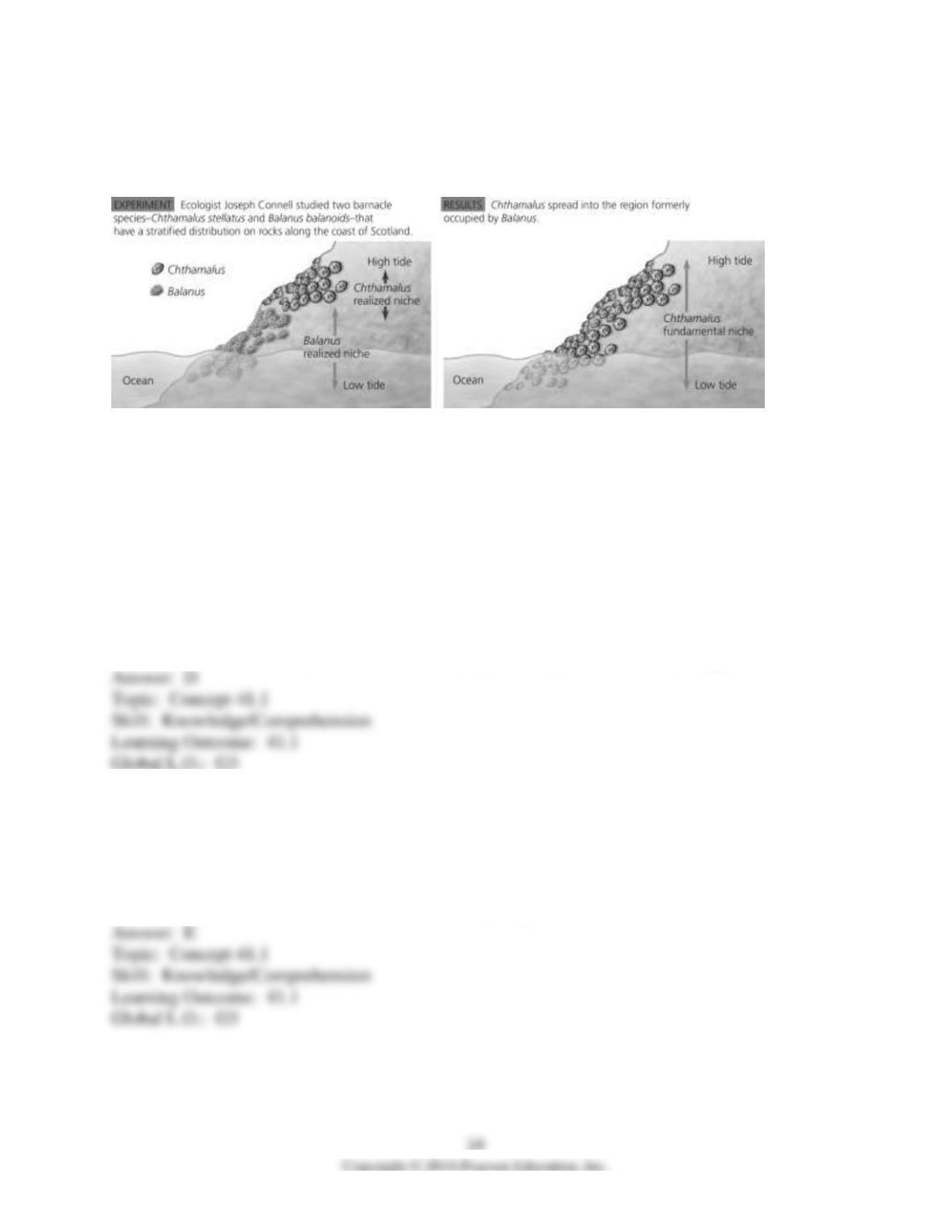
Figure 41.1 In this experiment, Balanus was removed from the habitat shown on the left.
1) Which of the following statements is a valid conclusion of this experiment?
A) Balanus can survive only in the lower intertidal zone because it is unable to resist desiccation.
B) Balanus is inferior to Chthamalus in competing for space on rocks lower in the intertidal
zone.
C) The two species of barnacles do not compete with each other because they feed at different
times of day.
D) The removal of Balanus shows that the realized niche of Chthamalus is smaller than its
fundamental niche.
E) These two species of barnacle do not show competitive exclusion.
F) If Chthamalus were removed, Balanus’s fundamental niche would become larger.
2) Connell conducted this experiment to learn more about
A) character displacement in the color of barnacles.
B) habitat preference in two different species of barnacles.
C) desiccation resistance and barnacle species.
D) how sea-level changes affect barnacle distribution.
E) competitive exclusion and distribution of barnacle species.
3) Chthamalus and Balanus belong to the same trophic level. Based on this information and their
distributions in the low tide zone in Connell’s experiment, what is the best way to represent the
interaction between the two species?
A) +/+
B) –/+
C) -/-
D) +/0
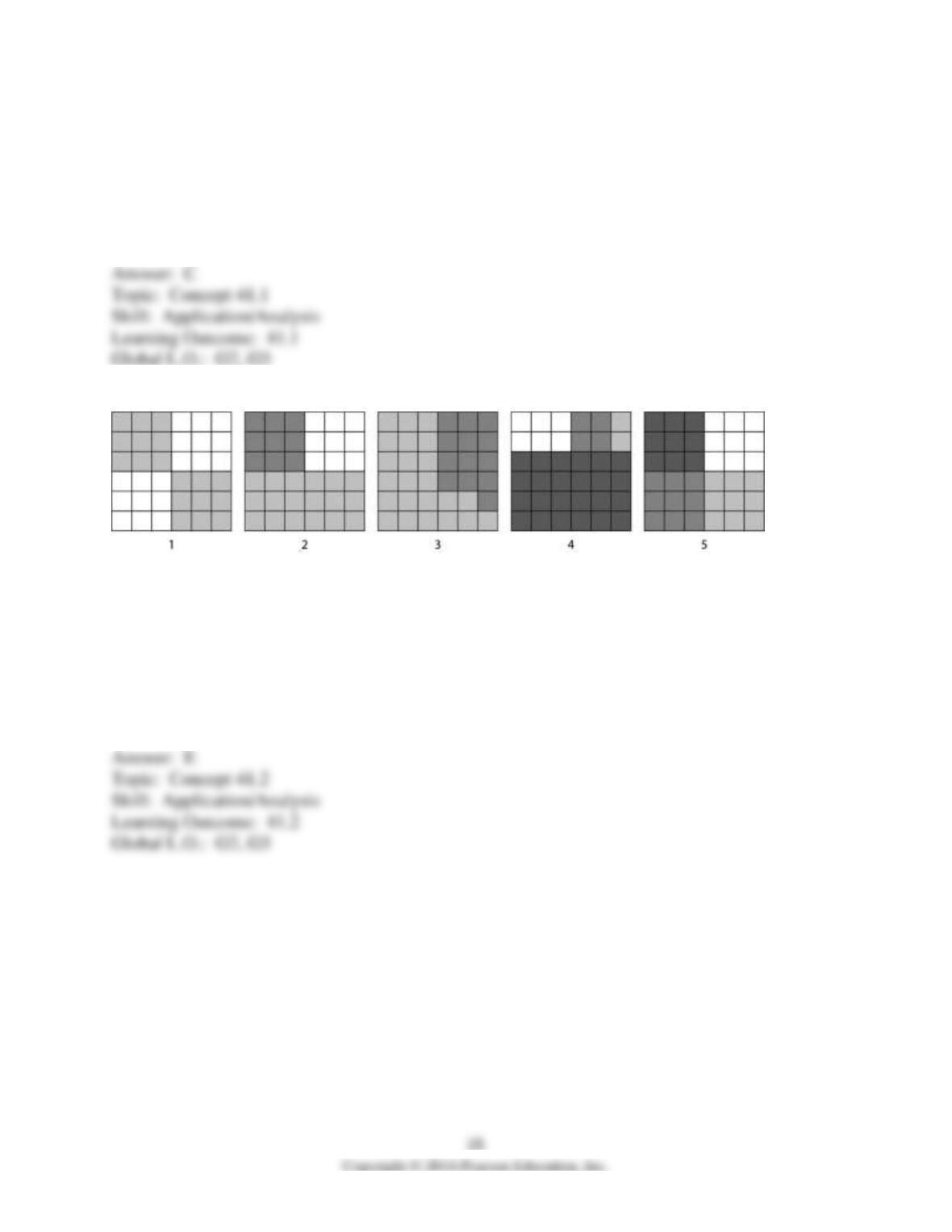
4)
Figure 41.2
Examine Figure 41.2. According to the Shannon diversity index, which block shows the greatest
diversity?
A) 1
B) 2
C) 3
D) 4
E) 5
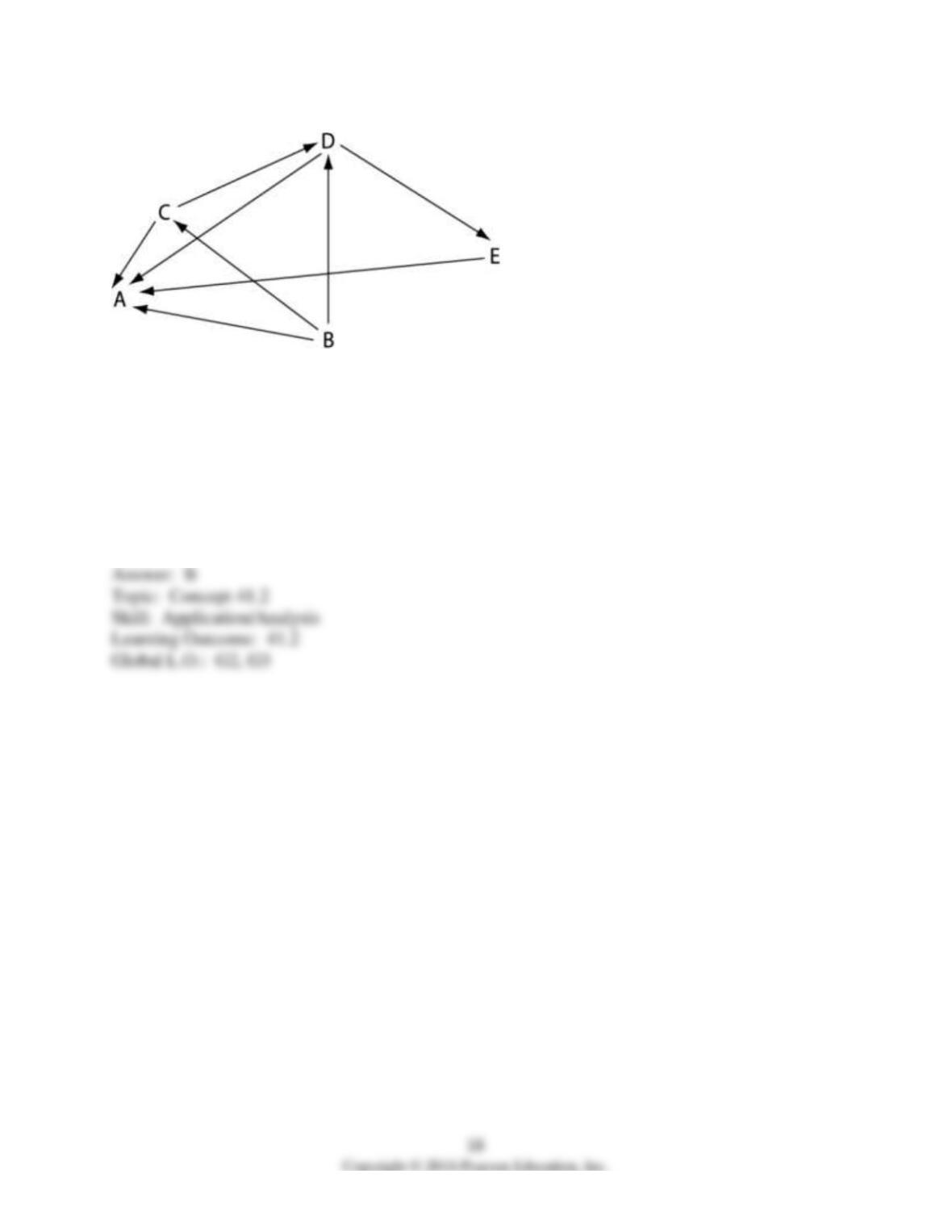
5)
Figure 41.3
Examine the diagram of a hypothetical food web in Figure 41.3. The arrows represent the
transfer of energy between the various trophic levels. Which letter represents an organism that
could be a primary producer?
A) A
B) B
C) C
D) D
E) E
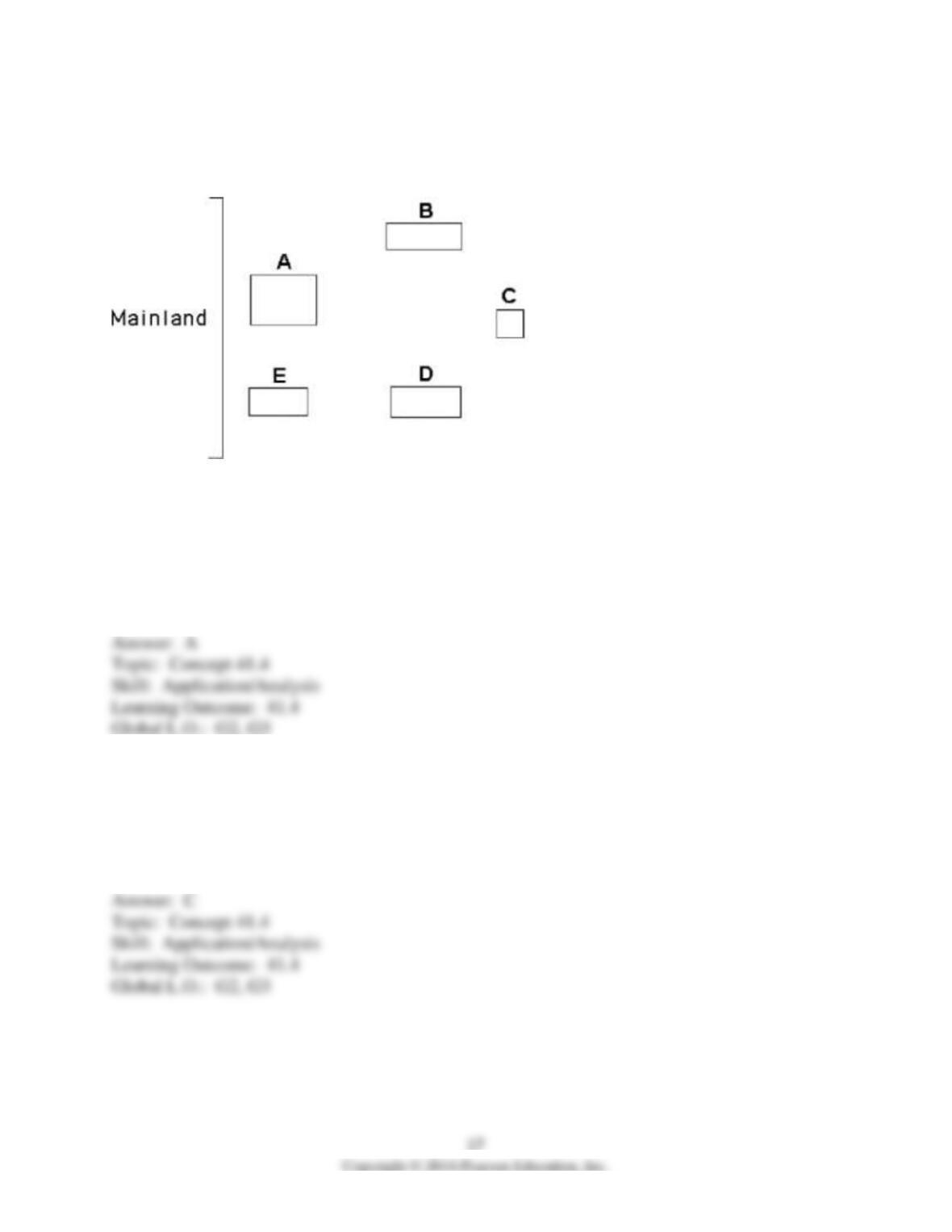
Use the diagram in Figure 41.4 of five islands formed at around the same time near a particular
mainland, as well as MacArthur and Wilson’s island biogeography principles, to answer the
following question(s).
Figure 41.4
6) Which island would likely have the greatest species diversity?
A) A
B) B
C) C
D) D
E) E
7) Which island would likely exhibit the most impoverished species diversity?
A) A
B) B
C) C
D) D
E) E

8) Which island would likely have the lowest extinction rate?
A) A
B) B
C) C
D) D
E) E
41.3 Scenario Questions
Please use the following information to answer the question(s) below.
The symbols +, -, and 0 are to be used to show the results of interactions between individuals and
groups of individuals in the examples that follow. The symbol + denotes a positive interaction, –
denotes a negative interaction, and 0 denotes an interaction that has no effect on the individuals
involved. The first symbol refers to the first organism mentioned.
1) What interactions exist between the cattle egret and grazing cattle?
A) 0/-
B) +/0
C) +/-
D) 0/0
E) -/-
2) What interactions exist between a lion pride and a hyena pack if they utilize the same food
sources?
A) +/+
B) +/0
C) +/-
D) 0/0
E) -/-

3) What interactions exist between a bee and a flower?
A) +/+
B) +/0
C) +/-
D) 0/0
E) -/-
4) What interactions exist between a tick on a dog and the dog?
A) +/+
B) +/0
C) +/-
D) 0/0
E) -/-
5) What interactions exist between cellulose-digesting organisms in the gut of a termite and the
termite?
A) +/+
B) +/0
C) +/-
D) 0/0
E) -/-

6) What interactions exist between mycorrhizae and evergreen tree roots?
A) +/+
B) +/0
C) +/-
D) 0/0
E) -/-
Please use the following information to answer the question(s) below.
The effect of invasive species on the diversity of communities can be large, and protecting native
communities from the invasion of non-native species is often a priority for conservation. You
conduct an experiment to study how the impact that invasive plant species have on the diversity
of plant communities varies as a function of distance from the source of the invasive species. In
this experiment, you create five communities with equal numbers of three native plant species at
the beginning. Each of these communities is located at increasing distances from a large patch of
an invasive species. You and your research assistant return 1 year later to measure the relative
abundance of each species. The results are shown in the table.
Relative Abundance
Species
Community 1
Community 2
Community 3
Community 4
Community 5
Invasive Species
0
0.05
0.1
0.45
1
Native Species A
0.333
0.317
0.3
0
0
Native Species B
0.333
0.317
0.3
0.15
0
Native Species C
0.333
0.317
0.3
0.4
0
Shannon
Diversity
1.1
1.2
1.3
1
0
7) The biological hypothesis for your experiment is based on the model of island biogeography.
What is the independent variable of your experiment?
A) the plant communities
B) the source patch of the invasive species
C) the distance from the source patch of invasive species
D) the relative abundance of the plant species
E) the length of time from the start to the end of the experiment

8) Your research assistant forgets to label the distance at which each community was located.
While you wait for your assistant to go back and check on the correct labels, you attempt to
match the communities to their distances based on the results. Predict the order of the
communities from closest to farthest from the source patch of invasive species.
A) 5, 4, 3, 2, 1
B) 5, 4, 1, 3, 2
C) 3, 2, 1, 4, 5
D) 1, 2, 3, 4, 5
E) 5, 1, 4, 2, 3
9) How would you calculate the final Shannon diversity index for each community?
A) H = −(pinvasive + pA + pB + pC)
B) H = −(pinvasive ln pinvasive + pA ln pA + pB ln pB + pC ln pC)
C) H = ln pinvasive + ln pA + ln pB + ln pC
D) H = pinvasive ln pinvasive + pA ln pA + pB ln pB + pC ln pC
41.4 End-of-Chapter Questions
1) The feeding relationships among the species in a community determine the community’s
A) secondary succession.
B) ecological niche.
C) species richness.
D) trophic structure.
2) Based on the intermediate disturbance hypothesis, a community’s species diversity is
increased by
A) frequent massive disturbance.
B) stable conditions with no disturbance.
C) moderate levels of disturbance.
D) human intervention to eliminate disturbance.

3) Which of the following could qualify as a top-down control on a grassland community?
A) limitation of plant biomass by rainfall amount
B) influence of temperature on competition among plants
C) influence of soil nutrients on the abundance of grasses versus wildflowers
D) effect of grazing intensity by bison on plant species diversity