
Campbell Biology in Focus, 2e (Urry)
Chapter 40 Population Ecology and the Distribution of Organisms
40.1 Multiple-Choice Questions
1) Trees are rare in the savanna biome because of
A) insufficient annual precipitation.
B) acidic soils.
C) frequent fires.
D) large variations in seasonal rainfall.
E) permafrost.
2) Which of the following statements best describes the effect of climate on biome distribution?
A) Average annual temperature and precipitation are sufficient to predict which biome will be
found in an area.
B) Seasonal fluctuation of temperature is not a limiting factor in biome distribution if areas have
the same annual temperature and precipitation means.
C) Not only is the average climate important in determining biome distribution but so is the
pattern of climatic variation.
D) Temperate forests and grasslands are different biomes because they receive a different quality
and quantity of sunlight, even though they have essentially the same annual temperature and
precipitation.
E) Correlation of climate with biome distribution is sufficient to determine the cause of biome
patterns.
3) The growing season would generally be shortest in which of the following biomes?
A) savanna
B) temperate broadleaf forest
C) temperate grassland
D) tropical rain forest
E) northern coniferous forest

4) Trees are not usually found in the tundra biome because of
A) insufficient annual precipitation.
B) acidic soils.
C) extreme winter temperatures.
D) overbrowsing by musk ox and caribou.
E) permafrost.
5) Which of the following levels of ecological organization is arranged in the correct sequence
from most to least inclusive?
A) community, ecosystem, individual, population
B) ecosystem, community, population, individual
C) population, ecosystem, individual, community
D) individual, population, community, ecosystem
E) individual, community, population, ecosystem
6) Which of the following choices causes all of the others in creating global terrestrial climates?
A) differential heating of Earth’s surface
B) ocean currents
C) global wind patterns
D) evaporation of water from ocean surfaces

7) Why is the climate drier on the leeward side of mountain ranges that are subjected to
prevailing winds?
A) Deserts create dry conditions on the leeward side of mountain ranges.
B) The sun illuminates the leeward side of mountain ranges at a more direct angle, creating heat
energy that evaporates most of the water present.
C) Pushed by the prevailing winds on the windward side, air is forced to rise, cool, condense,
and drop its precipitation, leaving drier air to descend the leeward side.
D) Air masses pushed by the prevailing winds are stopped by mountain ranges, and the moisture
is used up in the stagnant air masses on the leeward side.
E) When compared to the windward side, more organisms live on the sheltered, leeward side of
mountain ranges where their utilization of water lowers the amount available.
8) What would be the effect on climate in the temperate latitudes if Earth were to slow its rate of
rotation from a 24-hour period of rotation to a 48-hour period of rotation?
A) Seasons would be longer and more distinct (colder winters and warmer summers).
B) Smaller ranges between daytime high and nighttime low temperatures would be frequent.
C) Large-scale weather events such as tornadoes and hurricanes would no longer be a part of
regional climates.
D) Winter seasons in both the Northern and Southern Hemispheres would have more abundant
and frequent precipitation events.
E) Larger ranges between daytime high and nighttime low temperatures would be frequent.
9) Palm trees and subtropical plants are commonplace in Land’s End, England, whose latitude is
the equivalent of Labrador in coastal Canada, where the local flora is subarctic. Which statement
best explains why this apparent anomaly exists between North America and Europe?
A) Labrador does not get enough rainfall to support the subtropical flora found in Land’s End.
B) Regions such as Labrador are actually colder than England because colder Arctic water flows
down to eastern North America and warm water from the equator flows to England.
C) Rainfall fluctuates greatly in England; rainfall is consistently high in Labrador.
D) Labrador is too windy to support tall plants, such as palm trees.
E) Labrador receives sunlight of lower duration and intensity than does Land’s End.

10) In mountainous areas of western North America, north-facing slopes would be expected to
A) receive more sunlight than similar southern-exposed slopes.
B) be warmer and drier than comparable southern-exposed slopes.
C) consistently be steeper than southern-exposed slopes.
D) support biological communities similar to those found at lower elevations on similar south-
facing slopes.
E) support biological communities similar to those found at higher elevations on similar south-
facing slopes.
11) Deserts typically occur in a band around 30 degrees north and 30 degrees south latitude
because
A) descending air masses originating from the tropics tend to be dry.
B) trade winds have little moisture.
C) moisture-laden air is heavier than dry air and is not carried to these latitudes.
D) these locations get the most intense solar radiation of any location on Earth.
12) Which of the following events might you predict to occur if the tilt of Earth’s axis relative to
its plane of orbit was increased to 33 1/2 degrees?
A) Summers and winters in the United States would likely become warmer and colder,
respectively.
B) Winters and summers in Australia would likely become less distinct seasons.
C) Seasonal variation at the equator might decrease.
D) Both Northern and Southern Hemispheres would experience summer and winter at the same
time.
E) Both poles would experience massive ice melts.

13) Imagine that some cosmic catastrophe jolts Earth so that its axis is perpendicular to the
orbital plane between Earth and the sun. The most obvious effect of this change would be
A) the elimination of tides.
B) an increase in the length of night.
C) an increase in the length of a year.
D) a decrease in temperature at the equator.
E) the elimination of seasonal variation.
14) The main reason that polar regions are cooler than the equator is that
A) there is more ice at polar regions.
B) sunlight strikes polar regions at a lower angle.
C) the polar regions are farther from the sun.
D) the polar regions’ atmosphere is thinner and contains fewer greenhouse gases.
E) the polar regions are permanently tilted away from the sun.
15) Generalized global air circulation and precipitation patterns are caused by
A) rising, warm, moist air masses that cool and release precipitation as they rise and then, at high
altitude, cool and sink back to the surface as dry air masses after moving north or south of the
tropics.
B) air masses that are dried and heated over continental areas that rise, cool aloft, and descend
over oceanic areas followed by a return flow of moist air from ocean to land, delivering high
amounts of precipitation to coastal areas.
C) polar, cool, moist high-pressure air masses from the poles that move along the surface,
releasing precipitation along the way to the equator, where they are heated and dried.
D) the revolution of Earth around the sun.
E) mountain ranges that deflect air masses containing variable amounts of moisture.

16) Air masses formed over the Pacific Ocean are moved by prevailing westerlies where they
encounter extensive north-south mountain ranges, such as the Sierra Nevadas and the Cascades.
Which statement best describes the outcome of this encounter between a landform and an air
mass?
A) The cool, moist Pacific air heats up as it rises, releasing its precipitation as it passes the tops
of the mountains, and this warm, now dry air cools as it descends on the leeward side of the
range.
B) The warm, moist Pacific air rises and cools, releasing precipitation as it moves up the
windward side of the range, and this cool, now dry air mass heats up as it descends on the
leeward side of the range.
C) The cool, dry Pacific air heats up and picks up moisture from evaporation of the snowcapped
peaks of the mountain range, releasing this moisture as precipitation when the air cools while
descending on the leeward side of the range.
D) These air masses are blocked by the mountain ranges, producing high annual amounts of
precipitation on the windward sides of these mountain ranges.
E) These air masses remain essentially unchanged in moisture content and temperature as they
pass over these mountain ranges.
17) Coral reefs can be found on the southeast coast of the United States but not at similar
latitudes on the southwest coast. Differences in which of the following most likely account for
this?
A) sunlight intensity
B) precipitation
C) day length
D) ocean currents
E) salinity

18) What is the limiting factor for the growth of trees in the tundra?
A) low precipitation
B) lack of sunlight
C) insufficient minerals in bedrock
D) pH of soils
E) permafrost
19) In which of the following terrestrial biome pairs are both biomes dependent upon periodic
burning?
A) tundra and coniferous forest
B) chaparral and savanna
C) desert and savanna
D) tropical forest and temperate broadleaf forest
E) grassland and tundra
20) Fire suppression by humans
A) will always result in an increase in species diversity in a given biome.
B) can change the species composition within biological communities.
C) will result in fewer trees in savannas.
D) is necessary to maintain species composition in grassland and chaparral.
21) Which of the following statements best describes the interaction between fire and
ecosystems?
A) Fires maintain the low, widely scattered vegetation found in deserts.
B) Many kinds of plants and plant communities have adapted to frequent fires.
C) Unlike northern coniferous forests, temperate broadleaf forests contain many species that
depend on fire to regenerate.
D) Chaparral communities have evolved to the extent that they rarely burn.
E) Fire is unnatural in ecosystems and should be prevented.
22) Which marine zone is expected to have the lowest rates of primary productivity
(photosynthesis)?
A) pelagic
B) abyssal
C) photic
D) limnetic
E) intertidal
23) If a meteor impact or volcanic eruption injected a lot of dust into the atmosphere and reduced
the sunlight reaching Earth’s surface by 70% for one year, which of the following marine
communities most likely would be least affected?
A) deep-sea vent
B) coral reef
C) intertidal
D) pelagic
E) estuary

24) Which statement best describes how climate might change if Earth were 75% land and 25%
water?
A) Terrestrial ecosystems would likely experience more precipitation.
B) Earth’s daytime temperatures would be higher and nighttime temperatures lower.
C) Summers would be longer and winters shorter at midlatitude locations.
D) Earth would experience an unprecedented global warming.
E) More terrestrial microclimates would be created because of daily fluctuations in climate.
25) Which of the following examples of an ecological effect leading to an evolutionary effect is
most correct?
A) When seeds are not plentiful, trees produce more seeds.
B) A few organisms of a larger population survive a drought, and then these survivors emigrate
to less arid environments.
C) A few individuals with denser fur survive the coldest days of an ice age, and the reproducing
survivors of the ice age all have dense fur.
D) Fish that swim the fastest in running water catch the most prey and more easily escape
predation.
E) The insects that spend the most time exposed to sunlight have the most mutations.
26) Which of the following are important biotic factors that can affect the structure and
organization of biological communities?
A) precipitation, wind
B) nutrient availability, soil pH
C) predation, competition
D) temperature, water
E) light intensity, seasonality

27) A certain species of pine tree survives only in scattered locations at elevations above 2,800 m
in the western United States. To understand why this tree grows only in these specific places, an
ecologist should
A) conclude that lower elevations are limiting to the survival of this species.
B) study the anatomy and physiology of this species.
C) investigate the various biotic and abiotic factors that are unique to high altitude.
D) analyze the soils found in the vicinity of these trees, looking for unique chemicals that may
support their growth.
E) collect data on temperature, wind, and precipitation at several of these locations for a year.
28) Studying species transplants is a way that ecologists
A) determine the abundance of a species in a specified area.
B) determine the distribution of a species in a specified area.
C) develop mathematical models for distribution and abundance of organisms.
D) determine if dispersal is a key factor in limiting distribution of organisms.
E) consolidate a landscape region into a single ecosystem.
29) Which of the following is a physical factor that can limit the geographic distribution of
species?
A) predation
B) disease
C) soil structure
D) nutrients
E) pH

30) A population is correctly defined as having which of the following characteristics?
I. inhabits the same general area
II. belongs to the same species
III. possesses a constant and uniform density and dispersion
A) I only
B) III only
C) I and II only
D) II and III only
E) I, II, and III
31) An ecologist recorded 12 white-tailed deer, Odocoileus virginianus, per square mile in one
woodlot and 20 per square mile in another woodlot. What was the ecologist comparing?
A) density
B) dispersion
C) carrying capacity
D) cohorts
E) range
32) Uniform spacing patterns in plants such as the creosote bush are most often associated with
A) chance.
B) patterns of high humidity.
C) the random distribution of seeds.
D) competitive interaction between individuals of the same population.
E) the concentration of nutrients within the population’s range.

33) Which of the following groups would be most likely to exhibit uniform dispersion?
A) red squirrels, animals that actively defend territories
B) cattails, plants that grow primarily at edges of lakes and streams
C) dwarf mistletoes, plants that parasitize particular species of forest trees
D) moths in a city at night
E) lake trout, fish that seek out cold, deep water high in dissolved oxygen
34) To construct a life table for a sexual species, one needs to
A) assess sperm viability for the males in the population.
B) keep track of all of the offspring of a cohort.
C) keep track of the females in a cohort.
D) keep track of all of the offspring of the females in a cohort.
35) Which of the following methods would most accurately measure the density of the
population being studied?
A) counting the number of prairie dog burrows per hectare
B) counting the number of times a 1-km transect is intersected by tracks of red squirrels after a
snowfall
C) counting the number of coyote droppings per hectare
D) counting the number of moss plants in 1-m2 quadrats
E) counting the number of zebras from airplane observations.

36) Long-term studies of Belding’s ground squirrels show that immigrants move nearly 2 km
from where they are born and become 1-8% of the males and 0.7-6% of the females in other
populations. On an evolutionary scale, why is this significant?
A) These immigrants make up for the deaths of individuals, keeping the other populations’ sizes
stable.
B) Young reproductive males tend to stay in their home population and are not driven out by
other territorial males.
C) These immigrants provide a source of genetic diversity for the other populations.
D) Those individuals that emigrate to these new populations are looking for less crowded
conditions with more resources.
E) Gradually, the populations of ground squirrels will move from a clumped to a uniform
population pattern of dispersion.
37) Which of the following sets of measurements would best describe a population’s physical
structure and vital statistics?
A) density, dispersion, and demographics
B) gene frequency over time and the ratio of reproductive to nonreproductive individuals
C) annual precipitation averages and mean annual temperatures
D) minimum and maximum amounts of precipitation and annual temperature extremes
E) ratio of predators and the number of immigrants and emigrants
38) Which of the following methods would provide the most legitimate data on population
density?
A) Count the number of nests of a particular species of songbird and multiply this by two
(because there are two parent birds per nest).
B) Count the number of pine trees in several randomly selected 10-m × 10-m plots and
extrapolate this number to the fraction of the study area that these plots represent.
C) Use the mark-and-recapture method to estimate the size of the population.
D) Calculate the difference between all of the immigrants and emigrants to see if the population
is growing or shrinking.
E) Add the number of births and subtract the number of individuals that die to see if the
population’s density is increasing or decreasing.

39) Which of the following is the best natural example of uniform distribution?
A) bees collecting pollen in a wildflower meadow
B) snails in an intertidal zone at low tide
C) territorial songbirds in a mature forest during mating season
D) mushrooms growing on the floor of an old-growth forest
E) a cultivated cornfield in the Midwest
40) Which of the following would most likely promote random distribution?
A) territorial species
B) species that secrete chemicals to attract or inhibit other individuals
C) flocking and schooling behaviors
D) spacing during the breeding season
E) homogeneous chemical and physical factors in the environment
41) Which of the following best defines a cohort?
A) a group of individuals that inhabits a small isolated region within the range for the species
B) all of the individuals that are annually added to a population by birth and immigration
C) the reproductive males and females within the population
D) a group of individuals from the same age group, from birth until they are all dead
E) the number of individuals that annually die or emigrate out of a population

42) Why do some invertebrates, such as lobsters, show a “stair-step” survivorship curve?
A) Many invertebrates mate and produce offspring on multiyear cycles.
B) Within a species of invertebrates, younger individuals have a higher survivorship than older
individuals.
C) Many invertebrates molt in order to grow, and they are vulnerable to predation during their
“soft shell” stage.
D) Many invertebrate species have population cycles that go up and down according to the
frequency of sunspots.
E) The number of fertilized eggs that mature to become females in many species of invertebrates
is based on ambient temperature.
43) What is population dispersion?
A) the number of individuals per unit area or volume
B) the pattern of spacing among individuals within the boundaries of the population
C) the influx of new individuals from other areas
D) the defense of a bounded physical space against encroachment by others
44) Which of the following describes a Type II survivorship curve?
A) flat at the start, reflecting low death rates during early and middle life, then dropping steeply
as death rates increase among older age groups
B) dropping sharply at the start, reflecting very high death rates for the young, then flattening out
as death rates decline for those few that survive
C) a constant death rate over the organism’s life span
D) flat at the start, reflecting low death rates during early and middle life, then rising steeply as
death rates decrease among older age groups
45) A population of ground squirrels has an annual per capita birth rate of 0.06 and an annual per
capita death rate of 0.02. Calculate an estimate of the number of individuals added to (or lost
from) a population of 1,000 individuals in one year.
A) 120 individuals added
B) 40 individuals added
C) 20 individuals added
D) 400 individuals added
E) 20 individuals lost
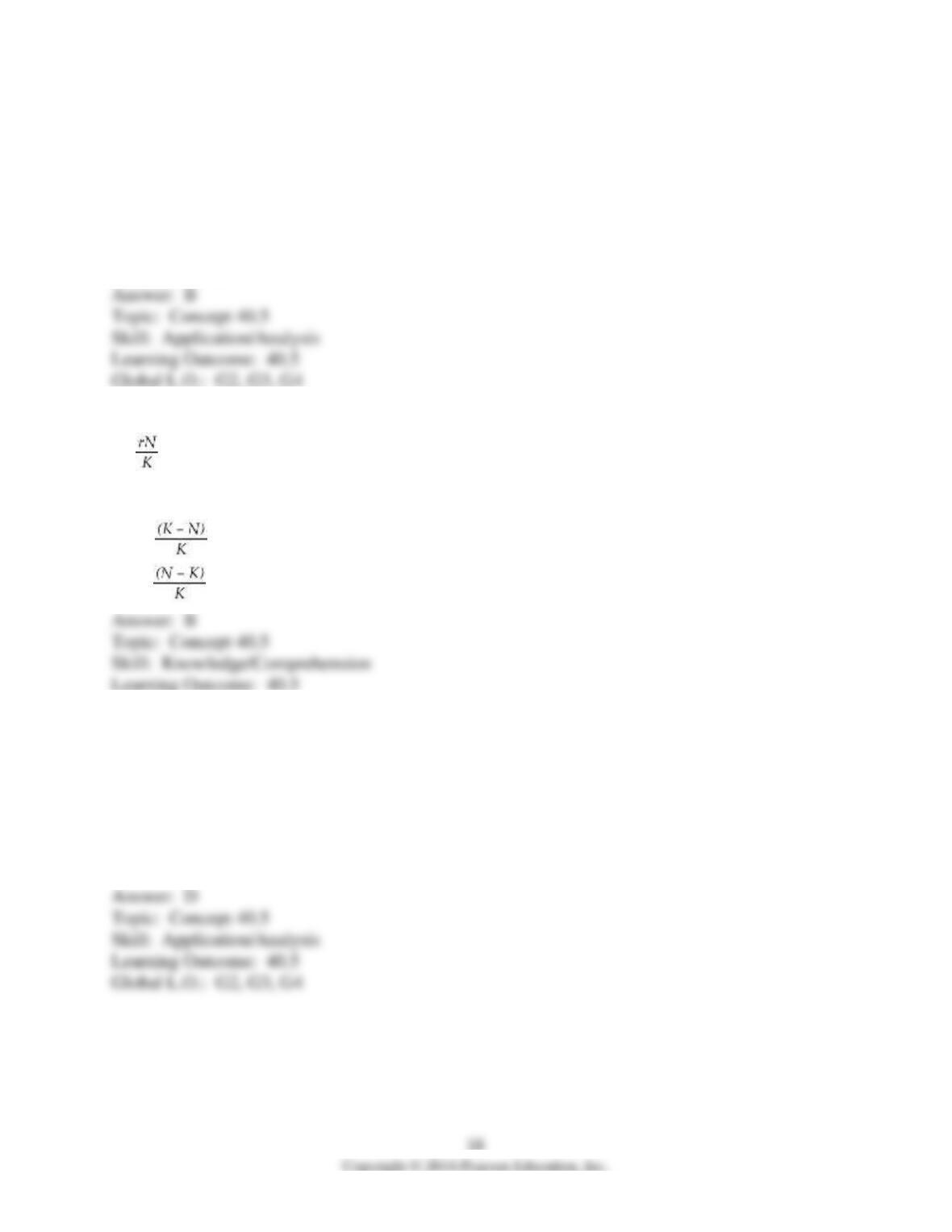
46) Exponential growth of a population is represented by dN/dt =
A) .
B) rN.
C) rN (K + N).
D) rN .
E) rN .
47) Starting from a single individual, what is the size of a population of bacteria that reproduce
by binary fission every 20 minutes at the end of a 2-hour time period? (Assume unlimited
resources and no mortality.)
A) 8
B) 16
C) 32
D) 64
E) 128

48) Which of the following equations represents zero population growth?
A) b = m or r = 0
B) dN/dt = rN
C) dN/dt = rN (K — N)/K
D) dN/dt = K
E) dN/dt = 1.0N
49) In July 2008, the U.S. population was approximately 302,000,000. Approximately how many
Americans were there in July 2009 if the estimated 2008 growth rate was 0.88%?
A) 2,700,000
B) 5,500,000
C) 303,000,000
D) 304,700,000
E) 2,710,800,000
50) In 2008, the New Zealand population was approximately 4,275,000. If the birth rate was 14
births for every 1,000 people, approximately how many births occurred in New Zealand in 2008?
A) 6,000
B) 42,275
C) 60,000
D) 140,000
E) 600,000
51) Consider two forests: one is an undisturbed old-growth forest and the other has recently been
logged. In which forest are species likely to experience exponential growth, and why?
A) old growth, because the stable conditions would favor exponential growth of all species in the
forest
B) old growth, because each of the species is well established and can produce many offspring
C) logged, because the disturbed forest affords more resources for increased specific populations
to grow
D) equally probable in old-growth and logged forests, because disturbed and stable habitats have
equal opportunity for tree seedlings to survive
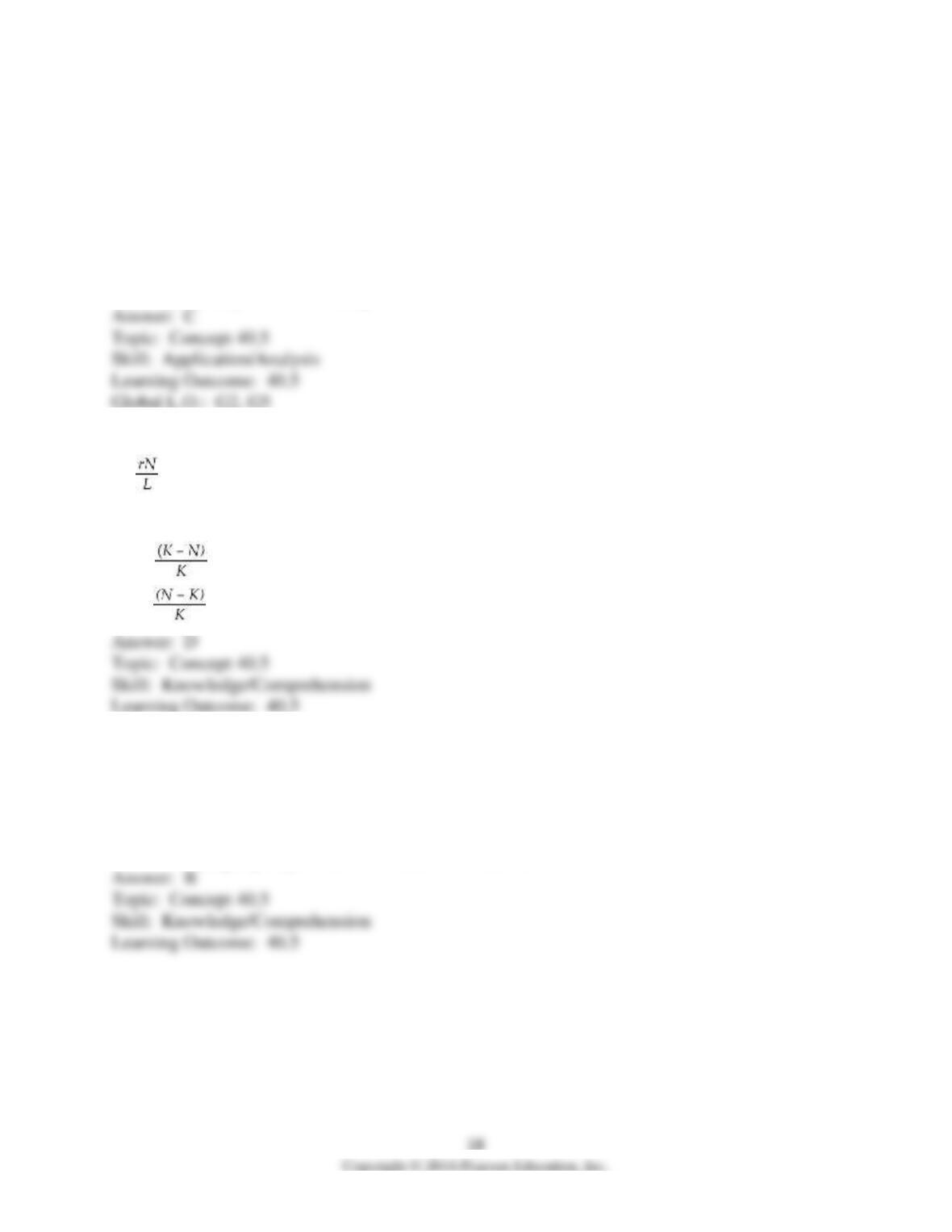
52) Logistic growth of a population is represented by dN/dt =
A) .
B) rN.
C) rN (K + N).
D) rN .
E) rN .
53) As N approaches K for a certain population, which of the following is predicted by the
logistic equation?
A) The population growth rate will not change.
B) The population growth rate will approach zero.
C) The population will increase exponentially.
D) The carrying capacity of the environment will increase.

54) In models of logistic population growth,
A) the population growth rate slows dramatically as N approaches K.
B) new individuals are added to the population most rapidly when there are few individuals.
C) new individuals are added to the population most rapidly as N approaches K.
D) only density-independent factors affect the rate of population growth.
E) carrying capacity is never reached.
55) Carrying capacity is
A) seldom exceeded in real populations.
B) the maximum population size that a particular environment can support.
C) fixed for most species over most of their range most of the time.
D) determined by density and dispersion data.
E) the term used to describe the stress a population undergoes due to limited resources.
56) Which of the following causes populations to shift most quickly from an exponential to a
logistic population growth?
A) increased birth rate
B) removal of predators
C) decreased death rate
D) competition for resources
E) favorable climatic conditions

57) Often the growth cycle of one population has an effect on the cycle of another. As moose
populations increase, for example, wolf populations also increase. Thus, if we are considering
the logistic equation for the wolf population, dN/dt = rN , which factor accounts for the
effect of the moose population?
A) r
B) N
C) rN
D) K
E) dt
58) What is an assumption of the logistic model of population growth?
A) Populations adjust instantaneously to growth.
B) There is a delay before the negative effects of an increasing population are realized.
C) There is no limitation to growth.
D) Population growth depends also on predators and competing species.
59) Natural selection involves energetic trade-offs between
A) choosing how many offspring to produce over the course of a lifetime and how long to live.
B) producing large numbers of gametes when employing internal fertilization and fewer numbers
of gametes when employing external fertilization.
C) increasing the number of individuals produced during each reproductive episode and a
corresponding increase in parental care.
D) high survival rates of offspring and the cost of parental care.