60) The three basic variables that make up the life history of an organism are
A) life expectancy, birth rate, and death rate.
B) number of reproductive females in the population, age structure of the population, and life
expectancy.
C) age when reproduction begins, how often reproduction occurs, and how many offspring are
produced per reproductive episode.
D) how often reproduction occurs, life expectancy of females in the population, and number of
offspring per reproductive episode.
E) the number of reproductive females in the population, how often reproduction occurs, and
death rate.
61) Which of the following pairs of reproductive strategies is consistent with energetic trade-off
and reproductive success?
A) Pioneer species of plants produce many very small, highly airborne seeds, whereas large
elephants that are very good parents produce many large offspring.
B) Female rabbits that suffer high predation rates may produce several litters per breeding
season, and coconuts produce few fruits, but most survive when they encounter proper growing
conditions.
C) Species that have to broadcast to distant habitats tend to produce seeds with heavy protective
seed coats, and animals that are caring parents produce fewer offspring with lower infant
mortality.
D) A free-living insect lays thousands of eggs and provides no parental care, whereas a flowering
plant takes good care of its thousands of seeds until they are ready to germinate.
E) Some mammals will not reproduce when environmental resources are low so they can survive
until conditions get better, and plants that produce many small seeds are likely found in stable
environments.
62) Which of the following is an expected characteristic of K-selected populations?
A) offspring with good chances of survival
B) small offspring
C) a high intrinsic rate of increase
D) early parental reproduction
63) Which variables define the ecological life history of a species?
A) the age at which reproduction begins, frequency of reproduction, and the number of offspring
for each reproductive episode
B) the ratio of females to males, the length of the breeding season, and the number of offspring
for each reproductive episode
C) the number of offspring produced over a lifetime by a breeding pair and the survivability of
the offspring
D) timing breeding sessions with optimal environmental conditions and the number of offspring
produced during each breeding session
E) the amount of parental care given after birth, the number of reproductive episodes per year,
and the number of years females are capable of producing viable offspring
64) In which of the following situations would you expect to find the largest number of K–
selected individuals?
A) a recently abandoned agricultural field in Ohio
B) a shifting sand dune community of south Lake Michigan
C) an old-growth forest
D) South Florida after a hurricane
E) a newly emergent volcanic island
65) Which of the following is most likely to contribute to density-dependent regulation of
populations?
A) the conversion of ethanol to carbohydrates by yeasts
B) intraspecific competition for nutrients
C) earthquakes
D) floods
E) fires
66) Why do populations grow more slowly as they approach their carrying capacity?
A) Density-dependent factors lead to fewer births and increased mortality.
B) Density-independent factors lead to fewer births and increased mortality.
C) Hormonal changes promote higher death rates in crowded populations.
D) Individuals voluntarily stop mating so that overcrowding does not occur.
E) The incoming energy decreases in populations experiencing a high rate of increase.
67) Which of the following could be a density-independent factor limiting human population
growth?
A) the number of homes that can fit in a city
B) earthquakes
C) plagues
D) famines
68) What is a metapopulation?
A) all of the populations of different species within a community
B) family units within a single population
C) populations that are linked by immigration and emigration
D) the exponential growth in a population’s numbers over time
69) What is one application of the metapopulation concept?
A) It provides a framework for species conservation when those species live in a network of
habitat fragments and reserves.
B) It demonstrates how the many populations of different species can coexist within a
community.
C) It predicts the carrying capacity of populations that exhibit limited growth.
D) It explains why some populations have a clumped dispersion pattern.
70) Which of the following is an intrinsic physiological factor that can regulate population size?
A) transmission rate of a disease
B) competition for territories
C) flooding by a river
D) hormonal changes in response to aggression
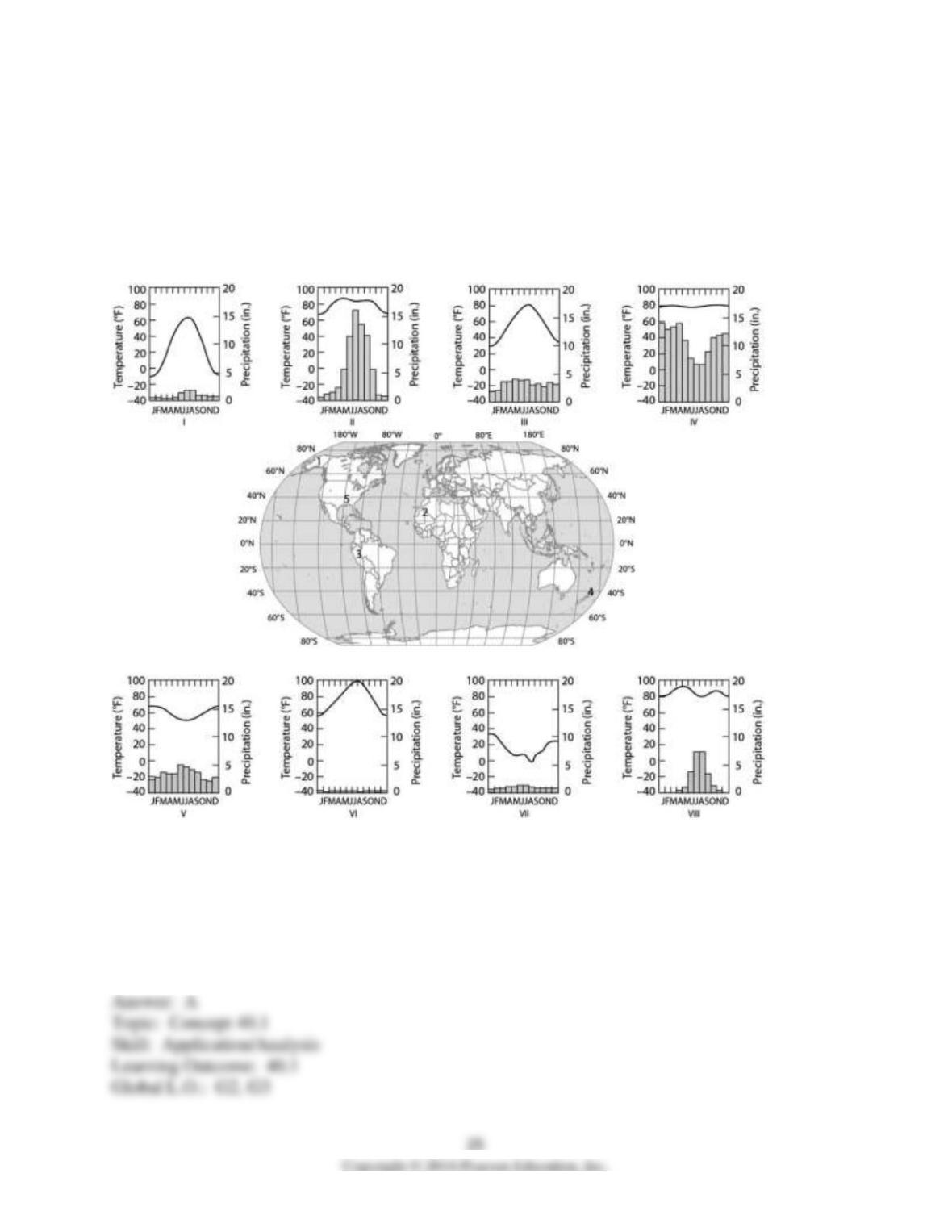
40.2 Art Questions
Please use the following information to answer the question(s) below.
The eight climographs in Figure 40.1 show yearly temperature (line graph and left vertical axis)
and precipitation (bar graph and right vertical axis) averages for each month for some locations
on Earth. Choose the climograph that best answers the question.
Figure 40.1
1) Which climograph shows the climate for location 1?
A) I
B) III
C) V
D) VII
E) VIII
2) Which climograph shows the climate for location 2?
A) II
B) III
C) IV
D) VI
E) VIII
3) Which climograph shows the climate for location 3?
A) II
B) III
C) IV
D) V
E) VI
4) Which climograph shows the climate for location 4?
A) I
B) II
C) III
D) V
E) VI
5) Which climograph shows the climate for location 5?
A) I
B) III
C) IV
D) V
E) VIII

6) Which of the following best substantiates why location 3 is an equatorial (tropical) climate?
A) It has a monsoon season during the winter months.
B) It has consistent monthly averages for rainfall.
C) The temperature is high for each monthly average.
D) The temperatures reach 100°F during some months.
E) The temperatures are lower in June, July, and August.
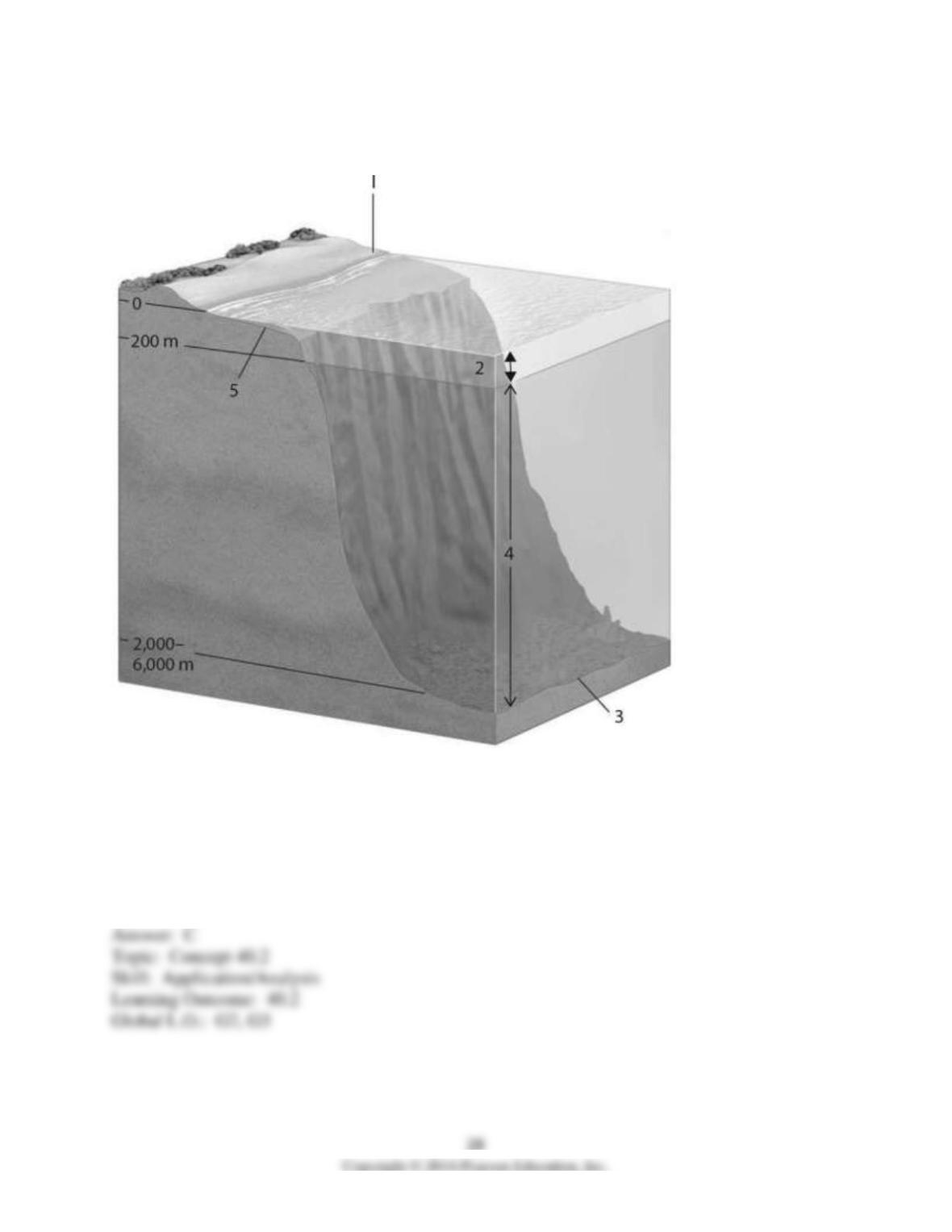
Figure 40.2 shows a generalized cross section of the marine environment with various zones
labeled with letters. Choose the number that best answers the question(s).
Figure 40.2
7) Which zone has a condition of constant temperature?
A) 1
B) 2
C) 3
D) 4
E) 5
8) Which zone produces the most global oxygen?
A) 1
B) 2
C) 3
D) 4
E) 5
9) Which zone has the lowest biomass per unit of volume?
A) 1
B) 2
C) 3
D) 4
E) 5
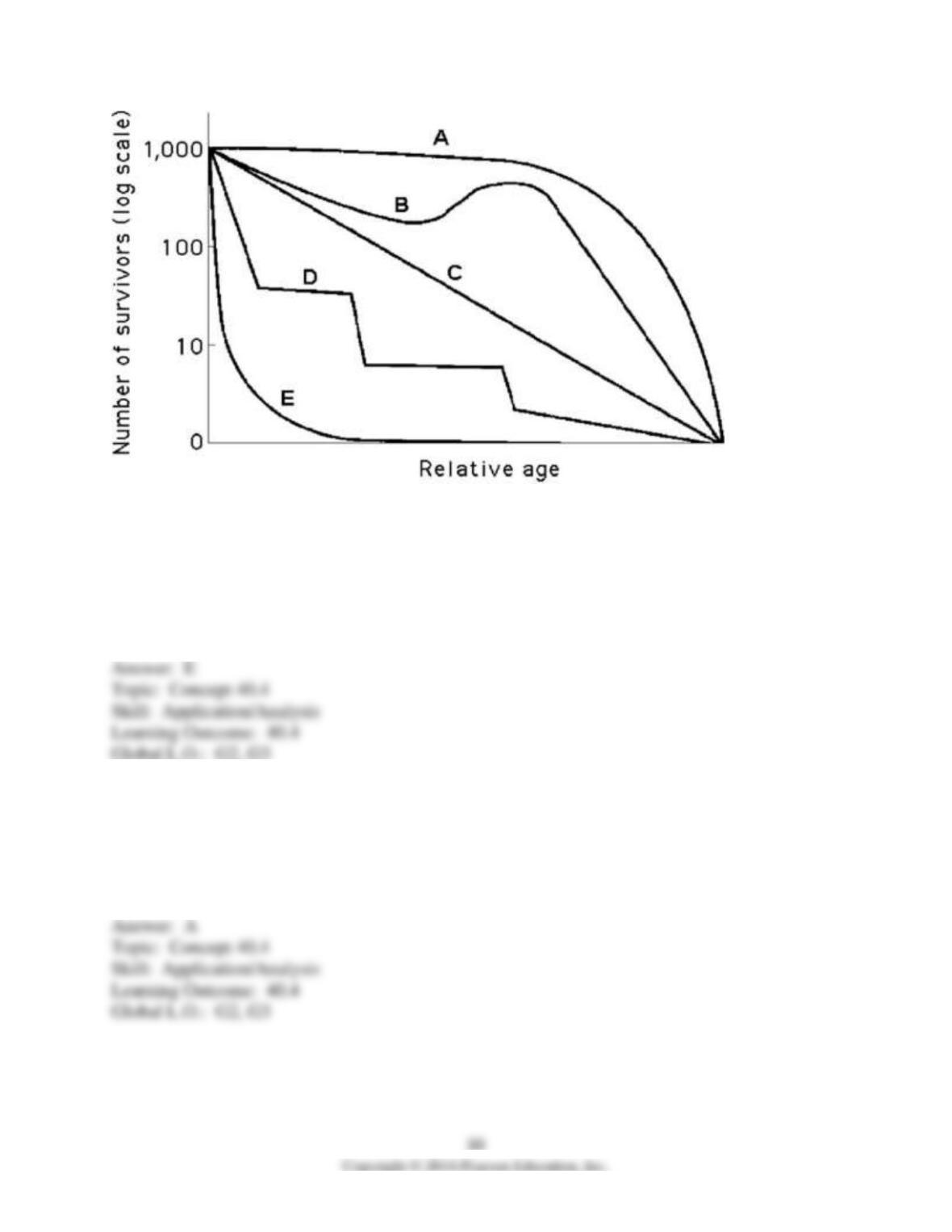
Figure 40.3
10) In Figure 40.3, which curve best describes survivorship in marine molluscs?
A) A
B) B
C) C
D) D
E) E
11) Which curve best describes survivorship in elephants?
A) A
B) B
C) C
D) D
E) E
12) Which curve best describes survivorship in a marine crustacean that molts (i.e., sheds its
exoskeleton in order to grow)?
A) A
B) B
C) C
D) D
E) E
13) Which curve best describes survivorship in humans who live in developed nations?
A) A
B) B
C) C
D) D
E) E
14) Which statement best explains survivorship curve B?
A) It is likely a species that provides little postnatal care, but lots of care for offspring during
midlife, as indicated by increased survivorship.
B) This curve is likely of a species that produces lots of offspring, only a few of which are
expected to survive.
C) It is likely a species where no individuals in the cohort die when they are at 60-70% relative
age.
D) There was a mass emigration of young to middle-aged individuals in this cohort.
E) Survivorship can only decrease; therefore, this curve could not happen in nature.
32
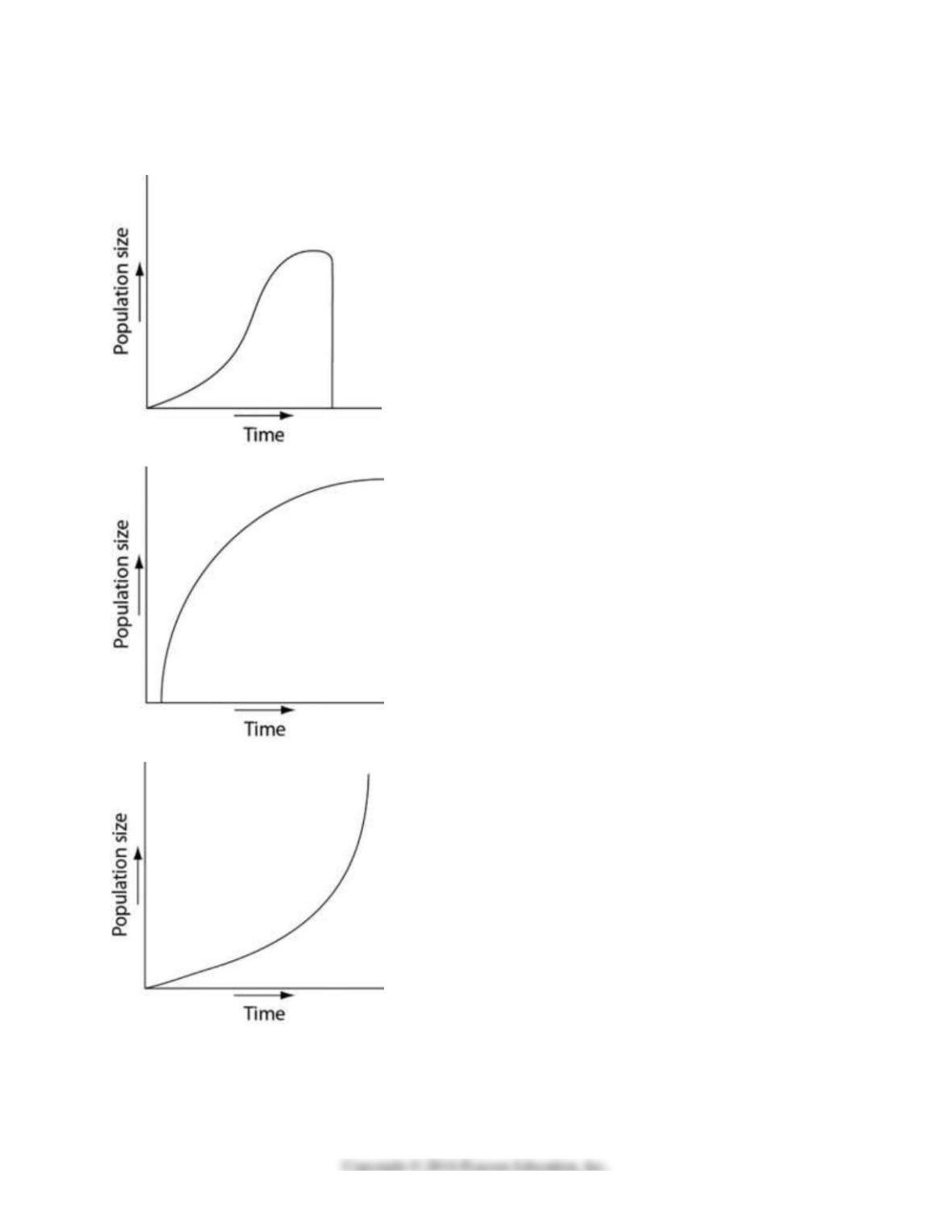
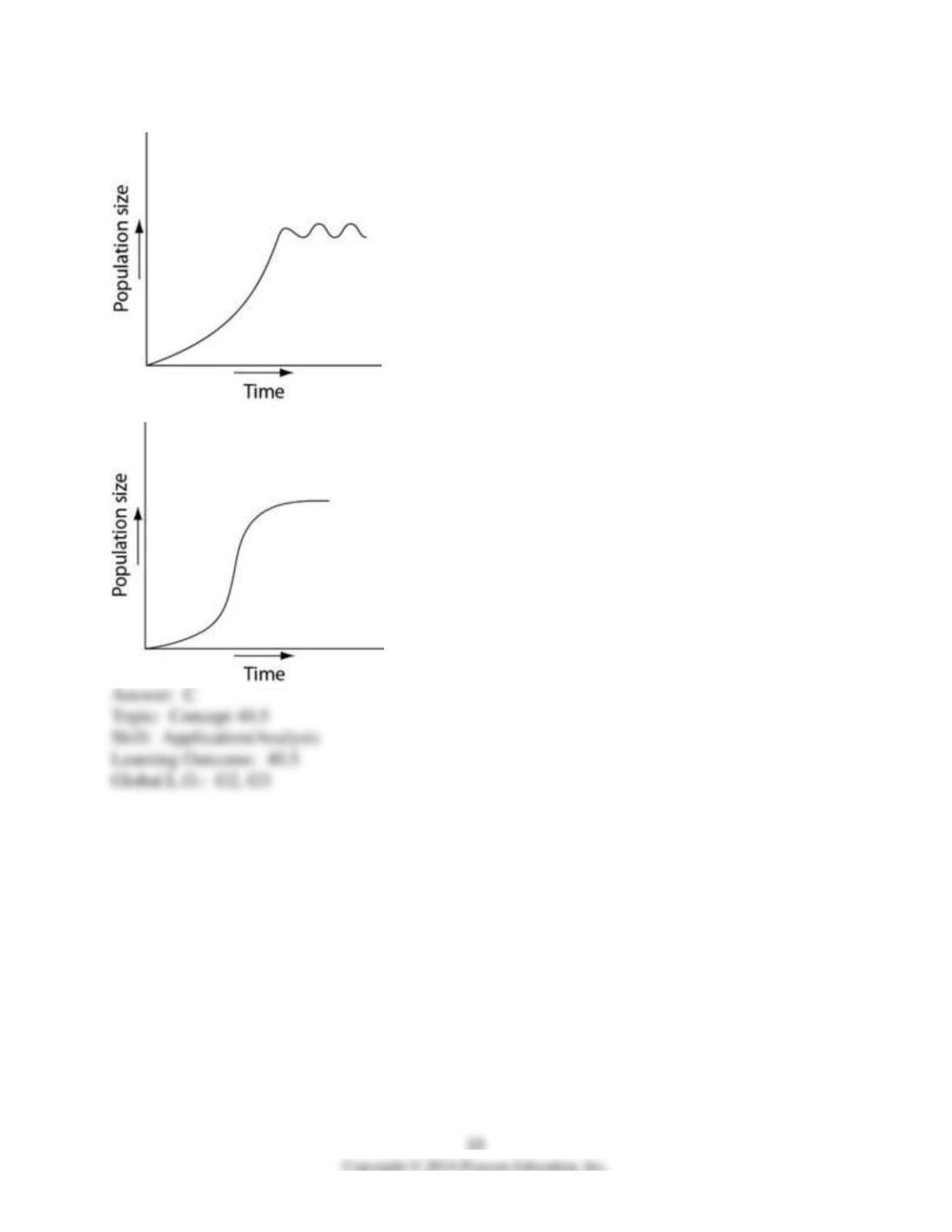
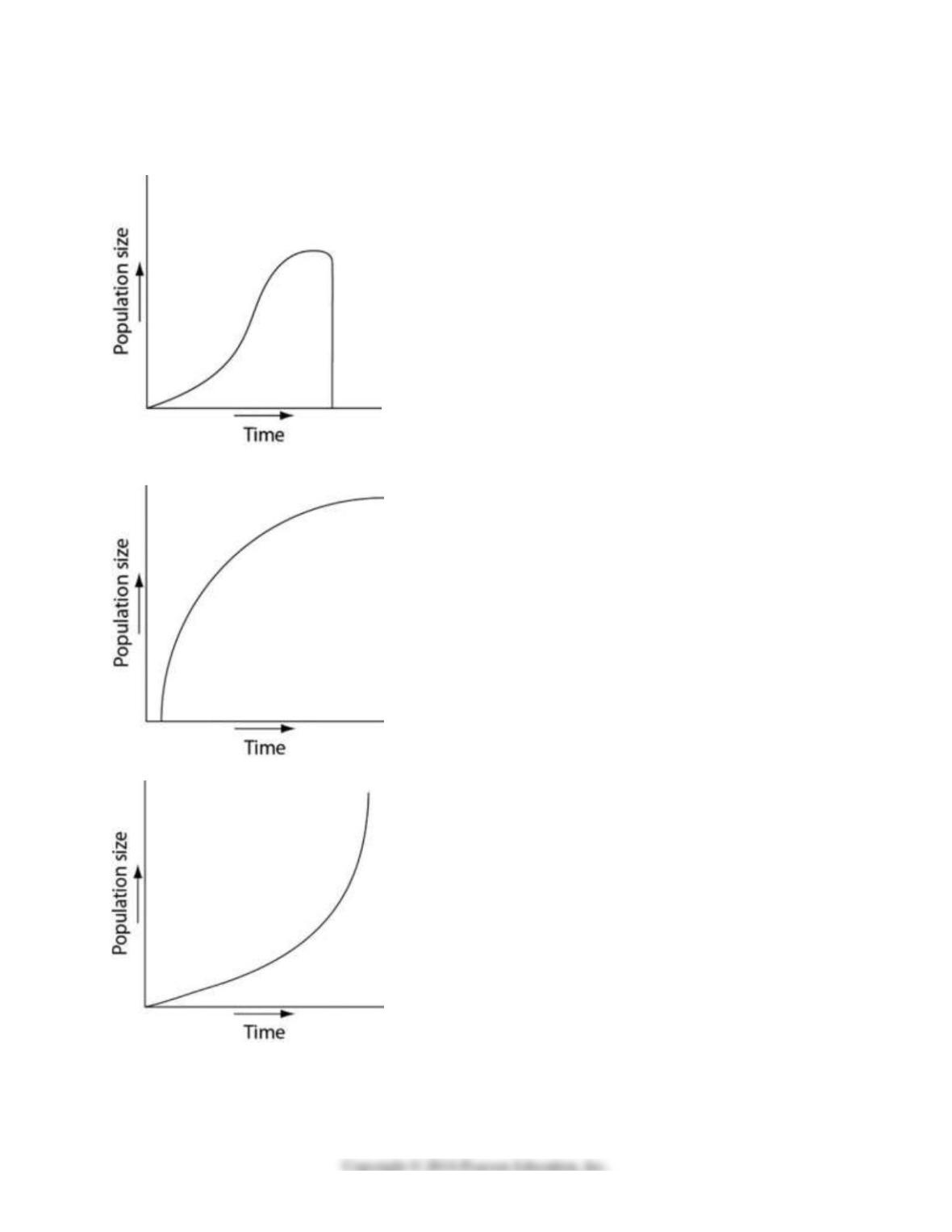
15) Which of the following graphs illustrates the population growth curve of single bacterium
growing in a flask of ideal medium at optimum temperature over a 24-hour period?
A)
B)
C)
D)
E)
34
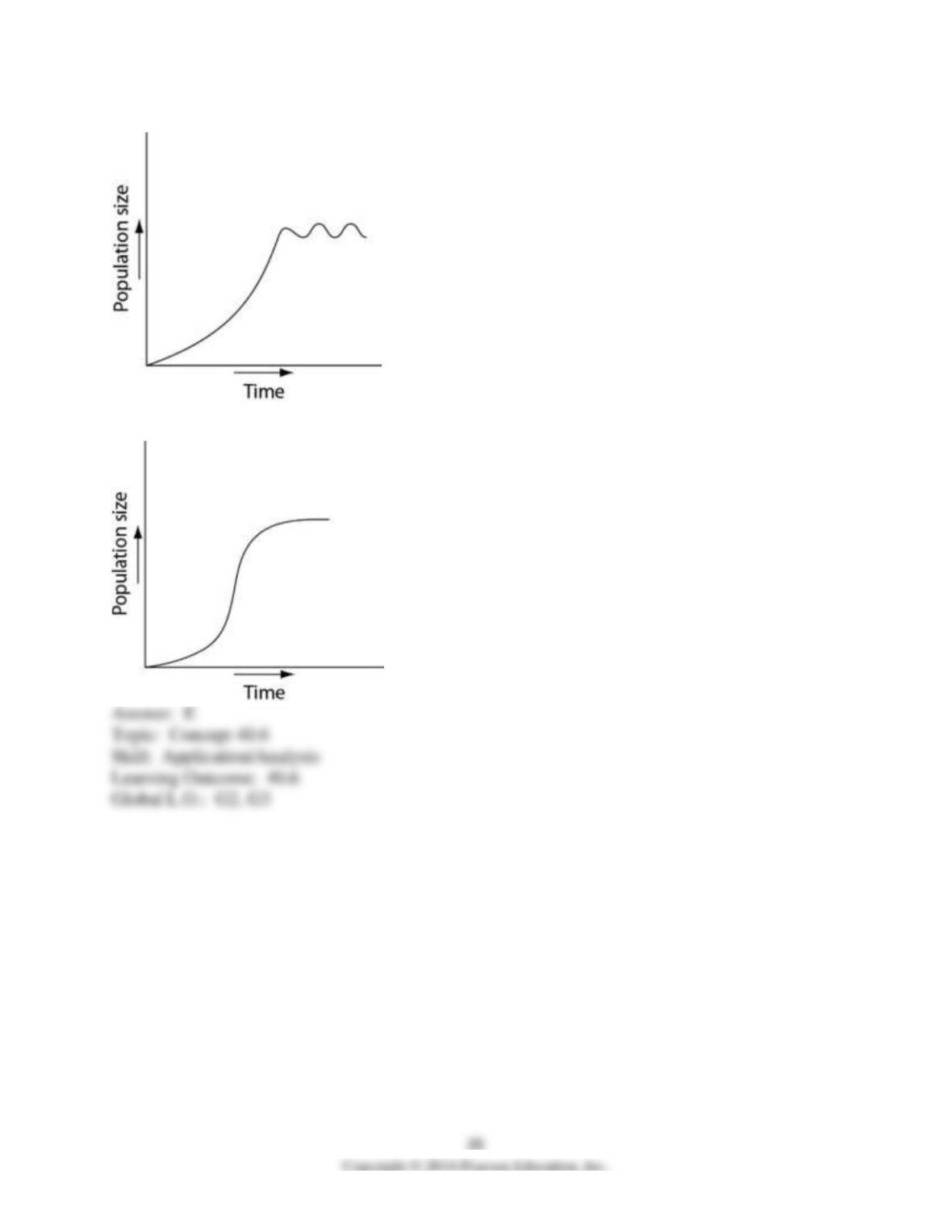
16) Which of the following graphs illustrates the growth curve of a small population of rodents
that has grown to reach a static carrying capacity?
A)
B)
C)
D)
E)
36
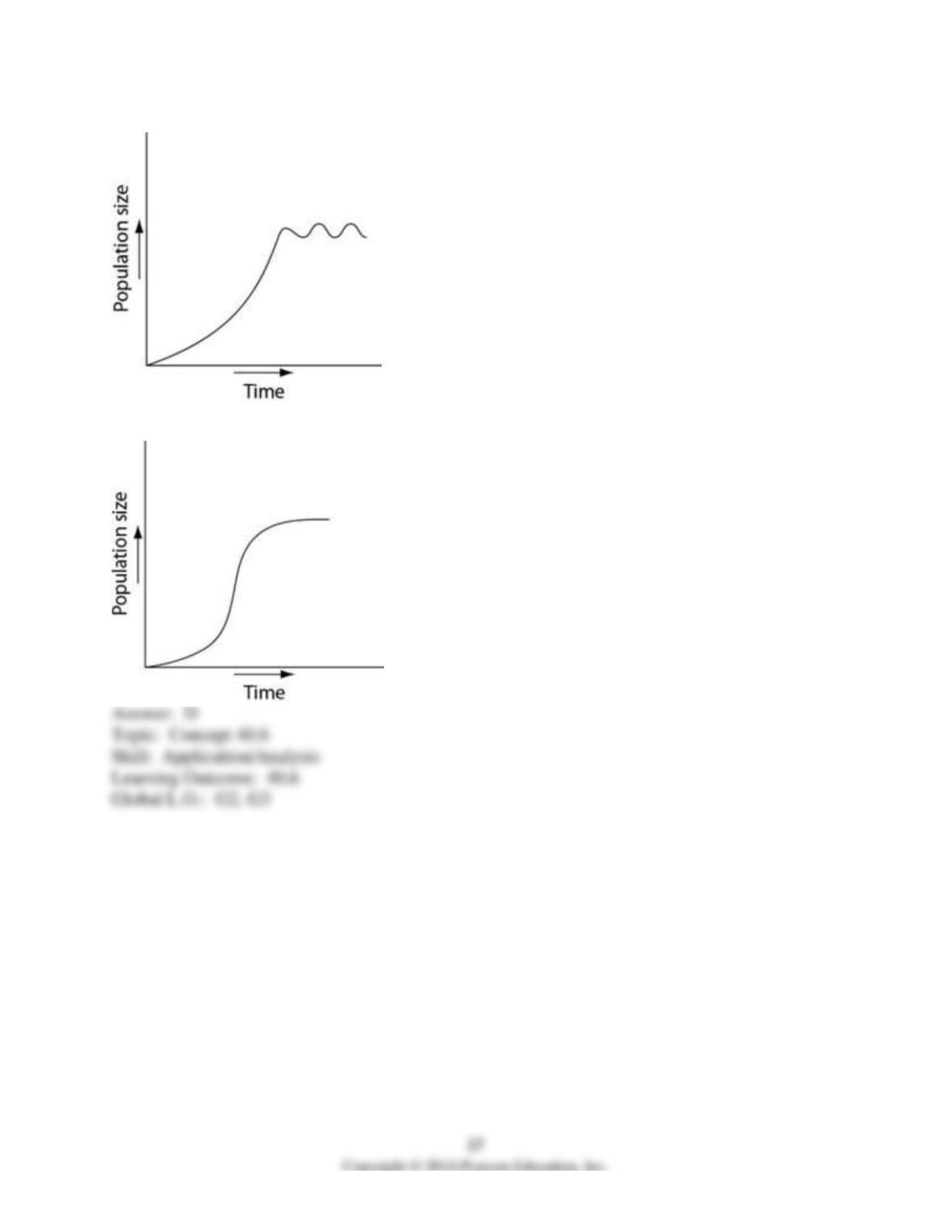
17) Which of the following graphs illustrates the growth over several seasons of a population of
snowshoe hares that were introduced to an appropriate habitat also inhabited by predators in
northern Canada?
A)
B)
C)
D)
E)

40.3 Scenario Questions
Please use the following information to answer the question(s) below.
In areas of permafrost, stands of black spruce are frequently observed in the landscape, whereas
other tree species are noticeably absent. Often these stands are referred to as “drunken forests”
because many of the black spruce are displaced from their normal vertical alignment.
1) What might be the adaptive significance of these unusual forests growing the way they do in
this marginal habitat?
A) Needles are adapted to withstand cold Arctic temperatures.
B) Branches are adapted to absorb more CO2 with this displaced alignment.
C) Taproot formation is impossible, so trees developed shallow root beds and easily tilt.
D) Trees are tilted so that snow won’t break them or tip them over.
E) Trees tip so that they do not compete with each other for sunlight.
2) Imagine that you are managing a large game ranch. You know from historical accounts that a
species of deer used to live there, but they have been extirpated. You decide to reintroduce them.
After doing some research to determine what might be an appropriately sized founding
population, you do so. You watch the population increase for several generations and then graph
the number of individuals (vertical axis) against the number of generations (horizontal axis). The
graph will likely appear as
A) a diagonal line, getting higher with each generation.
B) an “S,” increasing with each generation.
C) an upside-down “U.”
D) a “J,” increasing with each generation.
E) an “S” that ends with a vertical line.
40.4 End-of-Chapter Questions
1) Which of the following biomes is correctly paired with the description of its climate?
A) savanna—low temperature, precipitation uniform during the year
B) tundra—long summers, mild winters
C) temperate broadleaf forest—relatively short growing season, mild winters
D) tropical forests—nearly constant day length and temperature
2) A population’s carrying capacity
A) may change as environmental conditions change.
B) can be accurately calculated using the logistic model.
C) generally remains constant over time.
D) increases as the per capita growth rate decreases.
3) When climbing a mountain, we can observe transitions in biological communities that are
analogous to the changes
A) in different depths in the ocean.
B) in biomes at different latitudes.
C) in a community through different seasons.
D) in an ecosystem as it evolves over time.
4) According to the logistic growth equation
[&*frac*{dN}{dt}|=|rN|thn|*frac*{(K|-|N)}{K}&]
A) the number of individuals added per unit time is greatest when N is close to zero.
B) the per capita growth rate increases as N approaches K.
C) population growth is zero when N equals K.
D) the population grows exponentially when K is small.