Microbiology with Diseases by Body System, 5e (Bauman)
Chapter 4 Microscopy, Staining, and Classification
4.1 Multiple Choice Questions
1) Viruses are generally measured in
A) nanometers.
B) millimeters.
C) micrometers.
D) centimeters.
E) decimeters.
2) Which of the following is an INCORRECT pairing?
A) magnification; refraction of radiation
B) contrast; staining techniques
C) numerical aperture; curved glass
D) dark field: high contrast
E) electron beams; shorter wavelength
3) The ability of a lens to gather light is referred to as its
A) resolution.
B) numerical aperture.
C) refraction.
D) contrast.
E) magnification.

4) Which of the following are magnifying lenses?
A) objectives
B) oculars
C) condensers
D) prisms
E) both objectives and the oculars
5) Fluorescent dyes and lasers are used to visualize specimens on ________ microscopes.
A) phase-contrast
B) dark-field
C) fluorescent
D) confocal
E) bright-field
6) Why does immersion oil improve resolution?
A) It allows light to travel at a uniform speed on its way to the lens.
B) It decreases the working distance.
C) It increases the numerical aperture.
D) It increases numerical aperture and maintains a uniform light speed.
E) It increases the angle of refraction of the light.
7) You are shown a micrograph from a light microscope in which the specimens appear sharply
focused and nearly three-dimensional. The micrograph is probably from a(n) ________
microscope.
A) dark-field
B) phase-contrast
C) Nomarski (differential interference contrast)
D) bright-field
E) atomic force
8) The microscope preferred for viewing living specimens is the ________ microscope.
A) bright-field
B) phase-contrast
C) scanning electron
D) scanning tunneling
E) transmission electron
9) The resolution of a microscope is a function of the ________ of the lenses and the ________
of light.
A) curvature, color
B) curvature, wavelength
C) numerical aperture, wavelength
D) numerical aperture, intensity
E) convex shape, intensity
10) All of the following are types of light microscopes EXCEPT
A) fluorescent.
B) confocal.
C) phase-contrast.
D) scanning tunneling.
E) bright-field.
11) One-millionth of a meter is called a
A) centimeter.
B) decimeter.
C) micrometer.
D) millimeter.
E) nanometer.
12) If a microbiology lab student left the safranin out of the Gram stain procedure, what would
be the result?
A) All cells would be purple.
B) Gram-positive cells would be purple and Gram-negative cells would be colorless.
C) All cells would be pink.
D) Gram-positive cells would be pink and Gram-negative cells would be purple.
E) Gram-positive cells would be colorless and Gram-negative cells would be pink.
13) All of the following are common to both the Gram stain and the acid-fast stain EXCEPT
A) primary stain.
B) counterstain.
C) a decolorizing agent.
D) a chemical mordant.
E) a decolorizing agent and a counterstain.
14) Carbolfuchsin is a dye used in ________ stain(s).
A) the Gram
B) the endospore
C) the acid-fast
D) the flagellar
E) both the acid fast and flagellar
15) Histological samples prepared with the ________ stain may reveal the presence of abnormal
cells.
A) acid-fast
B) Gram
C) simple safranin
D) methylene blue
E) hematoxylin and eosin (HE)

16) Carbolfuchsin is the ________ in the acid-fast stain.
A) primary stain
B) mordant
C) decolorizer
D) counterstain
E) fixing reagent
17) Which of the following is the best definition of “empty magnification”?
A) An image is magnified so much resolution and contrast are lost.
B) A specimen is so lacking in color it cannot be observed on a light microscope.
C) A magnified specimen is so small it cannot be resolved on a light microscope.
D) The background on the field is almost totally black.
E) A magnified image has lots of empty space around a small object.
18) In a transmission electron microscope, the “lenses” are
A) made of glass.
B) thin films of metal.
C) lasers.
D) magnets.
E) vacuums.
19) You are examining a bacterial smear on a light microscope. You observe pinkishfired bacilli
and blue cells of various shapes. You are probably looking at a smear prepared with the
________ stain.
A) Gram
B) Ziehl-Neelsen acid-fast
C) Schaffer-Fulton endospore
D) Gomori methenamine
E) Hematoxylin and eosin
20) The placement of an organism into a domain is made on the basis of
A) G + C content.
B) cell ultrastructure.
C) ribosomal RNA analysis.
D) serological tests.
E) Gram-stain reactions.
21) Which of the following is NOT a characteristic of a genus name?
A) It is usually an adjective.
B) It is written before the specific epithet.
C) It is always capitalized.
D) It is either underlined or in italics.
E) It is one of two names used to identify an organism.
22) Carl Woese proposed the concept of the domain based on differences of which of the
following cellular molecules?
A) transfer RNA
B) membrane lipids
C) ribosomal RNA
D) DNA
E) proteins
23) Which of the following classification methods relies on the morphology of organisms?
A) phage typing
B) physical characteristics
C) biochemical tests
D) analysis of nucleic acids
E) serological tests
24) Bacteria in the genus Salmonella are frequent causes of serious food contamination. Which
of the following methods would provide rapid confirmation that a Salmonella species was a
contaminant in food suspected of causing food “poisoning”?
A) phage typing
B) biochemical tests
C) physical characteristics
D) analysis of nucleic acids
E) serological tests
25) Viruses are not included in the taxonomic scheme proposed by Carl Woese because they lack
A) genetic material.
B) ribosomal RNA.
C) proteins.
D) lipid membranes.
E) cytoplasm.
26) Why have some microbiologists proposed using ribosomal RNA as the basis for defining
bacterial species?
A) Ribosomal RNAs are highly conserved genetic sequences present in all prokaryotes.
B) The “interbreeding population” criterion does not apply to bacteria.
C) Ribosomal RNA is the basis for domain assignment.
D) Bacteria vary too little in their physical and biochemical traits.
E) Bacteria are not interbreeding populations, and ribosomal RNAs are highly conserved genes
present in all prokaryotes.
27) Which of the following phenomena produces magnification?
A) the wavelength of a radiation source
B) the refraction of radiation as it passes through a lens
C) the thickness of a microscopic specimen
D) the numerical aperture of a lens
E) the length of an objective lens
28) A virologist wants to observe the three-dimensional surface features of virus particles she is
studying. Which of the following microscopes would be most useful for her observations?
A) differential interference contrast
B) atomic force
C) scanning electron
D) transmission electron
E) atomic force or scanning electron
29) A structure that appears in a transmission electron micrograph but is NOT actually present in
the specimen is known as a(n)
A) antigen.
B) biofilm.
C) artifact.
D) refraction.
E) mordant.
30) Which of the following statements about transmission electron microscopy is CORRECT?
A) Three-dimensional images are produced.
B) Lasers are used for visualization.
C) Up to 1,000,000X magnification may be achieved.
D) Living specimens may be used.
E) Stains can be applied to create a color image.
31) Acidic dyes
A) work best in low pH environments.
B) are negatively charged.
C) are used for staining negatively charged molecular structures.
D) are lipid soluble.
E) are negatively charged and work best at low pH.
32) The kingdoms included in the Linnaeus system of classification are
A) Animalia and Prokaryotae.
B) Protista and Plantae.
C) Fungi and Protista.
D) Animalia and Plantae.
E) Prokaryotae and Protista.
33) The Gram stain works because of differences in the ________ of bacteria.
A) genetic characteristics
B) cell walls
C) cell membranes
D) antigens
E) capsules
34) The rules of naming organisms are called
A) taxonomy.
B) nomenclature.
C) classification.
D) binomials.
E) identification.
35) Why are modern light microscopes better than the ones Leeuwenhoek used?
A) Modern microscopes have a fivefold better resolution.
B) Modern microscopes are compound instead of simple.
C) Modern microscopes have lenses with smaller numerical apertures.
D) Modern lenses are made of prisms.
E) Modern microscopes are compound and have fivefold better resolution.

36) The function of a mordant in staining procedures is to
A) fix the specimen to the slide.
B) provide contrasting color.
C) decrease the solubility of dye molecules.
D) remove dye from certain structures.
E) damage cellular structures so they take up dyes better.
37) You are viewing an image from a microscope in which the specimens in the smear have
more than one color. You are probably looking at
A) a smear stained with a differential stain.
B) a specimen stained with various fluorescent molecules.
C) a scanning tunneling micrograph.
D) a specimen on a dark-field microscope.
E) either a specimen stained with a differential stain or fluorescent molecules.
38) In Gram staining, ethanol-acetone is used as a
A) decolorizing agent.
B) counterstain.
C) mordant.
D) drying agent.
E) primary stain.
39) A sample from a patient is prepared using the Gomori methenamine silver stain. What type
of microbe is suspected of being present?
A) bacteria
B) parasitic worm larva
C) fungus
D) protozoal parasite
E) virus

40) Tungsten is a reagent used in the
A) acid-fast stain.
B) electron microscopy stain.
C) endospore stain.
D) flagellar stain.
E) negative stain.
41) Acidic dyes are commonly used for ________ stains.
A) acid-fast
B) negative
C) flagellar
D) endospore
E) Gram
42) Low contrast specimens are made easier to see by
A) increasing the amount of light passing through the slide.
B) using dyes that react with their structures.
C) adding color filters to the microscope.
D) using smaller aperture lenses.
E) drying them in a vacuum.
43) Methylene blue can be used to stain DNA because it
A) forms ionic bonds with DNA.
B) changes the pH and therefore the structure of DNA.
C) covalently bonds with DNA.
D) makes DNA electron dense.
E) is an effective fixing agent for nucleic acids.
44) The ________ stain makes use of malachite green.
A) negative
B) flagellar
C) endospore
D) electron microscopy
E) acid-fast
45) The most appropriate unit of measurement for intact archaea is the
A) meter (m).
B) millimeter (mm).
C) micrometer (μm).
D) nanometer (nm).
E) centimeter (cm).
46) Specimens are prepared for ________ microscopy using electron-dense stains.
A) atomic probe
B) bright-field
C) confocal
D) transmission electron
E) scanning tunneling
47) An important function of nomenclature is to
A) facilitate unambiguous communication.
B) clarify relationships among organisms.
C) provide an understanding of evolutionary relationships.
D) define the characteristics used for classification.
E) provide a detailed description of an organism.
48) A measurement of a microbe is reported as 1 × 10⁻⁶ m, also known as
A) centimeters (cm).
B) millimeters (mm).
C) micrometers (μm).
D) nanometers (nm).
E) yards.
49) One-thousandth of a meter is a
A) yard.
B) millimeter (mm).
C) micrometer (μm).
D) nanometer (nm).
E) centimeter (cm).
50) Bacteria and many other microbes do not ________ and therefore do not fit Linneaus’
definition species.
A) reproduce sexually
B) have nuclei
C) exchange genetic material
D) have cytoplasmic membranes
E) reproduce asexually
4.2 True/False Questions
1) A resolution of 1 μm would be better than a resolution of 0.5 μm.
2) All types of radiation are used for microscopy.
3) The three domains proposed by Carl Woese and George Fox are the Archaea, the Eukarya,
and the Protista.
4) Gram staining of bacteria provides all the physical characterization necessary to identify
bacterial species.
5) A single basic dye is used in simple stains.
6) The endospore stain reveals internal structures within cells of the genera Bacillus and
Clostridium.
7) Acid-fast cells such as Mycobacterium lose the color of the primary stain in the presence of
hydrochloric acid.
8) Three-dimensional images of specimens can be obtained using scanning electron microscopes.
9) Images of living specimens can be produced using atomic force microscopes.
10) Specimens are visible on a phase contrast microscope because they refract the light that
illuminates them.
4.3 Short Answer Questions
1)
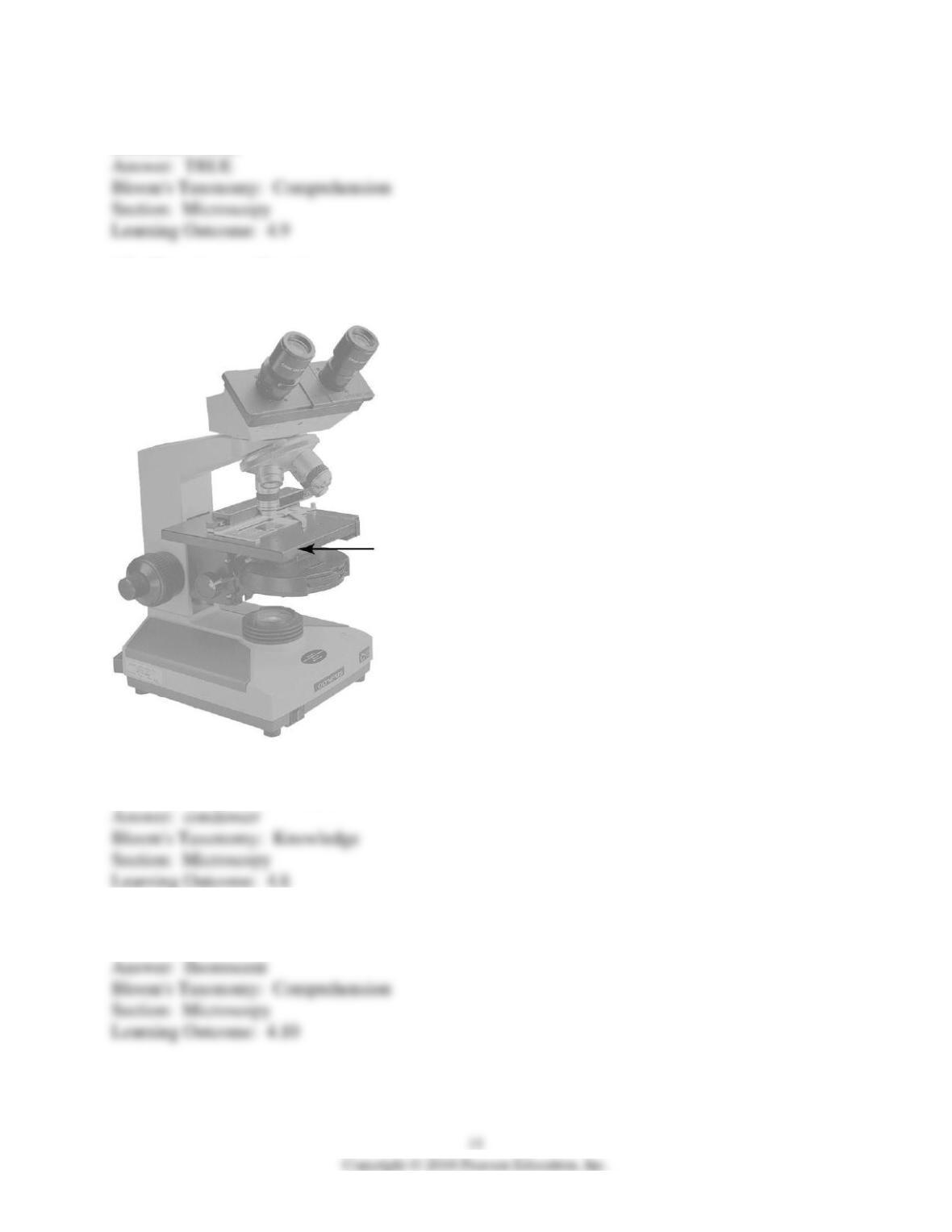
The part of the microscope indicated by the arrow in Figure 4.1 is the
(ocular/objective/condenser) lens.
2) A(n) (acidic/metallic/fluorescent) molecule is one that absorbs invisible radiation and emits
visible light.
3) The total magnification using a 10 ocular and a 100 objective would be (110/1000/10000)×.
(Be sure your answer is a numeral.)
4) A (decolorizer/mordant/fixer) is a substance that binds to a dye and makes it less soluble.
5) Coating a specimen with a heavy metal is a step in preparing it for
(phase/fluorescent/electron) microscopy.
6) A serological test that involves the clumping of antigen and antibody is the
(agglutination/antigen/ELISA) test.
7) The system of taxonomy used today was originated by (Linnaeus/Darwin/Woese). (Be sure to
capitalize your answer.)
8) Carl Woese and George Fox proposed the (phylum/domain/family), a taxon that contains
multiple kingdoms.
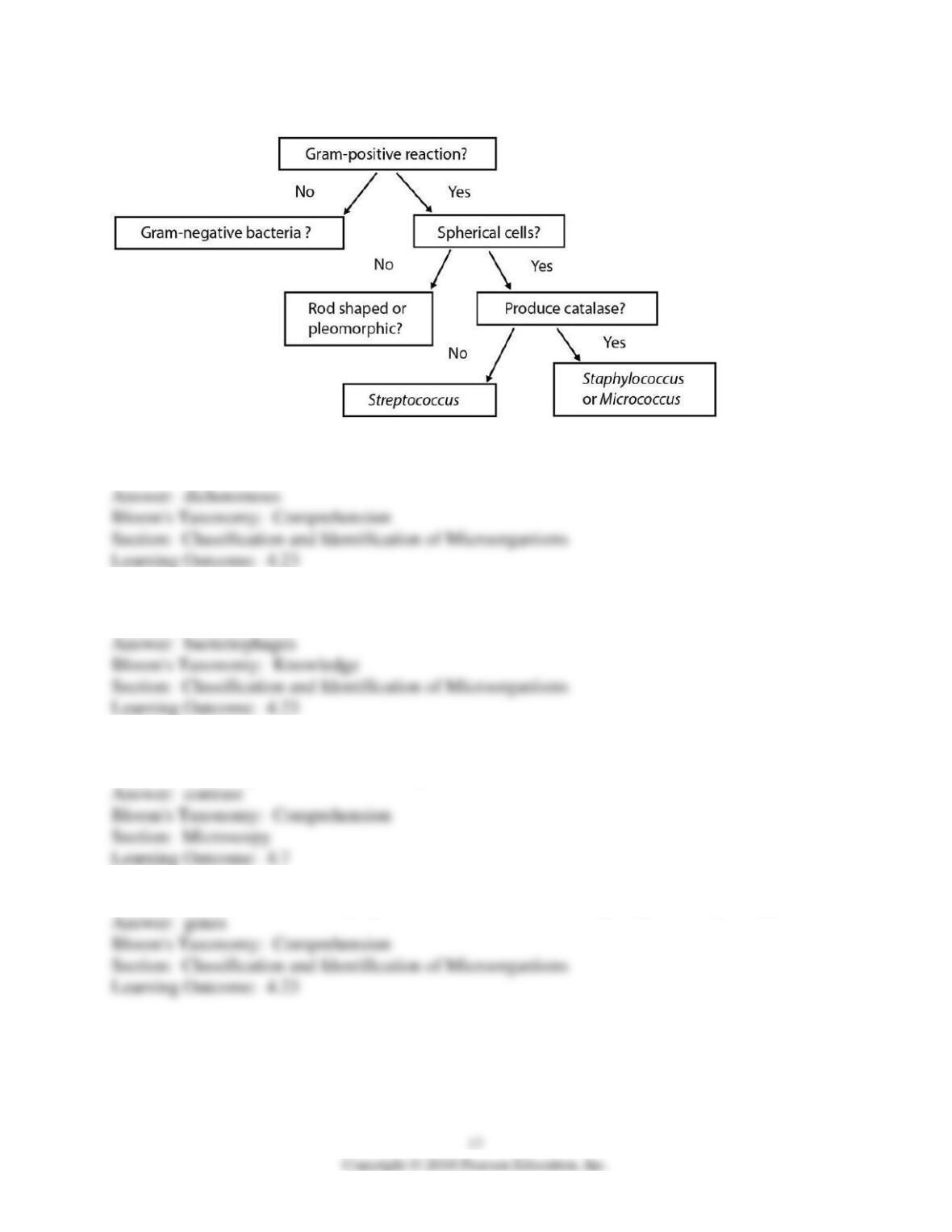
9)
Figure 4.2 represents a (dichotomous/classification/taxonomic) key of the type used to identify a
microbe.
10) Phage typing is useful for identifying bacteria because of the specificity of
(antibodies/bacteriophages/PCR) for unique bacterial structures.
11) A primary purpose for the use of stains in microscopy is to increase the
(magnification/brightness/contrast) of a specimen.
12) PCR is a method for identifying microbes based on their (antigens/genes/morphology).
13) In a compound microscope, the lens that directs light into the eye is the
(ocular/condenser/objective) lens.
14) In the Schaffer-Fulton endospore stain, heat is a (fixation/mordant/staining) step.
15) The resolution of a microscope lens is a function of the lens’ (aperture/color/contrast).
4.4 Essay Questions
1) Discuss the ways in which light rays can be manipulated to increase resolution and/or contrast.
2) Compare and contrast the light microscope with the electron microscope.
3) You are a scientist studying the highly specific interactions of bacteriophages with their host
cells when they first encounter the cell. Discuss what microscope(s) and preparation procedures
you might use for this study.
4) Compare and contrast the three domains identified by Woese and Fox: Eukarya, Bacteria, and
Archaea.
5) List and explain five types of techniques that can be used to identify unknown
microorganisms.