42) The evolution of eukaryotic cells most likely involved
A) endosymbiosis of an oxygen-using bacterium in a larger host cell–the endosymbiont evolved
into mitochondria.
B) endosymbiosis of an oxygen-using photosynthetic bacterium in a larger host cell–the
endosymbiont evolved into mitochondria.
C) endosymbiosis of an oxygen-using scavenger bacterium in a larger host cell–the
endosymbiont evolved into lysosomes.
D) evolution of an endomembrane system and subsequent evolution of mitochondria from a
portion of the Golgi.
43) In a liver cell detoxifying alcohol and some other poisons, the enzymes of the peroxisome
remove hydrogen from these molecules and
A) combine the hydrogen with water molecules to generate hydrogen peroxide.
B) combine the hydrogen with hydrogen peroxide to generate water.
C) combine the hydrogen with hydrogen peroxide to generate oxygen and water.
D) combine the hydrogen with oxygen molecules to generate hydrogen peroxide.
44) Which organelles or structures are absent in plant cells?
A) mitochondria
B) microtubules
C) Golgi apparatus
D) centrosomes
E) peroxisomes
13
45) Which of the following correctly describes the pathway taken by a protein destined for
secretion from an animal cell?
A) plasma membrane → transport vesicle → Golgi → transport vesicle → rough ER
B) Golgi → rough ER → transport vesicle → plasma membrane
C) rough ER → transport vesicle → lysosome → transport vesicle → plasma membrane
D) rough ER → transport vesicle → Golgi → transport vesicle → plasma membrane
E) rough ER → transport vesicle → Golgi → transport vesicle → lysosome → plasma
membrane
46) Motor proteins provide for molecular transport of materials in cells by interacting with what
types of cellular structures?
A) the nuclear envelope
B) membrane proteins
C) the extracellular matrix
D) cytoskeletal structures
E) cellulose fibers in the cell wall
47) Movement of vesicles within the cell depends on what cellular structures?
A) microtubules and motor proteins
B) actin filaments and microtubules
C) actin filaments and motor proteins
D) centrioles and motor proteins
48) A 9 + 2 arrangement of microtubules, consisting of nine doublets of microtubules
surrounding a pair of single microtubules, is associated with
A) motile cilia centrioles
B) centrioles only
C) both eukaryotic and bacterial flagella
D) eukaryotic flagella only
E) eukaryotic flagella and motile cilia
49) Vinblastine, a drug that inhibits microtubule polymerization, is used to treat some forms of
cancer. Cancer cells given vinblastine would be unable to
A) form cleavage furrows during cell division.
B) migrate by amoeboid movement.
C) separate chromosomes during cell division.
D) extend pseudopods.
E) maintain the shape of the nucleus.
50) Centrioles, cilia, flagella, and basal bodies have remarkably similar structural elements and
arrangements. Which of the following hypotheses is most plausible in light of such structural
similarities?
A) Cilia and flagella are derived from the centrioles.
B) Motor proteins such as dynein must have evolved before any of these four kinds of structures.
C) Centrioles are derived from cilia and/or flagella.
D) Natural selection for cell motility repeatedly selected for microtubular arrays in circular
patterns in the evolution of each of these structures.
51) Cytochalasin D is a drug that prevents actin polymerization. A cell treated with cytochalasin
D will still be able to
A) perform amoeboid movement.
B) form cleavage furrows.
C) contract muscle fibers.
D) extend pseudopodia.
E) move vesicles around the cell.
52) Which of the following statements about the cytoskeleton is true?
A) Transport vesicles move between organelles of the endomembrane system independently
from the cytoskeleton.
B) Microfilaments are structurally rigid and resist compression, whereas microtubules resist
tension (stretching).
C) Movement of cilia and flagella is the result of motor proteins causing microtubules to move
relative to each other.
D) Chemicals that block the assembly of the cytoskeleton would cause little effect on the cell’s
response to external signals and stimuli.
53) Cells require which of the following to form cilia or flagella?
A) laminin
B) tubulin
C) actin
D) myosin
54) A mutation that disrupts the ability of an animal cell to add polysaccharide modifications to
proteins would most likely cause defects in its
A) nuclear lamina
B) nuclear lamina and extracellular matrix.
C) smooth ER and Golgi apparatus.
D) Golgi apparatus and extracellular matrix.
55) Passive movement of fluids and bacteria from the interior of the small intestine through the
space between cells of the intestinal wall can cause serious infection and medical complications.
Defects in which of the following would be associated with such a condition?
A) cell walls
B) gap junctions
C) tight junctions
D) middle lamella
E) desmosomes
56) Intermediate filaments attach to which of the following structures in the plasma membrane?
A) extracellular matrix
B) gap junctions
C) tight junctions
D) middle lamella
E) desmosomes
57) The cell walls of bacteria, fungi, and plant cells and the extracellular matrix of animal cells
are all external to the plasma membrane. Which of the following is a characteristic common to
all of these extracellular structures?
A) They have pores that regulate the exchange of water and small molecules between cells and
their environment.
B) They are composed of complex mixtures of lipids and carbohydrates.
C) They provide a rigid structure that prevents the uptake of excess water into cells.
D) They are constructed of polymers that are synthesized in the cytoplasm and then transported
out of the cell for assembly.
58) When a potassium ion (K+) moves from the soil into the vacuole of a cell on the surface of a
root, it must pass through several cellular structures. Which of the following correctly describes
the order in which these structures will be encountered by the ion?
A) plasma membrane → primary cell wall → cytoplasm → vacuole
B) secondary cell wall → plasma membrane → primary cell wall → cytoplasm → vacuole
C) primary cell wall → plasma membrane → cytoplasm → vacuole
D) primary cell wall → plasma membrane → lysosome → cytoplasm → vacuole
E) primary cell wall → plasma membrane → cytoplasm → secondary cell wall → vacuole
59) The extracellular matrix is thought to participate in the regulation of animal cell behavior by
communicating information from the outside to the inside of the cell via which of the following?
A) gap junctions
B) cellulose fibers
C) integrins
D) plasmodesmata
60) Plasmodesmata in plant cells are most similar in function to which of the following
structures in animal cells?
A) peroxisomes
B) desmosomes
C) gap junctions
D) extracellular matrix
E) tight junctions
61) Ions can travel directly from the cytoplasm of one animal cell to the cytoplasm of an adjacent
cell through
A) plasmodesmata.
B) intermediate filaments.
C) tight junctions.
D) desmosomes.
E) gap junctions.
62) Which of the following makes it necessary for animal cells, although they have no cell walls,
to have intercellular junctions?
A) Cell membranes do not distinguish the types of ions and molecules passing through them.
B) Large molecules, such as proteins and RNA molecules, do not readily get through one, much
less two, adjacent cell membranes.
C) Cell-to-cell communication requires physical attachment of one cell to another.
D) Maintenance of tissue integrity and barriers to fluid leakage requires cells to adhere tightly to
one another.
63) Signals from the ECM to the cytoskeleton may be transmitted by
A) fibronectin.
B) proteoglycans.
C) integrins.
D) collagen.
E) middle lamella.
4.2 Art Questions
1)
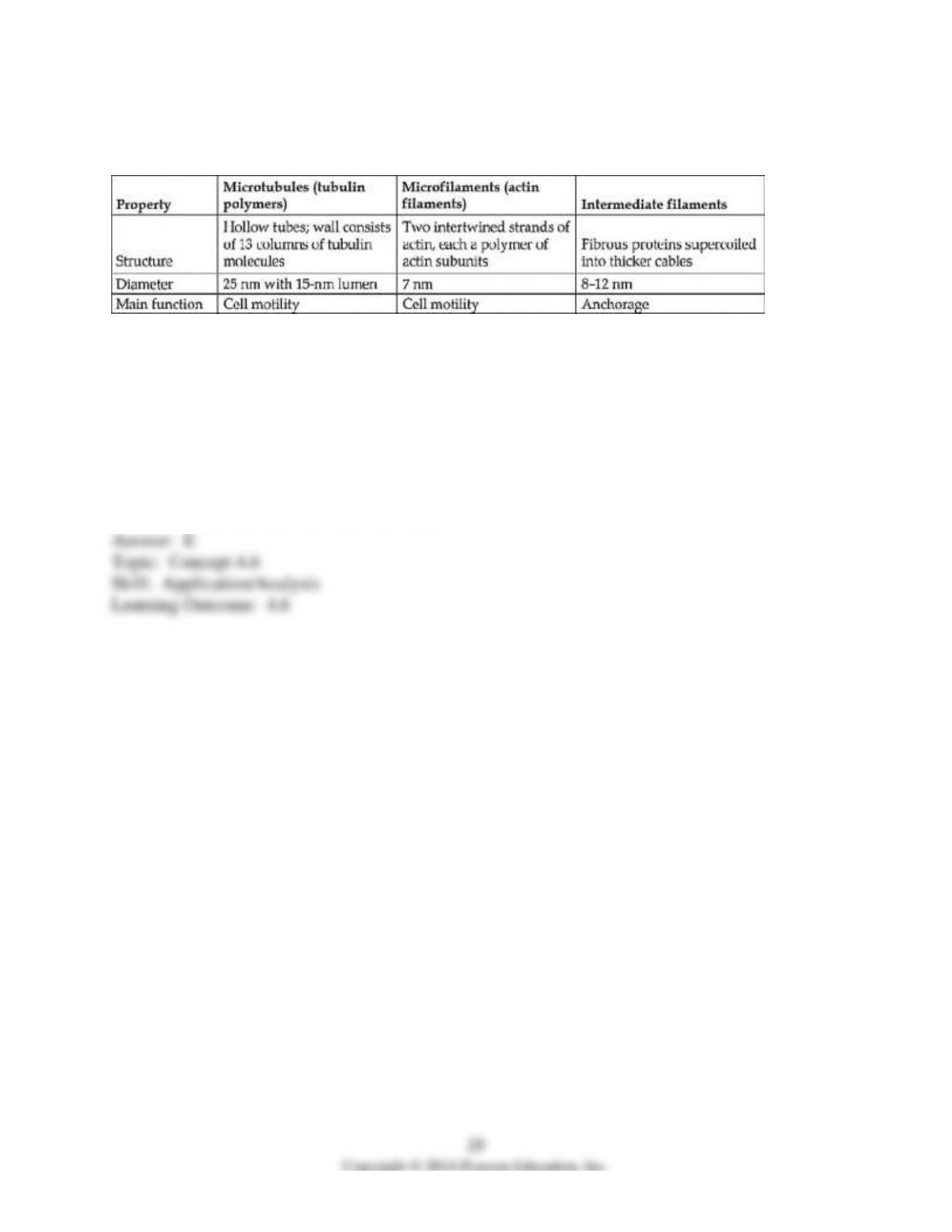
Table 4.1
The differences among the three categories of cytoskeletal elements outlined in Table 4.1 suggest
that each has a specialized role. Which of the following is a correct match between a cytoskeletal
element and its function? (All three elements are involved in the maintenance of cell shape.)
A) microfilaments and intracellular vesicle transport
B) microtubules and cleavage furrow formation
C) microfilaments and flagellar motility
D) intermediate filaments and cytoplasmic streaming
E) microtubules and chromosome movement
4.3 Scenario Questions
1) A biologist wants to examine the surfaces of different types of cells in kidney tubules of small
mammals. The cells in question can be distinguished by external shape, size, and 3-D
characteristics. Which of the following would be the optimum method for her study?
A) transmission electron microscopy
B) cell fractionation
C) light microscopy using stained sections of kidney tissue
D) light microscopy of living unstained material
E) scanning electron microscopy
2) A newspaper ad for a local toy store indicates that a very inexpensive microscope available for
a small child is able to magnify specimens nearly as much as the much more costly microscope
available in your college lab. What is the primary reason for the price difference?
A) The ad agency is misrepresenting the ability of the toy microscope to magnify.
B) The toy microscope does not have the same fine control for focus of the specimen.
C) The toy microscope has good magnification, but has low resolution and therefore poor-quality
images.
D) The college microscope produces greater contrast in the specimens.
3) A biologist ground up some plant leaf cells and then centrifuged the mixture to fractionate the
organelles. Organelles in one of the heavier fractions could produce ATP in the light, whereas
organelles in the lighter fraction could produce ATP in the dark. The heavier and lighter fractions
are most likely to contain, respectively,
A) mitochondria and chloroplasts.
B) chloroplasts and peroxisomes.
C) peroxisomes and chloroplasts.
D) chloroplasts and mitochondria.
E) mitochondria and peroxisomes.
4) Comparison of samples from the liver of an alcoholic with samples from the liver of a non-
drinker when examined by transmission electron microscopy would likely reveal that
A) the ultrastructure of the two livers is very similar.
B) the liver of the non-drinker has expansive rough ER compared to the alcoholic’s liver.
C) the liver of the alcoholic has expansive smooth ER compared to the non-drinker’s liver.
D) the liver of the alcoholic has substantially more lysosomes than the non-drinker’s liver.
4.4 End-of-Chapter Questions
1) Which structure is not part of the endomembrane system?
A) nuclear envelope
B) chloroplast
C) Golgi apparatus
D) plasma membrane
2) Which structure is common to plant and animal cells?
A) chloroplast
B) wall made of cellulose
C) mitochondrion
D) centriole
3) Which of the following is present in a prokaryotic cell?
A) mitochondrion
B) ribosome
C) nuclear envelope
D) chloroplast
4) Which structure-function pair is mismatched?
A) microtubule; muscle contraction
B) ribosome; protein synthesis
C) Golgi; protein trafficking
D) nucleolus; production of ribosomal subunits
5) Cyanide binds to at least one molecule involved in producing ATP. If a cell is exposed to
cyanide, most of the cyanide will be found within the
A) mitochondria.
B) ribosomes.
C) peroxisomes.
D) lysosomes.
6) What is the most likely pathway taken by a newly synthesized protein that will be secreted by
a cell?
A) ER → Golgi → nucleus
B) nucleus → ER → Golgi
C) ER → Golgi → vesicles that fuse with plasma membrane
D) ER → lysosomes → vesicles that fuse with plasma membrane
7) Which cell would be best for studying lysosomes?
A) muscle cell
B) nerve cell
C) phagocytic white blood cell
D) bacterial cell