Chapter 4—Metabolism in Cells Key
1. Starch is a polysaccharide composed of many glucose molecules. The conversion of starch into glucose
would be an example of…
2. Which is the longest?
3. Which has the greatest energy?
4. Which part of photosynthesis produces NADPH?
5. The subatomic particle ALWAYS transferred in an oxidation-reduction (redox) reaction is a(n)…
6. When a photon of light is absorbed by a pigment, the pigment…
7. What color(s) of light does chlorophyll absorb?
8. Which organelle contains the photosynthetic pigments?
9. The light-dependent (energy-capturing) reactions of photosynthesis occur in the…
10. When the reaction center for photosystem II loses and electron, how is the electron replaced?
11. Water is split during…
12. The carbon-fixation reactions of photosynthesis occur in the…
13. The two energy-carrying compounds that are obtained from the energy-capturing reactions of
photosynthesis and that supply energy to “run” the Calvin cycle are…
14. The incorporation of six carbon dioxide molecules by the Calvin cycle reactions are required to produce one
molecule of…
15. During chemiosmosis, a gradient of ____ is produced.
16. As part of photosynthesis, chemiosmosis provides the energy for making…
17. What happens during photorespiration?
18. How is a C4 plant different from a C3 plant?
19. How many ATP’s are produced (net) from glycolysis, starting with one molecule of glucose?
20. What is the end product of glycolysis?
21. Where does glycolysis take place?
22. In aerobic respiration, where is acetyl coenzyme A produced?
23. Where do the Krebs cycle reactions take place?
24. What is another name for the Krebs cycle?
25. Besides ATP, what other energy-carrying molecule is produced from glycolysis?
26. What waste molecule is produced during the formation of acetyl CoA from pyruvate?
27. The final electron acceptor in aerobic respiration, at the end of the electron transport system, is…
28. By the end of aerobic respiration, all of the carbons from the original glucose are gone. Where did they go?
29. A pigment is a molecule or substance that absorbs light.
30. Carotenoids are the primary photosynthetic pigments.
31. The electron in a chlorophyll molecule becomes “excited” when it absorbs light energy in the appropriate
wavelength.

32. Ribulose bisphosphate (RuBP) is a 5-carbon compound, to which carbon dioxide is added in the Calvin
cycle.
33. In photosynthesis, oxygen is produced from the splitting of carbon dioxide.
34. Light travels in discrete energy packets called photons.
36. Photosystems consist of chlorophyll molecules and associated electron acceptor molecules, organized in
thylakoid membranes.
37. The grana consist of stacks of thylakoid membrane sacs.
38. CAM plants are more efficient that C3 plants at utilizing water.
39. The conversion of glucose to pyruvic acid in cellular respiration requires oxygen.
40. During aerobic respiration, glucose is broken apart to release in the form of NAPDH.

41. The metabolic breakdown of glucose yields more energy during fermentation than during aerobic
respiration.
42. Light acts like a wave, so light can be measured in ____________________, which is the distance, from
peak to peak, of its waves.
43. Light is composed of discrete units called ____________________.
44. All of the oxygen that you breathe has been produced by the splitting of water during
____________________.
45. Most of the ATP of the cell is generated in the ____________________ (organelle), which is possessed by
all eukaryotic cells.
46. ____________________ is the enzyme that binds carbon dioxide to ribulose bisphosphate.
47. The addition of a phosphate group to a molecule is called ____________________.
48. A reaction in which a substance loses electrons. ____________________
49. Chemical reactions in which energy is stored in complex molecules. ____________________

50. The enzyme complex embedded in the thylakoid membrane which captures energy from the passage of
protons to form ATP from ADP and inorganic phosphate. ____________________
51. The synthesis of ATP by developing a proton gradient across a membrane. ____________________
52. All the chemical processes that occur in a cell are collectively referred to as its ____________________.
53. In the C4 pathway, the 4-carbon compound first formed by carbon fixation is transported to special cells,
called ____________________ cells.
54. CAM plants fix carbon dioxide during the ____________________, when their stomata are open.
55. In ____________________ respiration, energy is released from glucose and other fuel molecules without
oxygen being present.
56. In alcoholic fermentation, pyruvate is converted to alcohol and ____________________.
57. The ____________________ is the site of glycolysis.
58. Electron transport chains are found in the ____________________ of the mitochondria.
59. An electron transport chain is used to pump ____________________ across a membrane in order to
generate a gradient.
60. The buildup of ____________________ in your muscles during heavy exercise may cause fatigue and
muscle cramps.
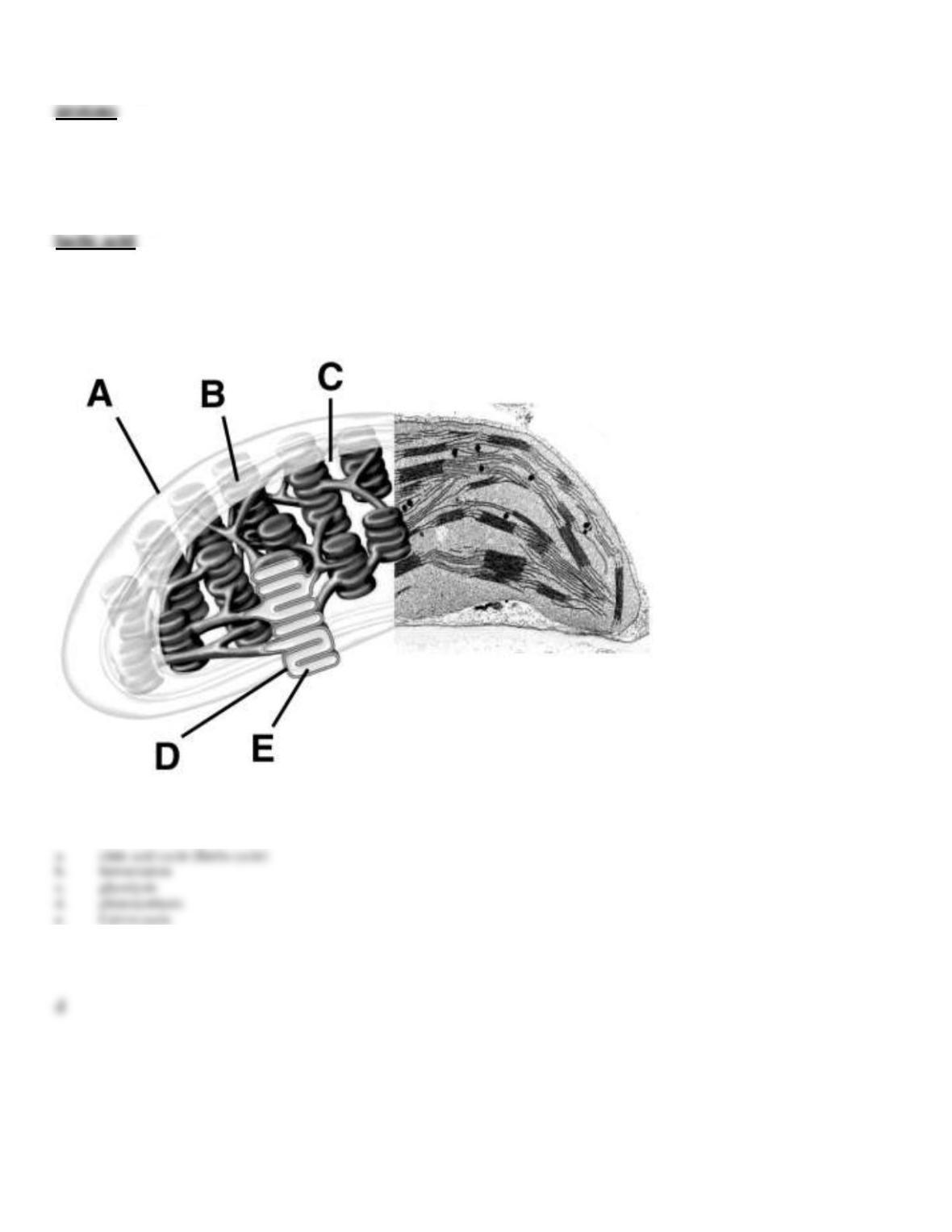
61. Figure 4-1
Refer to Figure 4-1. Which reactions take place in this organelle?
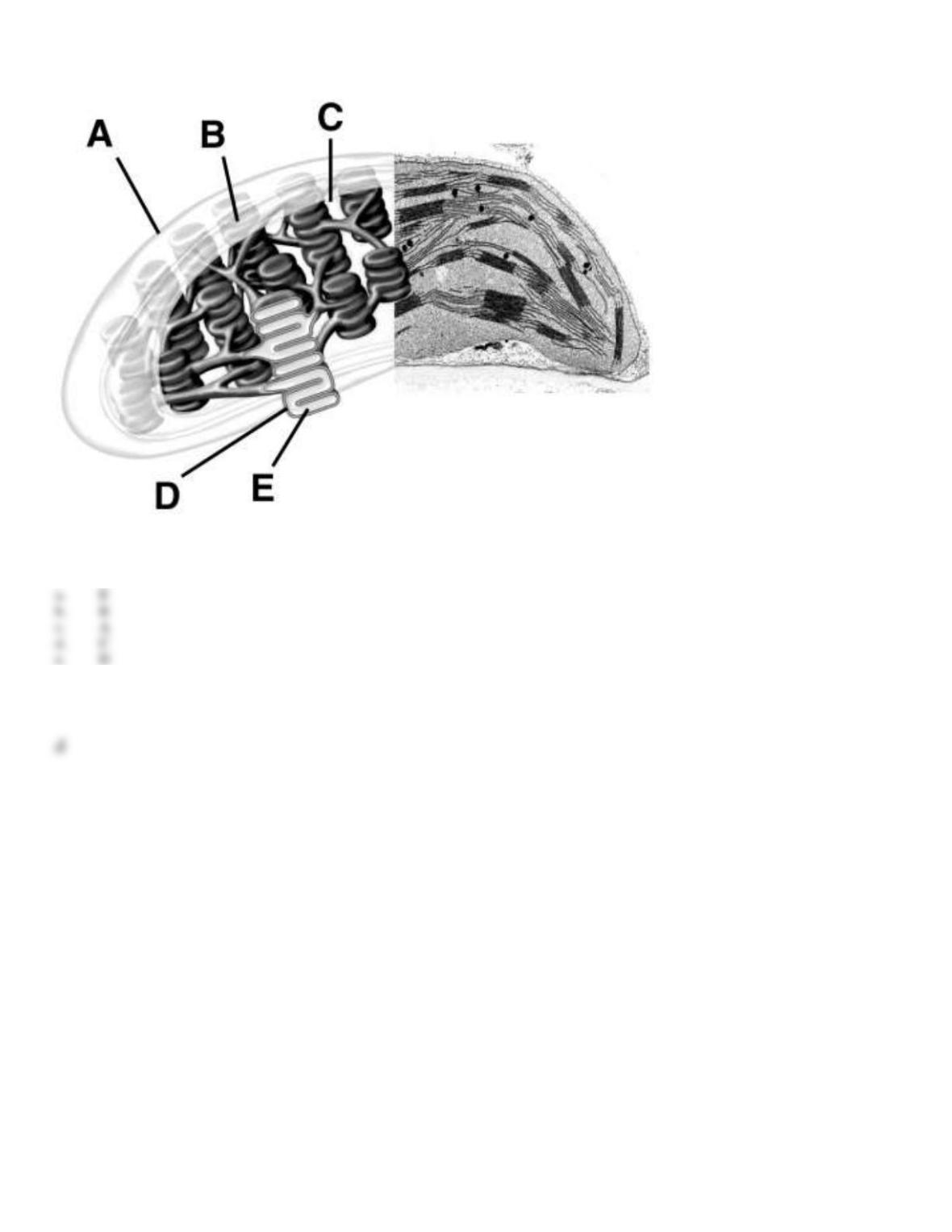
62. Figure 4-1
Refer to Figure 4-1. Which label points to the stroma?
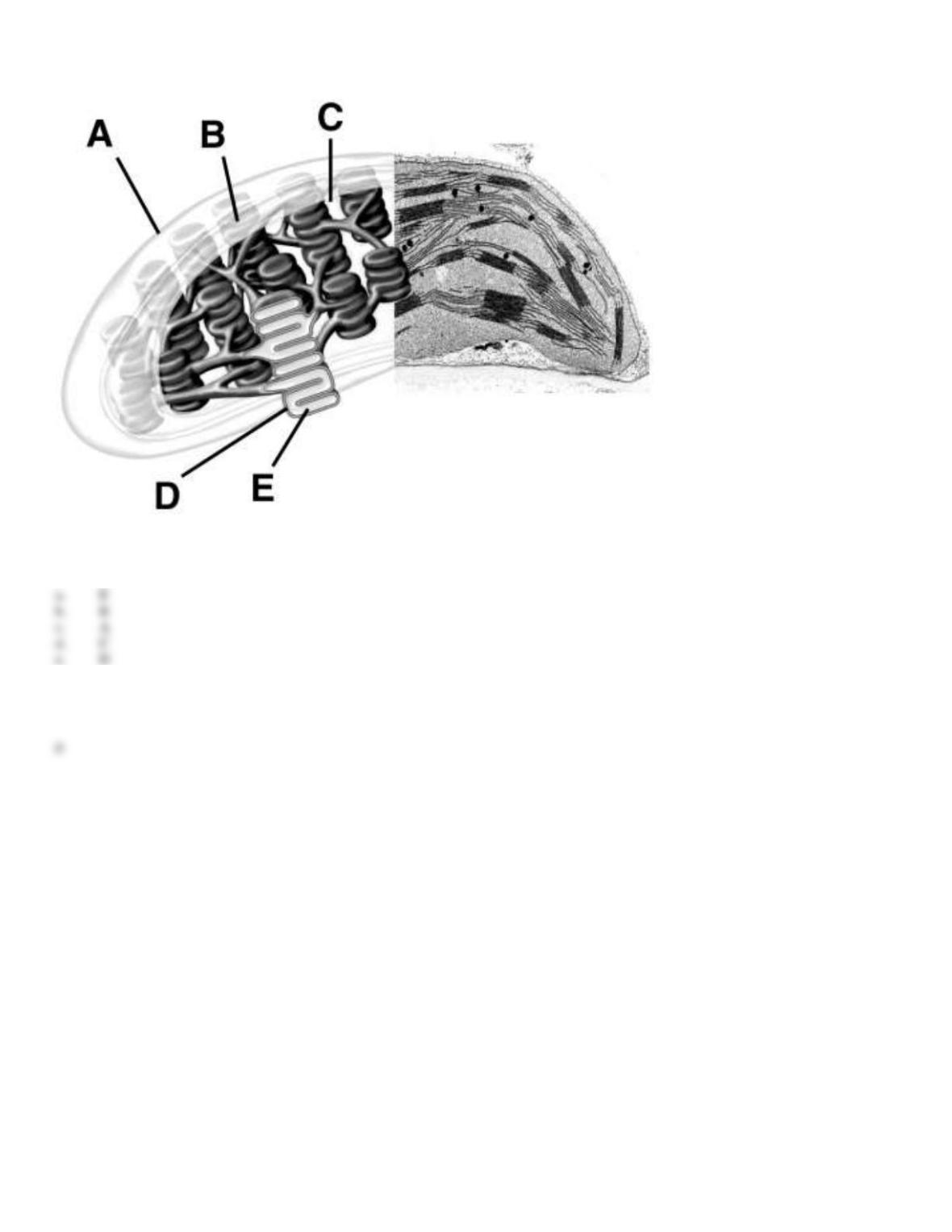
63. Figure 4-1
Refer to Figure 4-1. Which label points to the area in which the light-dependent reactions take place?
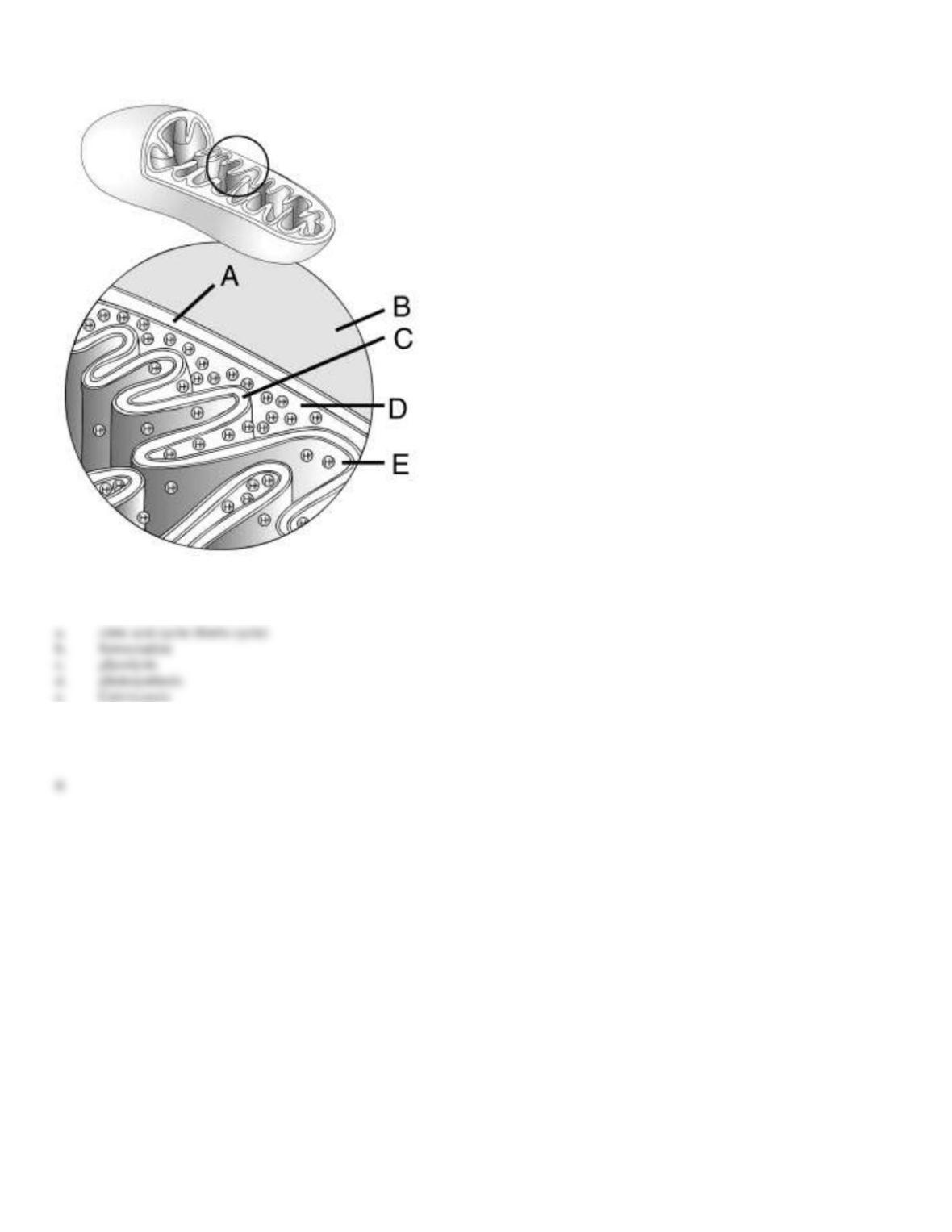
64. Figure 4-2
Refer to Figure 4-2. Which reactions take place in this organelle?
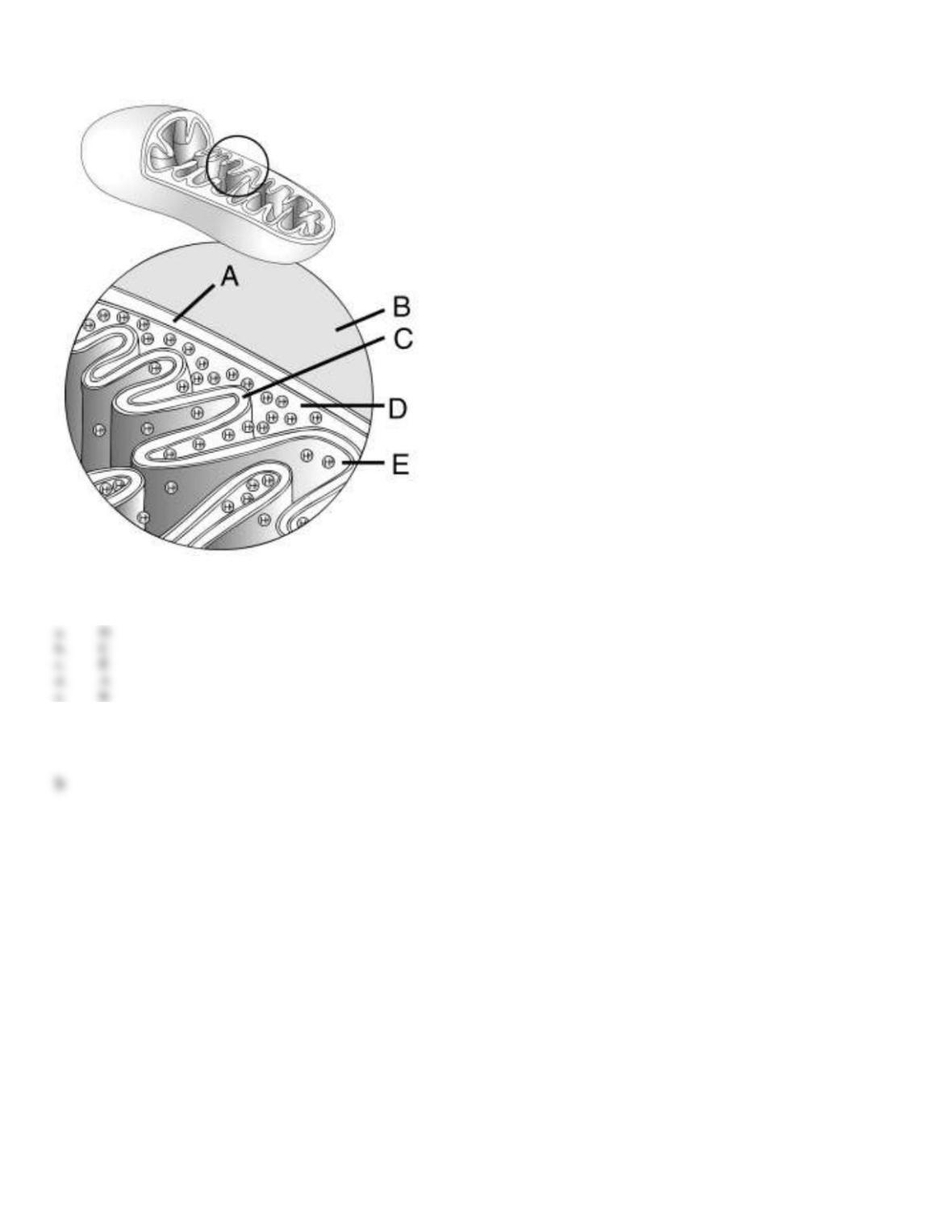
65. Figure 4-2
Refer to Figure 4-2. Which label points to the location of the electron transport chains?
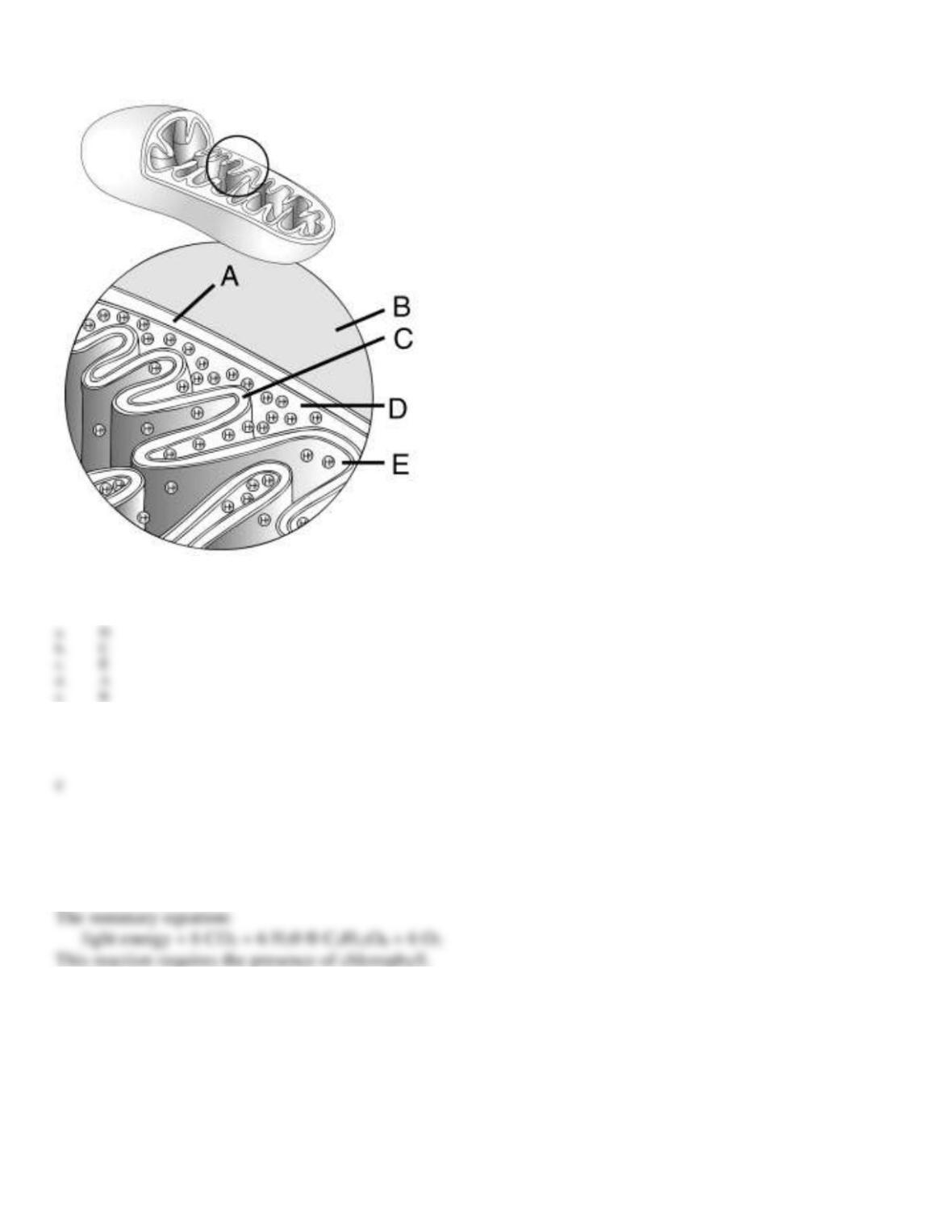
66. Figure 4-2
Refer to Figure 4-2. Which label points to the matrix?
67. Write the summary equation for photosynthesis.
68. Plants and algae use the wavelengths of light in the portion of the electromagnetic spectrum known as
visible light. Why do they not use the rest of the spectrum, including x-rays and radio waves, as well?
69. Why do plants contain more than one type of pigment?
70. If plants have more than one kind of pigment, then why can’t you see the other pigments during more of the
year?
71. Of what use are the final end products of photosynthesis to plants and to other living creatures?
72. How do plants capture light energy? Include in your answer the following terms: pigments, electron
73. How do plants capture light energy? Include in your answer the following terms: pigments Photosystem I,
Photosystem II, electron acceptor, electron transport, ATP, NADPH, oxygen, water, chemiosmosis.
74. How does the C4 pathway differ from the C3 pathway?
75. How is the CAM pathway different from the C3 and C4 pathways?
76. Write the summary equation for aerobic respiration.
77. Describe the four major steps in the complete oxidation of a molecule of glucose to carbon dioxide and
water. A sketch may be used to illustrate, but not replace, your answer.
78. Compare the overall energy efficiency of fermentation with that of aerobic respiration.