Microbiology: An Introduction, 13e (Tortora et al.)
Chapter 4 Functional Anatomy of Prokaryotic and Eukaryotic
4.1 Multiple-Choice Questions
1) Which of the following statements is INCORRECT regarding prokaryotic cells?
A) Their DNA is not enclosed within a membrane.
B) They lack membrane-enclosed organelles.
C) They typically have a circular chromosome.
D) They reproduce by binary fission.
E) They lack a plasma membrane.
2) Each of the following statements concerning the gram-positive cell wall is true EXCEPT
A) it maintains the shape of the cell.
B) it is sensitive to lysozyme.
C) it protects the cell in a hypertonic environment.
D) it contains teichoic acids.
E) it is sensitive to penicillin.
3) Which of the following statements best describes what happens when a bacterial cell is placed
in a solution containing 5% NaCl?
A) Sucrose will move into the cell from a higher to a lower concentration.
B) The cell will undergo osmotic lysis.
C) Water will move out of the cell.
D) Water will move into the cell.
E) No change will result; the solution is isotonic.
4) A gram-positive bacterium suddenly acquires resistance to the antibiotic methicillin. This trait
most likely occurred due to acquisition of new genetic information through
A) conjugation.
B) binary fission.
C) meiosis.
D) transformation.
E) transduction.
5) By which of the following mechanisms can a cell transport a substance from a lower to a
higher concentration?
A) simple diffusion
B) facilitated diffusion
C) active transport
D) extracellular enzymes
E) aquaporins
6) Which of the following is NOT a typical characteristic of most bacterial plasma membranes?
A) site of energy production
B) composed of a phospholipid bilayer
C) contains proteins
D) contains cholesterol
E) is selectively permeable
7) Which one of the following organisms has a cell wall?
A) protoplasts
B) fungi
C) L forms
D) mycoplasmas
E) animal cells
8) Which of the following statements is TRUE?
A) Endospores are for reproduction.
B) Endospores allow a cell to survive environmental changes by producing a dormant period
with no growth.
C) Endospores are easily stained in a Gram stain.
D) A cell produces one endospore and keeps growing.
E) A cell can produce many endospores.
9) Which of the following pairs is mismatched?
A) endoplasmic reticulum – internal transport
B) Golgi complex – secretion
C) mitochondria – ATP production
D) centrosome – food storage
E) lysosome – digestive enzymes
10) Which of the following organelles most closely resembles a prokaryotic cell?
A) nucleus
B) mitochondrion
C) Golgi complex
D) vacuole
E) cell wall
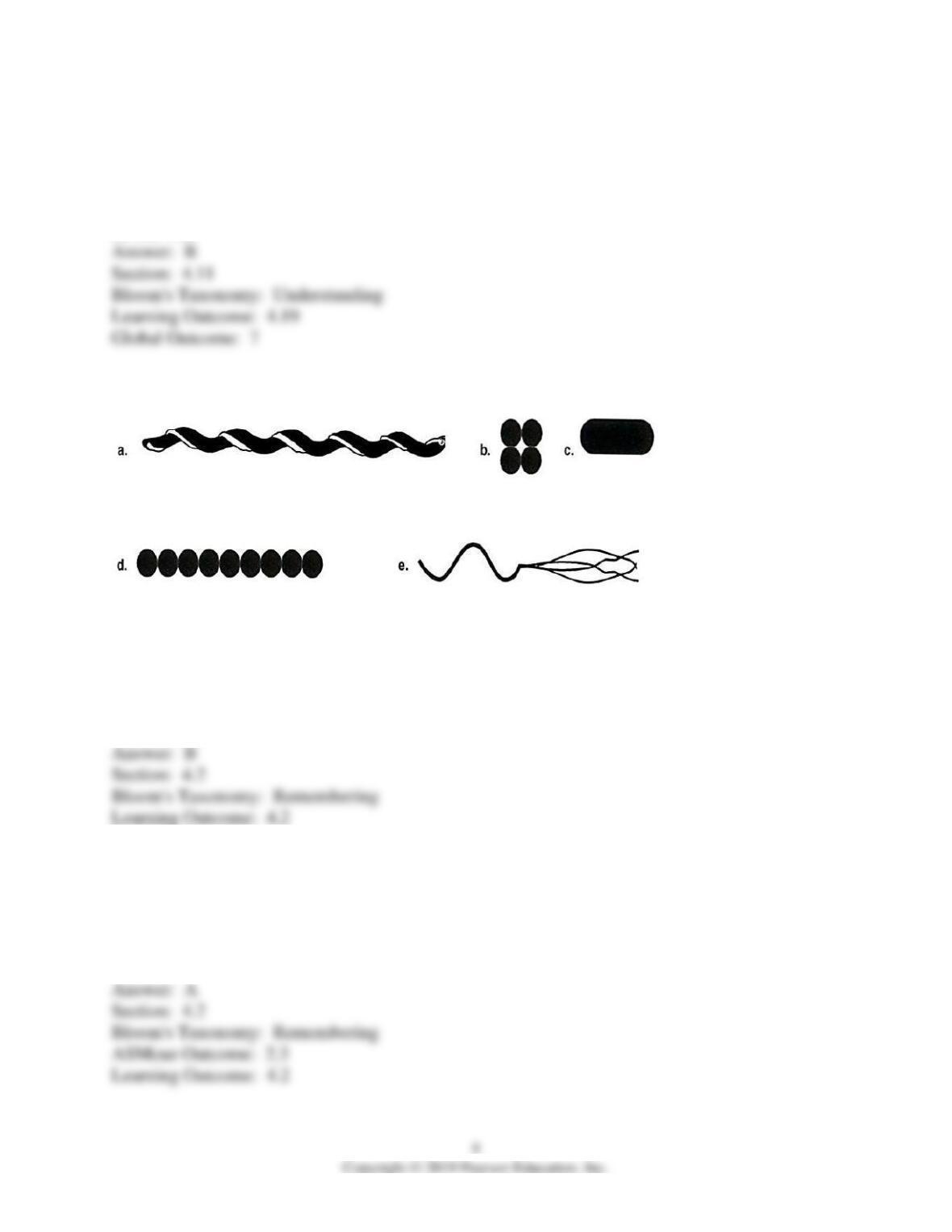
Figure 4.1
11) Which drawing in Figure 4.1 is a tetrad?
A) a
B) b
C) c
D) d
E) e
12) Which drawing in Figure 4.1 possesses an axial filament?
A) a
B) b
C) c
D) d
E) e
13) Which drawing in Figure 4.1 is streptococci?
A) a
B) b
C) c
D) d
E) e
14) Antibiotics that target cell wall synthesis ultimately cause bacterial cell death as a result of
A) osmotic lysis.
B) inhibition of molecular transport.
C) decreased synthesis of plasma membrane.
D) plasmolysis.
E) cell shrinkage.
15) Bacteria are a commonly used organism for studies of genetic material in the research
laboratory. The nucleic acids must first be isolated from the cells for these studies. Which of the
following would most likely be used to remove the cell wall from gram-positive bacterial cells
prior to their lysis for nucleic acid isolation?
A) lysozyme
B) polymixins
C) alcohol
D) water
E) mycolic acid
16) Which of the following statements about gram-negative cell walls is FALSE?
A) They protect the cell in a hypotonic environment.
B) They have an extra outer layer composed of lipoproteins, lipopolysaccharides, and
phospholipids.
C) They are toxic to humans.
D) They are sensitive to penicillin.
E) Their Gram reaction is due to the outer membrane.
17) Which of the following structures is NOT found in some prokaryotic cells?
A) flagellum
B) axial filament
C) cilium
D) pilus
E) peritrichous flagella
18) Functions of the glycocalyx include all of the following EXCEPT
A) biofilm formation.
B) increased virulence.
C) source of nutrition.
D) protection against dehydration.
E) binary fission.
19) Which structure protects bacteria from being phagocytized?
A) slime layer
B) fimbriae
C) capsule
D) cell membrane
E) cell wall
20) Which of the following is NOT part of the passive transport process?
A) plasma membrane
B) transporter proteins
C) ATP
D) concentration gradient
E) aquaporins
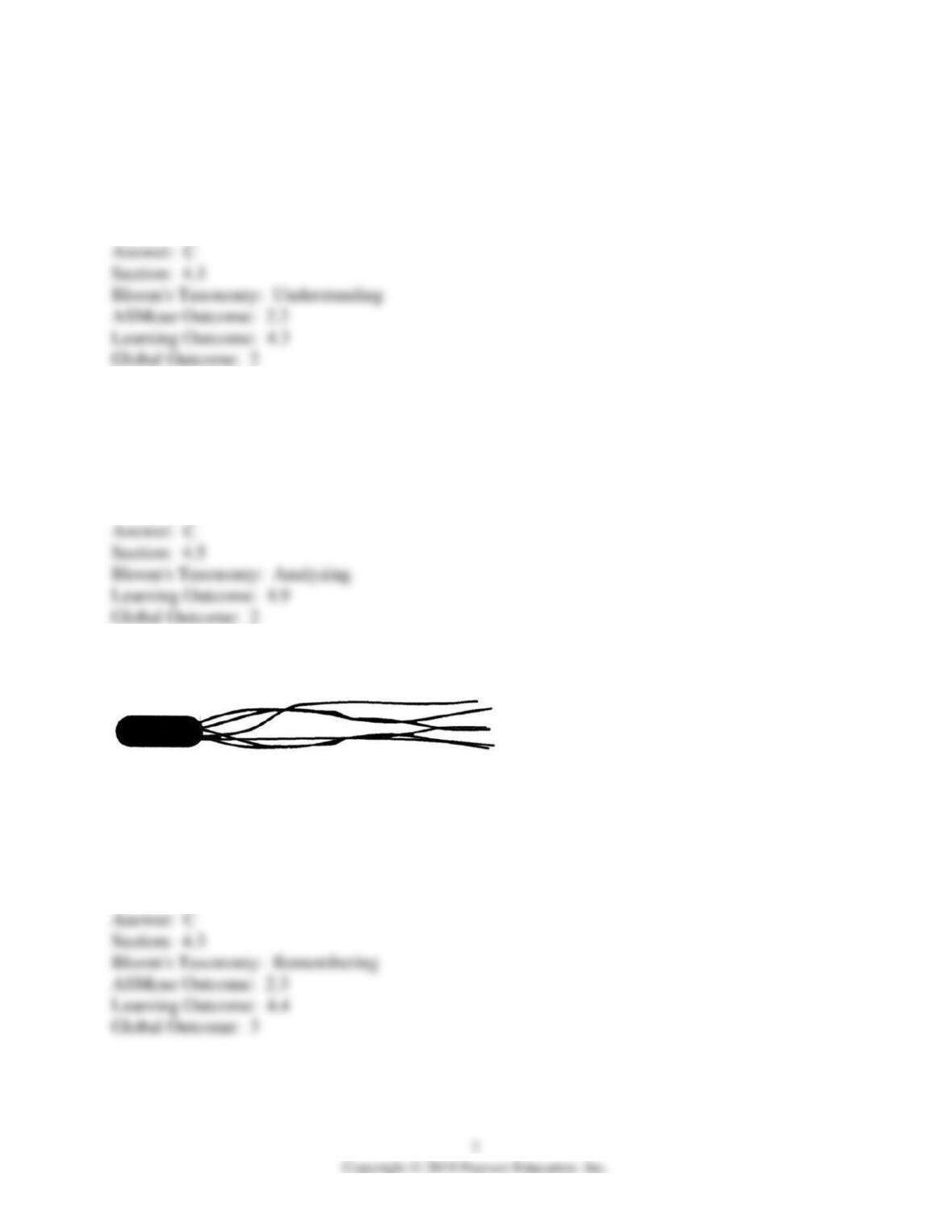
21) Figure 4.2
Which of the following terms best describes the cell in Figure 4.2?
A) peritrichous flagella
B) amphitrichous flagella
C) lophotrichous flagella
D) monotrichous flagellum
E) axial filament
22) In bacteria, photosynthetic pigments are found in
A) chloroplasts.
B) cytoplasm.
C) chromatophores.
D) mesosomes.
E) ribosomes.
23) The difference between simple diffusion and facilitated diffusion is that facilitated diffusion
A) moves materials from a higher to a lower concentration.
B) moves materials from a lower to a higher concentration.
C) requires ATP.
D) requires transporter proteins.
E) does not require ATP.
24) The terms “run” and “tumble” are generally associated with
A) cell wall fluidity.
B) taxic movements of the cell in response to attractants or repellents.
C) clustering properties of certain rod-shaped bacteria.
D) cell membrane synthesis.
25) You have isolated a motile, gram-positive cell with no visible nucleus. You can safely
assume that the cell
A) has 9 pairs + 2 flagella.
B) has a mitochondrion.
C) has a cell wall.
D) lives in an extreme environment.
E) has cilia.
26) Fimbriae and pili differ in that
A) there are only one or two pili per cell.
B) pili are used for motility.
C) pili are used to transfer DNA.
D) pili are used for transfer of DNA and motility.
E) pili are used for attachment to surfaces.
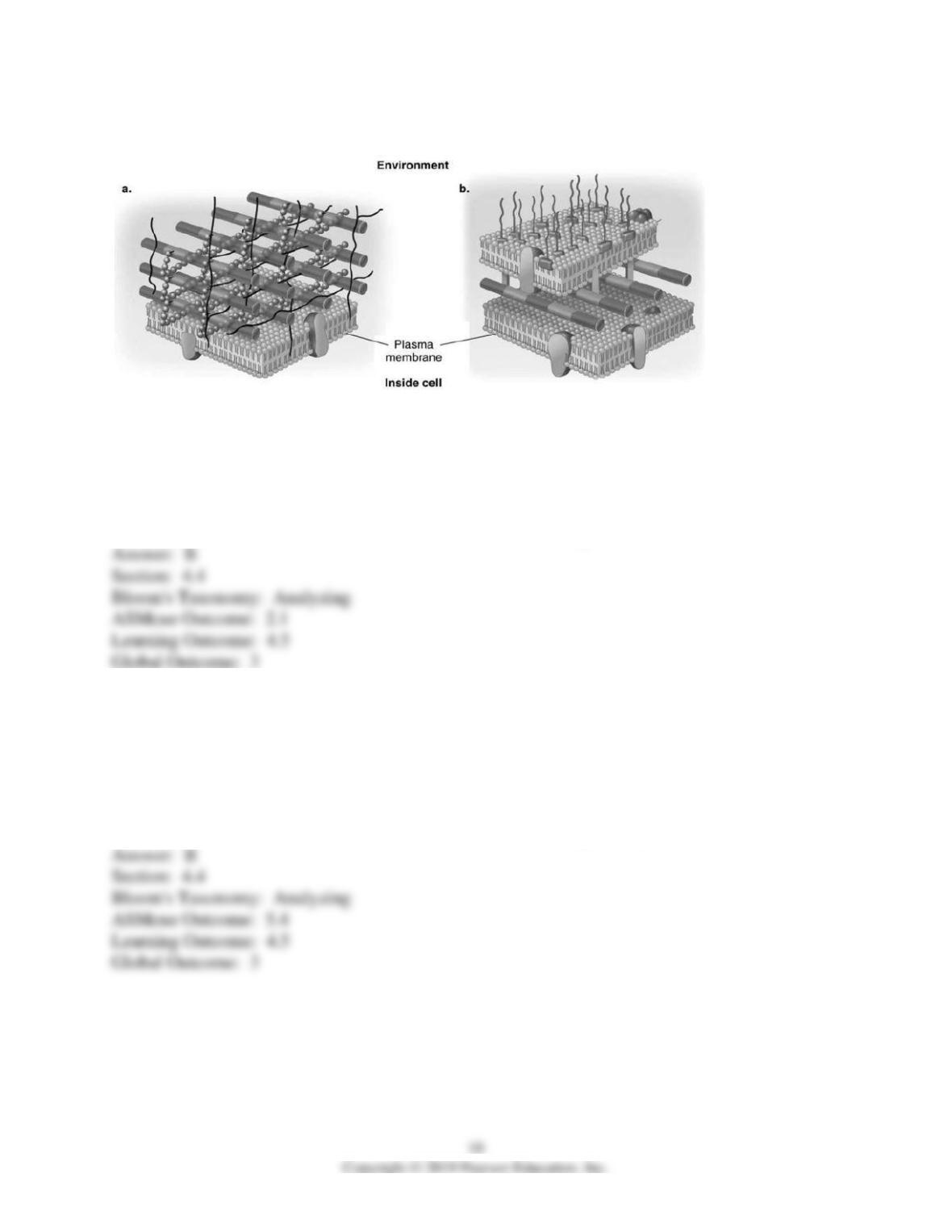
Figure 4.3
27) In Figure 4.3, which diagram of a cell wall is a gram-negative cell wall?
A) a
B) b
C) both a and b
D) neither a nor b
E) The answer cannot be determined based on the information provided.
28) In Figure 4.3, which diagram of a cell wall possesses lipid A/endotoxin responsible for
symptoms associated with infection?
A) a
B) b
C) both a and b
D) neither a nor b
E) The answer cannot be determined based on the information provided.
29) In Figure 4.3, which diagram of a cell wall has a structure that protects against osmotic lysis?
A) a
B) b
C) both a and b
D) neither a nor b
E) The answer cannot be determined based on the information provided.
30) In Figure 4.3, which diagram of a cell wall is decolorized by a brief exposure to alcohol?
A) a
B) b
C) both a and b
D) neither a nor b
E) The answer cannot be determined based on the information provided.
31) In Figure 4.3, which diagram of a cell wall is resistant to many antibiotics (e.g., penicillin)?
A) a
B) b
C) both a and b
D) neither a nor b
E) The answer cannot be determined based on the information provided.
32) In Figure 4.3, which diagram of a cell wall contains teichoic acids?
A) a
B) b
C) both a and b
D) neither a nor b
E) The answer cannot be determined based on the information provided.
33) In Figure 4.3, which diagram of a cell wall contains porins?
A) a
B) b
C) both a and b
D) neither a nor b
E) The answer cannot be determined based on the information provided.
34) Where are phospholipids most likely found in a prokaryotic cell?
A) flagella
B) organelles
C) the plasma membrane
D) ribosomes
E) the plasma membrane and organelles
35) Where are phospholipids most likely found in a eukaryotic cell?
A) metachromatic granules
B) organelles
C) the plasma membrane
D) ribosomes
E) the plasma membrane and organelles
36) Which of the following is NOT found or observed to occur in both mitochondria and
prokaryotes?
A) circular chromosome
B) 70S ribosomes
C) cell wall
D) binary fission
E) ATP-generating mechanism
37) Which of the following statements is correct about passive diffusion?
A) It requires an expenditure of energy by the cell.
B) It is a process in which molecules move from a region of higher concentration to a region of
lower concentration (or down a concentration gradient).
C) It is a process in which molecules move from a region of lower concentration to one of higher
concentration (or up a concentration gradient).
D) It may require a transport protein.
E) It involves movement of molecules down a concentration gradient and may require a transport
protein.
38) Oxygen crosses a plasma membrane
A) by osmosis.
B) through simple diffusion.
C) with the help of a nonspecific transporter.
D) through facilitated diffusion.
E) through porins.
39) In a hypertonic solution, a bacterial cell will typically
A) lyse.
B) burst.
C) stay the same.
D) plasmolyze.
E) osmolyze.
40) What will happen if a bacterial cell is pretreated with a lysozyme solution, then placed in
distilled water?
A) The cell will plasmolyze.
B) The cell will undergo osmotic lysis.
C) Water will leave the cell.
D) Lysozyme will diffuse into the cell.
E) No change will result; the solution is isotonic.
41) How do spirochetes and spirilla differ?
A) Spirochetes do not have a cell wall but spirilla do.
B) Spirilla are found in chains of cells whereas spirochetes exist as individual cells.
C) Spirilla have external flagella but spirochetes have axial filaments.
D) Spirochetes have a rigid, corkscrew shape while spirilla are helical and more flexible.
E) Spirochetes and spirilla are basically the same organisms and the terms can be used
interchangeably.
42) Which one of the following pairs is mismatched?
A) metachromatic granules – phosphate storage
B) lipid inclusions – energy reserve
C) ribosomes – carbon storage
D) sulfur granules – energy reserve
E) gas vacuoles – flotation
43) Which of the following are NOT energy reserves?
A) carboxysomes
B) polysaccharide granules
C) lipid inclusions
D) ribosomes
E) metachromatic granules
44) Which of the following is NOT a functionally analogous pair?
A) nucleus -nucleoid region
B) mitochondria – prokaryotic plasma membrane
C) chloroplasts – thylakoids
D) cilia – pili
E) 9+2 flagella – bacterial flagella
45) The DNA found in most bacterial cells
A) is surrounded by a nuclear membrane.
B) utilizes histones for chromosomal packaging.
C) is circular in structure.
D) is linear in structure.
E) is found in multiple copies.
46) Cells may frequently find themselves in an environment with very low extracellular
concentrations of substances needed in higher amounts inside the cell. To obtain these needed
items, such cells would be most likely to engage in
A) simple diffusion.
B) facilitated diffusion.
C) active transport.
D) osmosis.

47) What is the best reason why oxygen (O2) can cross the plasma membrane by simple
diffusion, but glucose must be transported across the barrier by facilitated diffusion?
A) Oxygen is a much smaller molecule, making it easier to pass through the molecules of the
plasma membrane.
B) Oxygen is a nonpolar molecule, easily passing through the nonpolar middle area of the
plasma membrane.
C) Oxygen can be burned/consumed as it crosses the membrane, providing the energy needed for
its passage.
D) Glucose is nonpolar, making it very difficult for it to cross the polar portions of the plasma
membrane structure.
48) In bacterial ribosomes, a small 30S subunit and a large 50S subunit come together to produce
the functional 70S ribosome. Why isn’t it an 80S ribosome?
A) The ribosome will become an 80S complex when the protein it is producing starts to be
formed.
B) Additional factors are required for protein synthesis. When these are put with the ribosome, it
will become an 80S ribosome complex.
C) S stands for Svedberg units, which indicates the relative rate of sedimentation due to size,
weight, and shape of a particle. The numbers aren’t strictly additive.
D) A portion of the larger 50S subunit is detached as the ribosomes come together, making the
final complex a 70S ribosome instead of an 80S ribosome.
49) A particular type of inclusion body that is used to orient bacteria in three-dimensional space
in a fluid environment is the
A) gas vacuole.
B) carboxysome.
C) sulfur granule.
D) metachromatic granule.
50) Endospores are highly resistant to harsh environmental conditions due to all EXCEPT which
one of the following?
A) dipicolinic acid (DPA) in the endospore
B) very low amounts of water
C) high concentration of calcium ions
D) a thick spore coat
E) small triggering molecules called germinants
4.2 True/False Questions
1) The cell walls of bacteria are responsible for the shape of the bacteria and the difference in the
Gram stain reaction.
2) Antibiotics that target the cell wall are an effective treatment against many pathogenic
bacteria.
3) Cells placed in a hypertonic solution tend to lose water due to osmotic pressure.
4) Small, hydrophobic molecules pass through a cell membrane most easily by simple diffusion.
5) Spheroplasts, protoplasts, and mycoplasms are bacterial cells without cell walls.
6) Endospores are a reproductive structure.
7) The internal structure of bacterial and eukaryotic flagella are the same.
8) Many enzymes in both prokaryotic and eukaryotic cells are compartmentalized within
organelles.
9) Prokaryotes lack organelles.
10) If you observe rod-shaped red cells after the Gram stain, you can assume their cell walls
contain endotoxin.
4.3 Essay Questions
1) Compare and contrast the characteristics of a typical prokaryotic and eukaryotic cell.
2) Provide evidence to substantiate the hypothesis that eukaryotic cells evolved from prokaryotic
cells.
3) Compare and contrast gram-positive and gram-negative cell walls with regard to (a)
sensitivity to antimicrobial agents, (b) resistance to phagocytosis, (c) chemical composition, and
(d) decolorization by alcohol.
4) What is a biofilm and what role does biofilm play in disease?
5) Based on the description of typical cell structures depicted in this chapter, do you think it is
possible for microbial life on Mars to exist? Remember, the environment on Mars is very cold,
and there is no appreciable free-flowing water. The core appears to be at least partially molten.
Gravity is less than that on Earth, and solar radiation levels are higher. The atmosphere is
roughly 95% carbon dioxide and much less than 1% oxygen. If life COULD exist, what might it
look like, and why?