48) While on a field expedition in Ethiopia, you come across a group of baboons. After watching
them for several days, you notice that one male baboon frequently mates with many different
females. You also don’t see any other males in the group. What type of mating system best
describes these baboons?
A) monogamy
B) polygyny
C) polyandry
D) intrasexual selection
49) Male stalk-eyed flies compete with other males in order to attract female attention. What
kind of mating behavior is this an example of?
A) intersexual selection
B) intrasexual selection
C) polygamy
D) monogamy
50) Male elephant seals routinely fight (sometimes to the death) in order to mate with large
groups of female elephant seals. What kind of mating behavior is this an example of?
A) intersexual selection
B) intrasexual selection
C) polygandry
D) monogamy
51) Upon observing a golden eagle flying overhead, a prairie dog on “guard duty” gives a
warning call to other members of the prairie dog community that are foraging. What form of
animal behavior is this?
A) associative learning
B) innate behavior
C) imprinting
D) altruistic behavior
E) agonistic behavior
52) You discover a rare new bird species, but you are unable to observe its mating behavior. You
see that the male is large and ornamental compared with the female. On this basis, you can
probably conclude that the species is
A) polygamous.
B) monogamous.
C) polyandrous.
D) promiscuous.
53) The mating system in which females are more ornamented than males is
A) monogamy.
B) promiscuity.
C) polygamy.
D) polygyny.
E) polyandry.
54) What is the fitness benefit of polygamy in birds that rear young that are precocious (develop
and mature rapidly)?
A) Females will copulate with many males to ensure that all of their eggs are fertilized.
B) Females don’t have to decide on one mate and can copulate with as many males as they deem
worthy to share their genes with in reproduction.
C) Fit males don’t have to help feed and rear young and can spend this time seeking out and
mating with many females.
D) Females don’t have to spend time rearing young and can mate and rear additional broods
during a breeding season.
E) Both males and females spend little time with courtship and brood-rearing and don’t tax their
own physiology, so they can breed again in subsequent breeding seasons.
55) Which of the following statements about the certainty of paternity is true?
A) Young or eggs laid by a female are likely to contain the same genes as another female’s eggs
in a population of birds.
B) The certainty of paternity is high in most species with internal fertilization because the acts of
mating and birth are separated by time.
C) Males that guard females they have mated with are certain of their paternity.
D) The certainty of paternity is low when egg laying and mating occur together, as in external
fertilization.
E) Paternal behavior exists because it has been reinforced over generations by natural selection.
56) Imagine that you are designing an experiment aimed at determining whether the initiation of
migratory behavior is largely under genetic control. Of the following options, the best way to
proceed is to
A) observe genetically distinct populations in the field and see if they have different migratory
habits.
B) perform within-population matings with birds from different populations that have different
migratory habits. Do this in the laboratory and see if offspring display parental migratory
behavior.
C) bring animals into the laboratory and determine the conditions under which they become
restless and attempt to migrate.
D) perform within-population matings with birds from different populations that have different
migratory habits. Rear the offspring in the absence of their parents and observe the migratory
behavior of offspring.
57) What probably explains why coastal and inland garter snakes react differently to banana slug
prey?
A) Ancestors of coastal snakes that could eat the abundant banana slugs had increased fitness.
No such selection occurred inland, where banana slugs were absent.
B) Banana slugs are camouflaged, and inland snakes, which have poorer vision than coastal
snakes, are less able to see them.
C) Garter snakes learn about prey from other garter snakes. Inland garter snakes have fewer
types of prey because they are less social.
D) Inland banana slugs are distasteful, so inland snakes learn to avoid them. Coastal banana
slugs are palatable to garter snakes.
E) Garter snakes learn to eat what their mothers eat. Coastal snake mothers happened to prefer
slugs.
58) Which of the following statements about the evolution of behavior is correct?
A) Natural selection will favor behavior that enhances survival and reproduction.
B) An animal may show behavior that minimizes reproductive fitness.
C) If a behavior is less than optimal, it will eventually become optimal through natural selection.
D) Innate behaviors can never be altered by natural selection.
59) Pair-bonding in a population of prairie voles can be prevented by
A) the ensuing confusion caused by introducing meadow voles.
B) administering a drug that inhibits the brain receptor for vasopressin in males.
C) administering a drug that turns on ADH receptor sites in male voles.
D) dying the coat color from brown to blond in either male or female prairie voles.
E) allowing the population size to reach critically low levels.
60) How do altruistic behaviors arise through natural selection?
A) By its actions, the altruist increases the likelihood that some of its genes will be passed on to
the next generation.
B) The altruist is appreciated by other members of the population because their survivability has
been enhanced by virtue of the altruist’s risky behavior.
C) Animals that perform altruistic acts are allowed by their population to breed more, thereby
passing on their behavior genes to future generations.
D) Altruistic behaviors lower stress in populations, which increases the survivability of all the
members of the population.
61) Which of the following has a coefficient of relatedness of less than 0.5?
A) a father to his daughter
B) a mother to her son
C) an uncle to his nephew
D) a brother to his brother
E) a sister to her brother
62) Animals that help other animals of the same species
A) have excess energy reserves.
B) are bigger and stronger than the other animals.
C) are usually related to the other animals.
D) are always male.
63) The presence of altruistic behavior is most likely due to kin selection, a theory maintaining
that
A) aggression between sexes promotes the survival of the fittest individuals.
B) genes enhance the survival of copies of themselves by directing organisms to assist others
who share those genes.
C) companionship is advantageous to animals because in the future they can help each other.
D) critical thinking abilities are normal traits for animals and they have arisen, like other traits,
through natural selection.
E) natural selection has generally favored the evolution of exaggerated aggressive and
submissive behaviors to resolve conflict without grave harm to participants.
39.2 Art Questions
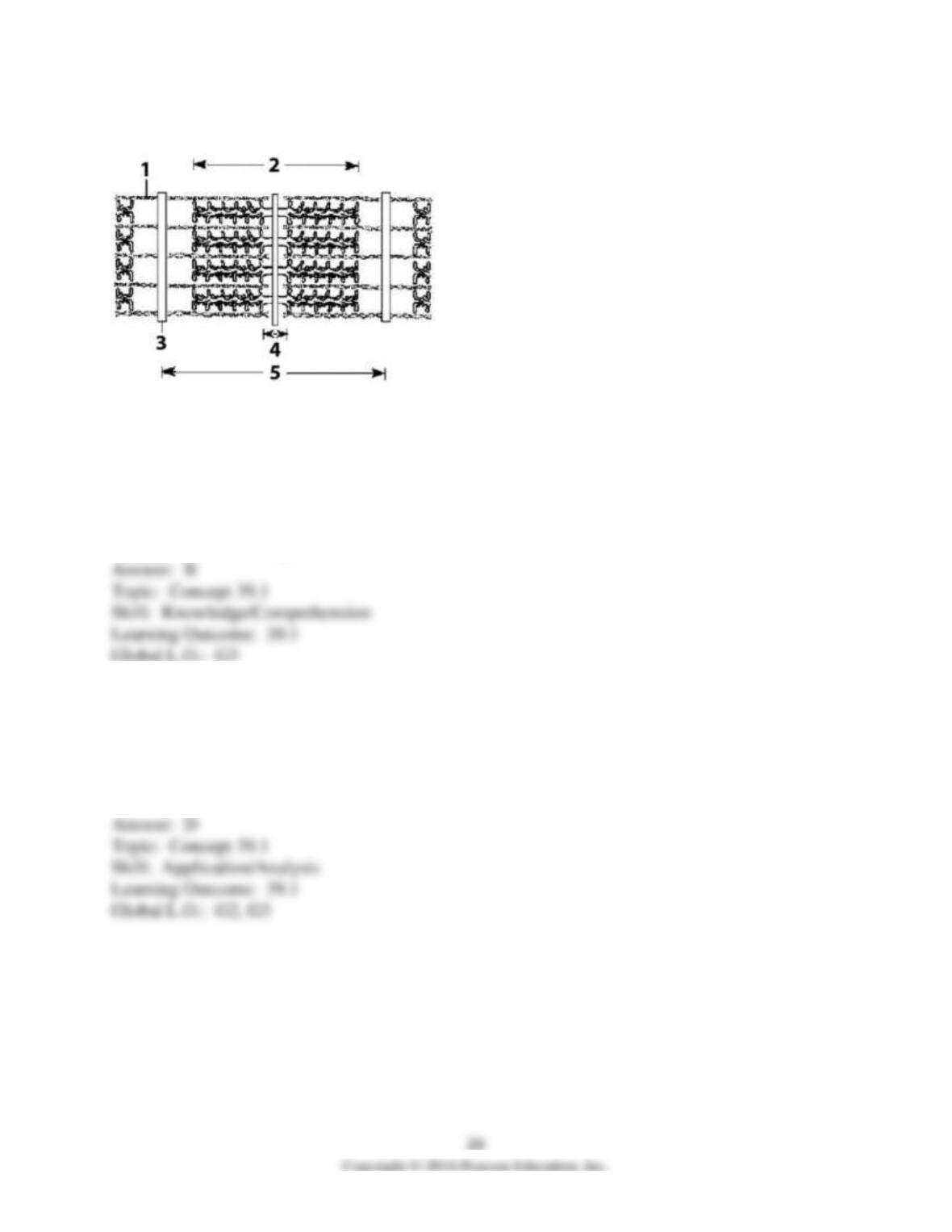
Figure 39.1
1) The structure pictured in Figure 39.1 is found in
A) skeletal muscles and smooth muscles only.
B) cardiac muscles and skeletal muscles only.
C) smooth muscles and cardiac muscles only.
D) smooth muscles, skeletal muscles, and cardiac muscles.
E) smooth muscles only.
2) Myosin filaments without actin overlap are in which section of Figure 39.1?
A) 1
B) 2
C) 3
D) 4
E) 5
3) Which area in Figure 39.1 indicates the Z line?
A) 1
B) 2
C) 3
D) 4
E) 5
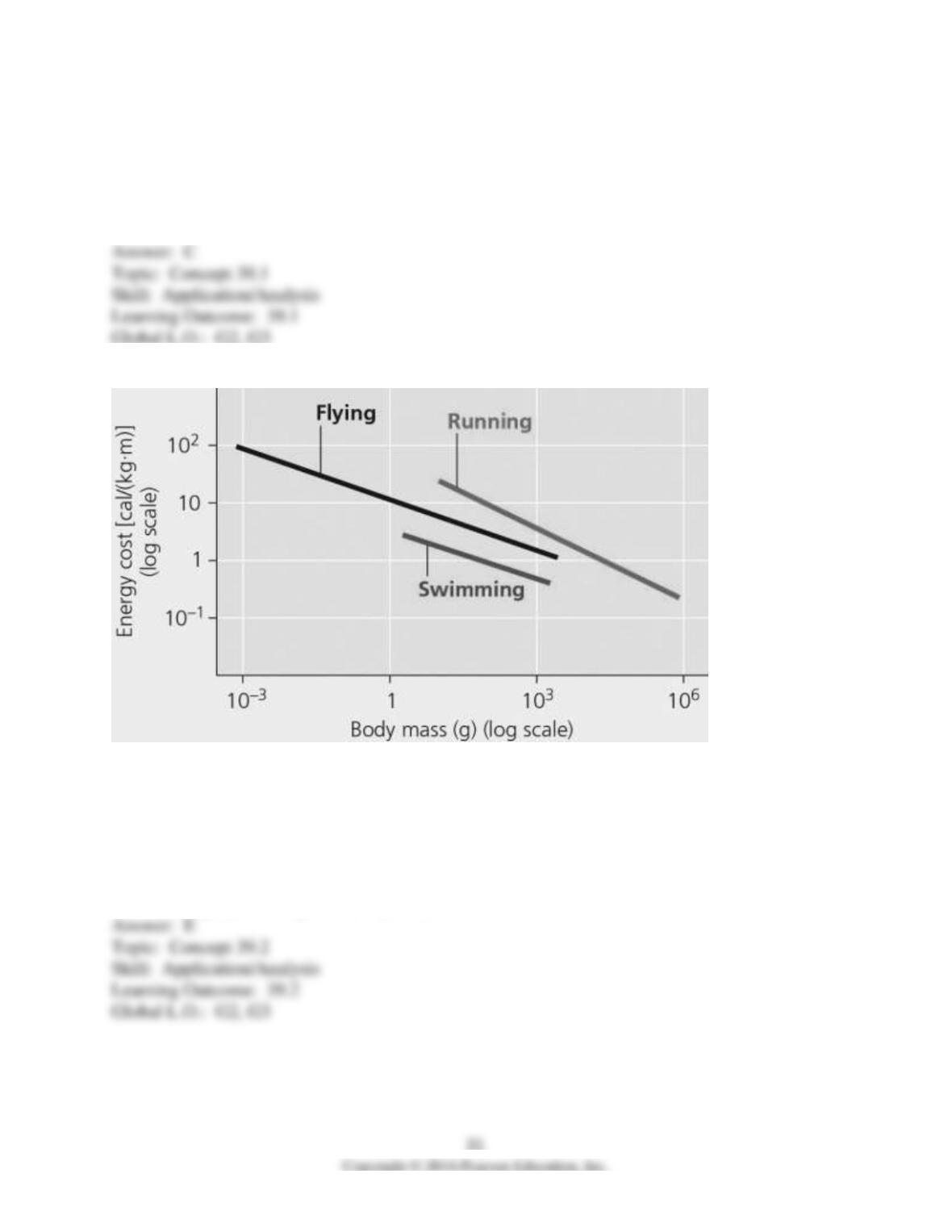
4)
Figure 39.2
The most energetically efficient locomotion per unit mass is likely
A) running by a 50-gram rodent.
B) running by a 40-kg ungulate.
C) flying by a 100-g bird.
D) swimming by a 10-g minnow (bony fish).
E) swimming by a 100-kg tuna (bony fish).
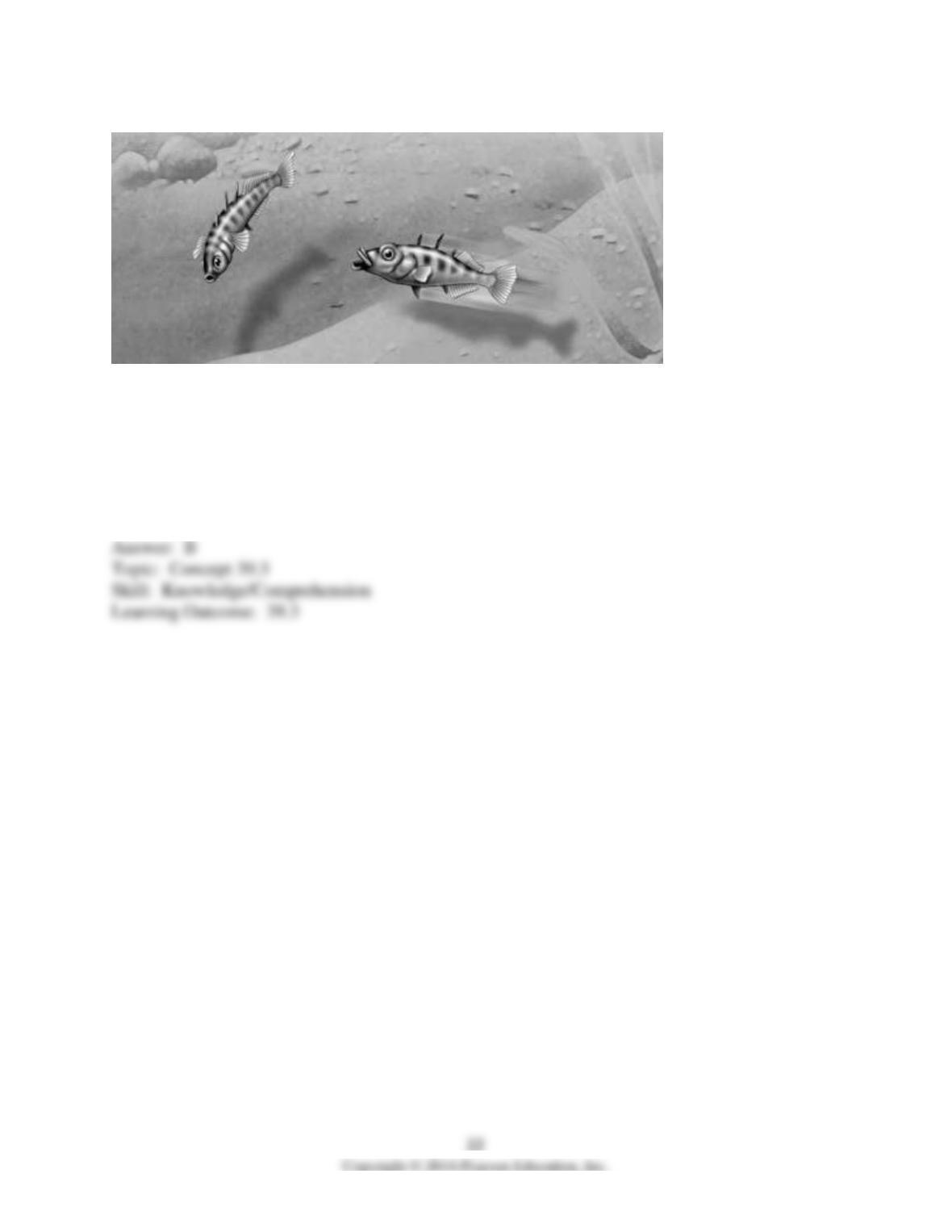
5)
Figure 39.3
In the territorial behavior of the stickleback fish, the red belly of one male that elicits attack from
another male is functioning as a
A) pheromone.
B) sign stimulus.
C) fixed action pattern.
D) hormone.
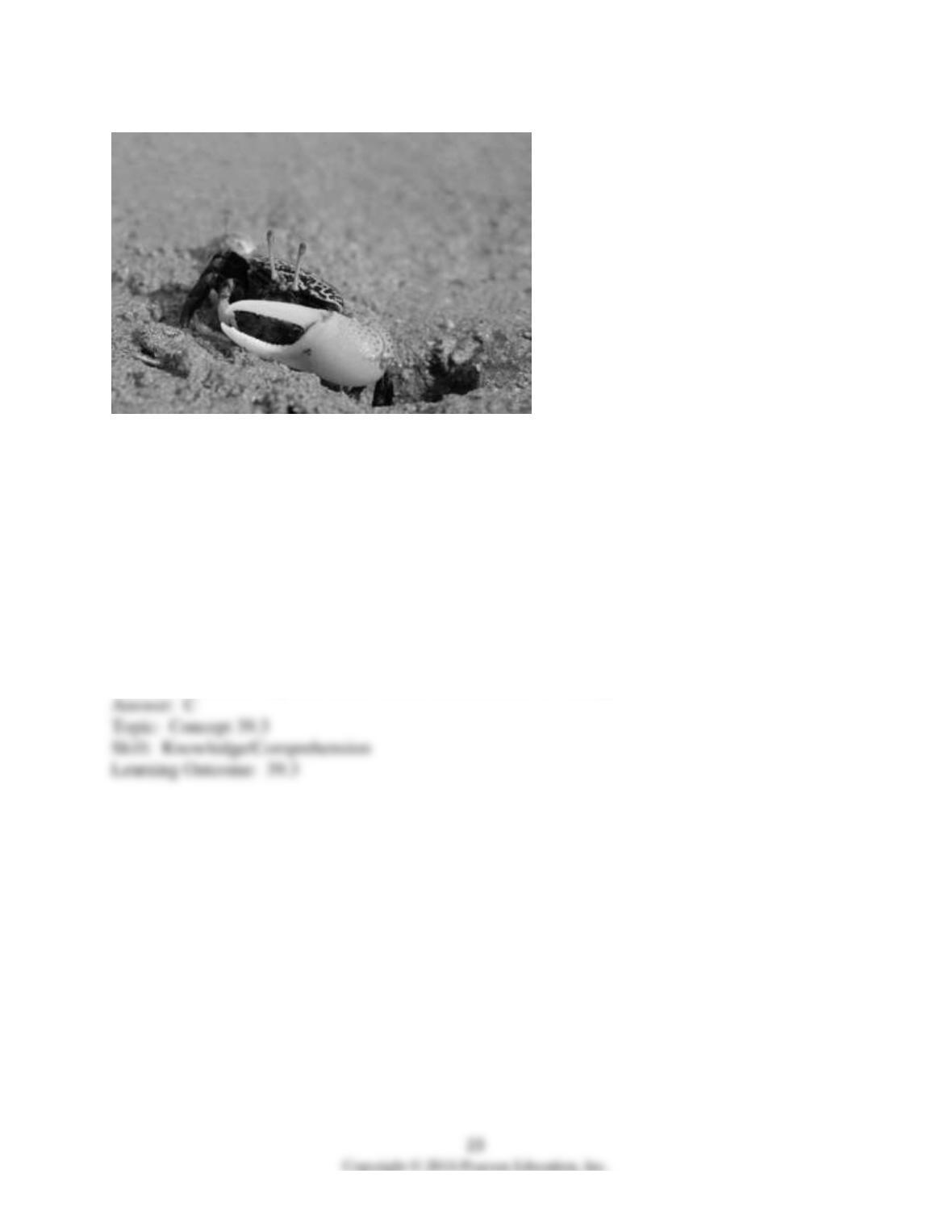
6)
Figure 39.4
The behavior of most animals is influenced by the periods of daylight and darkness in the
environment. Fiddler crabs’ courtship behaviors are instead synchronized by the 29 1/2-day cycle
of the moon. What is the adaptive significance of using lunar cues?
A) The fiddler crab courtship ritual is highly visual, so individuals need the light of the full moon
to be able to observe courtship displays.
B) Egg maturation in fiddler crab females takes 29 1/2 days.
C) By courting at the full and new moon, fiddler crabs link their reproduction to the times of the
highest tides that disperse their larvae to safer, deeper waters.
D) The algae that larval fiddler crabs consume for energy and metabolism bloom on a monthly
cycle, so recently hatched larvae have plenty to eat during a crucial time of their lives.
E) It takes about 29 days for a fiddler crab to reach sexual maturity.
39.3 Scenario Questions
1) During a field trip, an instructor touched a moth resting on a tree trunk. The moth raised its
forewings to reveal large eyespots on its hind wings. The instructor asked why the moth lifted its
wings. One student answered that sensory receptors had fired and triggered a neuronal reflex
culminating in the contraction of certain muscles. A second student responded that the behavior
might frighten predators. Which statement best describes these explanations?
A) The first explanation is correct, but the second is incorrect.
B) The first explanation refers to proximate causation, whereas the second refers to ultimate
causation.
C) The first explanation is testable as a scientific hypothesis, whereas the second is not.
D) Both explanations are reasonable and simply represent a difference of opinion.
2) One way to understand how early environment influences differing behaviors in similar
species is through the “cross-fostering” experimental technique. Suppose that the curly-
whiskered mud rat differs from the bald mud rat in several ways, including being much more
aggressive. How would you set up a cross-fostering experiment to determine if environment
plays a role in the curly-whiskered mud rat’s aggression?
A) You would cross curly-whiskered mud rats and bald mud rats and hand-rear the offspring to
see if any grew up to be aggressive.
B) You would place newborn curly-whiskered mud rats with bald mud rat parents, place
newborn bald mud rats with curly-whiskered mud rat parents, and let some mud rats of both
species be raised by their own species. Then you would compare the outcomes.
C) You would remove the offspring of curly-whiskered mud rats and bald mud rats from their
parents, raise them in the same environment, and then compare the outcomes.
D) You would see if curly-whiskered mud rats bred true for aggression.
E) You would replace normal newborn mud rats with deformed newborn mud rats to see if it
triggered an altruistic response.
3) Fred and Joe, two unrelated, mature male gorillas, encounter one another. Fred is courting a
female. Fred grunts as Joe comes near. As Joe continues to advance, Fred begins drumming
(pounding his chest) and bares his teeth. Joe then rolls on the ground on his back, gets up, and
quickly leaves. This behavioral pattern is repeated several times during the mating season.
Choose the most specific behavior described by this example.
A) agonistic behavior
B) spatial behavior
C) associative behavior
D) innate behavior
39.4 End-of-Chapter Questions
1) During the contraction of a vertebrate skeletal muscle fiber, calcium ions
A) break cross-bridges by acting as a cofactor in the hydrolysis of ATP.
B) bind with troponin, changing its shape so that the myosin-binding sites on actin are exposed.
C) transmit action potentials from the motor neuron to the muscle fiber.
D) spread action potentials through the T tubules.
2) Which of the following is true of innate behaviors?
A) Their expression is only weakly influenced by genes.
B) They occur with or without environmental stimuli.
C) They are expressed in most individuals in a population.
D) They occur in invertebrates and some vertebrates but not mammals.
3) According to Hamilton’s rule,
A) natural selection does not favor altruistic behavior that causes the death of the altruist.
B) natural selection favors altruistic acts when the resulting benefit to the recipient, corrected for
relatedness, exceeds the cost to the altruist.
C) natural selection is more likely to favor altruistic behavior that benefits an offspring than
altruistic behavior that benefits a sibling.
D) the effects of kin selection are larger than the effects of direct natural selection on individuals.
4) The binding of calcium to the troponin complex
A) disrupts cross-bridges, allowing filaments to slide past each other.
B) allows tropomyosin to bind actin.
C) opens ion channels, allowing sodium to rush into the muscle cells.
D) causes tropomyosin to shift position, exposing myosin bind sites on actin.
5) Curare, a substance that blocks the acetylcholine receptors on skeletal muscle, will cause
A) rapid muscle twitches.
B) sustained muscle contraction (tetanus).
C) muscle relaxation.
D) no effect in the absence of acetylcholinesterase.
6) Although many chimpanzees live in environments with oil palm nuts, members of only a few
populations use stones to crack open the nuts. The likely explanation is that
A) the behavioral difference is caused by genetic differences between populations.
B) members of different populations have different nutritional requirements.
C) the cultural tradition of using stones to crack nuts has arisen in only some populations.
D) members of different populations differ in learning ability.
7) Which of the following is not required for a behavioral trait to evolve by natural selection?
A) The form of the behavior is determined entirely by genes.
B) The behavior varies among individuals.
C) An individual’s reproductive success depends in part on how the behavior is performed.
D) Some component of the behavior is genetically inherited.