Chapter 39 The Genetic Code
Matching Questions
Use the following to answer questions 1–10:
Choose the correct answer from the list below. Not all of the answers will be used.
a) CCA 3
b) polysome
c) PPi hydrolysis
d) transcription
e) translation
f) phosphorylated
g) pG
h) two
i) wobble
j) three
k) charged tRNA
l) 30S
m) 20S
1.
The term applied to the process of protein synthesis is _______________.
2.
The amino acid is attached to the tRNA molecule at _______________.
Ans: a
Section: 39.1
3.
Another name for an amino acid ester of tRNA is _______________.
Ans: k
Section: 39.2
4.
_______________ is a group of ribosomes bound to a single mRNA.
Ans: b
Section: 39.3
5.
The _______________ hypothesis explains why some tRNA molecules can bind to more than
one codon.
Section: 39.1
6.
The 5 end of tRNA is _______________.
Ans: f
Section: 39.1
7.
An I in the first position of the anticodon indicates that _______________ codons can be read
by that tRNA.
Ans: j
Section: 39.1
Ans: e
Section: Introduction
Chapter 39 The Genetic Code
2
8.
The small subunit of the ribosome is _______________.
9.
In prokaryotic gene expression, _______________ and translation are closely coupled in time
and space.
Ans: d
Section: 39.3
10.
Hydrolysis of _______________ drives the charging of tRNA with amino acids.
Ans: c
Section: 39.2
Fill–in-the-Blank Questions
11.
The error frequency of protein synthesis is approximately ____.
Ans: 10−4 Section: 39.1
12.
Class I aminoacyl-tRNA synthetases acylate the _____ or 3 hydroxyl group of the terminal
adenosine of tRNA.
Ans: 2 Section: 39.2
13.
The 3 CCA terminal region of tRNA contains the _____.
Ans: acceptor stem Section: 39.1
14.
Precision of tRNA–mRNA recognition takes place at the first _____ base pairs of the codon.
Ans: two Section: 39.1
15.
The activation of a tRNA involves the formation of an _____ intermediate.
Ans: aminoacyl-AMP Section: 39.2
16.
Aminoacyl-tRNA synthetases contain both an activation site and an _____ site.
Ans: editing Section: 39.2
17.
A genetic code, which reads 5CCCACUGUA3, codes for _____ amino acid sequence?
Ans: Pro-Thr-Val Section: 39.1
18.
The genetic code is _____, in that some amino acids are coded for by more than one codon.
Ans: degenerate Section: 39.1
19.
Proteins constitute only _____ of the mass of ribosomes.
Ans: one-third Section: 39.3
20.
The synthesis of _____ is the crucial step in protein synthesis.
Ans: aminoacyl-tRNA Section: 39.2
Ans: l
Section: 39.3
Chapter 39 The Genetic Code
3
Multiple-Choice Questions
21.
Protein synthesis takes place on
A)
lysozomes.
B)
nuclear pores.
C)
vacuoles.
D)
ribosomes
E)
None of the above.
22.
The ribosome is thought to be
A)
an example of a catalyst that has survived from the RNA world.
B)
unique to eukaryotes.
C)
a ribozyme.
D)
A and C.
E)
A, B, and C.
Ans: D Section: Introduction
23.
The rate of translation in E. coli is ________ amino acids per second.
A)
5
B)
20
C)
40
D)
120
E)
None of the above.
Ans: C Section: 39.1
24.
What are some of the features common to tRNA molecules?
A)
Each is a single chain with between 73 and 93 ribonucleotides.
B)
They contain many unusual bases.
C)
About half the nucleotides in tRNA are base-paired.
D)
They usually have a pG at the 5′ terminal.
E)
All of the above.
Ans: E Section: 39.1
25.
The actual three-dimensional structure of tRNA is a(n)
A)
L-shape.
B)
cloverleaf.
C)
twisted triple helix.
D)
All of the above.
E)
None of the above.
Ans: A Section: 39.1
26.
In preparation for attachment to the tRNA, amino acids are activated by
A)
methylation.
B)
adenylation.
C)
dimethylation.
D)
All of the above.
E)
None of the above.
Ans: D Section: Introduction
Chapter 39 The Genetic Code
4
27.
Which of the following components of the tRNA is/are important for the binding specificity of
the tRNA synthetase?
A)
acceptor stem
B)
anticodon loop
C)
TΨC loop
D)
A and B.
E)
A, B, and C.
28.
Which amino acid has only one codon triplet?
A)
phenylalanine
B)
alanine
C)
methionine
D)
aspartate
E)
None of the above.
Ans: C Section: 39.1
29.
The start signal for most organisms is
A)
ATG.
B)
AUG.
C)
AAA.
D)
UAA.
E)
AGG.
Ans: B Section: 39.1
30.
Accuracy during translation occurs because of
A)
codon degeneracy.
B)
wobble at the third site.
C)
tRNA specificity in binding the mRNA.
D)
aminoacyl tRNA charging.
E)
the structure of mRNA and the stability of that molecule.
Ans: D Section: 39.2
31.
Abundant amino acids in proteins have the most codons and the least abundant amino acids
have the fewest. Why might this provide a selective advantage?
A)
Degeneracy decreases the likelihood that a substitution for a base will change the
encoded amino acid.
B)
Degeneracy prevents variation in base composition and therefore proofreading is not
necessary.
C)
Early organisms had overlapping DNA and under those conditions, each amino acid was
coded by the same number of codons.
D)
Thermodynamically, less energy is expended by the cell in making abundant amino acids.
E)
Redundancy allows for base modifications without affecting protein structure and
function.
Ans: A Section: 39.1
Ans: D Section: 39.2
Chapter 39 The Genetic Code
5
32.
Which of the following can occur in bacteria but not eukaryotes?
A)
RNA can be translated in both 5→3 and 3 → 5 directions.
B)
Eukaryotic mRNA is read without punctuation, whereas splicing can occur in bacteria.
C)
The bacterial genetic code is overlapping.
D)
Translation can start before transcription is completed.
E)
In bacteria, there is only one tRNA for each amino acid.
33.
Where in a tRNA molecule would you expect that a mutation would not cause a problem in
protein synthesis?
A)
the anticodon loop due to the wobble hypothesis
B)
the CCA terminus because this is where the amino acid binds and it is the amino acid that
determines specificity
C)
the 5 phosphorylation site because any purine would suffice.
D)
The TψC loop is not recognized by the synthetase.
E)
All of these would cause problems because tRNA recognition is important for high–
fidelity protein synthesis.
Ans: E Section: 39.2
34.
Consider the overall reaction an activated tRNA molecule.
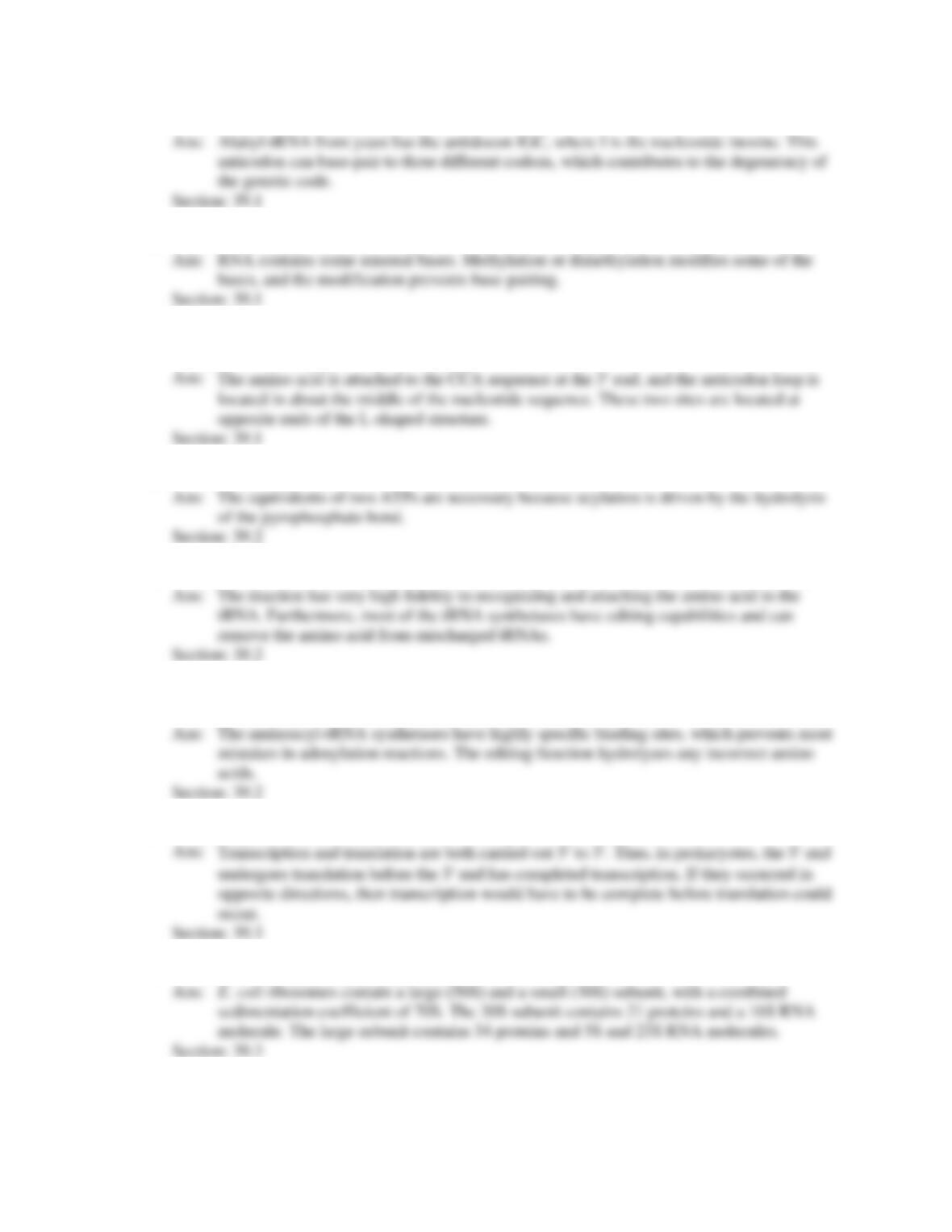
Amino acid + ATP + tRNA aminoacyl-tRNA + AMP + PPi
If the ATP was labeled with 32P in the α-position, where would the label end up?
A)
aminoacyl-Trna
B)
AMP
C)
AMP and PPi
D)
PPi
E)
the next tRNA in the sequence
Ans: B Section: 39.2
35.
In which component of the ribosome would a mutation have the greatest impact and why?
A)
RNA, because protein synthesis requires that the RNA be folded into complex structures
to ensure proper orientation of amino acids.
B)
RNA, because the RNA is thought to provide the catalytic activity.
C)
Protein, because the protein is thought to provide the catalytic activity.
D)
Protein, because the recognition sites are primarily protein.
E)
Carbohydrate, because the recognition sites are primarily protein.
Ans: B Section: 39.3
Short-Answer Questions
36.
What is the amino acid error rate in protein synthesis? Is this rate logical in evolutionary terms
of function?
Ans:
The error rate is approximately 10−4. This is consistent with a requirement to accurately
translate proteins of approximately 1000 amino acids without mistakes.
Section: 39.1
Ans: D Section: 39.2
Chapter 39 The Genetic Code
6
37.
What is significant about yeast alanyl-tRNA?
38.
Explain why some bases in RNA cannot be involved in base pairs.
Ans:
bases, and the modification prevents base-pairing.
Section: 39.1
39.
Where is the attachment site and where is the anticodon loop with respect to the nucleotide
sequence and with respect to the L-shaped structure of tRNA?
opposite ends of the L-shaped structure.
Section: 39.1
40.
How much energy is used to attach the amino acid to the tRNA?
of the pyrophosphate bond.
Section: 39.2
41.
How is a high level of fidelity maintained in attaching the amino acids to the tRNA structure?
tRNA. Furthermore, most of the tRNA synthetases have editing capabilities and can
remove the amino acid from mischarged tRNAs.
Section: 39.2
42.
How does the size of an amino acid influence accurate attachment of the amino acid to the
tRNA in aminoacyl-tRNA synthetase reactions?
mistakes in adenylation reactions. The editing function hydrolyzes any incorrect amino
acids.
Section: 39.2
43.
What is significant about the direction of transcription and translation?
occur.
Section: 39.3
44.
Describe the subunits of E. coli ribosomes.
sedimentation coefficient of 70S. The 30S subunit contains 21 proteins and a 16S RNA
molecule. The large subunit contains 34 proteins and 5S and 23S RNA molecules.
Section: 39.3
anticodon can base-pair to three different codons, which contributes to the degeneracy of
the genetic code.
Section: 39.1
Chapter 39 The Genetic Code
7
45.
Why is it important that transcription and translation are tightly coupled?
46.
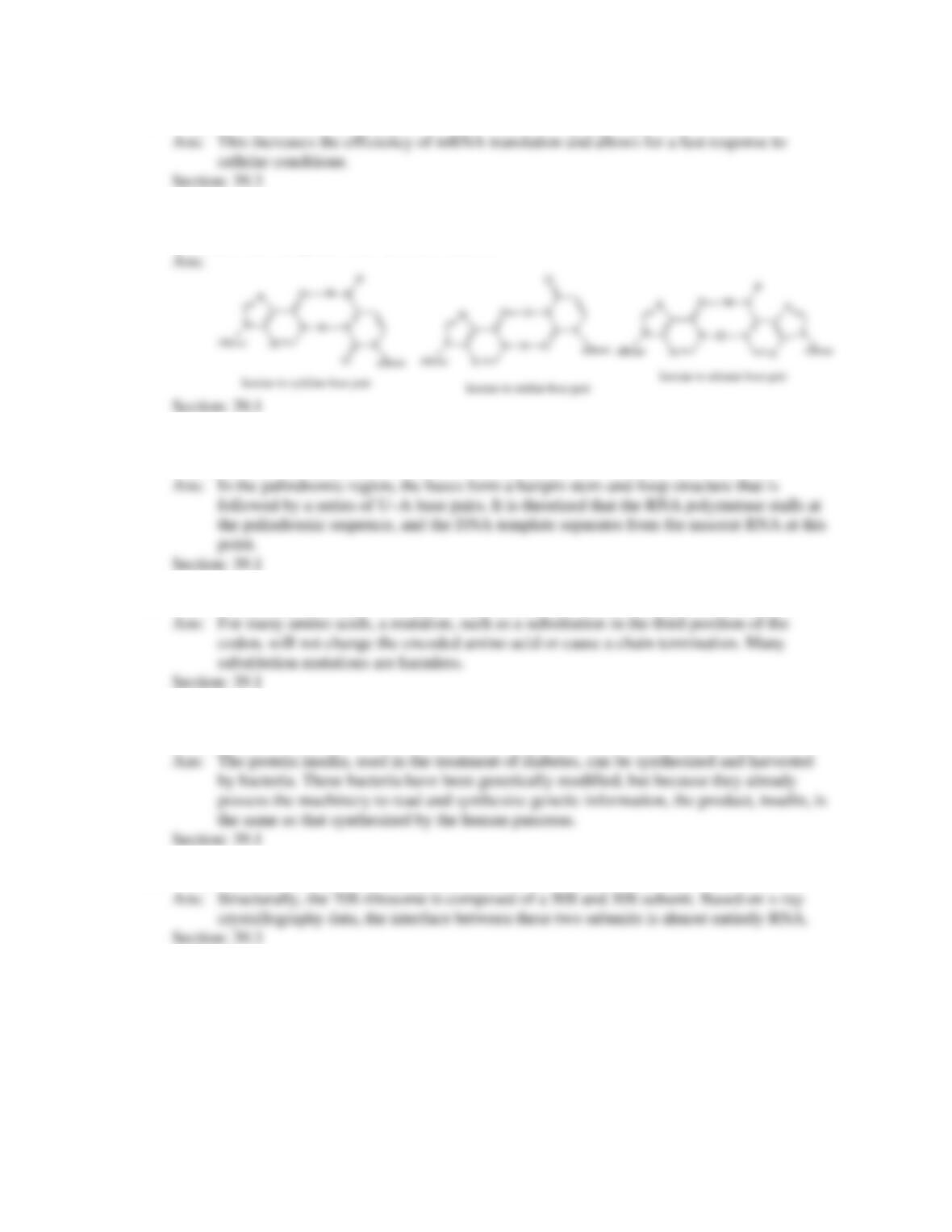
Using structures of the base pairs, show how the presence of inosine at the 5 position of the
anticodon can recognize three different codons.
Section: 39.1
47.
What is the theory about how palindromic RNA polymerase transcription termination signals
function?
the palindromic sequence, and the DNA template separates from the nascent RNA at this
point.
Section: 39.1
48.
What is meant by the statement “Degeneracy minimizes the deleterious effects of mutation”?
substitution mutations are harmless.
Section: 39.1
49.
Give an example of how the treatment of diabetes has benefited from the near universality of the
genetic code.
possess the machinery to read and synthesize genetic information, the product, insulin, is
the same as that synthesized by the human pancreas.
Section: 39.1
50.
What role does the ribosomal RNA play in the 70S ribosome structure?
crystallography data, the interface between these two subunits is almost entirely RNA.
Section: 39.3
Ans:
This increases the efficiency of mRNA translation and allows for a fast response to
cellular conditions.
Section: 39.3