61) The cellular membrane across which ion flow varies during auditory transduction is the
A) tectorial membrane.
B) tympanic membrane.
C) hair cell membrane.
D) basilar membrane.
62) Sound waves arriving at a listener first strike the
A) tectorial membrane.
B) tympanic membrane.
C) hair cell membrane.
D) basilar membrane.
63) The pathway leading to the perception of sound by mammals begins with the
A) hair cells of the organ of Corti, which rests on the basilar membrane, coming in contact with
the tectorial membrane.
B) hair cells of the organ of Corti, which rests on the tympanic membrane, coming in contact
with the tectorial membrane.
C) hair cells of the organ of Corti, which rests on the tectorial membrane, coming in contact with
the basilar membrane.
D) hair cells of the organ of Corti coming in contact with the tectorial membrane as a result of
fluid waves in the cochlea causing vibrations in the round window.
E) hair cells on the tympanic membrane as a result of fluid waves in the cochlea causing
vibrations in the round window.
64) The cochlea is an organ of auditory transduction that contains
A) fluid and cells that can undergo mechanosensory transduction.
B) air and cells that produce wax.
C) air and small bones that vibrate in response to sound waves.
D) fluid with stacks of chemosensory cells.
E) air and statocysts activated by movement.
65) Dizziness is a perceived sensation that can occur when
A) the hair cells in the cochlea move more than their normal limits.
B) moving fluid in the semicircular canals encounters a stationary cupula.
C) the basilar membrane makes physical contact with the tectorial membrane.
D) the utricle is horizontal but the saccule is vertical.
66) The perceived pitch of a sound depends on
A) which part of the tympanic membrane is being vibrated by sound waves.
B) which part of the oval window produces waves in the cochlear fluid.
C) which region of the basilar membrane was set in motion.
D) whether or not the sound moves the incus, malleus, and stapes.
67) The sand grains or other dense materials resting on mechanoreceptors used by most
invertebrates to sense gravity are called
A) cochlea.
B) statoliths.
C) otoliths.
D) pinnae.
68) It can be very difficult to select an angle for sneaking up to a grasshopper to catch it because
grasshoppers have
A) excellent hearing for detecting predators.
B) compound eyes with multiple ommatidia.
C) eyes with multiple fovea.
D) a camera-like eye with a single fovea.
69) Sensory transduction of light/dark information in the vertebrate retina is accomplished by
A) ganglion cells.
B) amacrine cells.
C) bipolar cells.
D) horizontal cells.
E) rods and cones.
70) Rods exposed to light will
A) depolarize due to the opening of sodium channels.
B) hyperpolarize due to the closing of sodium channels.
C) depolarize due to the opening of potassium channels.
D) hyperpolarize due to the closing of potassium channels.
71) A rod exposed to light will
A) undergo a graded depolarization that will increase its release of glutamate.
B) undergo a graded hyperpolarization that will increase its release of glutamate.
C) undergo a graded depolarization that will decrease its release of glutamate.
D) undergo a graded hyperpolarization that will decrease its release of glutamate.
72) In the human retina
A) cone cells can detect color, but rod cells cannot.
B) cone cells are more sensitive than rod cells to light.
C) cone cells, but not rod cells, have a visual pigment.
D) rod cells are most highly concentrated in the center of the retina.
E) rod cells require higher illumination for stimulation than do cone cells.
73) A patient has been diagnosed with a tumor that has destroyed the center of her optic chiasm.
How has this affected her vision?
A) She is blind.
B) She can only see out of her left eye.
C) She can only see out of her right eye.
D) She has a limited field of view in each eye.
E) She has normal vision.
74) Raccoons are most active from dusk until dawn. What kinds of cells would you expect to
find in the retina of a raccoon?
A) a high density of cones at the fovea
B) an equal mixture of cones and rods
C) three or more types of cones in large quantities
D) many more rods than cones
75) While on an African safari, you squint into the distance in order to get a better view of an
elephant. What is happening in your eye to allow you to focus on the elephant?
A) The iris is opening to allow more light into the pupil.
B) The iris is closing to allow less light into the pupil.
C) The lens is becoming flatter.
D) The lens is becoming more spherical.
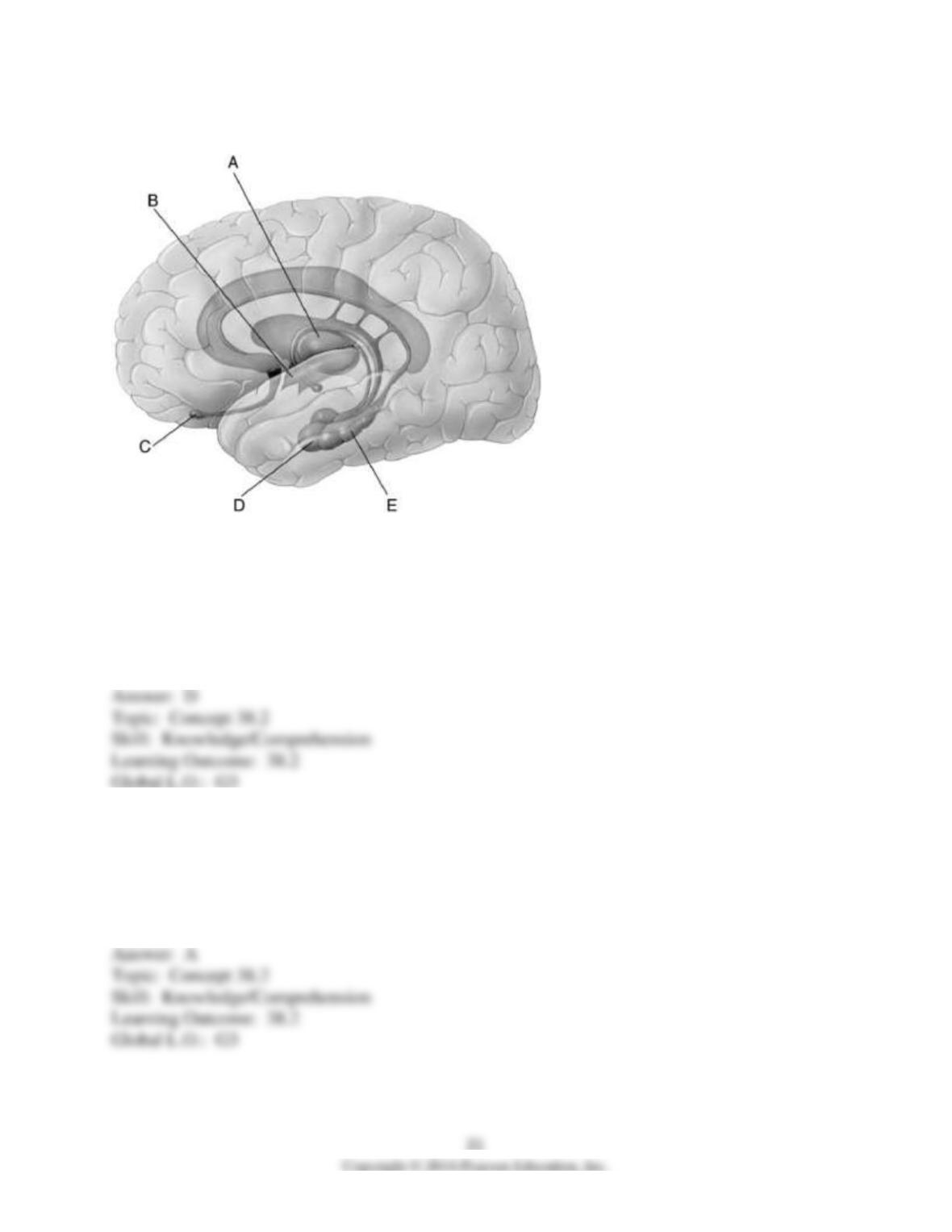
38.2 Art Questions
Figure 38.1
1) In Figure 38.1, which letter points to the amygdala?
A) A
B) B
C) C
D) D
E) E
2) In Figure 38.1, which letter points to the thalamus?
A) A
B) B
C) C
D) D
E) E
3) In Figure 38.1, which letter points to the olfactory bulb?
A) A
B) B
C) C
D) D
E) E
4) In Figure 38.1, which letter points to the hippocampus?
A) A
B) B
C) C
D) D
E) E
5) In Figure 38.1, which letter points to the hypothalamus?
A) A
B) B
C) C
D) D
E) E
6)
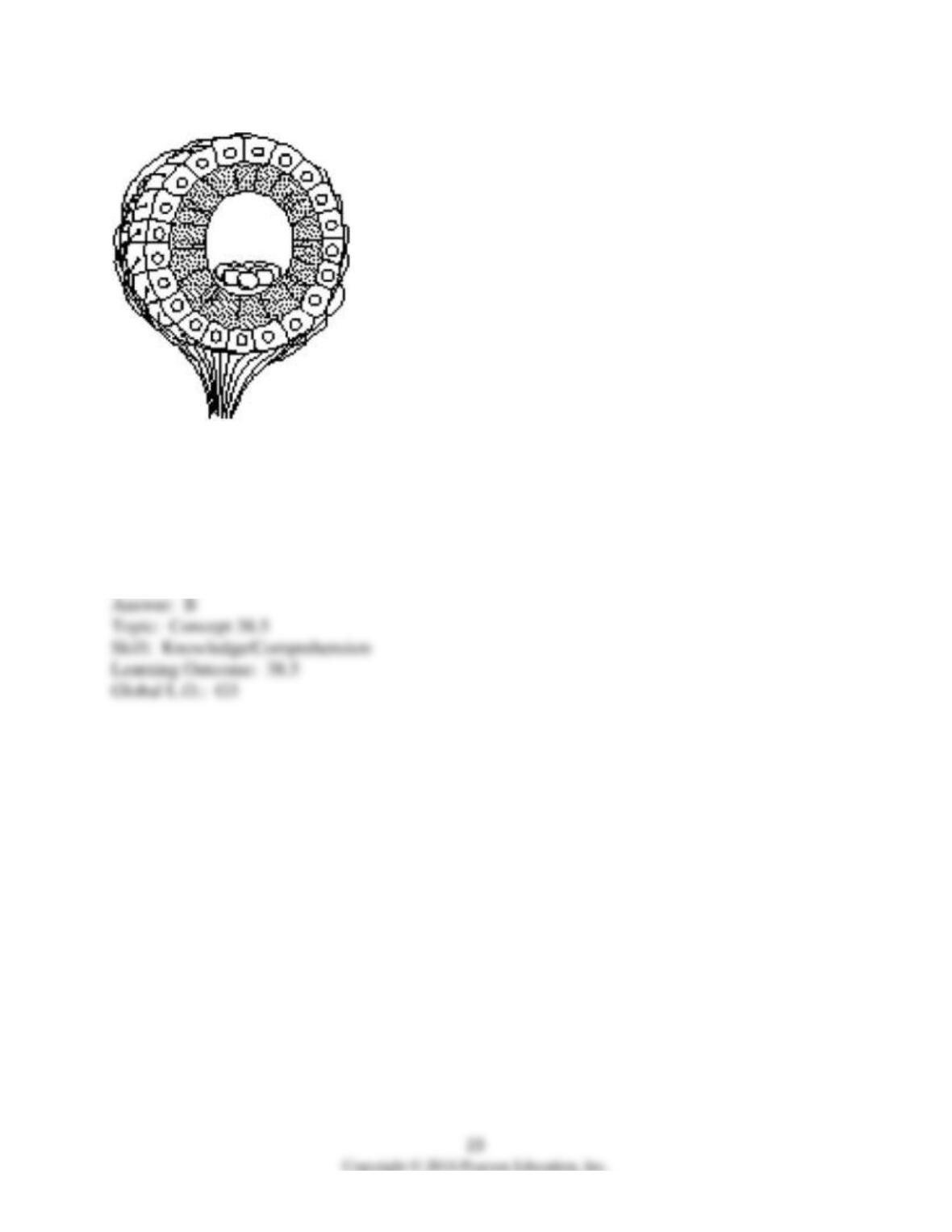
Figure 38.2
The structure diagrammed in Figure 38.2 is a
A) rod.
B) statocyst.
C) taste bud.
D) cone.
E) olfactory bulb.
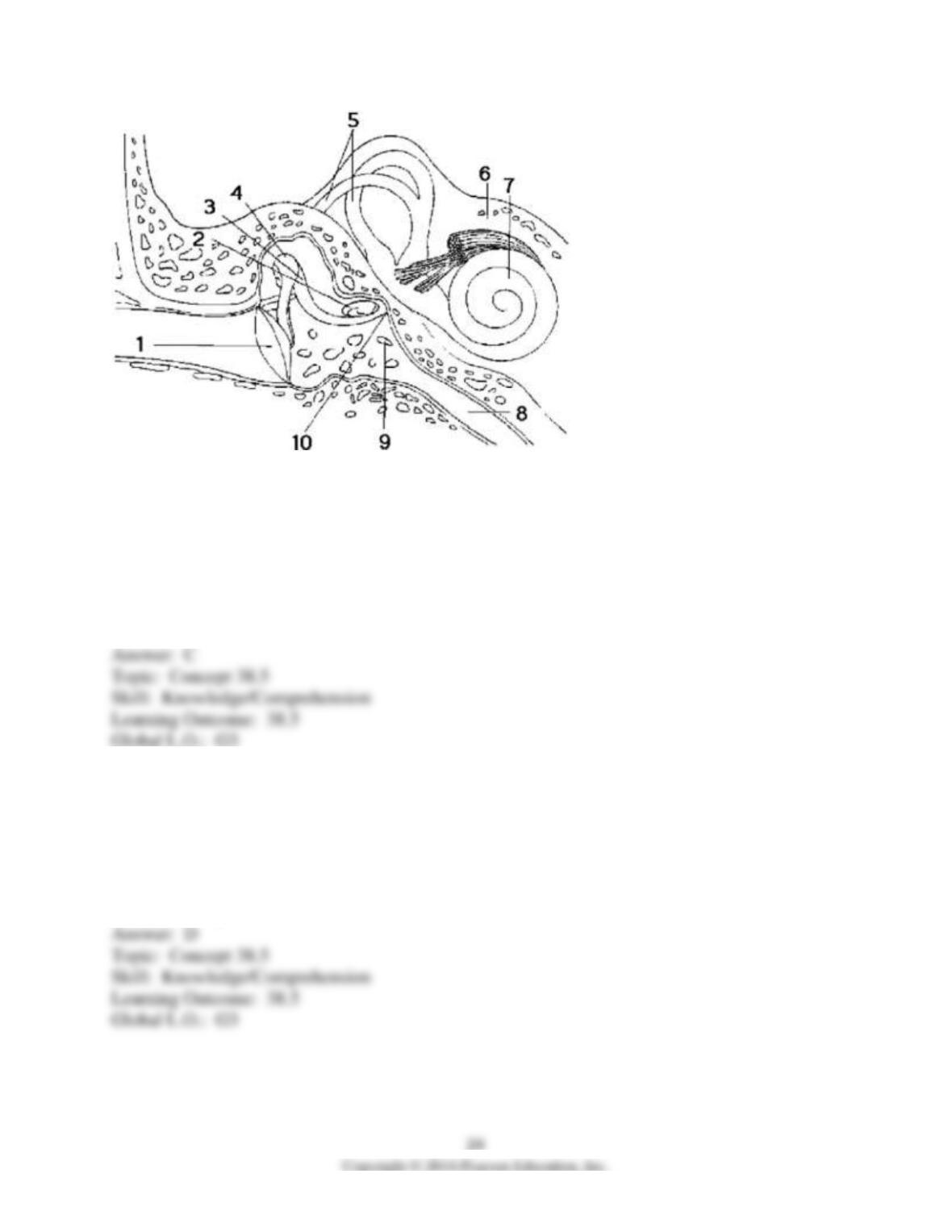
Figure 38.3
7) The structure involved in equalizing the pressure between the ear and the atmosphere is
represented by number
A) 7.
B) 1.
C) 8.
D) 9.
E) 10.
8) The sense of head motion begins with sensory transduction by the structure(s) at which
number(s)?
A) 2, 3, and 4 only
B) 2, 5, and 7 only
C) 4 only
D) 5 only
E) 7 and 8 only
9) Vibrations of the tympanic membrane are transmitted to the oval window by the structure(s) at
which number(s)?
A) 1, 2, 3, and 4 only
B) 2, 3, and 4 only
C) 3 and 4 only
D) 4 only
E) 5 only
10) The organ of Corti is contained in the structure numbered
A) 3.
B) 4.
C) 5.
D) 6.
E) 7.
11) Hair cells are found in the structures represented by which two numbers?
A) 1 and 2
B) 3 and 4
C) 5 and 7
D) 6 and 8
E) 9 and 10
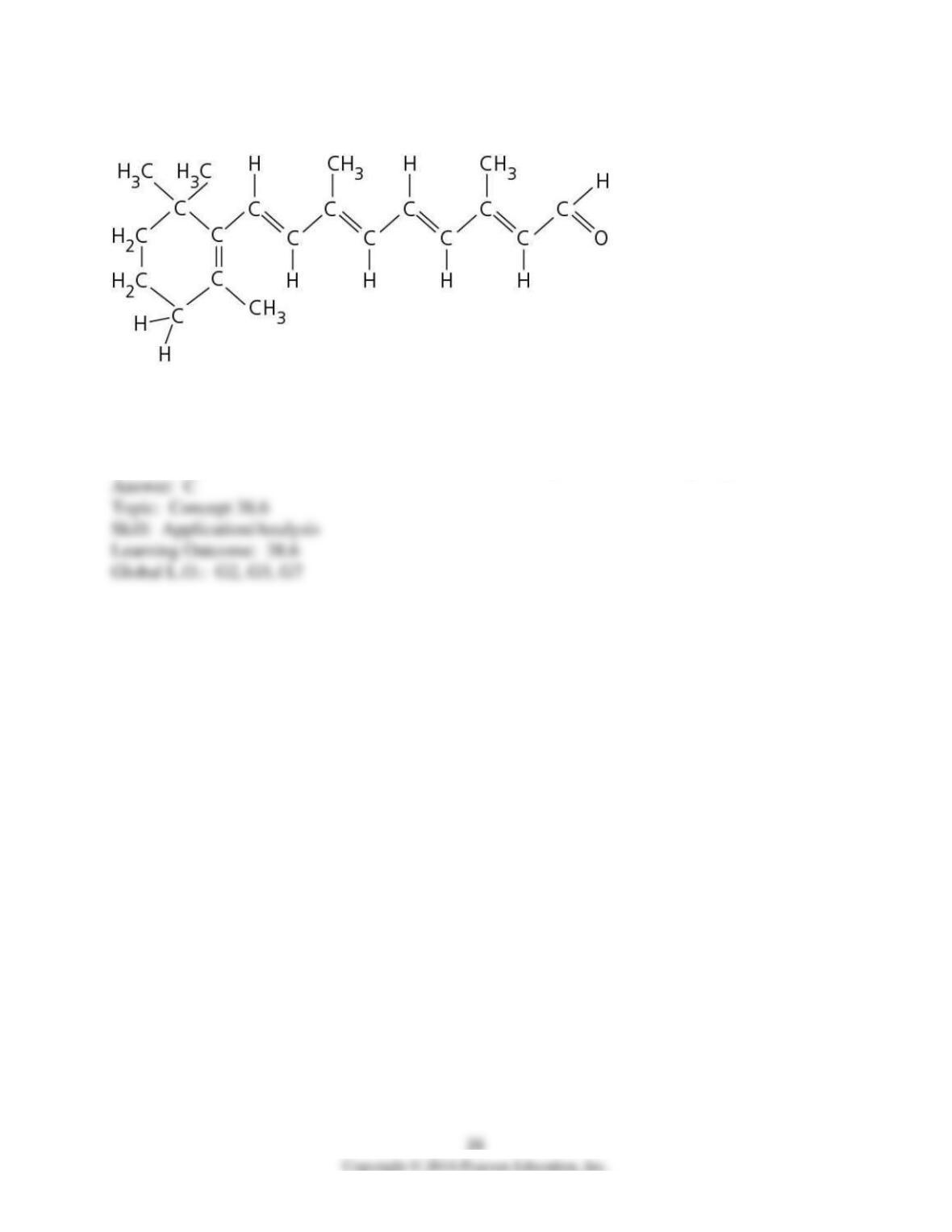
12) This is the trans isomer of retinal. Where would it be bound to the opsin protein and why?
A) Retinal would be found at the cytosolic side of opsin because it is hydrophilic.
B) Retinal would be found at the cytosolic side of opsin because it is hydrophobic.
C) Retinal would be found in the transmembrane core of opsin because it is hydrophobic.
D) Retinal would be found in the transmembrane core of opsin because it is hydrophilic.
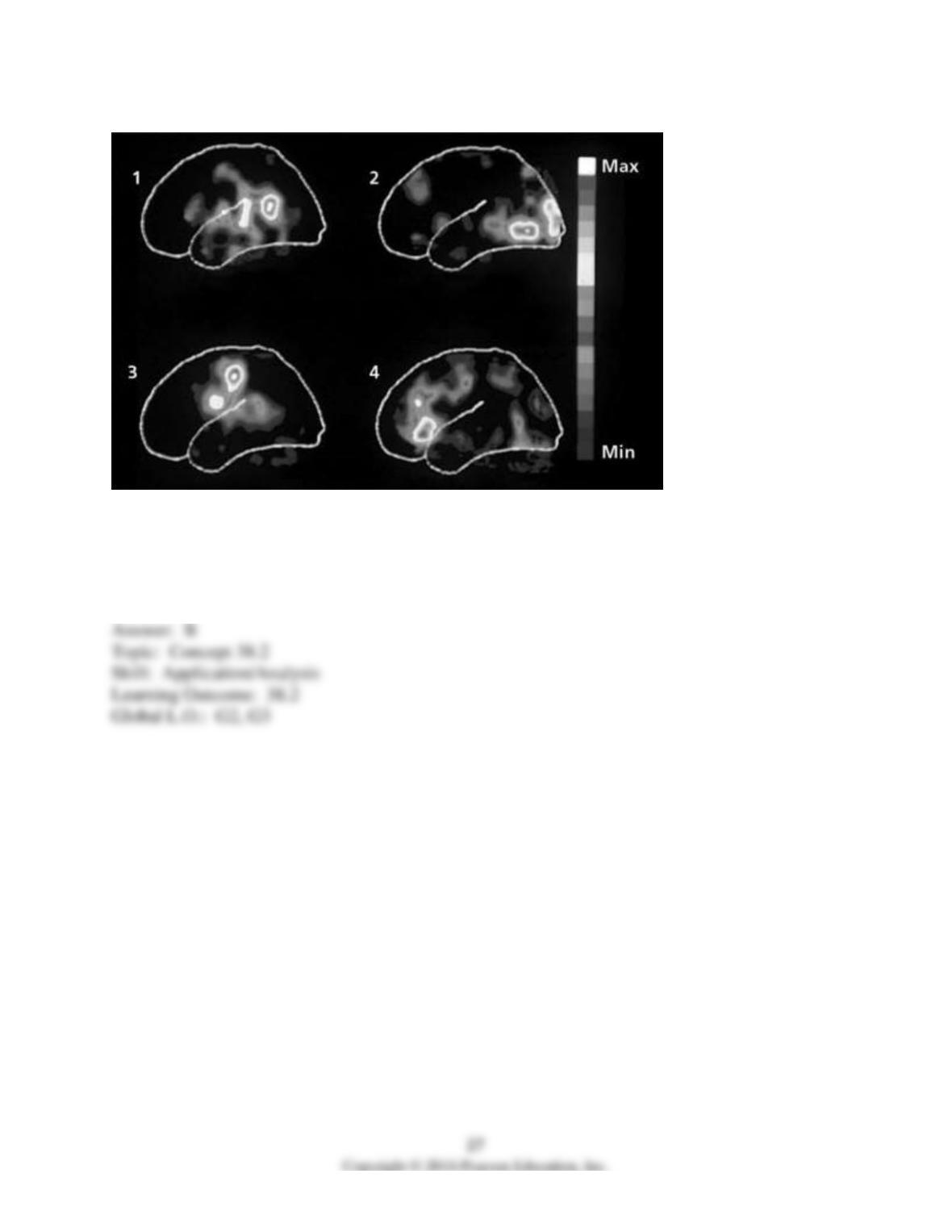
13)
Which of the PET images above shows high levels of activity in the occipital lobe?
A) 1
B) 2
C) 3
D) 4
38.3 Scenario Questions
1) Experiments with genetically altered mice showed that the mice would consume abnormally
high amounts of bitter-tasting compounds in water after their
A) hormone receptors for digestive hormones were reduced or eliminated, showing that bitter
tastes are reinforced by digestive responses.
B) salt-taste cells were altered to express receptors for bitter tastants, suggesting that animals
have unregulated salt appetites.
C) visual sense was reduced or eliminated, suggesting that mice learn visual cues about bitter
tastes.
D) olfactory sense was reduced or eliminated, suggesting that mice learn odor cues about bitter
tastes.
E) sweet-taste cells were altered to express receptors for bitter tastants, suggesting that the
sensation of taste depends only on which taste cell is stimulated.
Please use the following information to answer the question(s) below.
The southern grasshopper mouse feeds regularly on the Arizona bark scorpion, the most
venomous scorpion in the United States. While attempting to capture the scorpion, the mouse
usually gets stung multiple times by the scorpion but does not seem to be affected.
2) What type of sensory receptor in the mouse seems to be immune to the scorpion’s sting and
venom?
A) thermoreceptors
B) chemoreceptors
C) electromagnetic receptors
D) nociceptors
3) While attempting to capture the scorpion, the mouse’s heart rate increases, and there is an
increase in epinephrine in the mouse’s blood. What nervous system division is responsible for the
mouse’s physiological state?
A) enteric
B) sensory
C) sympathetic
D) parasympathetic
4) A sensation of hunger triggers the mouse to leave its den to hunt the scorpions. Where would
you expect to see a high level of activity in the mouse’s brain when it feels hungry?
A) on the outer edges
B) near the middle
C) at the bottom
D) only on the left side
5) What would be the best experiment to conduct to determine if the grasshopper mouse is
unique among mouse species in that it does not feel pain when stung by the bark scorpion?
A) Inject a grasshopper mouse with bark scorpion venom and measure its brain activity in
regards to pain reception. Then inject the same grasshopper mouse with other venoms and
measure its pain response.
B) Inject other species of mice with bark scorpion venom and measure their brain activity in
regards to pain reception. Compare their pain responses to that of the grasshopper mouse.
C) Inject a grasshopper mouse with bark scorpion venom and measure its brain activity in
regards to pain reception. Then inject the same grasshopper mouse with a benign salt solution
and measure its pain response.
D) Inject other species of mice with bark scorpion venom and measure their brain activity in
regards to pain reception. Compare their pain responses to that of the grasshopper mouse and
also to their level of pain response when injected with a benign salt solution.
38.4 End-of-Chapter Questions
1) Patients with damage to Wernicke’s area have difficulty
A) coordinating limb movement.
B) generating speech.
C) recognizing faces.
D) understanding language.
2) The cerebral cortex does not play a major role in
A) short-term memory.
B) long-term memory.
C) circadian rhythm.
D) breath holding.
3) The middle ear converts
A) air pressure waves to fluid pressure waves.
B) air pressure waves to nerve impulses.
C) fluid pressure waves to nerve impulses.
D) pressure waves to hair cell movements.
4) If the following events are arranged in the order in which they occur for an animal hiding and
holding still in response to seeing a predator, which is the fourth event in the series?
A) signaling by an afferent PNS neuron
B) signaling by an efferent PNS neuron
C) information processing in the CNS
D) activation of a sensory receptor
5) Injury to just the hypothalamus would most likely disrupt
A) regulation of body temperature.
B) short-term memory.
C) executive functions, such as decision making.
D) sorting of sensory information.
6) Which sensory distinction is not encoded by a difference in which axon transfers the
information to the brain?
A) white and red
B) red and green
C) loud and faint
D) salty and sweet