49) The major inhibitory neurotransmitter of the human brain is
A) acetylcholine.
B) epinephrine.
C) glutamate.
D) nitric oxide.
E) GABA.
50) A neuropeptide that might function as a natural analgesic is
A) acetylcholine.
B) epinephrine.
C) endorphin.
D) nitric oxide.
E) GABA.
51) An amino acid that operates at inhibitory synapses in the brain is
A) acetylcholine.
B) epinephrine.
C) endorphin.
D) nitric oxide.
E) GABA.
52) The botulinum toxin inhibits the synaptic release of
A) acetylcholine.
B) epinephrine.
C) endorphin.
D) nitric oxide.
E) GABA.
53) The heart rate decreases in response to the arrival of
A) acetylcholine.
B) epinephrine.
C) endorphin.
D) nitric oxide.
E) GABA.
54) A chemical that affects neuronal function but is not stored in presynaptic vesicles is
A) acetylcholine.
B) epinephrine.
C) endorphin.
D) nitric oxide.
E) GABA.
55) Motor neurons alter skeletal muscle activities by releasing neurotransmitters because
A) they are electrically coupled by gap junctions to the muscles.
B) their signals bind to receptor proteins on the muscles.
C) their signals reach the muscles via the blood.
D) their light pulses activate contraction in the muscles.
E) they are connected to the internal neural network of the muscles.
56) Most of the synapses in vertebrates conduct information in only one direction
A) as a result of the nodes of Ranvier.
B) as a result of voltage-gated sodium channels found only in the vertebrate system.
C) because vertebrate nerve cells have dendrites.
D) because only the postsynaptic cells can bind and respond to neurotransmitters.
E) because the sodium-potassium pump moves ions in one direction.
57) Assume that excessive consumption of ethanol increases the influx of negative chloride ions
into “commonsense” neurons whose action potentials are needed for you to act appropriately and
not harm yourself or others. Thus, any resulting poor decisions associated with ethanol ingestion
are likely due to
A) increased membrane depolarization of “commonsense” neurons.
B) increased membrane hyperpolarization of “commonsense” neurons.
C) more action potentials in your “commonsense” neurons.
D) more EPSPs in your “commonsense” neurons.
E) fewer IPSPs in your “commonsense” neurons.
Please use the following information to answer the question(s) below.
Curare is a potent neurotoxin extracted from the Strychnos toxifera plant in Central and South
America. Indigenous peoples of South America apply curare to arrows, which they used to hunt
and kill animals. Curare acts at synapses between motor neurons and skeletal muscle cells. When
a motor neuron synapses with a skeletal muscle cell, the skeletal muscle cell may be stimulated
or inhibited just like postsynaptic neurons are. Curare acts by binding temporarily to
acetylcholine receptors on the postsynaptic cell and prevents acetylcholine from binding.
58) What effect does curare likely have on the postsynaptic cell?
A) prevents voltage-gated sodium channels from opening
B) hyperpolarizes the postsynaptic cell
C) stimulates muscle contraction
D) depolarizes the presynaptic cell
59) Which of the following could be an effective treatment for curare poisoning?
A) a drug that promotes acetylcholine reuptake into the presynaptic cells
B) a drug that removes acetylcholine receptors from the postsynaptic cell
C) a drug that inhibits acetylcholinesterase
D) a drug that activates acetylcholinesterase
37.2 Art Questions
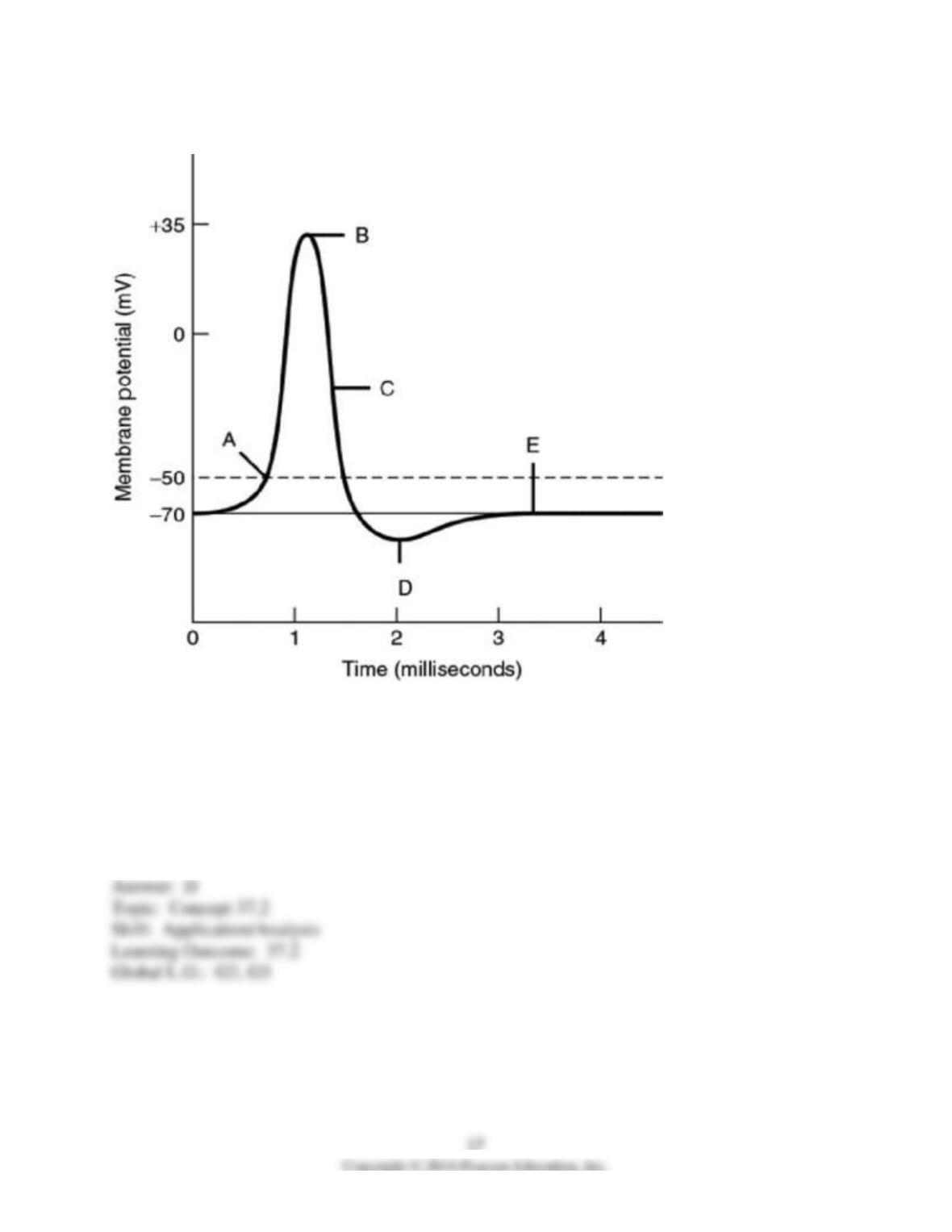
Figure 37.1
1) In Figure 37.1, the membrane potential is closest to the equilibrium potential for potassium at
label
A) A.
B) B.
C) C.
D) D.
E) E.
2) The period in which voltage-gated potassium channels are open and hyperpolarization has yet
to occur is at label
A) A.
B) B.
C) C.
D) D.
E) E.
3) In Figure 37.1, the membrane’s permeability to sodium ions is at its maximum at label
A) A.
B) B.
C) C.
D) D.
E) E.
4) In Figure 37.1, the minimum graded depolarization needed to operate the voltage-gated
sodium and potassium channels is indicated by the label
A) A.
B) B.
C) C.
D) D.
E) E.
5) In Figure 37.1, at what point in the graph are sodium channels closed (or closing) and
potassium channels opened?
A) A.
B) B.
C) C.
D) D.
E) E.
6) In Figure 37.1, the neuronal membrane is at its resting potential at label
A) A.
B) B.
C) C.
D) D.
E) E.
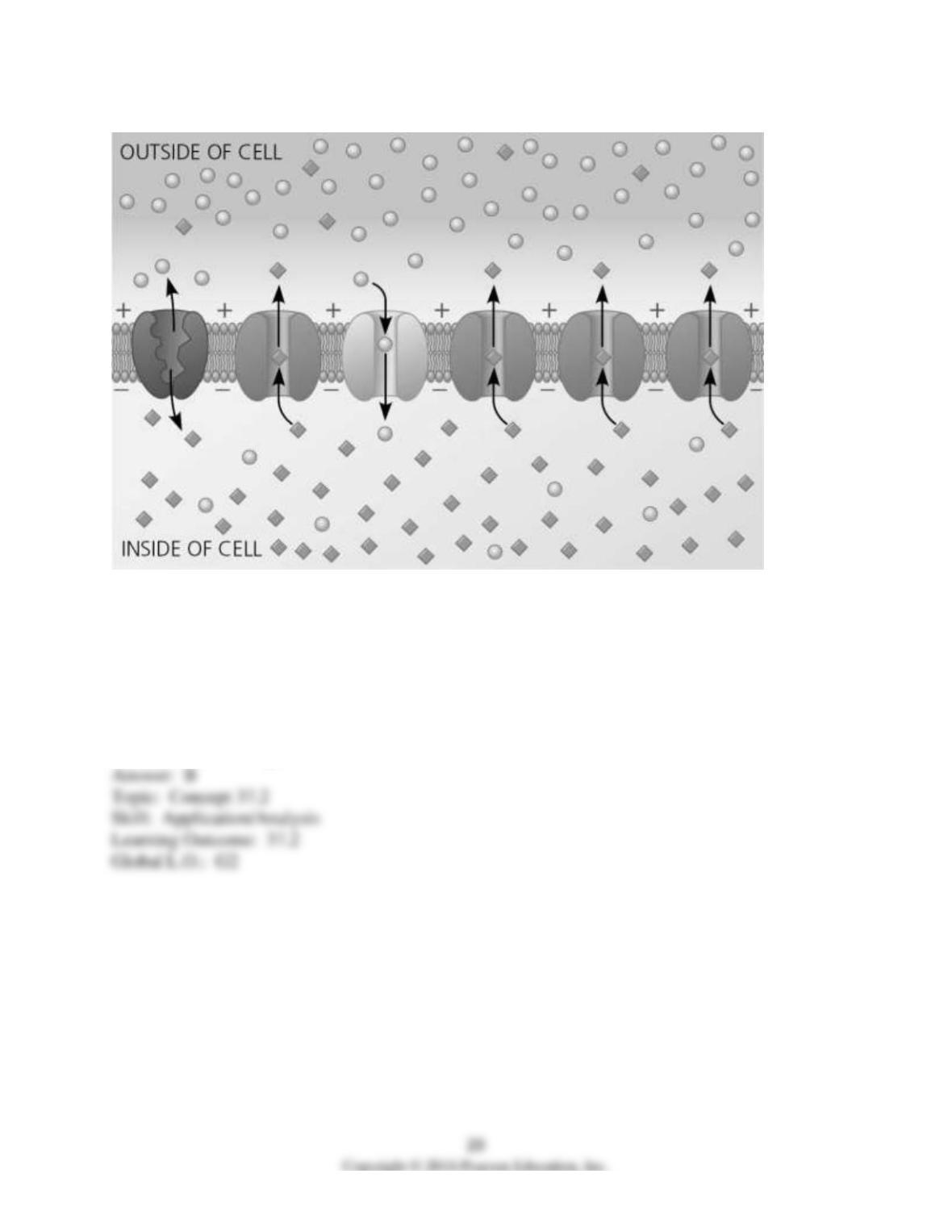
7)
Figure 37.2
Figure 37.2 shows many channels in a cell membrane. The channel third from the left is a
voltage-gated sodium channel. What would happen if this channel became blocked and thus
unable to function?
A) The cell’s membrane potential would not change.
B) The cell would hyperpolarize.
C) The cell would depolarize.
D) There is not enough information to make a conclusion.
37.3 Scenario Questions
Please use the following information to answer the question(s) below.
The Arizona bark scorpion is the most venomous scorpion in North America, and its bite will
cause extensive pain to a human that lasts up to three days. However, the southern grasshopper
mouse is essentially immune to the sting of this scorpion and actually eats the scorpions as prey.
Researchers have recently elucidated the neuronal reason for why the southern grasshopper
mouse does not feel pain from bark scorpion venom.
1) The southern grasshopper mouse essentially does not feel pain when stung by the bark
scorpion. What type of neuron is most likely blocked in this scenario?
A) interneuron
B) motor neuron
C) sensory neuron
D) glial cells
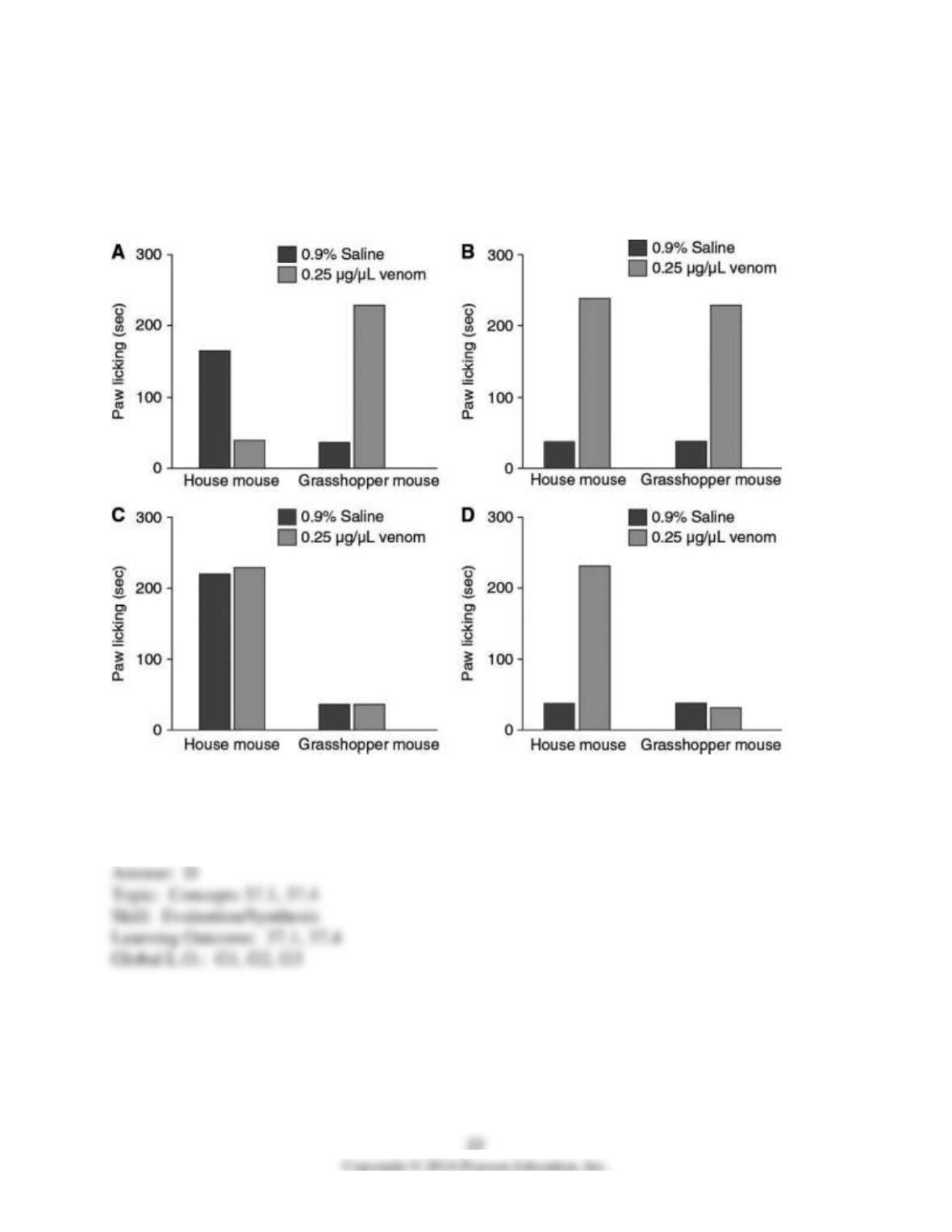
2) When mice feel pain on their bodies, they lick that part of their body. Researchers injected
bark scorpion venom into the hind paws of the common house mouse and the southern
grasshopper mouse; they also injected 0.9% saline (essentially salt water) as a control. The
researchers then observed how long the mice licked their paws. What data do you think the
researchers collected?
A) A
B) B
C) C
D) D
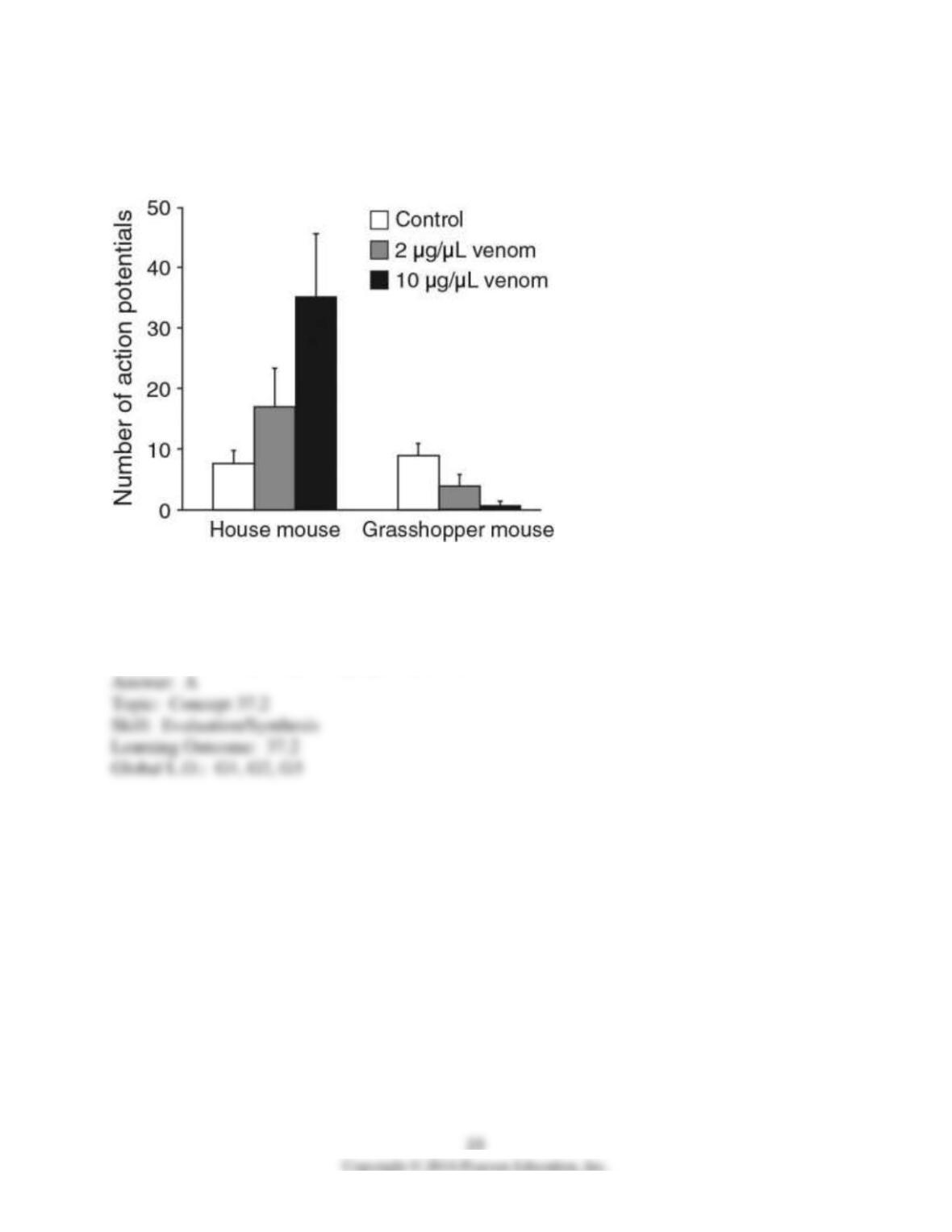
3) Researchers injected bark scorpion venom in mouse neurons (both a common house mouse
and the southern grasshopper mouse) and measured how many action potentials were generated
after the venom was introduced. Their data is shown below.
Based on these data, what effect do you think the venom is having on the grasshopper mouse?
A) The venom is blocking voltage-gated sodium channels.
B) The venom is blocking voltage-gated potassium channels.
C) The venom is opening voltage-gated sodium channels.
D) The venom is opening voltage-gated potassium channels.
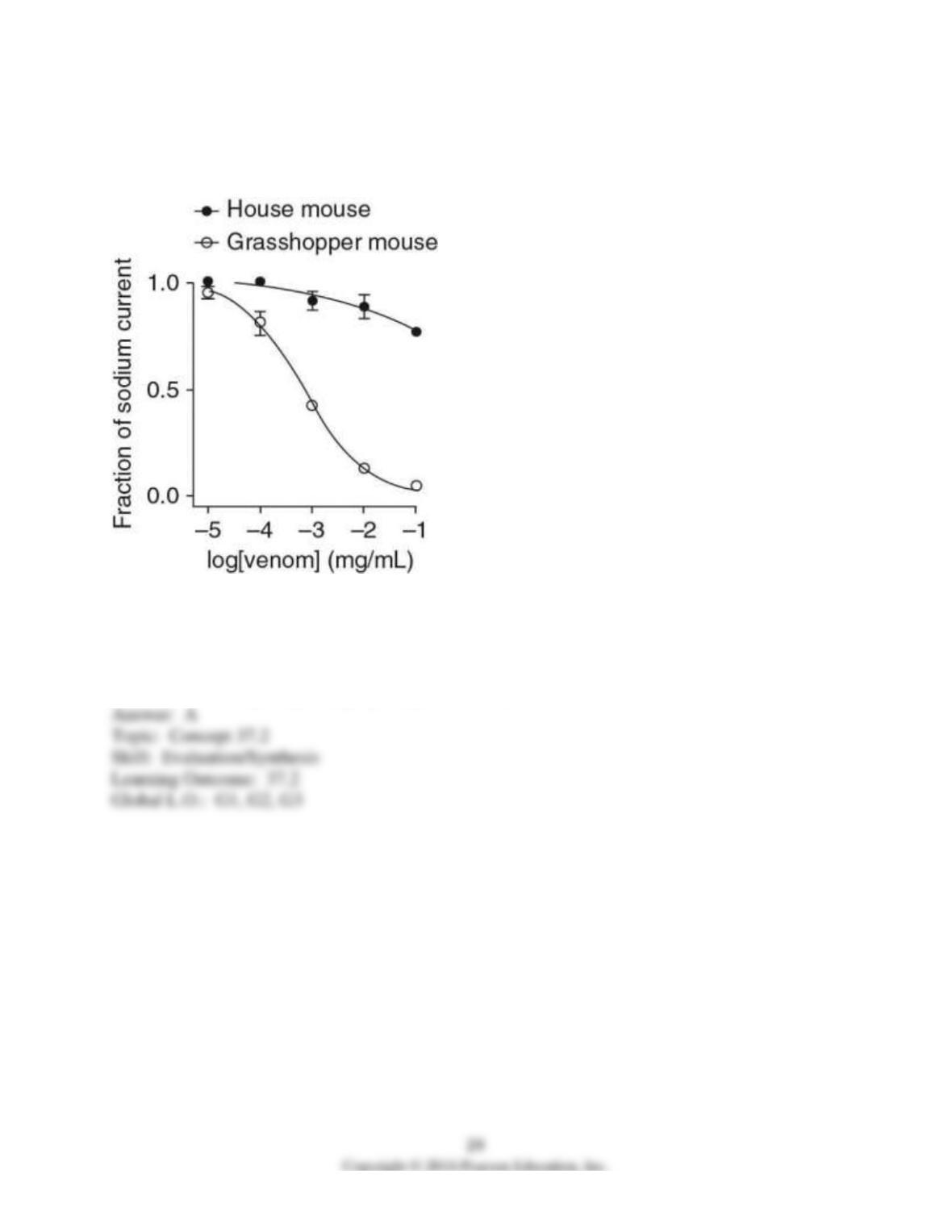
4) Researchers injected bark scorpion venom in mouse neurons (both a common house mouse
and the southern grasshopper mouse) and measured the flow of sodium ions across the cell
membrane. Their data is shown below.
Based on these data, what effect do you think the venom is having on the grasshopper mouse?
A) The venom is blocking voltage-gated sodium channels.
B) The venom is blocking voltage-gated potassium channels.
C) The venom is opening voltage-gated sodium channels.
D) The venom is opening voltage-gated potassium channels.
37.4 End-of-Chapter Questions
1) What happens when a resting neuron’s membrane depolarizes?
A) There is a net diffusion of Na+ out of the cell.
B) The equilibrium potential for K+ (EK) becomes more positive.
C) The neuron’s membrane voltage becomes more positive.
D) The cell’s inside is more negative than the outside.
2) A common feature of action potentials is that they
A) cause the membrane to hyperpolarize and then depolarize.
B) can undergo temporal and spatial summation.
C) are triggered by a depolarization that reaches threshold.
D) move at the same speed along all axons.
3) Where are neurotransmitter receptors located?
A) the nuclear membrane
B) the nodes of Ranvier
C) the postsynaptic membrane
D) synaptic vesicle membranes
4) Why are action potentials usually conducted in one direction?
A) Ions can flow along the axon in only one direction.
B) Voltage-gated Na+ channels are inactivated during the refractory period.
C) The axon hillock has a higher membrane potential than the terminals of the axon.
D) Voltage-gated channels for both Na+ and K+ open in only one direction.
5) Which of the following is a direct result of depolarizing the presynaptic membrane of an axon
terminal?
A) Voltage-gated calcium channels in the membrane open.
B) Synaptic vesicles fuse with the membrane.
C) Ligand-gated channels open, allowing neurotransmitters to enter the synaptic cleft.
D) An EPSP or IPSP is generated in the postsynaptic cell.
6) Suppose a particular neurotransmitter causes an IPSP in postsynaptic cell X and an EPSP in
postsynaptic cell Y. A likely explanation is that
A) the threshold value in the postsynaptic membrane is different for cell X and cell Y.
B) the axon of cell X is myelinated, but that of cell Y is not.
C) only cell Y produces an enzyme that terminates the activity of the neurotransmitter.
D) cells X and Y express different receptor molecules for this particular neurotransmitter.