62) Of the following contraception methods, the highest risk of accidental pregnancy
accompanies
A) the use of a diaphragm.
B) the use of a condom.
C) the practice of coitus interruptus.
D) a verified vasectomy.
E) the practice of the “rhythm method.”
63) The use of birth control pills (oral contraceptives)
A) reduces the incidence of ovulation.
B) prevents fertilization by keeping the sperm and egg physically separated by a mechanical
barrier.
C) prevents implantation of an embryo.
D) prevents sperm from exiting the male urethra.
E) prevents oocytes from entering the uterus.
64) Two contraceptive methods that are generally irreversible and that block the gametes from
moving to a site where fertilization can occur are
A) the male condom and the female condom.
B) the male condom and oral contraceptives.
C) vasectomy and tubal ligation.
D) coitus interruptus and the rhythm method.
E) the diaphragm and the rhythm method.
65) For lactation to take place, the synthesis of breast milk and its release from the mammary
gland, respectively, are caused by
A) testosterone and human chorionic gonadotropin (hCG).
B) estrogen and progesterone.
C) cortisol and testosterone.
D) prolactin and oxytocin.
E) luteinizing hormone (LH) and follicle-stimulating hormone (FSH).
66) So-called “combination” birth control pills function in contraception by
A) inhibiting the release of luteinizing hormone (LH), follicle-stimulating hormone (FSH), and
gonadotropin-releasing hormone (GnRH).
B) irritating the uterine lining so as to prevent implantation.
C) causing spontaneous abortions.
D) blocking progesterone receptors so that pregnancy cannot be maintained.
E) binding to and inactivating any sperm that enter the oviduct.
67) As an embryo develops, new cells are produced as the result of
A) differentiation.
B) preformation.
C) cell division.
D) morphogenesis.
E) epigenesis.
68) Fertilization of an egg without activation is most like
A) placing the key in the ignition of a car but not starting the engine.
B) resting during halftime of a basketball game.
C) preparing a pie from scratch and baking it in the oven.
D) walking to the cafeteria and eating lunch.
E) dropping a rock off a cliff and watching it land in the valley below.
69) Contact of a sperm with signal molecules in the coat of an egg causes the sperm to undergo
A) mitosis.
B) depolarization.
C) gastrulation.
D) asexual reproduction.
E) the acrosomal reaction.
70) Even in the absence of sperm, metabolic activity in an egg can be artificially activated by
A) abnormally high levels of carbonic acid in the cytosol.
B) abnormally low levels of extracellular oxygen.
C) injection of calcium ions into the cytosol.
D) exposure to the low pH of the uterus.
E) depletion of its ATP supplies.
71) The formation of the fertilization membrane requires an increase in the availability of
A) bicarbonate ions.
B) calcium ions.
C) hydrogen ions.
D) potassium ions.
E) sodium ions.
72) A human zygote undergoes its first cell division
A) 5 seconds after fertilization.
B) 30 minutes after fertilization.
C) 90 minutes after fertilization.
D) 4 hours after fertilization.
E) 24 hours after fertilization.
73) A reproductive difference between sea urchins and humans is that
A) the sea urchin egg completes meiosis prior to fertilization, but meiosis in humans is
completed after fertilization.
B) sea urchin eggs are produced by meiosis, but human eggs are produced by mitosis.
C) sea urchin eggs and sperm are of equal size, but human eggs are much bigger than human
sperm.
D) sea urchins, but not humans, have a need to block polyspermy because only in sea urchins can
there be more than one source of sperm to fertilize the eggs.
E) sea urchin zygotes get their mitochondria from the sperm, but human zygotes get their
mitochondria from the egg.
74) Fusion of egg and sperm membranes triggers ________, which then blocks polyspermy.
A) mitosis
B) membrane depolarization
C) cleavage
D) cortical reaction
E) acrosomal reaction
75) During fertilization, the acrosomal contents
A) block polyspermy.
B) help propel more sperm toward the egg.
C) digest the protective jelly coat on the surface of the egg.
D) nourish the mitochondria of the sperm.
E) trigger the completion of meiosis by the sperm.
76) The cortical reaction functions directly in the
A) formation of a fertilization envelope.
B) production of a fast block to polyspermy.
C) release of hydrolytic enzymes from the sperm cell.
D) generation of a nerve-like impulse by the egg cell.
E) fusion of egg and sperm nuclei.
77) In sea urchins, the “fast block” and the longer-lasting “slow block” to polyspermy,
respectively, are
A) the acrosomal reaction and the formation of jelly coat.
B) the cortical reaction and the formation of cortical granules.
C) the jelly coat of the egg and the vitelline layer.
D) membrane depolarization and the cortical reaction.
E) inactivation of the sperm acrosome.
78) In mammals, the nuclei resulting from the union of the sperm and the egg are first truly
diploid at the end of the
A) acrosomal reaction.
B) completion of spermatogenesis.
C) initial cleavage.
D) activation of the egg.
E) completion of gastrulation.
79) Fertilization normally
A) reinstates diploidy.
B) follows gastrulation.
C) merges two diploid cells into one haploid cell.
D) precedes ovulation.
80) During the early part of the cleavage stage in many animal species, the rapidly developing
cells skip
A) the mitosis phase of the cell cycle.
B) the S phase of the cell cycle.
C) the G1 and G2 phases of the cell cycle.
D) the cytokinesis phase of the cell cycle.
81) Which of the following correctly displays the sequence of developmental milestones?
A) blastula → gastrula → cleavage
B) blastula → cleavage → gastrula
C) cleavage → gastrula → blastula
D) cleavage → blastula → gastrula
E) gastrula → blastula → cleavage
82) Cells move to new positions as an embryo establishes its three germ tissue layers during
A) the cortical reaction.
B) cleavage.
C) fertilization.
D) the acrosomal reaction.
E) gastrulation.
83) The outer-to-inner sequence of tissue layers in a post-gastrulation vertebrate embryo is
A) endoderm → ectoderm → mesoderm.
B) mesoderm → endoderm → ectoderm.
C) ectoderm → mesoderm → endoderm.
D) ectoderm → endoderm → mesoderm.
E) endoderm → mesoderm → ectoderm.
84) If gastrulation was blocked by an environmental toxin, then
A) cleavage would not occur in the zygote.
B) embryonic germ layers would not form.
C) fertilization would be blocked.
D) the blastula would not be formed.
E) internal fertilization could not occur.
85) The archenteron of the developing sea urchin eventually develops into the
A) reproductive organs.
B) blastocoel.
C) heart and lungs.
D) digestive tract.
E) brain and spinal cord.
86) The vertebrate ectoderm is the origin of the
A) nervous system.
B) liver.
C) sensory system.
D) heart.
E) kidneys.
87) An open space within the gastrula is the
A) ectoderm.
B) mesoderm.
C) archenteron.
D) endoderm.
E) blastocoel wall.
88) At the time of implantation, the human embryo is called a
A) blastocyst.
B) gastrula.
C) fetus.
D) placenta.
E) zygote.
89) Thalidomide, now banned for use as a sedative in pregnancy, was used in the early 1960s by
many women in their first trimester of pregnancy. Some of these women gave birth to children
with arm and leg deformities, suggesting that the drug most likely influenced
A) early cleavage divisions.
B) determination of the polarity of the zygote.
C) differentiation of bone tissue.
D) morphogenesis.
E) organogenesis.
90) From earliest to latest, the overall sequence of early development proceeds in which of the
following sequences?
A) gastrulation → organogenesis → cleavage
B) ovulation → gastrulation → fertilization
C) cleavage → gastrulation → organogenesis
D) gastrulation → morphogenesis → ovulation
E) organogenesis → morphogenesis → cleavage
91) Changes in both cell shape and cell position occur extensively during
A) gastrulation, but not organogenesis or cleavage.
B) organogenesis, but not gastrulation or cleavage.
C) cleavage, but not gastrulation or organogenesis.
D) gastrulation and organogenesis, but not cleavage.
E) gastrulation, organogenesis, and cleavage.
92) Select the choice that correctly associates the organ with its embryonic sources.
A) pituitary gland—mesoderm and endoderm
B) thyroid gland—mesoderm and ectoderm
C) adrenal gland (adrenal medulla and adrenal cortex)—ectoderm and mesoderm
D) skin—endoderm and mesoderm
E) jaws—mesoderm and endoderm
93) The first cavity formed during sea urchin development is the
A) blastopore.
B) mouth.
C) blastocoel.
D) anus.
94) Human trophoblasts
A) form the inner cell mass.
B) form from ectoderm.
C) are the precursors of the mesoderm.
D) are of embryonic origin and function in embryo nutrition.
E) are of maternal origin and function in embryo gas exchange.
95) Assume that successful reproduction in a rare salamander species, wherein all individuals are
females, relies on those females having access to sperm from males of another species but that
the resulting embryos show no signs of a genetic contribution from the sperm. In this case, the
sperm appear to be used only for
A) morphogenesis.
B) epigenesis.
C) egg activation.
D) cell differentiation.
E) the creation of a diploid cell.
96) Obesity is directly related to low testosterone levels. Why would this be of concern for a
male-female couple interested in having a baby?
A) Testosterone is involved in sperm production, so obese males may be more likely to have
infertility problems.
B) Low testosterone levels in males will cause lower luteinizing hormone (LH) production in
females during reproduction.
C) Low testosterone levels in males will cause the adrenal glands to reduce production of other
sex hormones.
D) Low testosterone levels in males will cause their offspring to have delayed secondary sex
characteristic development.

97) Uterine fibroid tumors are benign tumors that grow in the wall of the uterus. These tumors
may alter the shape of the uterine cavity, thereby potentially affecting
A) the formation of the blastula.
B) the S and M cycles of cleavage.
C) proper implantation of the fertilized egg.
D) frequency of polyspermy.
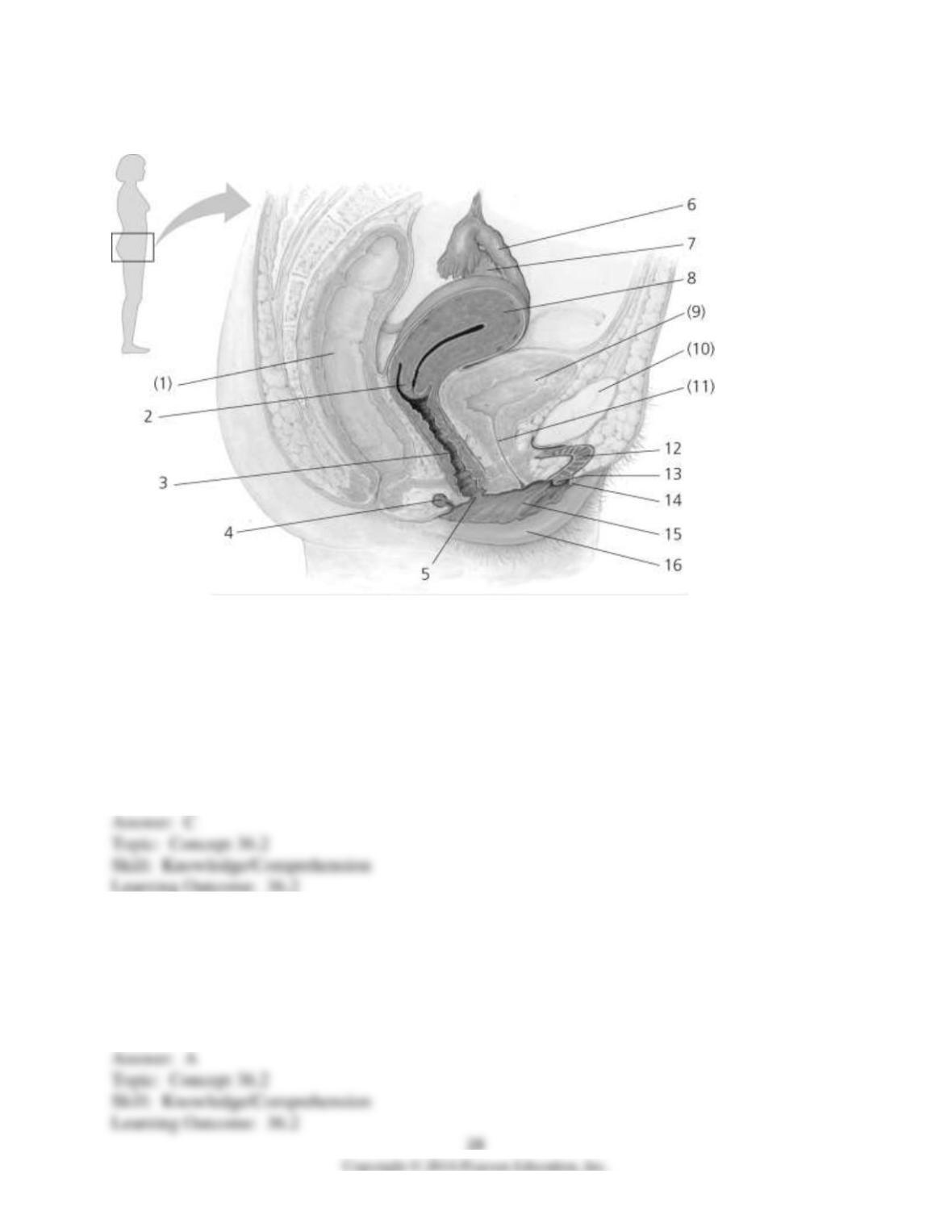
36.2 Art Questions
Figure 36.1
Some nonreproductive structures are labeled in parentheses for orientation purposes.
1) In Figure 36.1, which number corresponds to the oviduct?
A) 2
B) 4
C) 6
D) 12
E) 13
2) In Figure 36.1, which number corresponds to the cervix?
A) 2
B) 4
C) 6
D) 7
E) 15
3) In Figure 36.1, which numbers comprise the clitoris?
A) 5, 10, 15
B) 7, 8, 9
C) 3, 4, 5
D) 9, 10, 11
E) 12, 13, 14
4) In Figure 36.1, which number corresponds to the corpus uterus?
A) 3
B) 5
C) 6
D) 8
E) 11
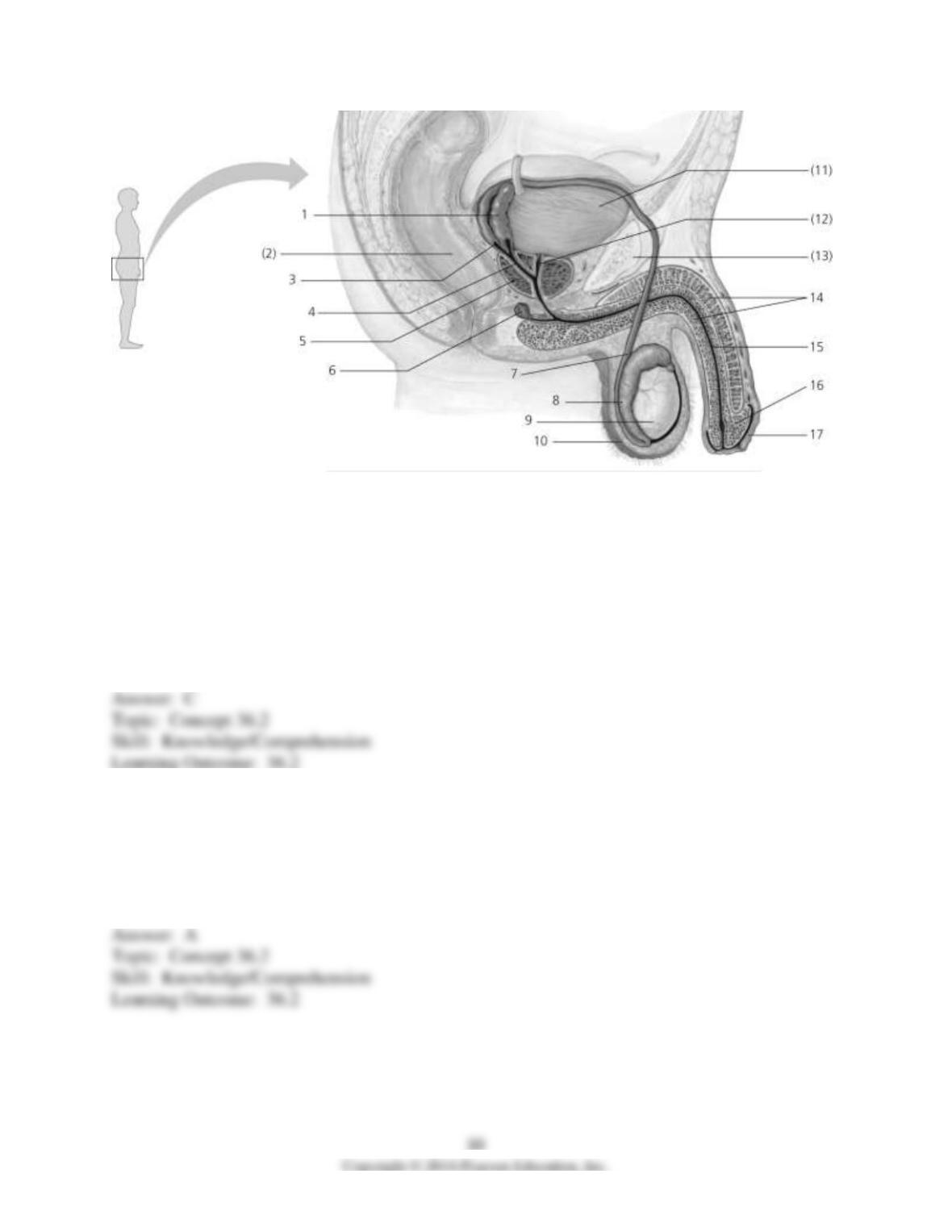
Figure 36.2
Some nonreproductive structures are labeled in parentheses for orientation purposes.
5) In the figure, which number corresponds to the scrotum?
A) 3
B) 6
C) 10
D) 13
E) 16
6) In the figure, which number corresponds to the testis?
A) 9
B) 10
C) 11
D) 12
E) 13
7) In the figure, which number corresponds to the urethra?
A) 2
B) 4
C) 8
D) 14
E) 13
8) In the figure, which number corresponds to the prostate gland?
A) 4
B) 5
C) 6
D) 7
E) 8
9) In the figure, which numbers correspond to the vas deferens?
A) 1, 4
B) 2, 6
C) 8, 13
D) 3, 7
E) 5, 12
10) Sertoli cells are important for nourishing sperm. Where in the figure are they located?
A) 1
B) 4
C) 9
D) 11
11) In spermatogenesis, stem cells that eventually produce sperm are located near the outer edge
of what location?
A) 2
B) 9
C) 12
D) 13
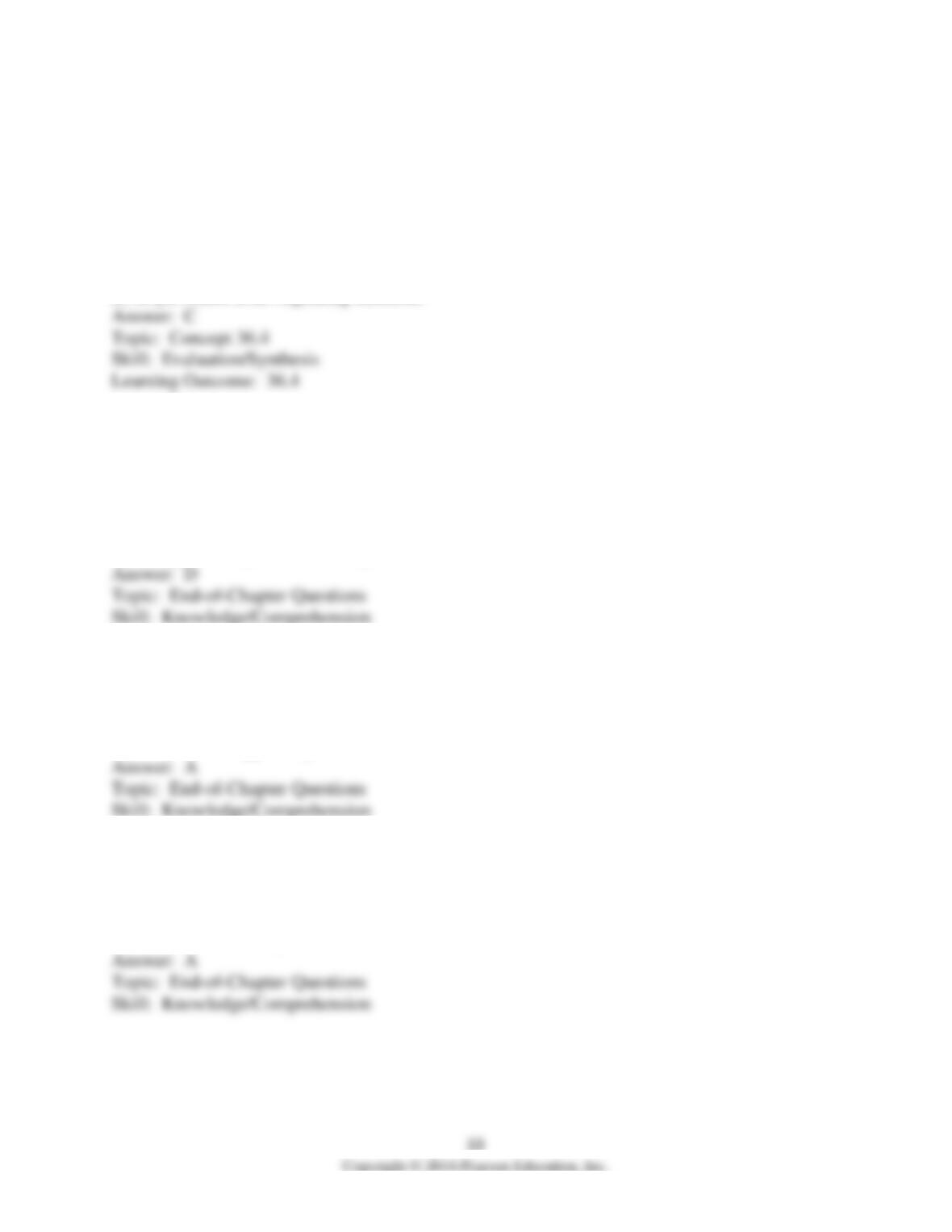
12)
Figure 36.3
According to the figure, what is a likely consequence if one or both negative feedback loops do
not function properly?
A) Androgen levels will not be maintained at optimal levels.
B) Estrogen levels will not be maintained at optimal levels.
C) Oogenesis will not occur as frequently.
D) Mammalian reproduction will cease.
36.3 Scenario Questions
1) Imagine that a woman is in the final week of her pregnancy. Her doctor gives her an injection
of oxytocin. The likely result of this is that the pregnant woman would
A) undergo the loss of oxytocin receptors from her uterine smooth muscle cells.
B) stop secreting prostaglandins from the placenta.
C) undergo vigorous contractions of her uterine muscles.
D) increase the synthesis and secretion of progesterone.
E) be prevented from beginning lactation.
36.4 End-of-Chapter Questions
1) Which of these refers to parthenogenesis?
A) An individual may change its sex.
B) Groups of cells grow into new individuals.
C) An organism is first a male and then a female.
D) An egg develops without being fertilized.
2) The cortical reaction of sea urchin eggs functions directly in
A) the formation of a fertilization envelope.
B) the production of a fast block to polyspermy.
C) the generation of an electrical impulse by the egg.
D) the fusion of egg and sperm nuclei.
3) Which of the following is not properly paired?
A) seminiferous tubule—cervix
B) vas deferens—oviduct
C) testosterone—estradiol
D) scrotum—labia majora
4) Peaks of LH and FSH production occur during
A) the menstrual flow phase of the uterine cycle.
B) the beginning of the follicular phase of the ovarian cycle.
C) the period just before ovulation.
D) the secretory phase of the menstrual cycle.
5) During human gestation, rudiments of all organs develop
A) in the first trimester.
B) in the second trimester.
C) in the third trimester.
D) during the blastocyst stage.
6) Which of the following statements is true?
A) All mammals have menstrual cycles.
B) The endometrial lining is shed in menstrual cycles but reabsorbed in estrous cycles.
C) Estrous cycles are more frequent than menstrual cycles.
D) Ovulation occurs before the endometrium thickens in estrous cycles.
7) For which is the number the same in males and females?
A) interruptions in meiotic divisions
B) functional gametes produced by meiosis
C) meiotic divisions required to produce each gamete
D) different cell types produced by meiosis
8) Which statement about human reproduction is false?
A) Fertilization occurs in the oviduct.
B) Spermatogenesis and oogenesis require different temperatures.
C) An oocyte completes meiosis after a sperm penetrates it.
D) The earliest stages of spermatogenesis occur closest to the lumen of the seminiferous tubules.