49) Air-breathing insects carry out gas exchange
A) in their specialized external gills.
B) in their specialized internal gills.
C) in the alveoli of their lungs.
D) across the finest branches of the trachea and cell membranes.
E) across all parts of their thin exoskeleton.
50) An oil-water mixture works as an insecticidal spray against mosquitoes and other insects
because it
A) coats their lungs.
B) blocks the openings into the tracheal system.
C) interferes with gas exchange across the capillaries.
D) clogs their bronchi.
E) prevents gases from leaving the atmosphere.
51) Atmospheric pressure at sea level is equal to a column of 760 mm Hg. Oxygen makes up
21% of the atmosphere by volume. The partial pressure of oxygen in such conditions is
A) 160 mm Hg.
B) 16 mm Hg.
C) 120/75.
D) 21/760.
E) 760/21.
52) Some human infants, especially those born prematurely, suffer serious respiratory failure
because of
A) the sudden change from the uterine environment to the air.
B) the overproduction of surfactants.
C) the incomplete development of the lung surface.
D) lung collapse due to inadequate production of surfactant.
E) mutations in the genes involved in lung formation.
53) At an atmospheric pressure of 870 mm Hg of 21% oxygen, the partial pressure of oxygen is
A) 100 mm Hg.
B) 127 mm Hg.
C) 151 mm Hg.
D) 182 mm Hg.
E) 219 mm Hg.
54) At sea level, atmospheric pressure is 760 mm Hg. Nitrogen gas is approximately 78% of the
total gases in the atmosphere, so the approximate partial pressure of nitrogen is
A) 5.9 mm Hg.
B) 59.2 mm Hg.
C) 76 mm Hg.
D) 160 mm Hg.
E) 592.8 mm Hg.
55) At the summit of a high mountain, the atmospheric pressure is 380 mm Hg. If the
atmosphere is still composed of 21% oxygen, then the partial pressure of oxygen at this altitude
is
A) 0 mm Hg.
B) 80 mm Hg.
C) 160 mm Hg.
D) 380 mm Hg.
E) 760 mm Hg.
56) Of the following choices, impairment of a mammal’s breathing cycle is most likely following
neural damage in
A) the cerebrum and cerebellum.
B) the medulla oblongata and the pons.
C) the adrenal medulla and the adrenal cortex.
D) the thalamus and the hypothalamus.
E) the frontal lobe and the temporal lobe.
57) Air rushes into the lungs of humans during inhalation because
A) the rib muscles and diaphragm contract, increasing the lung volume.
B) the volume of the alveoli increases as smooth muscles contract.
C) gas flows from a region of lower pressure to a region of higher pressure.
D) pulmonary muscles contract and pull on the outer surface of the lungs.
E) a positive respiratory pressure is created when the diaphragm relaxes.
58) The exhalation of air from human lungs is driven by
A) a decrease in the volume of the thoracic cavity.
B) a decrease in the residual volume of the lungs.
C) the contraction of the diaphragm.
D) the closure of the mouth.
E) the expansion of the rib cage.
59) During most daily activities, the human respiration rate is most closely linked to the blood
levels of
A) nitrogen.
B) oxygen.
C) carbon dioxide.
D) sodium.
60) Breathing is usually regulated by
A) erythropoietin levels in the blood.
B) the concentration of red blood cells.
C) hemoglobin levels in the blood.
D) CO2 and O2 concentration and pH-level sensors.
E) the lungs and the larynx.
61) Blood pH and cerebrospinal fluid pH are affected by carbon dioxide content. This enables
the organism to sense a disturbance in gas levels as
A) the brain directly measures and monitors carbon dioxide and causes breathing changes
accordingly.
B) the medulla oblongata, which is in contact with cerebrospinal fluid, monitors pH and uses this
measure to control breathing.
C) the brain alters the pH of the cerebrospinal fluid to force the animal to retain more or less
carbon dioxide.
D) the lungs sense changes in oxygen concentration, which causes the medulla oblongata to
speed up or slow breathing.
E) the medulla oblongata is able to control the concentration of bicarbonate ions in the blood.
62) To become bound to hemoglobin for transport in a mammal, atmospheric molecules of
oxygen must cross
A) zero membranes–oxygen binds directly to hemoglobin, a protein dissolved in the plasma of
the blood.
B) one membrane–that of the lining in the lungs–and then bind directly to hemoglobin, a protein
dissolved in the plasma of the blood.
C) two membranes–in and out of the cell lining the lung–and then bind directly to hemoglobin, a
protein dissolved in the plasma of the blood.
D) four membranes–in and out of the cell lining the lung and in and out of the endothelial cell
lining an alveolar capillary–and then bind directly to hemoglobin, a protein dissolved in the
plasma of the blood.
E) five membranes–in and out of the cell lining the lung, in and out of the endothelial cell lining
an alveolar capillary, and into the red blood cell–to bind with hemoglobin.
63) An increase from pH 7.1 to pH 7.5 around hemoglobin causes
A) hemoglobin to release all bound oxygen molecules.
B) an increase in the affinity of hemoglobin to bind oxygen molecules.
C) hemoglobin to denature.
D) an increase in the binding of H+ by hemoglobin.
E) hemoglobin to more readily give up its oxygen molecules.
64) An “internal reservoir” of oxygen in rested muscle is found in oxygen molecules bound to
A) hemoglobin.
B) bicarbonate ions.
C) carbonic acid.
D) actin and myosin.
E) myoglobin.
65) Hemoglobin and hemocyanin
A) are both found within blood cells.
B) are both red in color.
C) are both freely dissolved in the plasma.
D) both transport oxygen.
E) are both found in mammals.
66) The Bohr shift on the oxygen-hemoglobin dissociation curve is produced by changes in
A) the partial pressure of oxygen.
B) the partial pressure of carbon dioxide.
C) hemoglobin concentration.
D) temperature.
E) pH.
67) Most of the carbon dioxide produced by humans is
A) converted to bicarbonate ions by an enzyme in red blood cells.
B) bound to hemoglobin.
C) transported in the erythrocytes as carbonic acid.
D) simply dissolved in the plasma.
68) Hydrogen ions produced within human red blood cells are prevented from significantly
lowering plasma pH because they bind to
A) hemoglobin.
B) plasma proteins.
C) carbon dioxide.
D) carbonic acid.
69) The hemocyanin of arthropods and molluscs differs from the hemoglobin of mammals in that
A) the oxygen dissociation curve for hemocyanin is linear.
B) hemocyanin carries more carbon dioxide.
C) hemocyanin has protein coupled to copper rather than iron.
D) the protein of hemocyanin is not bound to metal.
E) hemocyanin is bound to sodium ions.
70) In an animal species known for endurance running rather than fast sprinting, you would
expect to find
A) a slower rate of oxygen consumption so that its breathing will not have to be accelerated.
B) a decrease in myoglobin concentration in the muscles.
C) a relatively slow heart rate in order to lower oxygen consumption.
D) a lower pressure of oxygen in the alveoli.
E) a much higher rate of oxygen consumption for its size.
71) In which of the following animals would you expect to find high concentrations of
myoglobin?
A) snake
B) frog
C) tiger
D) whale
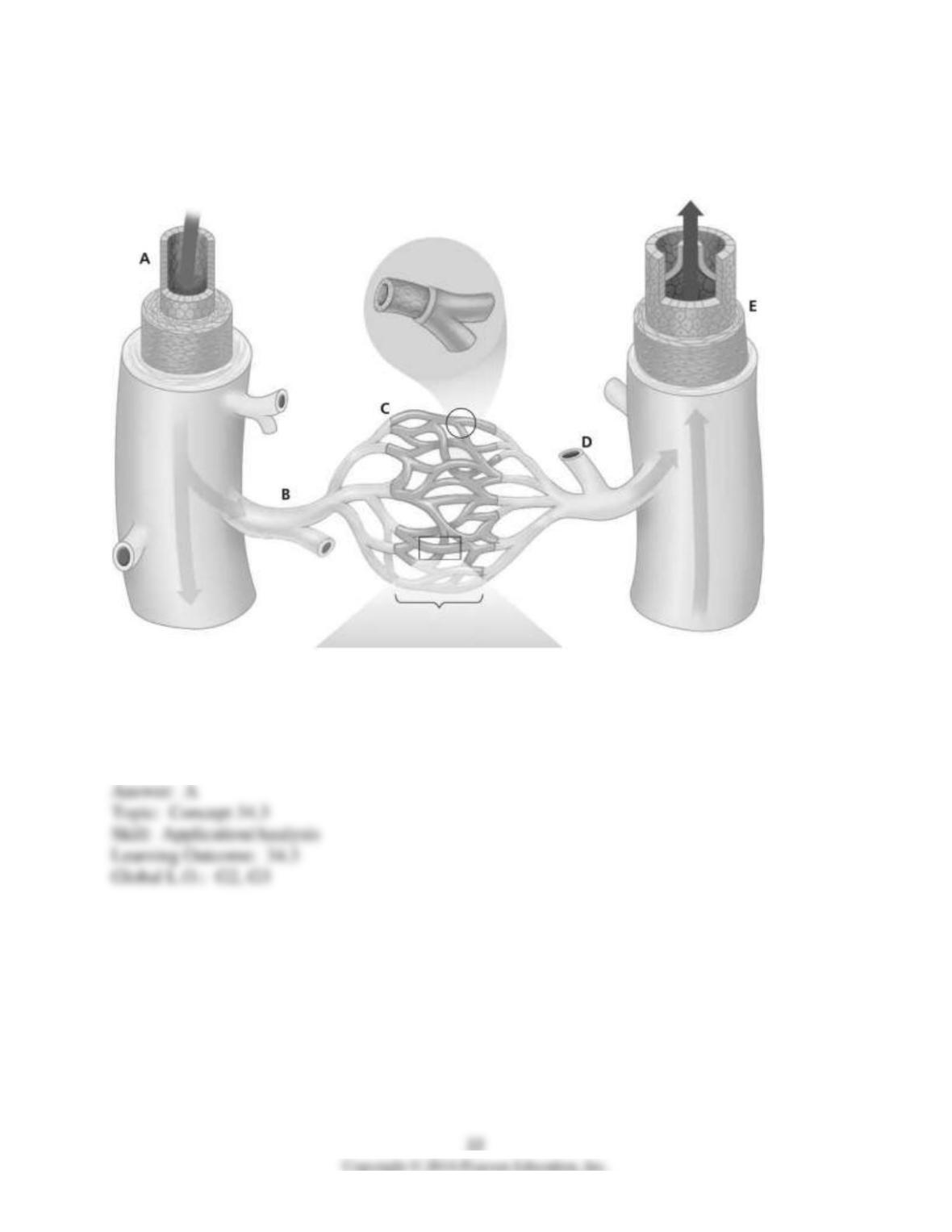
34.2 Art Questions
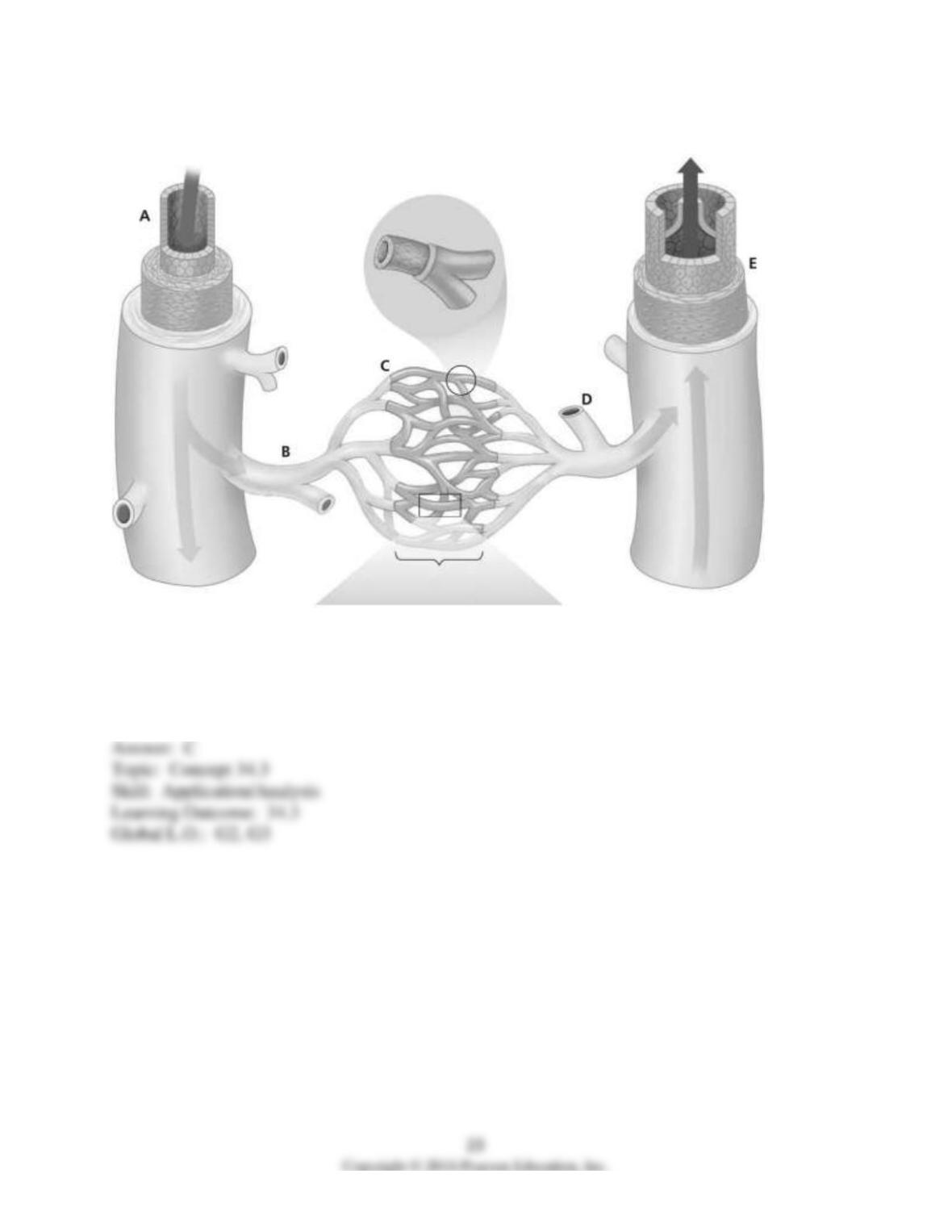
1) At what point in the following figure would blood pressure be highest?
A) A
B) B
C) C
D) D
E) E
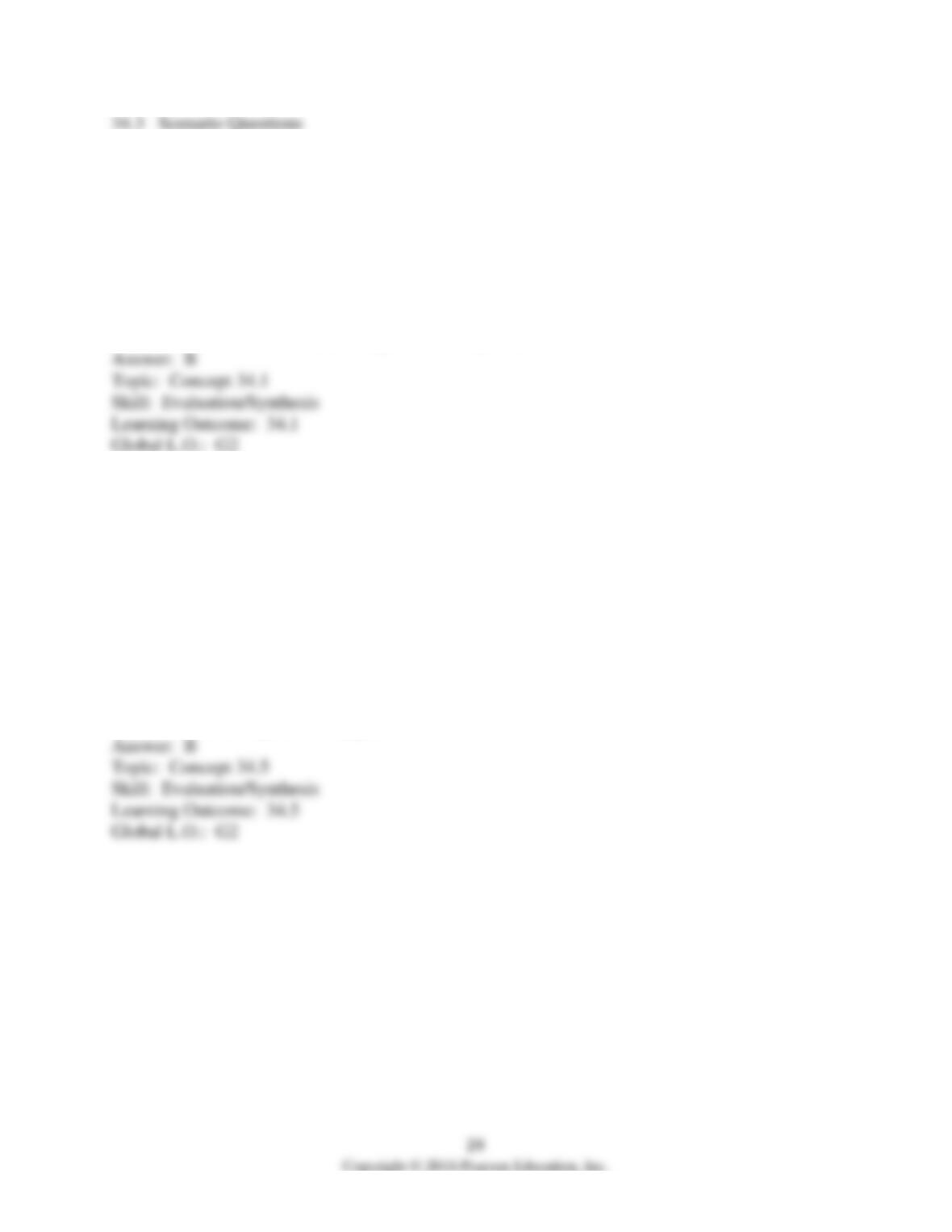
2) At what point in the following figure would blood velocity be lowest?
A) A
B) B
C) C
D) D
E) E
1) An anthropologist discovers the fossilized heart of an extinct animal. The evidence indicates
that the organism’s heart was large, was well formed, and had four chambers, with no connection
between the right and left sides. A reasonable conclusion supported by these observations is that
the
A) animal had evolved from birds.
B) animal was endothermic and had a high metabolic rate.
C) animal was most closely related to alligators and crocodiles.
D) animal was likely an invertebrate animal.
E) species had little to no need to regulate blood pressure.
2) A group of students was designing an experiment to test the effect of smoking on grass frogs.
They hypothesized that keeping the frogs in a smoke-filled environment for defined periods of
time would result in the animals developing lung cancer. However, when they searched for
previously published information to support their hypothesis, they discovered they were wrong
in their original assessment. Even though they were never going to go ahead with their
experiment (so as not to harm frogs needlessly), they knew that a more likely outcome of putting
carcinogens in the air would be the development of
A) the amphibian equivalent of hypertension.
B) skin cancer.
C) gill abnormalities in the next generation of tadpoles.
D) tracheal tube abnormalities.
E) diminished absorption of oxygen.
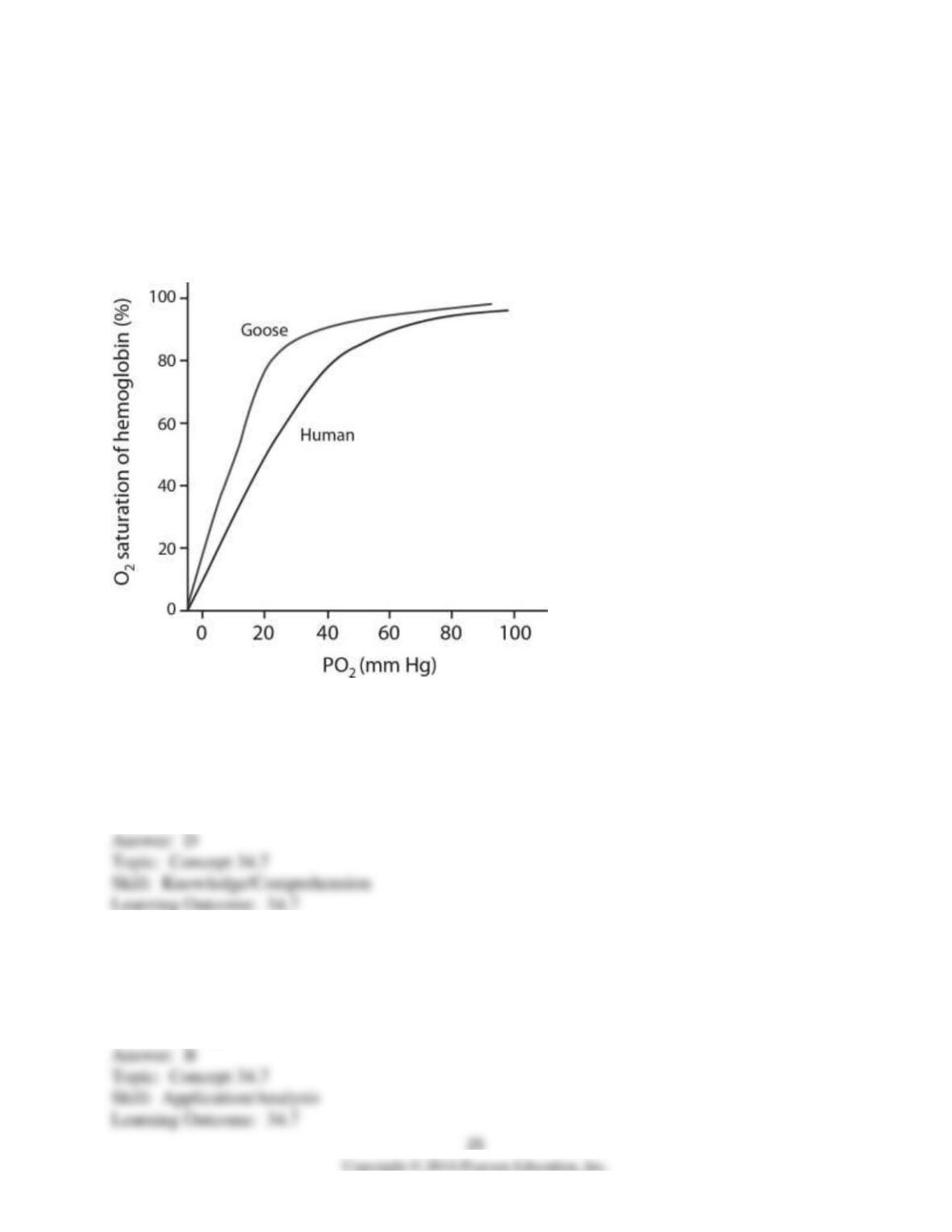
Please use the following information to answer the question(s) below.
In the Himalayas, Mount Everest, Earth’s highest mountain, reaches over 8,800 meters at its
peak. At this altitude the atmospheric pressure is only 254 mm Hg. Although humans cannot
survive at this altitude, the bar-headed goose can fly there without any problems. Bar-headed
goose hemoglobin can bind the same number of oxygen molecules as human hemoglobin, but
their affinities for binding oxygen are different (see graph below).
3) What is the maximum number of molecules of oxygen that bar-headed goose hemoglobin can
bind to?
A) 1
B) 2
C) 3
D) 4
4) What is the approximate partial pressure of oxygen on top of Mount Everest?
A) 26 mm Hg
B) 53 mm Hg
C) 159 mm Hg
D) 254 mm Hg
5) What is the approximate oxygen saturation percentage of bar-headed goose hemoglobin on
top of Mount Everest?
A) 70%
B) 80%
C) 90%
D) 100%
6) In order to fly over Mount Everest, bar-headed geese must fly higher and increase their
altitude. What will happen in bar-headed geese as they increase their altitude?
A) More oxygen molecules will bind to hemoglobin.
B) Fewer oxygen molecules will bind to hemoglobin.
C) Carbon dioxide molecules will bind to hemoglobin instead of oxygen.
D) The number of oxygen molecules bound to hemoglobin will not change.
7) What statement about the data in the graph is true?
A) Bar-headed geese hemoglobin can bind more oxygen at higher altitudes than human
hemoglobin.
B) Bar-headed geese hemoglobin can bind more oxygen at lower altitudes than human
hemoglobin.
C) Bar-headed geese hemoglobin can bind more oxygen at higher temperatures than human
hemoglobin.
D) Bar-headed geese hemoglobin can bind more oxygen at lower temperatures than human
hemoglobin.
8) Which of the following best explains how the bar-headed goose can survive at an altitude of
8,800 meters?
A) The bar-headed goose has a higher metabolic rate.
B) The bar-headed goose has a mutation in the hemoglobin gene.
C) The bar-headed goose has a decreased tidal volume.
D) The bar-headed goose has an open circulatory system.
34.4 End-of-Chapter Questions
1) Which of the following respiratory systems is not closely associated with a blood supply?
A) the lungs of a vertebrate
B) the gills of a fish
C) the tracheal system of an insect
D) the skin of an earthworm
2) Blood returning to the mammalian heart in a pulmonary vein drains first into the
A) left atrium.
B) right atrium.
C) left ventricle.
D) right ventricle.
3) Pulse is a direct measure of
A) blood pressure.
B) stroke volume.
C) cardiac output.
D) heart rate.
4) When you hold your breath, which of the following blood gas changes first leads to the urge
to breathe?
A) rising O2
B) falling O2
C) rising CO2
D) falling CO2
5) One feature that amphibians and humans have in common is
A) the number of heart chambers.
B) a complete separation of circuits for circulation.
C) the number of circuits for circulation.
D) a low blood pressure in the systemic circuit.
6) If a molecule of CO2 released into the blood in your left toe is exhaled from your nose, it must
pass through all of the following except
A) the pulmonary vein.
B) the trachea.
C) the right atrium.
D) the right ventricle.
7) Compared with the interstitial fluid that bathes active muscle cells, blood reaching these cells
in arteries has a
A) higher PO2.
B) higher PCO2.
C) greater bicarbonate concentration.
D) lower pH.