Chapter 33 The Structure of Informational Macromolecules:
DNA and RNA
Matching Questions
Use the following to answer questions 1–10:
Choose the correct answer from the list below. Not all of the answers will be used.
a) supercoiling
b) DNA
c) 5 → 3
d) circular
e) stem loop
f) B-DNA
g) retroviruses
h) exon
i) Erwin Chargaff
j) histones
k) RNA
l) Rosalind Franklin
m) A-DNA
n) 3 → 5
1.
The stable genetic information passed on from one generation to the next is _______________.
Ans:
b
Section: Introduction
2.
_______________ A transient copy of genetic information.
Ans:
k
Section: Introduction
3.
The scientist who provided data for Watson and Crick’s model of DNA is _______________.
Ans:
l
Section: 33.2
4.
The ____________ form is more accessible for interactions with proteins.
Ans:
f
5.
The axis of a double helix can be twisted by a mechanism called _______________.
Ans:
Section: 33.3
6.
DNA can exist in both linear and _______________ forms.
Ans:
d
Section: 33.3
Chapter 33 The Structure of Informational Macromolecules: DNA and RNA
2
7.
_______________ Form of DNA that exists under dehydrating conditions.
8.
The base sequence, as written by convention, is in the _______________ direction.
Ans:
Section: 33.1
9.
_______________ is the simple motif of RNA structure.
Ans:
Section: 33.5
10.
H2A, H2B, H3, and H4 are all major classes of _______________.
Ans:
Section: 33.4
Fill–in-the-Blank Questions
11.
A nitrogen containing an aromatic base attached to a ribose is a _____.
Ans: nucleoside Section: 33.1
12.
5 dAMP refers to _____.
Ans: deoxyadenosine 5 monophosphate Section: 33.1
13.
The distribution of parental atoms in newly synthesized DNA is called _____ replication.
Ans: semiconservative Section: 33.2
14.
There are approximately _____ bases per turn of a B-DNA double helix.
Ans: 10 Section: 33.2
15.
The _____ effect stabilizes the structure of DNA, resulting in more polar surfaces being exposed
to the aqueous media.
Ans: hydrophobic Section: 33.2
16.
The nature of replication was determined using DNA labeled with nitrogen isotopes and _____.
Ans: density-gradient centrifugation Section: 33.2
17.
The nucleoside that is composed of a D-ribose linked to a cytosine base is called _____.
Ans: cytidine Section: 33.1
18.
_____ is a left–handed double helix.
Ans: Z-DNA Section: 33.3
19.
Unwinding of naturally occurring plasmid, circular DNA results in _____.
Ans: supercoiling Section: 33.3
20.
Proteins that bind to DNA are rich the amino acids _____and _____.
Ans: arginine; lysine Section: 33.4
Ans:
m
Section: 33.3
Chapter 33 The Structure of Informational Macromolecules: DNA and RNA
3
Multiple-Choice Questions
21.
The difference in RNA bases compared to DNA bases is
A)
RNA contains A instead of T.
B)
RNA contains U instead of G.
C)
RNA contains U instead of T.
D)
RNA contains A instead of U.
E)
None of the above.
22.
How does a nucleotide differ from a nucleoside?
A)
Nucleosides are found in DNA, whereas nucleotides are found in RNA.
B)
Purines are only found in nucleotides.
C)
Nucleosides contain only deoxyribose sugars.
D)
A nucleotide is a nucleoside with a phosphate ester linked to the sugar.
E)
None of the above.
Ans: D Section: 33.1
23.
Replication takes place in which manner?
A)
conservative
B)
random
C)
semiconservative
D)
N-linked
E)
None of the above.
Ans: C Section: 33.2
24.
How many different sequence possibilities are there for a DNA polymer that is 10 bases long?
A)
262,13232
B)
320
C)
32,000
D)
1,048,576
E)
100,000
Ans: D Section: 33.1
25.
The shorthand notation pApCpG denotes that
A)
a phosphate is attached to the 5 of the adenosine nucleotide unit.
B)
a phosphate is attached to the 3 of the guanine nucleotide unit.
C)
the cytosine nucleotide has a free hydroxyl group.
D)
A and C.
E)
All of the above.
Ans: A Section: 33.1
26.
The feature(s) of DNA deduced by Watson and Crick include
A)
two antiparallel polynucleotide chains coiled in a helix around a common axis.
B)
that the pyrimidine and purine bases lie on the inside of the helix.
C)
that the bases are nearly perpendicular to the axis.
D)
All of the above.
E)
None of the above.
Ans: D Section: 33.2
Ans: C Section: 33.1
Chapter 33 The Structure of Informational Macromolecules: DNA and RNA
4
27.
The chemical forces that contribute to the stability of the DNA due to the base stacking present
in the DNA helix are
A)
hydrogen bonds.
B)
van der Waals interactions.
C)
disulfide bonds.
D)
C and B.
E)
None of the above.
28.
What is the approximate error rate in DNA replication?
A)
1 10−8
B)
1 10−6
C)
1 10−15
D)
1 10−10
E)
None of the above.
Ans: A Section: 33.3
29.
The form of DNA that is the narrowest but having the longest pitch per turn of helix is the
A)
A form.
B)
B form.
C)
C form.
D)
Z form.
E)
None of the above.
Ans: D Section: 33.3
30.
The temperature at which half of the DNA helical structure is lost is called the
A)
denaturation temperature.
B)
Tm.
C)
annealing temperature.
D)
dehybridization temperaure.
E)
replication temperature.
Ans: B Section: 33.2
31.
After two generations of replication in the Meselson and Stahl experiment, what was the
composition of the two bands?
A)
One band was all 14N and one ba nd was all 15N.
B)
One band was all 14N and one band was half 14N and half 15N.
C)
One band was all 15N and one band was half 14N and half 15N.
D)
One band was all 14N and one band was one quarter 14N and three quarters 15N.
E)
One band was all 15N and one band was one quarter 14N and three quarters 15N.
Ans: B Section: 33.3
Ans: B Section: 33.2

Chapter 33 The Structure of Informational Macromolecules: DNA and RNA
5
32.
The process of rehybridizing melted DNA is called
A)
denaturation.
B)
Tm.
C)
annealing.
D)
dehybridization.
E)
replication.
33.
Unwinding prior to ligation results in
A)
relaxed DNA.
B)
a wider major groove.
C)
negative supercoiling.
D)
positive supercoiling.
E)
None of the above.
Ans: C Section: 33.3
34.
The anticancer drug cisplatin disrupts
A)
histone binding to DNA.
B)
supercoiling of DNA.
C)
chromatin–DNA binding.
D)
replication and transcription.
E)
None of the above.
Ans: D Section: 33.4
35.
RNA
A)
is oxygenated on the 2 of ribose.
B)
can form non-Watson–Crick base pairings.
C)
uses metals to stabilize folding.
D)
may form triplet base pairings.
E)
All of the above.
Ans: E Section: 33.5
36.
The mole-fraction composition of one of the strands of a double-helical DNA molecule is [T] =
0.22 and [C] = 0.28. What can you say about [A], [G], [T], and [C] of the complementary
strand?
A)
[A] = 0.22, [G] = 0.28, [T] = 0.50 – [C], [C] = 0.50 – [T]
B)
[A] = 0.22, [G] = 0.28, [T] = 0.28, [C] = 0.22
C)
[A] = 0.22, [G] = 0.28, [T] = 0.22, [C] = 0.28
D)
[A] = 0.50 – [G], [G] = 0.50 – [A], [T] = 0.22, [C] = 0.28
E)
Not enough information is given to determine these concentrations.
Ans: A Section: 33.2
Ans: C Section: 33.2
Chapter 33 The Structure of Informational Macromolecules: DNA and RNA
6
37.
You perform melting experiments on double stranded DNA, starting at low salt concentrations
(~0.2 M NaCl) and then increasing the salt concentration to about 0.6 M NaCl. How does salt
concentration affect the melting temperature of the DNA?
A)
Salt at these low concentrations have no effect on Tm.
B)
Increasing salt causes a decrease in Tm due to the stabilizing actions of the salt.
C)
Increasing salt causes an increase in Tm due to the destabilizing actions of the salt.
D)
Increasing salt causes a decrease in Tm due to the destabilizing actions of the salt.
E)
Increasing salt causes an increase in Tm due to the stabilizing actions of the salt.
38.
What makes DNA so much more stable than RNA in the presence of a basic solution?
A)
The negative charge on the phosphate repels the negative charged base.
B)
Histones block access to all but a few nucleotides that act as linkers.
C)
The 2-H in DNA is not reactive, whereas the 2OH of RNA is under basic conditions.
D)
DNA precipitates in basic solutions making it unreactive.
E)
RNA forms elaborate structures that are susceptible to alkaline digestion.
Ans: C Section: 33.5
39.
Which of the following explain why RNA forms unique structures not found in DNA?
A)
RNA can wrap around itself to form supercoiled structures but not DNA.
B)
RNA contains hydrogen-bond donors and acceptors that are not normal participants in
Watson-Crick base pairs.
C)
Histones can direct the folding of RNA into unique structures, as it does with DNA.
D)
The uracil base in RNA allows for additional hydrogen bonding to stabilize unique
structures.
E)
Unique structures in RNA are due to mismatches because there is no proofreading in
RNA synthesis.
Ans: B Section: 33.5
40.
The mole-fraction composition of a strand of a RNA molecule is [U] = 0.19 and [C] = 0.33.
What can you say about the [A] and [G] of this RNA?
A)
[A] = 0.19, [G] = 0.33
B)
[A] = 0.33, [G] = 0.19
C)
[A] + [G} = 0.52
D)
[A] + [G} = 0.48
E)
There is not enough information to determine these concentrations.
Ans: D Section: 33.4
Short-Answer Questions
Ans: E Section: 33.2
Chapter 33 The Structure of Informational Macromolecules: DNA and RNA
7
41.
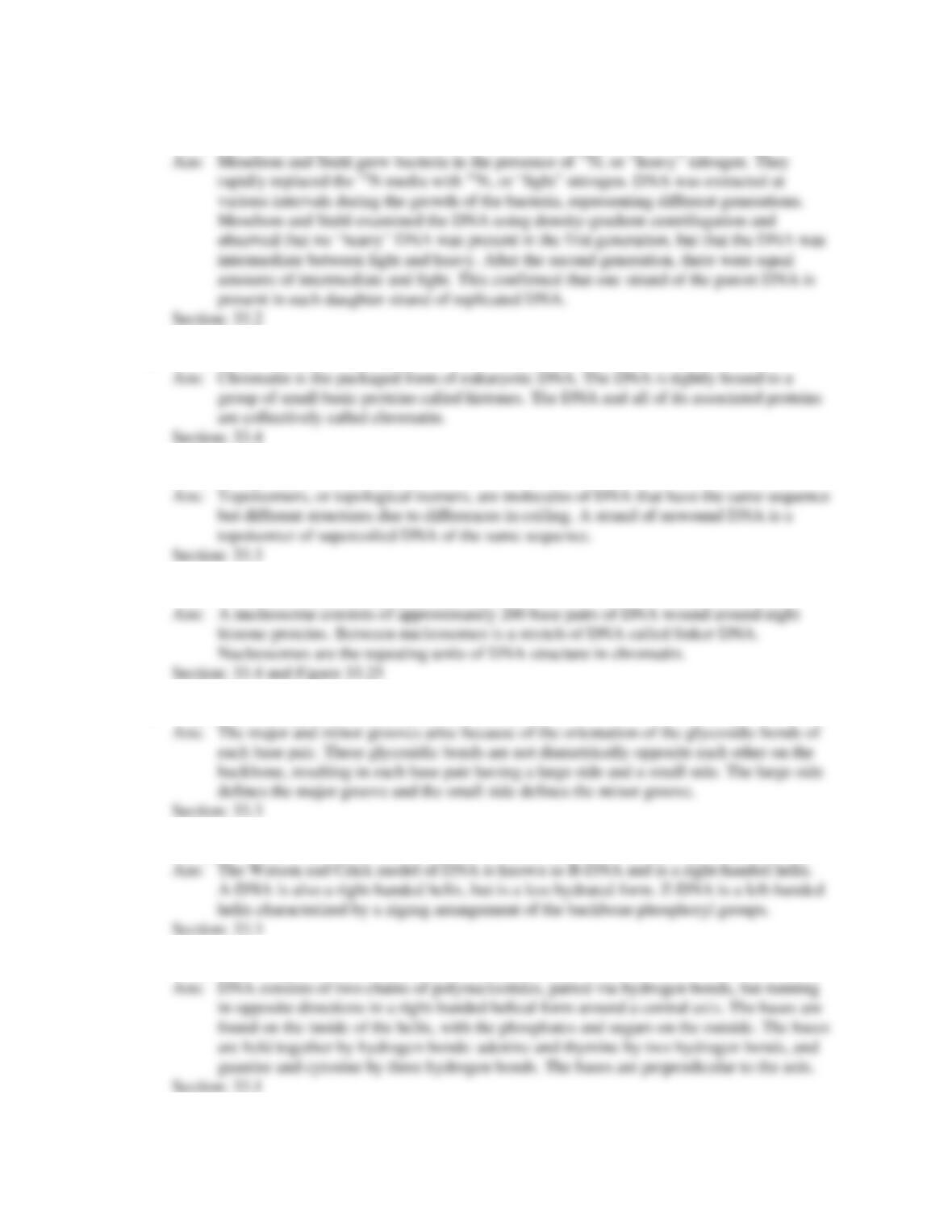
Draw two nucleotides in DNA, showing the linkage between the sugars.
42.
What advantage do phosphodiesters have compared to other esters?
cleavage.
Section: 33.1
43.
Describe the DNA helix proposed by Watson and Crick.
structure repeats every 34 Å.
Section: 33.1
44.
Draw the hydrogen-bonded base pairs of A to T and show why A does not hydrogen bond to C.
Section: 33.1
should be no oxygen at the 2 position of the sugar.
Section: 33.1 and Figure 33.4
Chapter 33 The Structure of Informational Macromolecules: DNA and RNA
8
45.
Briefly describe the Meselson and Stahl experiment that indicated that DNA replication is
semiconservative.
46.
Describe the structure of chromatin.
are collectively called chromatin.
Section: 33.4
47.
What are topoisomers of DNA?
topoisomer of supercoiled DNA of the same sequence.
Section: 33.3
48.
What role does a nucleosome play in DNA structure?
Nucleosomes are the repeating units of DNA structure in chromatin.
Section: 33.4 and Figure 33.25
49.
Why is there a major and a minor groove in DNA?
defines the major groove and the small side defines the minor groove.
Section: 33.3
50.
Compare and contrast the three forms of DNA with respect to handedness and hydration state.
helix characterized by a zigzag arrangement of the backbone phosphoryl groups.
Section: 33.3
51.
Describe, in simple terms, the hallmarks of DNA structure.
guanine and cytosine by three hydrogen bonds. The bases are perpendicular to the axis.
Section: 33.1
present in each daughter strand of replicated DNA.
Section: 33.2