45) If someone is feeling stressed or anxious, hormones present in blood communicate with cells
to begin breaking down stored energy if the body needs it. In this situation, how does stress
affect metabolic rate?
A) It does not affect metabolic rate.
B) It causes metabolic rate to decrease.
C) It causes metabolic rate to increase.
D) It causes metabolic rate to decrease sharply and then slowly increase.
E) It causes metabolic rate to decrease slowly and then remain stable.
46) Omega-3 and omega-6 essential fatty acids are readily available in leafy green plants. What
is one way to ensure that animals raised for commercial purposes have enough of these fatty
acids in their diets such that fatty acid supplementation is not needed?
A) Regularly check the health of the livestock’s teeth to ensure that they can efficiently grind
plants.
B) Allow the livestock adequate environment for natural grazing.
C) Regularly test for the presence of symbiotic bacteria in the gut of the livestock.
D) Reduce the amount of calcium that the livestock intake daily.
E) Increase the amount of phosphorus that the livestock intake daily.
47) The hydra is an example of an organism with a simple body plan that uses the same site for
both digestion and nutrient distribution. What is the name of that site?
A) gastrovascular cavity
B) mouth
C) crop
D) midgut
E) anus
48) A main difference between organisms with simple body plans and those with complex body
plans is that
A) animals with simple body plans have digestive tubes with two openings, whereas organisms
with complex body plans have a digestive compartment with one opening.
B) animals with simple body plans have a digestive compartment with one opening, whereas
organisms with complex body plans have digestive tubes with two openings.
C) animals with simple body plans have digestive tubes with specialized compartments, whereas
animals with complex body plans do not.
D) animals with simple body plans can ingest food while earlier meals are still being digested,
whereas animals with complex body plans cannot.
E) animals with simple body plans eliminate undigested food via an anus, whereas animals with
complex body plans eliminate undigested food via a mouth.
49) In the process of intracellular digestion, what do you predict will happen if food vacuoles are
unable to fuse with lysosomes?
A) Cells will not be able to engulf solid food by pinocytosis.
B) Cells will not be able to engulf liquid food by phagocytosis.
C) The cells will not be able to utilize their hydrolytic enzymes.
D) The food to be digested will not be able to come in contact with hydrolytic enzymes.
50) A person diagnosed with exocrine pancreatic insufficiency (EPI) does not have the digestive
enzymes that are needed to adequately digest fats, proteins, and carbohydrates. What would be a
likely consequence of this medical condition?
A) weight gain
B) weight loss
C) dilated hepatic portal vein
D) increased rate of peristalsis
E) increased bile production
51) People who live in agrarian societies eat more starch and have extra copies of the amylase
gene compared with people who live in societies that depend on hunting or fishing. This is an
example of
A) a dietary deficiency.
B) acquisition of essential amino acids.
C) feedback circuits that regulate appetite and digestion.
D) evolutionary adaptations to differences in diet.
E) absorption in the small intestine.
52) In 2011 it was reported that scientists used GPS (Global Positioning Systems) to create a
“map” of bats’ molar teeth that was similar to a GPS-produced topographic map of a mountain.
Why would scientists want to pursue this project?
A) Differences in the features of the molars might provide information about intracellular
digestion processes in bats.
B) Differences in the features of the molars might provide information about how the relative
size of the bats affected their abilities to acquire food.
C) Differences in the features of the molars might suggest evolutionary adaptations to diet.
D) Differences in the features of the molars might provide information about climate change in
the bats’ area of origin.
E) Differences in the features of the molars might provide information about mating behaviors.
33.2 Art Questions
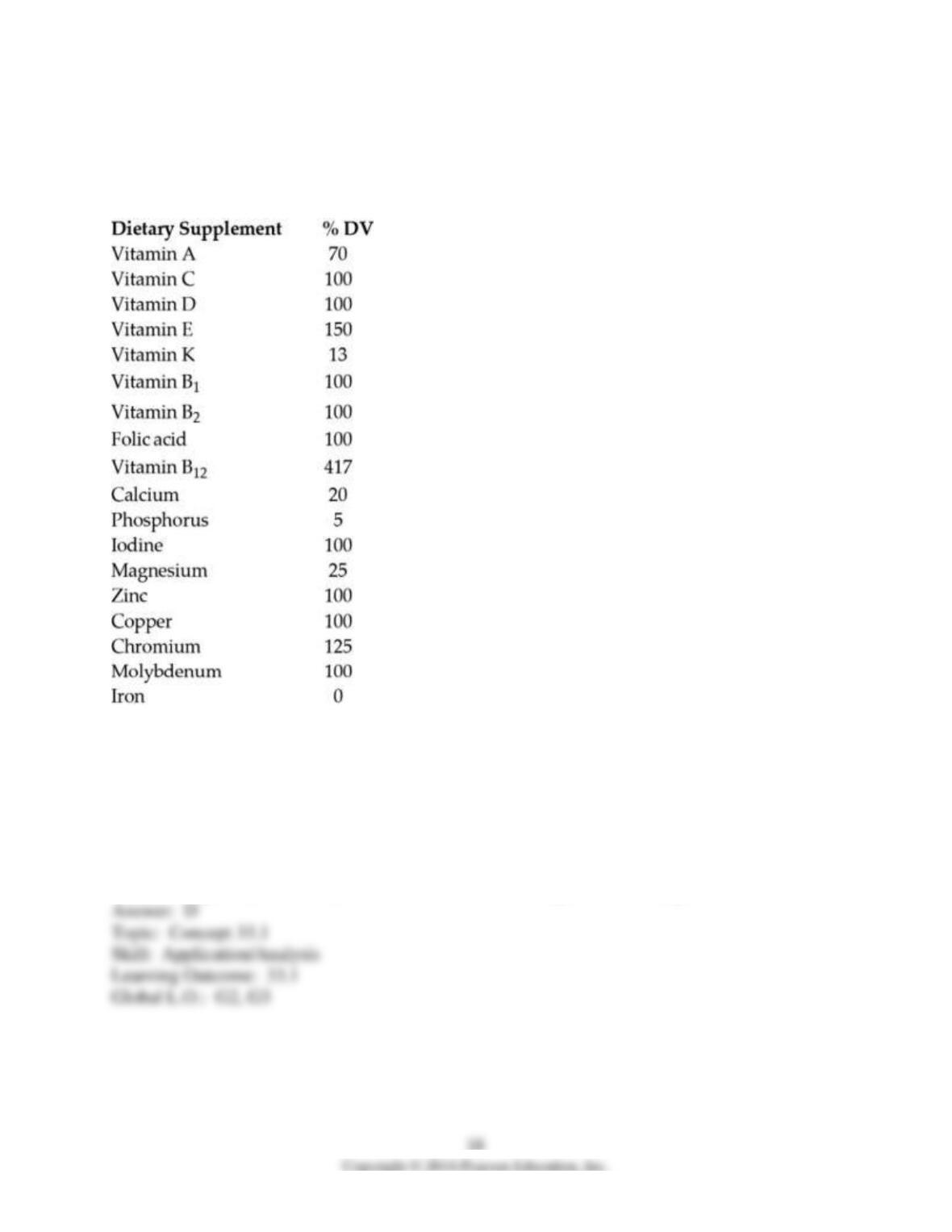
Use the following table showing the contents of a multivitamin supplement and its percentage of
recommended daily values (% DV) to answer the following question(s).
Figure 33.1
1) The most likely reason that some of the vitamins and minerals in this supplement are found at
less than 100% is that
A) it would be chemically impossible to add more.
B) these vitamins and minerals are too large in size to reach 100%.
C) it is too easy to overdose on minerals such as phosphorus and calcium.
D) it is dangerous to overdose on fat-soluble vitamins such as A and K.
E) these supplements are meant for those who have been deprived of healthy foods.
2) A mineral that is especially important for preventing anemia, a disease in which there are not
enough healthy red bloods cells available to bring enough oxygen to body tissues, is
A) zinc.
B) iron.
C) iodine.
D) molybdenum.
E) folic acid.
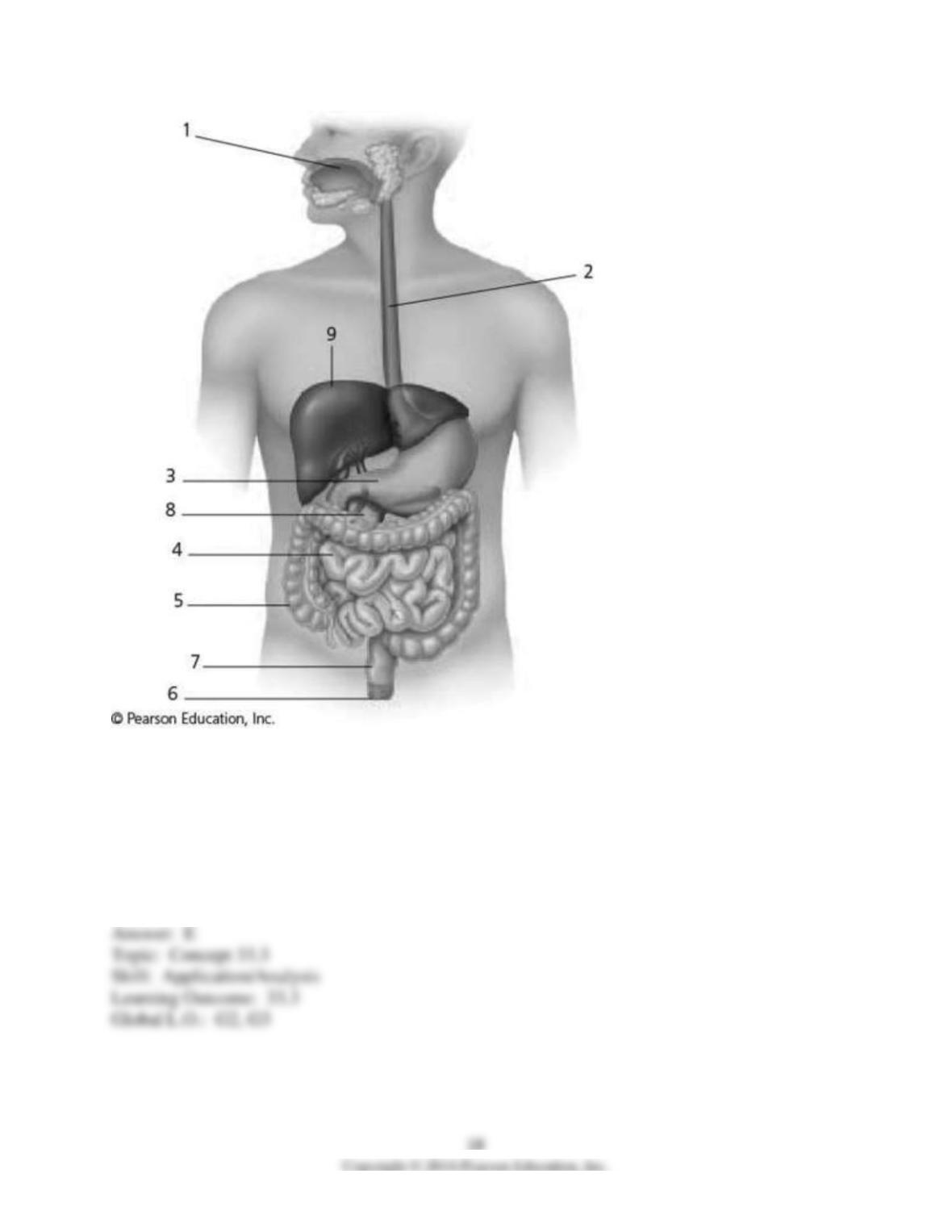
Figure 33.2
3) Examine the digestive system structures in the figure above. The agent(s) that help emulsify
fats are produced in location
A) 1.
B) 2.
C) 3.
D) 8.
E) 9.
4) Examine the digestive system structures in the figure above. The most enzymatic hydrolysis
of macromolecules occurs at location(s)
A) 3 only.
B) 4 only.
C) 1 and 4.
D) 3 and 4.
E) 1, 3, and 4.
5) Examine the digestive system structures in the figure above. Most of the digestion of fats
occurs in location(s)
A) 3 only.
B) 4 only.
C) 1 and 4.
D) 3 and 4.
E) 1, 3, and 4.
33.3 Scenario Questions
Please use the following information to answer the question(s) below.
Mouse mutations can affect an animal’s appetite and eating habits. The ob gene codes for a
satiety factor, the hormone leptin. The db gene product, the leptin receptor, is required to respond
to the satiety factor.
1) Leptin is a product of adipose cells. Therefore, a very obese mouse would be expected to have
A) increased gene expression of ob and decreased expression of db.
B) increased gene expression of db and decreased expression of ob.
C) decreased transcription of both ob and db.
D) mutation of ob or db.
2) Imagine that you are a biologist who is attempting to get an accurate measure of an animal’s
basal metabolic rate. The best time to measure the metabolic rate is when the animal
A) is resting and has not eaten its first meal of the day.
B) is resting and has just completed its first meal of the day.
C) has recently eaten a sugar-free meal.
D) has not consumed any water for at least 48 hours.
E) has just completed 30 minutes of vigorous exercise.
Please use the following information to answer the question(s) below.
Once a person turns 25 years of age, the person’s BMR decreases by approximately 2-6% every
ten years. This is due to the fact that as one ages, muscle mass decreases and fat levels increase.
These changes decrease BMR and therefore the amount of calories one’s body burns at rest.
3) If a person wants to stay the same weight between ten-year periods without changing his
activity level, what action should he take?
A) He needs to raise his daily calorie intake by 2-6% every ten years.
B) He needs to maintain his daily calorie intake.
C) He needs to increase his essential amino acid daily intake and decrease his essential fatty acid
daily intake.
D) He needs to maintain his essential vitamin daily intake and increase his daily caloric intake.
E) He needs to lower his daily calorie intake by the same amount.
4) If a person were to maintain the same level of activity at ages 25 and 35, how would the
weight of the person differ between the two ages?
A) The person will weigh the same at ages 25 and 35.
B) The person will weigh more at age 25 than at age 35.
C) The person will weigh more at age 35 than at age 25.
D) There is not enough information to determine how weight might change between the two
ages.
33.4 End-of-Chapter Questions
1) The mammalian trachea and esophagus both connect to the
A) large intestine.
B) stomach.
C) pharynx.
D) rectum.
2) Which organ is incorrectly paired with its function?
A) stomach–protein digestion
B) large intestine–bile production
C) small intestine–nutrient absorption
D) pancreas–enzyme production
3) Which of the following is not a major activity of the stomach?
A) storage
B) HCl production
C) nutrient absorption
D) enzyme secretion
4) Fat digestion yields fatty acids and glycerol. Protein digestion yields amino acids. Both
digestive processes
A) occur inside cells in most animals.
B) add a water molecule to break bonds.
C) require a low pH resulting from HCl production.
D) consume ATP.
5) After surgical removal of the gallbladder, a person might need to limit their dietary intake of
A) starch.
B) protein.
C) sugar.
D) fat.
6) If you were to jog 1 km a few hours after lunch, which stored fuel would you probably tap?
A) muscle proteins
B) muscle and liver glycogen
C) fat in the liver
D) fat in adipose tissue