68) Ammonia is likely to be the primary nitrogenous waste in living conditions that include
A) lots of fresh water flowing across the gills of a fish.
B) lots of seawater, such as the environment of a marine bird.
C) lots of seawater, such as the environment of a marine mammal (e.g., a polar bear).
D) a terrestrial environment, such as one that supports crickets.
E) a moist system of burrows, such as those of naked mole rats.
69) Among vertebrate animals, urea
A) is made in the kidneys and immediately excreted.
B) is exhaled, along with carbon dioxide, by the lungs.
C) is made in the liver by combining two ammonia molecules with one carbon dioxide.
D) is made in the pancreas and added to the intestinal contents, along with bile salts, for
excretion.
E) is rarely excreted as a waste product.
70) The nitrogenous waste that requires the most energy to produce is
A) ammonia.
B) ammonium.
C) urea.
D) uric acid.
71) Ammonia
A) is soluble in water.
B) can be stored in the body as a precipitate.
C) has low toxicity relative to urea.
D) requires more energy to synthesize than urea.
E) is the major nitrogenous waste excreted by insects.
72) An advantage of excreting nitrogenous wastes as urea rather than as ammonia is that
A) urea can be exchanged for Na+.
B) urea is less toxic than ammonia.
C) urea requires more water for excretion than ammonia.
D) urea does not affect the osmolarity gradient.
E) less nitrogen is removed from the body.
73) The primary nitrogenous waste excreted by birds is
A) ammonia.
B) nitrate.
C) ammonium.
D) urea.
E) uric acid.
74) Which nitrogenous waste requires hardly any water for its excretion?
A) amino acids
B) urea
C) uric acid
D) ammonia
E) nitrogen gas
75) In animals, nitrogenous wastes are produced mostly from the catabolism of
A) starch and cellulose.
B) triglycerides and steroids.
C) proteins and nucleic acids.
D) phospholipids and glycolipids.
E) fatty acids and glycerol.
76) Birds secrete uric acid as their nitrogenous waste because uric acid
A) is readily soluble in water.
B) is metabolically less expensive to synthesize than other excretory products.
C) requires little water for nitrogenous waste disposal, thus reducing body mass.
D) excretion allows birds to live in desert environments.
77) Of the following choices, the most concentrated urine is excreted by
A) frogs.
B) kangaroo rats.
C) humans.
D) desert tortoises.
E) birds.
78) Materials are returned to the blood from the filtrate by which of the following processes?
A) filtration
B) reabsorption
C) secretion
D) excretion
79) Excretory structures known as protonephridia are present in
A) flatworms.
B) earthworms.
C) insects.
D) vertebrates.
E) cnidarians.
80) Excretory organs known as Malpighian tubules are present in
A) earthworms.
B) flatworms.
C) insects.
D) jellyfish.
E) sea stars.
81) The osmoregulatory/excretory system of a freshwater flatworm is based on the operation of
A) protonephridia.
B) gills.
C) Malpighian tubules.
D) nephrons.
E) kidneys.
82) The osmoregulatory process called secretion refers to the
A) formation of filtrate at an excretory structure.
B) reabsorption of nutrients from a filtrate.
C) selective elimination of excess ions and toxins from body fluids.
D) formation of an osmotic gradient along an excretory structure.
E) excretion of urine from the body.
83) Which of the following pairs of organisms excrete nitrogenous wastes in the form of uric
acid?
A) mice and birds
B) insects and birds
C) lions and horses
D) humans and frogs
E) fish and turtles
84) Choose a pair that correctly associates the mechanism for osmoregulation or nitrogen
removal with the appropriate animal.
A) protonephridium—earthworm
B) Malpighian tubule—frog
C) kidney—insect
D) flame bulb—snake
E) exchange across the body surface—marine invertebrate
85) An excretory system that is partly based on the filtration of fluid under high hydrostatic
pressure is the
A) flame bulb system of flatworms.
B) protonephridia of flatworms.
C) Malpighian tubules of insects.
D) kidneys of vertebrates.
86) Freshwater flatworms form urine that is typically
A) of high solute concentration in order to conserve body fluids.
B) of low volume in order to conserve body fluids.
C) of high solute concentration and low volume in order to conserve body fluids.
D) of high solute concentration and high volume, similar to their normal fluid uptake.
E) of low solute concentration and high volume, similar to their normal fluid uptake.
87) The transfer of fluid from the glomerulus to Bowman’s capsule
A) results from active transport.
B) transfers large molecules as easily as small ones.
C) is very selective as to which subprotein-sized molecules are transferred.
D) is mainly a consequence of blood pressure in the capillaries of the glomerulus.
E) usually includes the transfer of red blood cells into Bowman’s capsule.
88) Within a normally functioning kidney, blood can be found in
A) the vasa recta.
B) Bowman’s capsule.
C) the loop of Henle.
D) the proximal tubule.
E) the collecting duct.
89) The filtrate in the renal pelvis enters directly from
A) the loop of Henle.
B) the collecting duct.
C) Bowman’s capsule.
D) the proximal tubule.
E) the glomerulus.
90) Juxtamedullary nephrons can concentrate salt effectively in the renal medulla because of
their long
A) loops of Henle.
B) distal convoluted tubules.
C) Bowman’s capsules.
D) proximal convoluted tubules.
E) glomeruli.
91) The filtrate in the proximal convoluted tubule of the human does not normally include
A) ions.
B) glucose.
C) plasma proteins.
D) amino acids.
E) dissolved gasses.
92) The osmolarity of human urine
A) can be four times as great as the normal osmolarity of human plasma.
B) is always equal to the plasma osmolarity.
C) is always less than the plasma osmolarity.
D) is always greater than the plasma osmolarity.
E) is determined primarily by the concentration of glucose.
93) A primary reason that the kidneys have one of the highest metabolic rates of all body organs
is that
A) they store the body’s excess fats.
B) they have membranes of varying permeability to water.
C) they operate an extensive set of active-transport ion pumps.
D) they are the body’s only means of shedding excess nutrients.
E) they have an abundance of smooth muscle.
94) Low selectivity of solute movement is a characteristic of
A) salt pumping to control osmolarity.
B) H+ pumping to control pH.
C) reabsorption mechanisms along the proximal tubule.
D) filtration from the glomerular capillaries.
E) secretion along the distal tubule.
95) If ATP production in a human kidney was suddenly halted, urine production would
A) come to a complete halt.
B) decrease, and the urine would be hypoosmotic compared to plasma.
C) increase, and the urine would be isoosmotic compared to plasma.
D) increase, and the urine would be hyperosmotic compared to plasma.
E) decrease, and the urine would be isoosmotic compared to plasma.
96) Compared to wetland mammals, water conservation in mammals of arid regions is enhanced
by them having more
A) juxtamedullary nephrons.
B) Bowman’s capsules.
C) kidneys.
D) critical nephrons.
E) urinary bladders.
97) Processing of filtrate in the proximal and distal tubules
A) achieves the sorting of plasma proteins according to size.
B) achieves the conversion of toxic ammonia to less toxic urea.
C) maintains homeostasis of pH in body fluids.
D) regulates the speed of blood flow through the nephrons.
E) reabsorbs urea to maintain osmotic balance.
98) In humans, the transport epithelial cells in the ascending loop of Henle
A) are the largest epithelial cells in the body.
B) are not in contact with interstitial fluid.
C) have plasma membranes of low permeability to water.
D) have 50% of their cell mass made of smooth endoplasmic reticulum.
E) are not affected by high levels of nitrogenous wastes.
99) The typical osmolarity of human blood is
A) 30 mosm/L.
B) 100 mosm/L.
C) 200 mosm/L.
D) 300 mosm/L.
E) 500 mosm/L.
100) When stimulated by antidiuretic hormone (ADH), the reabsorption of water is increased
along
A) the loop of Henle.
B) the glomerulus.
C) the collecting duct.
D) the proximal tubule.
E) the distal tubule.
101) Increased ADH secretion likely occurs after
A) drinking lots of pure water.
B) sweating-induced dehydration increases plasma osmolarity.
C) ingestion of ethanol (drinking alcoholic drinks).
D) eating a small sugary snack.
E) blood pressure becomes abnormally high.
102) After drinking alcoholic beverages, increased urine excretion is the result of
A) increased activation of the renin-angiotensin-aldosterone system (RAAS).
B) increased blood pressure.
C) inhibited secretion of ADH.
D) increased reabsorption of water in the proximal tubule.
E) increased activity of the brain’s osmoregulator cells
103) Osmoregulatory adjustment via the renin-angiotensin-aldosterone system (RAAS) can be
triggered by
A) sleeping for one hour.
B) severe sweating on a hot day.
C) eating a bag of potato chips.
D) eating a pizza with olives and pepperoni.
E) drinking several glasses of water.
104) Antidiuretic hormone (ADH) functions at the cellular level by
A) stimulating the reabsorption of glucose through channel proteins.
B) triggering the synthesis of an enzyme that makes the phospholipid bilayer more permeable to
water.
C) causing membranes to include more phospholipids that have unsaturated fatty acids.
D) causing an increase in the number of aquaporin molecules of collecting duct cells.
E) decreasing the speed at which filtrate flows through the nephron, leading to increased
reabsorption of water.
105) ADH and RAAS work together in maintaining osmoregulatory homeostasis through which
of the following ways?
A) ADH regulates the osmolarity of the blood, and RAAS regulates the volume of the blood.
B) ADH regulates the osmolarity of the blood by altering renal reabsorption of water, and RAAS
maintains the osmolarity of the blood by stimulating Na+ and water reabsorption.
C) ADH and RAAS work antagonistically: ADH stimulates water reabsorption during
dehydration, and RAAS causes increased excretion of water when it is in excess in body fluids.
D) Both stimulate the adrenal gland to secrete aldosterone, leading to an increase in both blood
volume and pressure via receptors in the urinary bladder.
E) They combine at the receptor sites of proximal tubule cells where reabsorption of essential
nutrients takes place.
106) If a person loses a large amount of water in a short period of time, she may die from
dehydration. ADH can help reduce water loss through its interaction with its target cells in the
A) anterior pituitary gland.
B) posterior pituitary gland.
C) adrenal gland.
D) bladder.
E) kidney.
107) A football player has been rushed to the emergency room after passing out during practice
on a hot day. The player is sweating extensively, but appears to have normal blood pressure. As
the attending physician, you need to give the player a drug to counteract his symptoms. Which of
the following drugs would be best to give the player?
A) a drug that acts like ADH
B) a drug that acts like oxytocin
C) a drug that acts like insulin
D) a drug that acts like melatonin
E) a drug that acts like angiotensin II
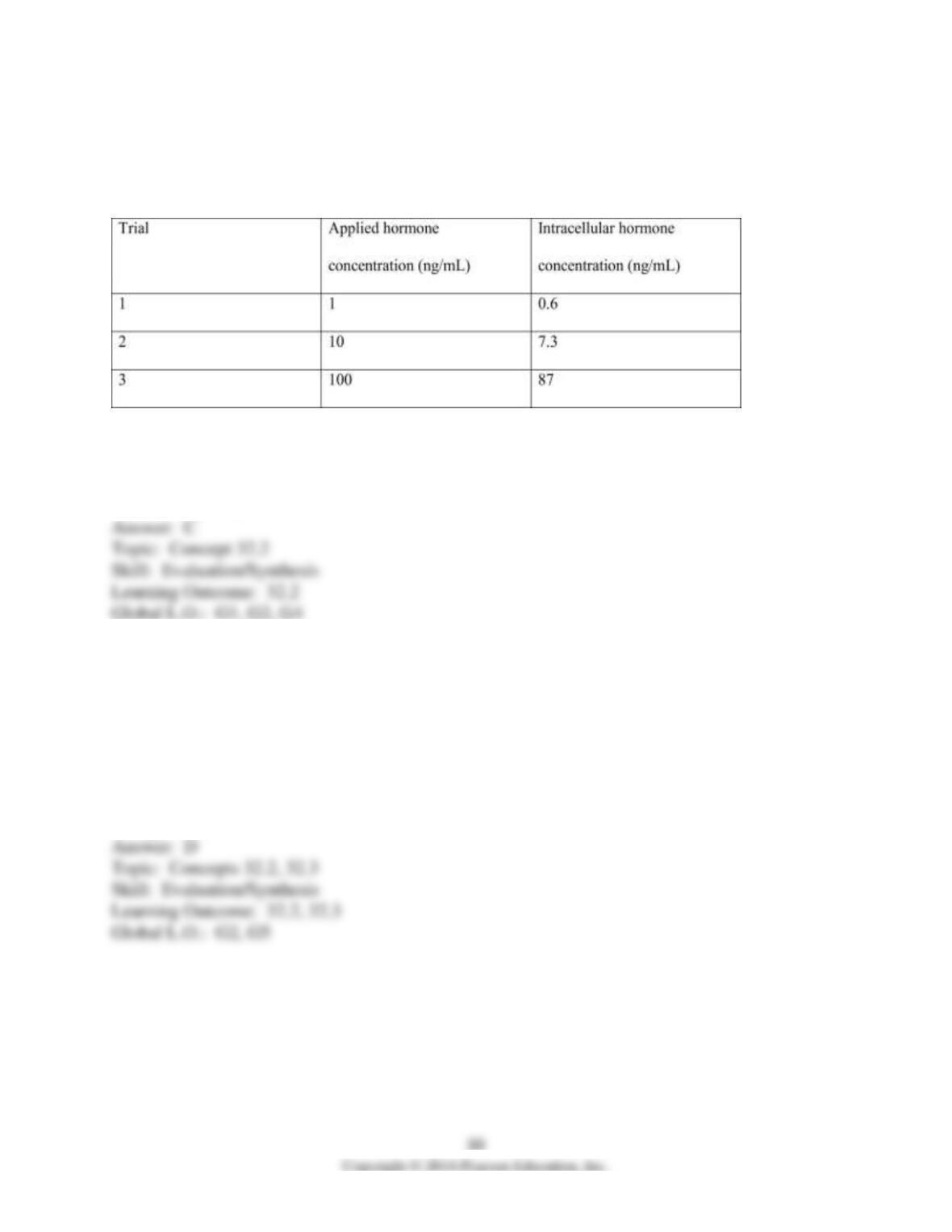
108) A researcher is conducting an experiment to identify an unknown hormone. The experiment
consists of exposing cells to the hormone and determining where the hormone is after a period of
time. The researcher collects the data in the table below. What could be the identity of the
unknown hormone?
A) oxytocin
B) ADH
C) testosterone
D) It could be any of the three.
109) An inoperable tumor has been discovered in a patient’s brain. While the tumor is small now,
it potentially may become malignant and grow. As the patient’s doctor, you tell her to keep a
diary of how she is feeling and to call you if she notices any trends. One day she calls you to tell
you that after taking hot showers, it takes hours for her to cool off. What region of the brain may
be affected by the tumor?
A) pineal gland
B) anterior pituitary gland
C) posterior pituitary gland
D) hypothalamus
110) You are observing an unknown animal species in the Amazon rain forest and want to know
whether it is an ectotherm or an endotherm. Which of the following methods would be the least
helpful in making this determination?
A) Measure the animal’s body temperature and compare it to ambient temperature at various
times throughout the day and night.
B) Determine the animal’s method of urine production and compare it to ambient temperature at
various times throughout the day and night.
C) Measure the animal’s rate of oxygen consumption and compare it to ambient temperature at
various times throughout the day and night.
D) Observe the animal’s behavior and activity level and compare it to ambient temperature at
various times throughout the day and night.
32.2 Art Questions
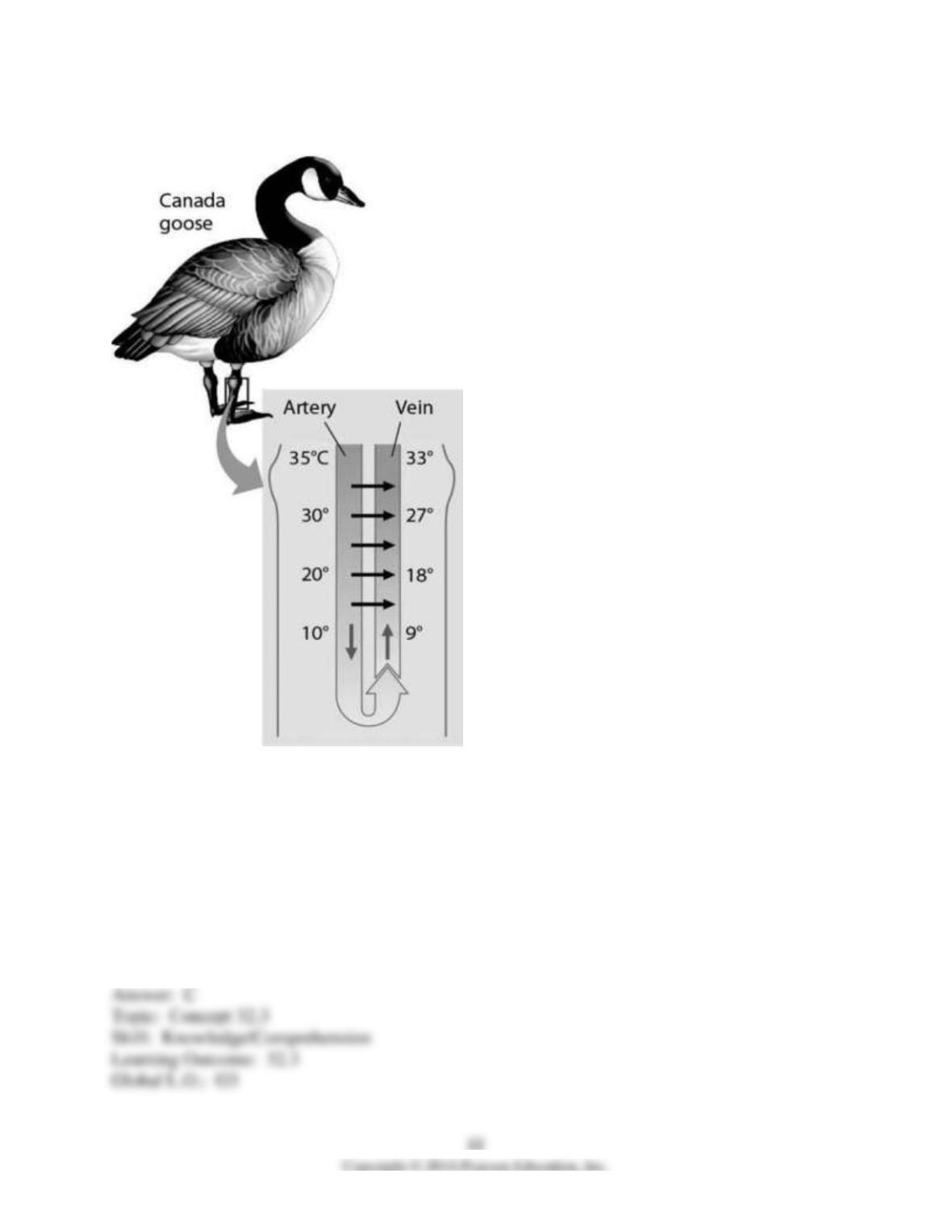
Figure 32.1
1) The thin horizontal arrows in Figure 32.1 show that
A) the warmer arterial blood can bypass the legs as needed when the legs are too cold to function
well.
B) the warmer venous blood transfers heat to the cooler arterial blood.
C) the warmer arterial blood transfers heat to the cooler venous blood.
D) the arterial blood is always cooler in the abdomen, compared to the temperature of the venous
blood in the feet of the goose.
E) the goose’s legs get progressively warmer as the blood moves away from the abdomen to the
feet.
2) Examine Figure 32.1. Near a goose’s abdomen, the countercurrent arrangement of the arterial
and venous blood vessels causes
A) the temperature difference between the contents of the two sets of vessels to be minimized.
B) the venous blood to be as cold near the abdomen as it is near the feet.
C) the blood in the feet to be as warm as the blood in the abdomen.
D) the temperature at the abdomen to be less than the temperature at the feet.
E) the loss of the maximum possible amount of heat to the environment.
3) Researchers measure animals’ oxygen consumption (VO2) as a way to quantify metabolic
rate. A researcher measured the VO2 for two animals, A and B, as function of ambient
temperature and collected the data shown in Figure 32.2 below. One of the animals was an
ectotherm and one was an endotherm. Which animal was the endotherm and why?
A) Animal A is the endotherm because at colder temperatures endotherms need to warm
themselves through their own metabolic activity, which is supported by the data.
B) Animal A is the endotherm because endotherms do not need to regulate their own body
temperature by changing metabolic activity, which is supported by the data.
C) Animal B is the endotherm because at colder temperatures endotherms need to warm
themselves through their own metabolic activity, which is supported by the data.
D) Animal B is the endotherm because endotherms do not need to regulate their own body
temperature by changing metabolic activity, which is supported by the data.
32.3 End-of-Chapter Questions
1) The body tissue that consists largely of material located outside of cells is
A) epithelial tissue.
B) connective tissue.
C) muscle.
D) nervous tissue.
2) Which of the following would increase the rate of heat exchange between an animal and its
environment?
A) feathers or fur
B) vasoconstriction
C) wind blowing across the body surface
D) countercurrent heat exchanger
3) Which process in the nephron is least selective?
A) filtration
B) reabsorption
C) active transport
D) secretion
4) Homeostasis typically relies on negative feedback because positive feedback
A) requires a response but not a stimulus.
B) drives processes to completion rather than to a balance point.
C) acts within, but not beyond, a normal range.
D) can decrease but not increase a variable.
5) Which of the following is an accurate statement about thermoregulation?
A) Endotherms are regulators and ectotherms are conformers.
B) Endotherms maintain a constant body temperature and ectotherms do not.
C) Endotherms and ectotherms differ in their primary source of heat for thermoregulation.
D) Endothermy has a lower energy cost than ectothermy.
6) In which of the following species should natural selection favor the highest proportion of
nephrons with loops of Henle that extend deep into the renal medulla?
A) a river otter
B) a mouse species living in a temperate broadleaf forest
C) a mouse species living in a desert
D) a beaver
7) African lungfish, which are often found in small, stagnant pools of fresh water, produce urea
as a nitrogenous waste. What is the advantage of this adaptation?
A) Urea takes less energy to synthesize than ammonia.
B) Small, stagnant pools do not provide enough water to dilute the toxic ammonia.
C) Urea forms an insoluble precipitate.
D) Urea makes lungfish tissue hypoosmotic to the pool.