
44) Plants that have their flowering inhibited by being exposed to bright lights at night are
A) day-neutral plants.
B) short-night plants.
C) short-day plants.
D) long-day plants.
45) Classic experiments suggested that a floral stimulus, florigen, could move across a graft from
an induced plant to a non-induced plant and trigger flowering. Recent evidence using
Arabidopsis has shown that florigen is probably
A) a phytochrome molecule that is activated by red light.
B) a protein that is synthesized in leaves, travels to the shoot apical meristems, and initiates
flowering.
C) a membrane signal that travels through the symplast from leaves to buds.
D) a second messenger that induces Ca2+ to change membrane potential.
46) A short-day plant exposed to nights longer than the minimum for flowering but interrupted
by short flashes of light
A) will never flower.
B) might flower depending upon the duration of the light flash.
C) will not be affected and will flower.
D) might flower depending upon the wavelengths of the light flashes.
47) A long-day plant will flower
A) in the late fall.
B) when the night is shorter than a critical value.
C) only under artificial light in the summer.
D) regardless of the photoperiod imposed.

48) You are part of a desert plant research team trying to discover crops that will be productive
in arid climates. You discover a plant that produces a hormone under water-deficit conditions
that triggers a suite of drought responses. Most likely the hormone is
A) ABA.
B) GA.
C) IAA.
D) 2,4-D.
49) What do the results of research on gravitropic responses of roots and stems show?
A) Different tissues have the same response to auxin.
B) The effect of a plant hormone can depend on the tissue.
C) Some responses of plants require no hormones at all.
D) Light is required for the gravitropic response.
50) A botanist discovers a plant that lacks the ability to form starch grains in root cells, yet the
roots still grow downward. This evidence refutes the long-standing hypothesis that
A) falling statoliths trigger gravitropism.
B) starch accumulation triggers the negative phototropic response of roots.
C) starch grains block the acid growth response in roots.
D) starch is converted to auxin, which causes the downward bending in roots.
51) Most scientists agree that global warming is under way; thus, it is important to know how
plants respond to heat stress. Which of the following would be a useful line of inquiry to try to
improve plant response to and survival of heat stress?
A) the production of heat-stable carbohydrates
B) increased production of heat-shock proteins
C) the opening of stomata to increase evaporational heat loss
D) protoplast fusion experiments with xerophytic plants

52) In extremely cold regions, woody species may survive freezing temperatures by
A) emptying water from the vacuoles to prevent freezing.
B) decreasing the numbers of phospholipids in cell membranes.
C) decreasing the fluidity of all cellular membranes.
D) increasing cytoplasmic levels of specific solute concentrations, such as sugars.
53) The initial response of the root cells of a tomato plant watered with seawater would be to
A) rapidly produce organic solutes in the cytoplasm.
B) rapidly expand until the cells burst.
C) begin to plasmolyze as water is lost.
D) actively transport water from the cytoplasm into the vacuole.
54) The rapid leaf movements resulting from a response to touch (thigmotropism) primarily
involve
A) rapid growth response.
B) potassium channels.
C) nervous tissue.
D) aquaporins.
55) Which of the following is the most likely plant response to an attack by herbivores?
A) leaf abscission to prevent further loss
B) early flowering to try to reproduce before being eaten
C) production of chemical compounds for defense or to attract predators
D) production of physical defenses, such as thorns

56) In order for a plant to initiate chemical responses to herbivory,
A) the plant must be directly attacked by an herbivore.
B) volatile “signal” compounds must be perceived.
C) gene-for-gene recognition must occur.
D) phytoalexins must be released.
57) The transduction pathway that activates systemic acquired resistance in plants is initially
signaled by
A) antisense RNA.
B) Pfr phytochrome.
C) salicylic acid.
D) abscisic acid.
58) Which of the following would only be activated or upregulated after a plant has already been
infected by a pathogen?
A) phytochrome
B) salicylic acid
C) molecular chaperones
D) stress proteins
59) A plant will recognize a pathogenic invader
A) if it has many specific plant disease resistance (R) genes.
B) when the pathogen has an R gene complementary to the plant’s antivirulence (Avr) gene.
C) only if the pathogen and the plant have the same R genes.
D) if it has the specific R gene that corresponds to the pathogen molecule encoded by an Avr
gene.

60) What is the probable role of salicylic acid in the defense responses of plants?
A) to destroy pathogens directly
B) to activate the systemic acquired resistance of plants
C) to close stomata, thus preventing the entry of pathogens
D) to activate heat-shock proteins
61) When an arborist prunes a limb off a valuable tree, he or she usually paints the cut surface.
The primary purpose of the paint is to
A) minimize water loss by evaporation from the cut surface.
B) improve the appearance of the cut surface.
C) stimulate growth of the cork cambium to “heal” the wound.
D) block entry of pathogens through the wound.
62) When plants exhibit generalized defense responses in organs distant from the infection site,
this is termed
A) a hyperactive response.
B) systemic acquired resistance.
C) pleiotropy.
D) hyperplasia.
31.2 Art Questions
1)
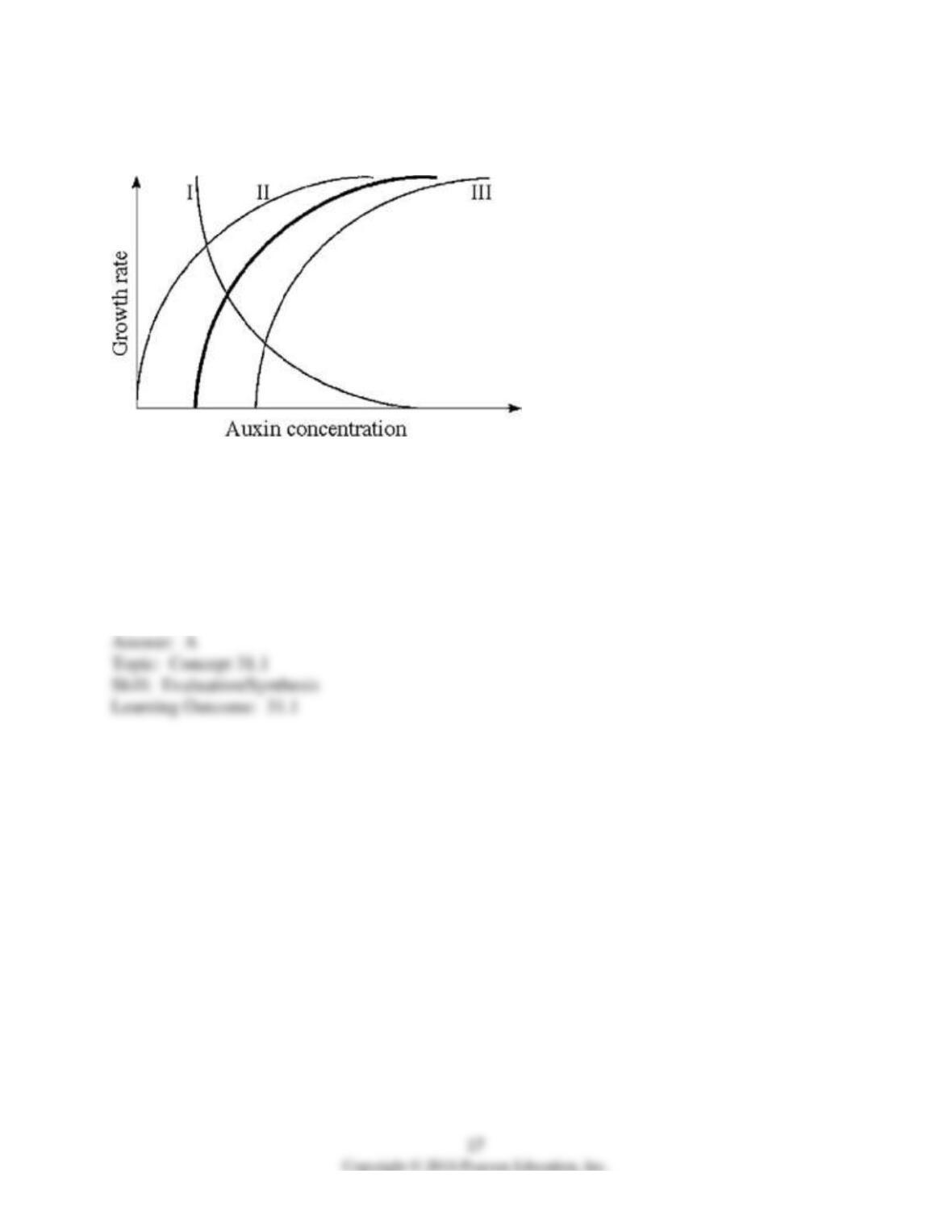
Figure 31.1
The heavy line in Figure 31.1 illustrates the relationship between auxin concentration and cell
growth in stem tissues. If the same range of concentrations were applied to lateral buds, what
curve(s) would probably be produced?
A) I
B) II
C) III
D) II or III
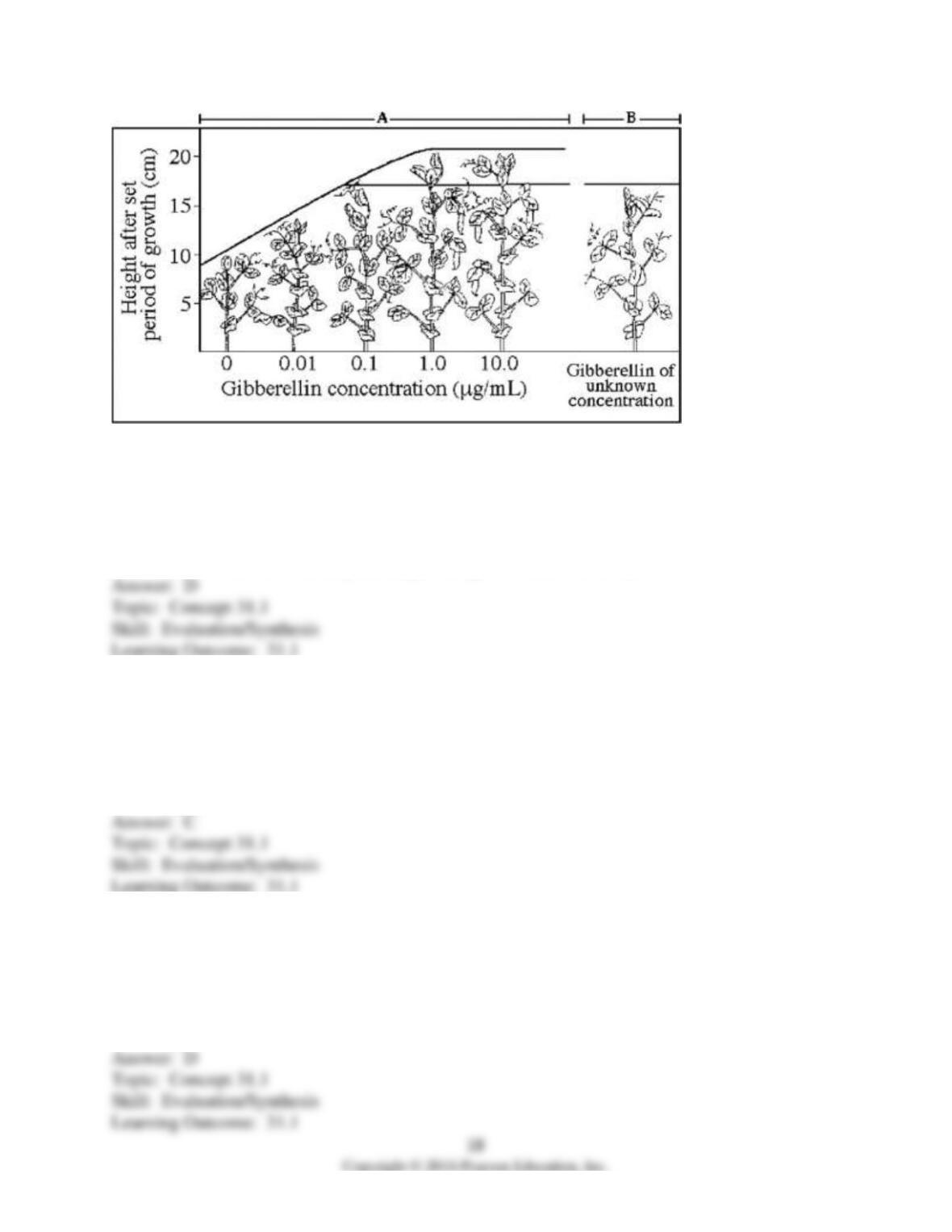
Figure 31.2
2) The results of this experiment, shown on the left of the graph (area A), may be used to
A) show that these plants can live without gibberellin.
B) show that gibberellin is necessary in positive gravitropism.
C) show that taller plants with more gibberellin produce fruit (pods).
D) show a correlation between plant height and gibberellin concentration.
3) This experiment suggests that the unknown amount of gibberellin in the experimental plant
(B) is approximately
A) zero.
B) 0.01 μg/mL.
C) 0.1 μg/mL.
D) 1.0 μg/mL.
4) This experiment suggests that the optimum amount of gibberellin in the experiment is
approximately
A) zero.
B) 0.01 μg/mL.
C) 0.1 μg/mL.
D) 1.0 μg/mL.

31.3 Scenario Questions
1) In an experiment, a plant physiologist has four groups of bananas of the same species. He
exposes each of the four groups of bananas with the same concentration of auxins, gibberellins,
abscisic acid, or ethylene. Which of these four groups of bananas ripen the fastest?
A) auxins
B) gibberellins
C) abscisic acid
D) ethylene
2) In nature, poinsettias bloom in early March. Research has shown that the flowering process is
triggered 3 months before blooming occurs. In order to make poinsettias bloom in December,
florists change the length of the light/dark cycle in September. Given this information and clues,
which of the following is a correct statement about poinsettias?
A) They are short-day plants.
B) They require a light period longer than some set minimum.
C) They require a shorter dark period than is available in September.
D) The dark period can be interrupted without affecting flowering.
3) A botanist exposed two groups of the same plant species to two photoperiods, one with 14
hours of light and 10 hours of dark and the other with 10 hours of light and 14 hours of dark.
Under the first set of conditions, the plants flowered, but they failed to flower under the second
set of conditions. Which of the following conclusions is consistent with these results?
A) The critical night length is 14 hours.
B) The plants are short-day plants.
C) The critical day length is 10 hours.
D) The plants flower in the late spring.

31.4 End-of-Chapter Questions
1) The hormone that helps plants respond to drought is
A) auxin.
B) abscisic acid.
C) cytokinin.
D) ethylene.
2) Auxin enhances cell elongation in all of these ways except
A) increased uptake of solutes.
B) gene activation.
C) acid-induced denaturation of cell wall proteins.
D) increased activity of plasma membrane proton pumps.
3) Charles and Francis Darwin discovered that
A) red light is most effective in shoot phototropism.
B) auxin can pass through agar.
C) light destroys auxin.
D) light is perceived by the tips of coleoptiles.
4) The signaling molecule for flowering might be released earlier than usual in a long-day plant
exposed to flashes of
A) far-red light during the night.
B) red light during the night.
C) far-red light during the day.
D) red light during the day.

5) If a long-day plant has a critical night length of 9 hours, which 24-hour cycle would prevent
flowering?
A) 16 hours light/8 hours dark
B) 14 hours light/10 hours dark
C) 4 hours light/8 hours dark/4 hours light/8 hours dark
D) 8 hours light/8 hours dark/light flash/8 hours dark
6) A plant mutant that showed normal gravitropic bending but did not store starch in its plastids
would require a reevaluation of the role of ________ in gravitropism.
A) auxin
B) statoliths
C) light
D) differential growth