
27) In most fungi, karyogamy does not immediately follow plasmogamy, which consequently
_____.
A) means that sexual reproduction can occur in specialized structures
B) results in multiple diploid nuclei per cell
C) allows fungi to reproduce asexually most of the time
D) results in heterokaryotic or dikaryotic cells
28) Asexual reproduction in yeasts occurs by budding. Due to unequal cytokinesis, the “bud” cell
receives less cytoplasm than the parent cell. Which of the following should be true of the smaller
cell until it reaches the size of the larger cell?
A) It should produce fewer fermentation products per unit time.
B) It should be transcriptionally less active.
C) It should have reduced motility.
D) It should have a smaller nucleus.
29) The microsporidian Brachiola gambiae parasitizes the mosquito Anopheles gambiae. Adult
female mosquitoes must take blood meals for their eggs to develop, and it is while they take
blood that they transmit malarial parasites to humans. Male mosquitoes drink flower nectar. If
humans are to safely and effectively use Brachiola gambiae as a biological control to reduce
human deaths from malaria, then how many of the following statements should be true?
1. Brachiola should kill the mosquitoes before the malarial parasite they carry reaches maturity.
2. The microsporidian should not be harmful to other insects.
3. Microsporidians should infect mosquito larvae, rather than mosquito adults.
4. The subsequent decline in anopheline mosquitoes should not significantly disrupt human food
resources or other food webs.
5. Brachiola must be harmful to male mosquitoes, but not to female mosquitoes.
A) 2 and 5
B) 1, 2, and 4
C) 2, 3, 5
D) 3 and 4

30) Why are mycorrhizal fungi superior to plants at acquiring mineral nutrition from the soil?
A) Hyphae are one hundred to one thousand times larger than plant roots.
B) Hyphae have a smaller surface-area-to-volume ratio than do the hairs on a plant root.
C) Mycelia are able to grow in the direction of food.
D) Fungi secrete extracellular enzymes that can break down large molecules.
31) Fossil fungi date back to the origin and early evolution of plants. What combination of
environmental and morphological change is similar in the evolution of both fungi and plants?
A) presence of “coal forests” and change in mode of nutrition
B) periods of drought and presence of filamentous body shape
C) predominance in swamps and presence of cellulose in cell walls
D) colonization of land and loss of flagellated cells
32) The multicellular condition of animals and fungi seems to have arisen _____.
A) due to common ancestry
B) by convergent evolution
C) by inheritance of acquired traits
D) by serial endosymbioses
33) Which feature seen in chytrids supports the hypothesis that they diverged earliest in fungal
evolution?
A) the absence of chitin within the cell wall
B) coenocytic hyphae
C) flagellated spores
D) parasitic lifestyle

Recent genetic studies of the structure of microsporidian genomes, as well as the sequences of
their tubulin genes and the gene for RNA polymerase II, indicate that microsporidians are closely
related to the fungi. Microsporidians lack flagella, centrioles, peroxisomes, and mitochondria
(although they do have degenerate mitochondria, called mitosomes). They have the smallest
genome of any eukaryote, and it is a genome that changes quickly. The genome is contained
within two haploid nuclei. All microsporidians are obligate intracellular parasites. They use a
unique organelle called a polar filament to gain access to the cells of their hosts. One species
causes chronic diarrhea in AIDS patients. Another parasitizes Anopheles gambiae, the mosquito
that transmits a fatal form of malaria to humans.
34) Given the eukaryotic structures they lack, it should be expected that microsporidians also
lack _____.
A) the “9 + 2 pattern” of microtubules
B) centrosomes
C) lysosomes
D) nuclei
35) It has been hypothesized that fungi and plants have a mutualistic relationship because plants
make sugars available for the fungi’s use. What is the best evidence in support of this hypothesis?
A) Fungi survive better when they are associated with plants.
B) Radioactively labeled sugars produced by plants eventually show up in the fungi with which
they are associated.
C) Fungi associated with plants have the ability to undergo photosynthesis and produce their own
sugars, while those not associated with plants do not produce their own sugars.
D) Radioactive labeling experiments show that plants pass crucial raw materials to the fungus for
manufacturing sugars.
36) You observe the gametes of a fungal species under the microscope and realize that they
resemble animal sperm. To which of the following group does the fungus belong?
A) Chytrids
B) Zygomycetes
C) Basidiomycota
D) Ascomycota

37) Which of the following has the LEAST affiliation with all of the others?
A) Glomeromycota
B) mycorrhizae
C) lichens
D) arbuscules
38) Arrange the following in order from largest to smallest.
1. ascospore
2. ascocarp
3. ascomycete
4. ascus
A) 3 → 2 → 4 → 1
B) 3 → 4 → 1 → 2
C) 2 → 3 → 4 → 1
D) 2 → 4 → 1 → 3
39) Arrange the following in order from largest to smallest, assuming that they all come from the
same fungus.
1. basidiocarp
2. basidium
3. basidiospore
4. mycelium
5. gill
A) 4 →? 5 → 1→ 2 → 3
B) 5 → 1 → 4 → 2 → 3
C) 5 → 1 → 3 → 2 → 4
D) 4 → 1 → 5 → 2 → 3
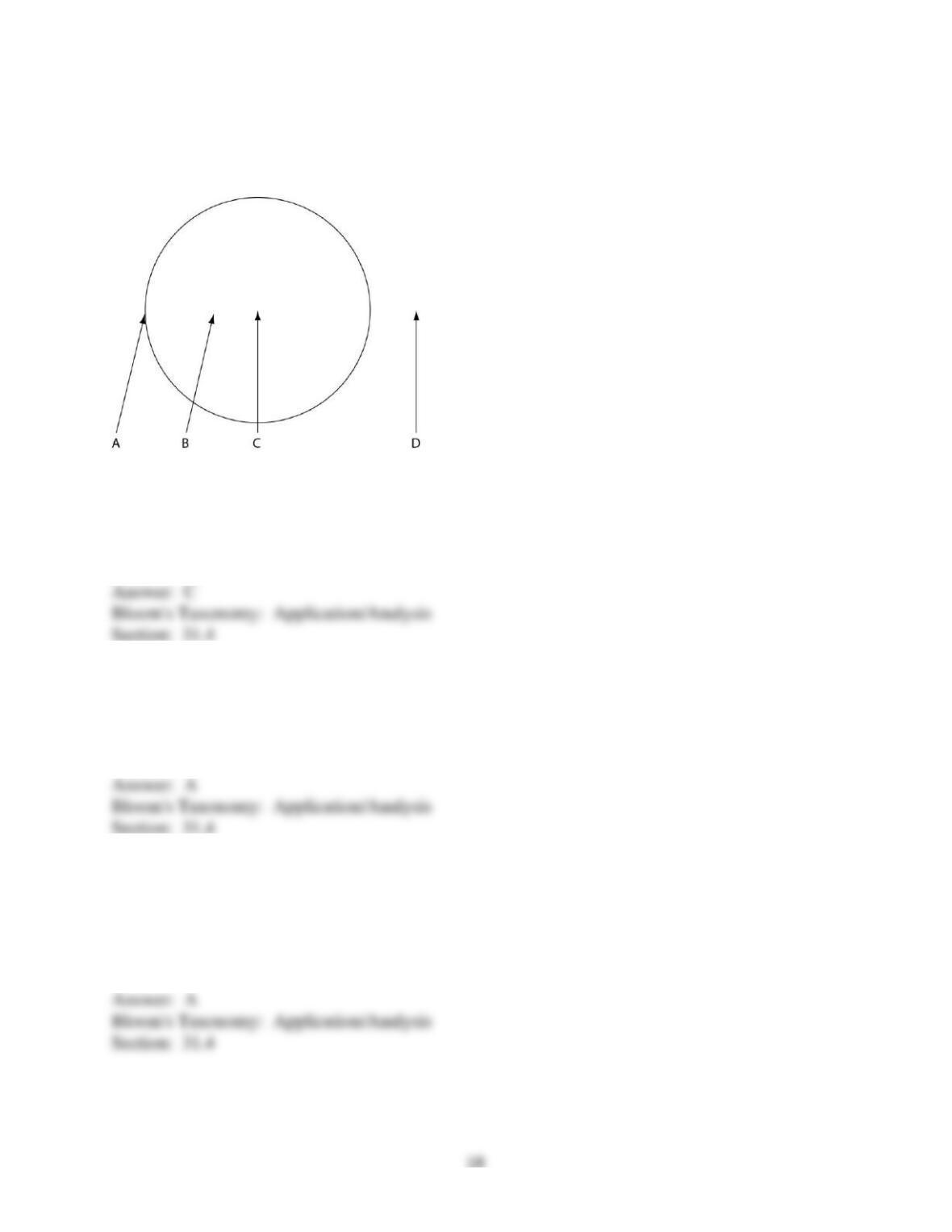
The following figure depicts the outline of a large fairy ring that has appeared overnight in an
open meadow, as viewed from above. The fairy ring represents the furthest advance of this
mycelium through the soil. Locations A-D are all 0.5 meters below the soil surface.
40) What is the most probable location of the oldest portion of this mycelium?
A) A
B) B
C) C
D) D
41) Which location is nearest to basidiocarps?
A) A
B) B
C) C
D) D
42) At which location is the mycelium currently absorbing the most nutrients per unit surface
area, per unit time?
A) A
B) B
C) C
D) D

43) At which location should one find the lowest concentration of fungal enzymes, assuming that
the enzymes do not diffuse far from their source, and that no other fungi are present in this
habitat?
A) A
B) B
C) C
D) D
44) Assume that all four locations are 0.5 meters above the surface. On a breezy day with
prevailing winds blowing from left to right, where should one expect to find the highest
concentration of free basidiospores in an air sample?
A) A
B) B
C) C
D) D
45) If the fungus that produced the fairy ring can also produce arbuscules, then which of the
following is most likely to be buried at location “C”?
A) tree stump
B) deceased animal
C) fire pit
D) cement-capped well

Use the following information to answer the question(s) below.
For several decades now, amphibian species worldwide have been in decline. A significant
proportion of the decline seems to be due to the spread of the chytrid fungus, Batrachochytrium
dendrobatidis (Bd). Chytrid sporangia reside within the epidermal cells of infected animals,
animals that consequently show areas of sloughed skin. They can also be lethargic, which is
expressed through failure to hide and failure to flee. The infection cycle typically takes four to
five days, at the end of which zoospores are released from sporangia into the environment. In
some amphibian species, mortality rates approach 100%; other species seem able to survive the
infection.
46) Apart from direct amphibian-to-amphibian contact, what is the most likely means by which
the zoospores spread from one free-living amphibian to another?
A) by wind-blown spores
B) by flagella
C) by cilia
D) by hyphae
47) When adult amphibian skin harbors populations of the bacterium, Janthinobacterium lividum
(Jl), chytrid infection seems to be inhibited. Which of the following represents the best
experimental design to test whether this inhibition is real?
A) Inoculate uninfected amphibians with Jl, and determine whether the amphibians continue to
remain uninfected by chytrids.
B) Inoculate infected amphibians with Jl, and determine whether the amphibians recover from
infection by chytrids.
C) Take infected amphibians and assign them to two populations. Leave one population alone;
inoculate the other with Jl. Measure the rate at which infection proceeds in both populations.
D) Take infected amphibians and assign them to two populations. Inoculate one population with
a high dose of Jl; inoculate the other with a low dose of Jl. Measure the survival frequency in
both populations.

48) A researcher took water in which a Jl population had been thriving, filtered the water to
remove all bacterial cells, and then applied the water to the skins of adult amphibians to see if
there would subsequently be a reduced infection rate by Bd when frog skins were inoculated
with Bd. For which of the following hypotheses is the procedure described a potential test?
A) the hypothesis that a toxin secreted by Jl cells kills Bd cells when both are present together on
frog skin
B) the hypothesis that Jl cells infect and kill Bd cells when both are present together on frog skin
C) the hypothesis that Jl outcompetes Bd when both are present together on a frog’s skin
D) the hypothesis that the presence of Jl on frog skin causes a skin reaction that prevents
attachment by Bd cells
49) Basidiomycetes are the only fungal group capable of synthesizing lignin peroxidase. What
advantage does this group of fungi have over other fungi because of this capability?
A) This is always the first group of fungi to begin any kind of plant decomposition.
B) This fungal group can break down the tough lignin, which cannot be harnessed for energy, to
get to the more useful cellulose.
C) This is the only group of fungi that can use lignin for adenosine triphosphate (ATP)
production.
D) This enzyme releases heat energy from the breakdown of lignin that is used to kill off
competing fungi.

Use the following information to answer the question(s) below.
For several decades now, amphibian species worldwide have been in decline. A significant
proportion of the decline seems to be due to the spread of the chytrid fungus, Batrachochytrium
dendrobatidis (Bd). Chytrid sporangia reside within the epidermal cells of infected animals,
animals that consequently show areas of sloughed skin. They can also be lethargic, which is
expressed through failure to hide and failure to flee. The infection cycle typically takes four to
five days, at the end of which zoospores are released from sporangia into the environment. In
some amphibian species, mortality rates approach 100%; other species seem able to survive the
infection.
50) If Bd cannot grow properly at temperatures above 28°C (82°F), then, assuming the
amphibians can survive, in which time or place should the chytrid infection proceed most
rapidly?
1. cooler months
2. warmer months
3. lower altitudes
4. higher altitudes
A) 1 or 3
B) 1 or 4
C) 2 or 3
D) 2 or 4
Use the following information to answer the question(s) below.
Diploid nuclei of the ascomycete, Neurospora crassa, contain 14 chromosomes. A single diploid
cell in an ascus will undergo one round of meiosis, followed in each of the daughter cells by one
round of mitosis, producing a total of eight ascospores.
51) If a single, diploid G2 nucleus in an ascus contains 400 nanograms (ng) of DNA, then a
single ascospore nucleus of this species should contain how much DNA (ng), carried on how
many chromosomes?
A) 100, carried on 7 chromosomes
B) 100, carried on 14 chromosomes
C) 200, carried on 7 chromosomes
D) 200, carried on 14 chromosomes
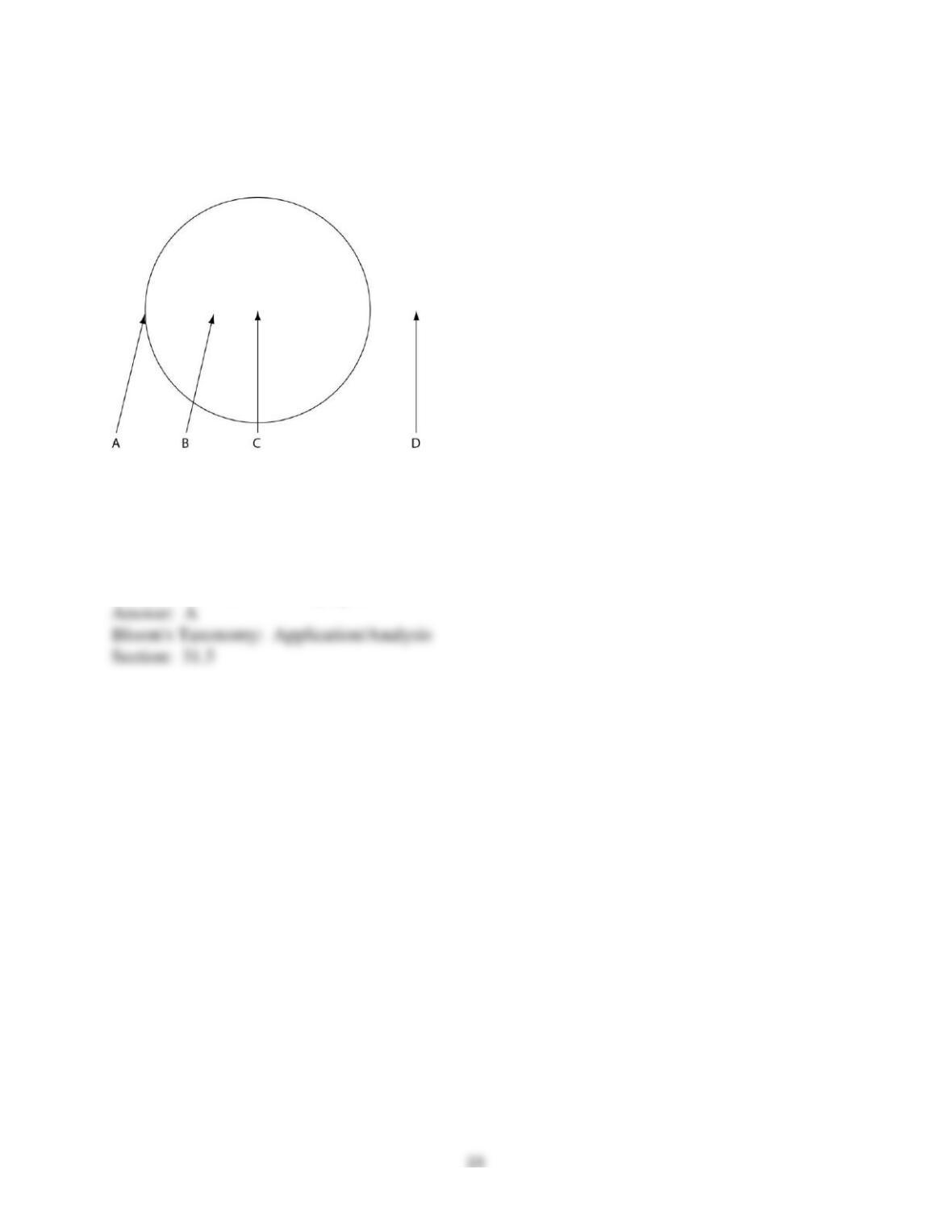
The following figure depicts the outline of a large fairy ring that has appeared overnight in an
open meadow, as viewed from above. The fairy ring represents the furthest advance of this
mycelium through the soil. Locations A-D are all 0.5 meters below the soil surface.
52) In which of the following human mycoses should one expect to find a growth pattern most
similar to that of the mycelium that produced the fairy ring?
A) skin mycoses
B) coccidiomycosis (lung infection)
C) systemic (bloodborne) Candida infection
D) Sporothrix infection of lymphatic vessels

24
Use the following information to answer the question(s) below.
Rose-picker’s disease is caused by the yeast Sporothrix schenkii (S. schenkii). The yeast grows
on the exteriors of rose-bush thorns. If a human gets pricked by such a thorn, the yeasts can be
introduced under the skin. The yeasts then assume a hyphal morphology and grow along the
interiors of lymphatic vessels until they reach a lymph node. This often results in the
accumulation of pus in the lymph node, which subsequently ulcerates through the skin surface
and then drains.
53) Humans have immune systems in which lymph nodes are important, because many
phagocytes and lymphocytes reside there. Given that a successful infection by S. schenkii
damages lymph nodes themselves, which of the following is most probable?
A) The hyphae secrete antibiotics, which increases the ability of the infected human to tolerate
the fungus.
B) Their conversion from yeast to hyphal morphology allows such fast growth that the body’s
defenses are at least temporarily overwhelmed.
C) Defensive cells of humans cannot detect foreign cells that are covered with cell walls
composed of cellulose.
D) Given that most fungal pathogens attack plants, human defenses are simply not adapted to
seek out and destroy fungi.
54) If haustoria from the fungal partner were to appear within the photosynthetic partner of a
lichen, and if the growth rate of the photosynthetic partner consequently slowed substantially,
then this would support the claim that _____.
A) algae and cyanobacteria are autotrophic
B) lichens are not purely mutualistic relationships
C) algae require maximal contact with the fungal partner in order to grow at optimal rates
D) soredia are asexual reproductive structures combining both the fungal and photosynthetic
partners
55) A billionaire buys a sterile volcanic island that recently emerged from the sea. To speed the
arrival of conditions necessary for plant growth, the billionaire might be advised to aerially sow
what over the island?
A) basidiospores
B) spores of ectomycorrhizae
C) soredia
D) yeasts
56) Orchid seeds are tiny, with virtually no endosperm and with miniscule cotyledons. If such

seeds are deposited in a dark, moist environment, then which of the following represents the
most likely means by which fungi might assist in seed germination, given what the seeds lack?
A) by transferring some chloroplasts to the embryo in each seed
B) by providing the seeds with water and minerals
C) by providing the embryos with some of the organic nutrients they have absorbed
D) by strengthening the seed coat that surrounds each seed
Use the following information to answer the question(s) below.
Rose-picker’s disease is caused by the yeast Sporothrix schenkii (S. schenkii). The yeast grows
on the exteriors of rose-bush thorns. If a human gets pricked by such a thorn, the yeasts can be
introduced under the skin. The yeasts then assume a hyphal morphology and grow along the
interiors of lymphatic vessels until they reach a lymph node. This often results in the
accumulation of pus in the lymph node, which subsequently ulcerates through the skin surface
and then drains.
57) The answer to which of these questions would be of most assistance to one who is attempting
to assign the genus Sporothrix to the correct fungal phylum?
A) Do these yeasts perform fermentation while growing on the rose-bush thorns, or do they wait
until inside a human host?
B) Does S. schenkii rely on animal infection to complete some part of its life cycle, or is the
infection merely opportunistic?
C) Are the hyphae in lymphatic vessels septate, or are they coenocytic?
D) Is S. schenkii best described as a decomposer, parasite, pathogen, or mutualist of humans?

58) Suppose that S. schenkii had initially been classified as a deuteromycete. Asci were later
discovered in the pus that oozed from an ulcerated lymph node, and the spores therein
germinated, giving rise to S. schenkii yeasts. Which two of these are conclusions make sense on
the basis of this information?
1. S. schenkii produces asexual spores within lymph nodes.
2. S. schenkii should be reclassified.
3. S. schenkii continues to have no known sexual stage.
4. The hyphae growing in lymphatic vessels probably belonged to a different fungal species.
5. S. schenkii yeasts belonging to two different mating strains were introduced by the same
thorn prick.
A) 1 and 3
B) 1 and 5
C) 2 and 5
D) 4 and 5
59) Which of the following best describes the physical relationship of the partners involved in
lichens?
A) Fungal cells are enclosed within algal cells.
B) Lichen cells are enclosed within fungal cells.
C) Photosynthetic cells are surrounded by fungal hyphae.
D) The fungi grow on rocks and trees and are covered by algae.
60) Mycorrhizae are to the roots of vascular plants as endophytes are to vascular plants’ _____.
A) leaf mesophyll
B) stem apical meristems
C) root apical meristems
D) xylem