
Campbell Biology, 10e (Reece)
Chapter 31 Fungi
Use the following information to answer the question(s) below.
In the United States and Canada, bats use one of two strategies to survive winter: They either
migrate south, or they hibernate. Recently, those that hibernate seem to have come under attack
by a fungus, Geomyces destructans (Gd), an attack that is occurring from Missouri to southern
Canada. Many infected bats have a delicate, white filamentous mat on their muzzles, which is
referred to as white-nose syndrome (WNS). The fungus invades the bat tissues, causes
discomfort, and awakens the bat from its hibernation. The bat fidgets and wastes calories, using
up its stored fat. The bat then behaves abnormally, leaving its cave during daytime in winter to
search for food. Their food, primarily insects, is scarce during the winter, and the bats ultimately
starve to death. Since 2007, it is estimated that up to one million bats have perished from WNS.
1) The Gd mat on the fur of the bats should be expected to consist of _____.
A) hyphae
B) haustoria
C) yeasts
D) basidia
2) What do fungi and arthropods have in common?
A) The haploid state is dominant in both groups.
B) Both groups are predominantly autotrophs that produce their own food.
C) Both groups use chitin for support.
D) Both groups have cell walls.
3) Fungi have an extremely high surface-area-to-volume ratio. What is the advantage of this to
an organism that gets most of its nutrition through absorption?
A) The larger surface area allows for more material to be transported through the cell membrane.
B) The lower volume prevents the cells from drying out too quickly, which can interfere with
absorption.
C) This high ratio creates more room inside the cells for additional organelles involved in
absorption.
D) This high ratio means that fungi have a thick, fleshy structure that allows the fungi to store
more of the food it absorbs.
2
Use the following information to answer the question(s) below.
Suzanne Simard and colleagues knew that the same mycorrhizal fungal species could colonize
multiple types of trees. They wondered if the same fungal individual would colonize different
trees, forming an underground network that potentially could transport carbon and nutrients from
one tree to another (S. Simard et al. 1997. Net transfer of carbon between mycorrhizal tree
species in the field. Nature 388:579-82).
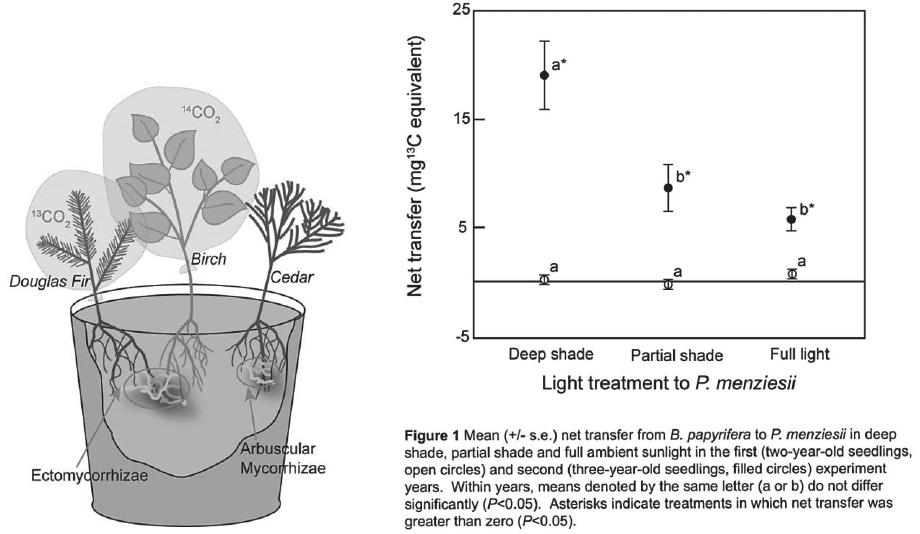
Figure A illustrates the team’s experimental setup. Pots containing seedlings of three different
tree species were set up and grown under natural conditions for three years; two of the three
species (Douglas fir, birch) formed ectomycorrhizae and the other (cedar) formed arbuscular
mycorrhizae. For the experiment, the researchers placed airtight bags over the Douglas fir and
birch seedlings; into each bag, they injected either carbon dioxide made from carbon-13 or
carbon-14 (13CO2 and 14CO2, isotopes of carbon). As the seedlings photosynthesized, the
radioactive carbon dioxide was converted into radioactively labeled sugars that could be tracked
and measured by the researchers.
Figure A Figure B
4) Refer to Figure A. Which of the following results would support Simard et al.’s (1997)
hypothesis that fungi can move carbon from one plant to another? [Hypothesis: Sugars made by
one plant during photosynthesis can travel through a mycorrhizal fungus and be incorporated
into the tissues of another plant.]
A) Carbon-14 is found in the birch seedling’s tissues and carbon-13 in the Douglas fir.
B) Carbon-14 is found in the Douglas fir seedling’s tissues and carbon-13 in the birch.
C) Either carbon-13 or carbon-14 is found in the fungal tissues.
D) Either carbon-13 or carbon-14 is found in the cedar seedling’s tissues.

5) Based on the idea that fungi have pores between their cell walls, which allow cytoplasm to
move from one end of the mycelium to the other, which of the following hypotheses is the most
plausible?
A) If a single mycorrhizal fungus formed symbiotic associations with more than one tree, carbon
could travel from one plant to another.
B) Parasitic fungi steal nutrients from their hosts.
C) Predatory fungi capture their prey by encircling them with hyphae, and the flowing of the
cytoplasm through the pores helps the hyphae to move around the prey.
D) Fungi function as part of the global carbon cycle not only by converting carbon from one
form to another, but by physically moving it from one location to another.
4
Use the following information to answer the question(s) below.
There is much discussion in the media about protecting biodiversity. But does biodiversity really
matter? Canadian and Swiss researchers wanted to know if the diversity of arbuscular
mycorrhizal fungi (AMF) was important to the productivity of grasslands (M.G.A. van der
Heijden, J. N. Klironomos, M. Ursic, P. Moutoglis, R. Streitwolf-Engel, T. Boler, A. Wiemken,
and I. R. Sanders. 1998. Mycorrhizal fungal diversity determines plant biodiversity, ecosystem
variability and productivity. Nature 396:69-72). Specifically, they wanted to know if it mattered
which specific AMF species were present, or just that some type of AMF was present. They
grew various plants in combination with one of four AMF species (A, B, C, and D), no AMF
species (O), or all four AMF species together (A+B+C+D); and they measured plant growth
under each set of conditions. All plant species were grown in each plot, so they always competed
with each other with the only difference being which AMF species were present.
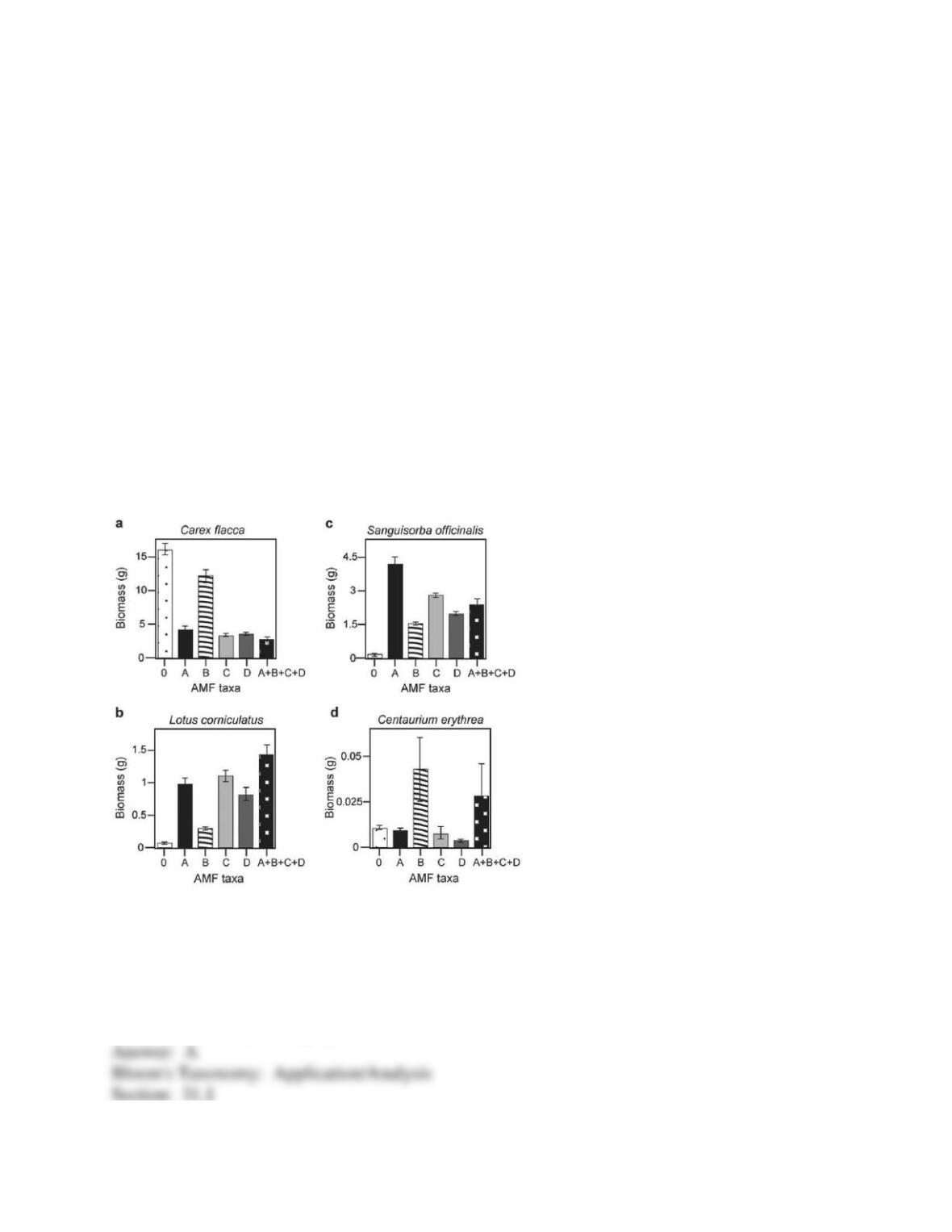
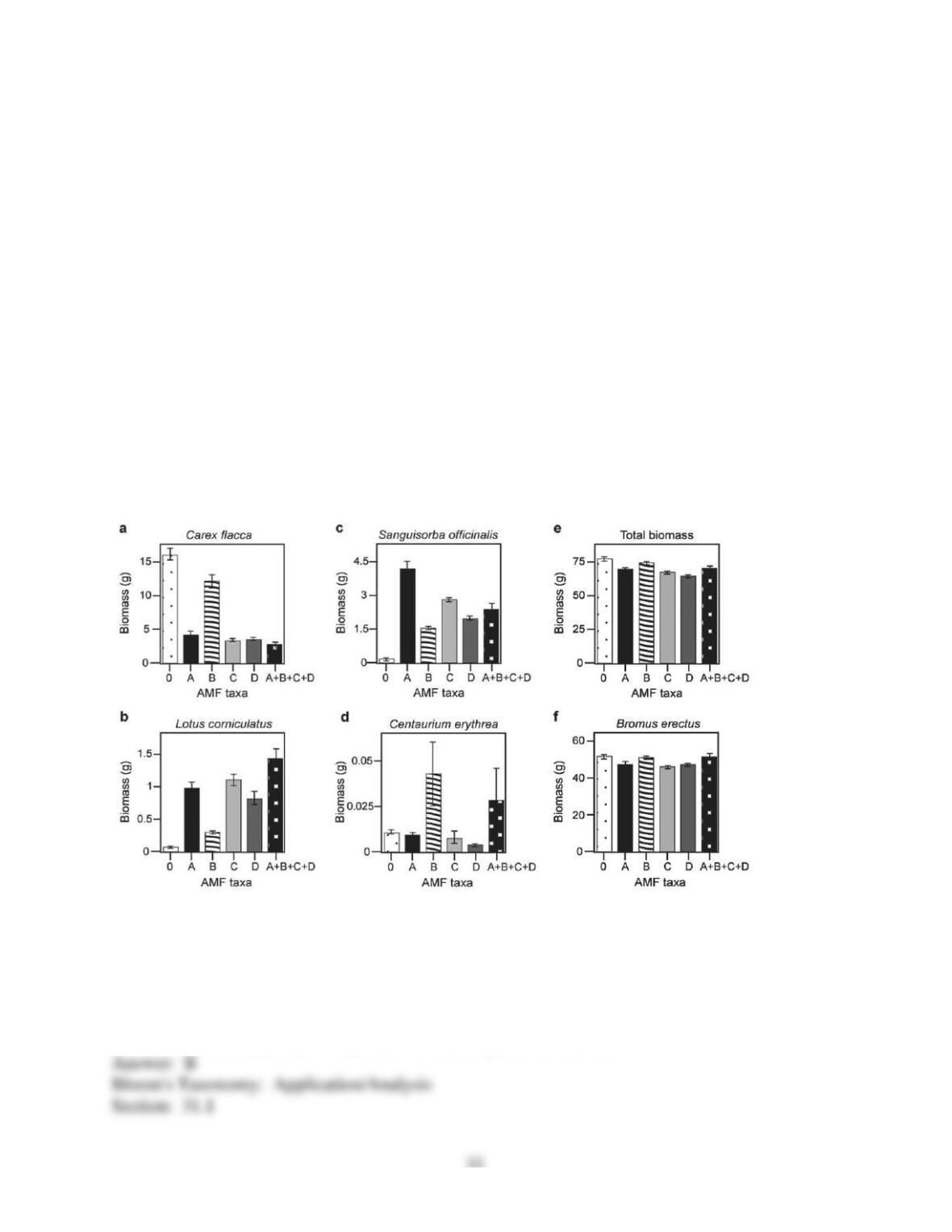
On the graphs below, the x-axis labels indicate the number and identity of AMF species (bar 0 =
no fungi; bars A-D = individual AMF species; bar A+B+C+D = all AMF species together). The
y-axis indicates the amount (grams) of plant biomass for the species shown in italics above each
graph.
6) Based on the graphs in the figure above, which of the following plant species is most likely
NOT to form mycorrhizal associations?
A) Carex flacca (graph a)
B) Lotus corniculatus (graph b)
C) Sanguisorba officinalis (graph c)
D) Centaurium erythrea (graph d)
7) If all fungi in an environment that perform decomposition were to suddenly die, then which

group of organisms should benefit most, due to the fact that their fungal competitors have been
removed?
A) flowering plants
B) protists
C) prokaryotes
D) grasses
8) When a mycelium infiltrates an unexploited source of dead organic matter, what are most
likely to appear within the food source soon thereafter?
A) fungal haustoria
B) fungal enzymes
C) increased oxygen levels
D) larger bacterial populations
9) The functional significance of porous septa in certain fungal hyphae is most similar to that
represented by which pair of structures in animal cells and plant cells, respectively?
A) desmosomes — tonoplasts
B) gap junctions — plasmodesmata
C) tight junctions — plastids
D) centrioles — plastids
10) A fungal spore germinates, giving rise to a mycelium that grows outward into the soil
surrounding the site where the spore originally landed. Which of the following accounts for the
fungal movement, as described here?
A) karyogamy
B) mycelial flagella
C) breezes distributing spores
D) cytoplasmic streaming in hyphae

11) When pathogenic fungi are found growing on the roots of grape vines, grape farmers
sometimes respond by covering the ground around their vines with plastic sheeting and pumping
a gaseous fungicide into the soil. The most important concern of grape farmers who engage in
this practice should be that the _____.
A) fungicide might also kill the native yeasts residing on the surfaces of the grapes
B) lichens growing on the vines’ branches are not harmed
C) fungicide might also kill mycorrhizae
D) sheeting is transparent so that photosynthesis can continue
12) The adaptive advantage associated with the filamentous nature of fungal mycelia is primarily
related to _____.
A) the ability to form haustoria and parasitize other organisms
B) the potential to inhabit almost all terrestrial habitats
C) the increased probability of contact between different mating types
D) an extensive surface area well suited for invasive growth and absorptive nutrition
13) Some fungal species can kill herbivores while feeding off of sugars from its plant host. What
type of relationship does this fungus have with its host?
A) parasitic
B) mutualistic
C) commensal
D) predatory
7
Use the following information to answer the question(s) below.
Suzanne Simard and colleagues knew that the same mycorrhizal fungal species could colonize
multiple types of trees. They wondered if the same fungal individual would colonize different
trees, forming an underground network that potentially could transport carbon and nutrients from
one tree to another (S. Simard et al. 1997. Net transfer of carbon between mycorrhizal tree
species in the field. Nature 388:579-82).
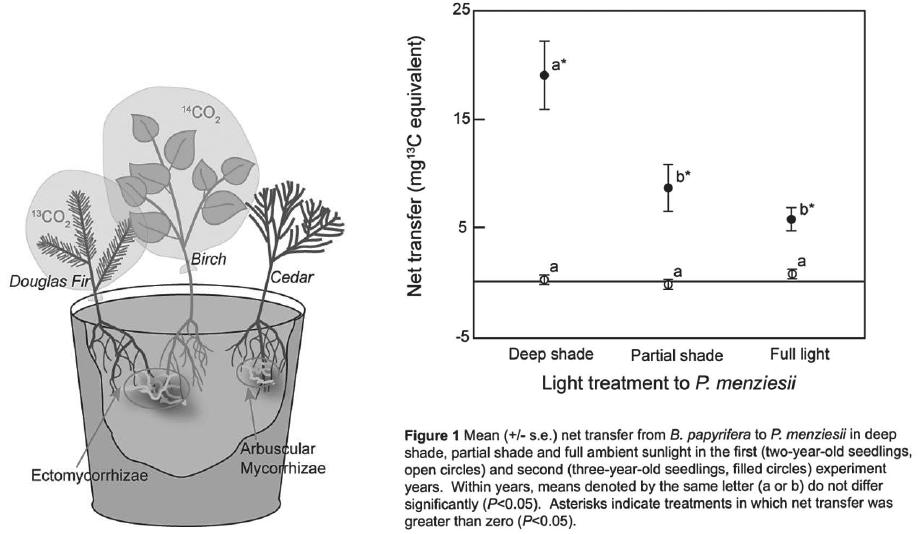
Figure A illustrates the team’s experimental setup. Pots containing seedlings of three different
tree species were set up and grown under natural conditions for three years; two of the three
species (Douglas fir, birch) formed ectomycorrhizae and the other (cedar) formed arbuscular
mycorrhizae. For the experiment, the researchers placed airtight bags over the Douglas fir and
birch seedlings; into each bag, they injected either carbon dioxide made from carbon-13 or
carbon-14 (13CO2 and 14CO2, isotopes of carbon). As the seedlings photosynthesized, the
radioactive carbon dioxide was converted into radioactively labeled sugars that could be tracked
and measured by the researchers.
Figure A Figure B

14) Referring to Simard et al. (1997), what is the result that would most strongly refute their
hypothesis? [Hypothesis: Sugars made by one plant during photosynthesis can travel through a
mycorrhizal fungus and be incorporated into the tissues of another plant.]
A) No movement: Carbon-14 is found in the birch seedling’s tissues and carbon-13 in the
Douglas fir.
B) Reciprocal exchange: Carbon-14 is found in the Douglas fir seedling’s tissues and carbon-13
in the birch.
C) Either carbon-13 or carbon-14 is found in the fungal tissues.
D) Either carbon-13 or carbon-14 is found in the cedar seedling’s tissues.
15) Referring to Simard et al. (1997), which design element is the control in this experiment and
why?
A) the bags over the seedlings to contain the different types of carbon dioxide
B) the fact that all the seedlings are different species
C) the cedar seedling, because it is not bagged
D) the cedar seedling, because it forms arbuscular mycorrhizae
16) Simard et al. (1997) further hypothesized that if reciprocal transfer did occur, it would be a
source-sink relationship driven by photosynthetic rates. That is, if one seedling is in full sun and
the other in deep shade, there will be a net movement of carbon from the seedling in full sun to
the one in deep shade. If a shade was placed over the birch seedlings and the cedar, and the
Douglas fir was left in full sun, what result could Simard and colleagues expect?
A) More 13C would be found in the birch than in the Douglas fir.
B) More 13C would be found in the Douglas fir than in the birch.
C) The most 13C would be found in the cedar.
D) The most 14C would be found in the cedar.
Use the following information to answer the question(s) below.
There is much discussion in the media about protecting biodiversity. But does biodiversity really
matter? Canadian and Swiss researchers wanted to know if the diversity of arbuscular
mycorrhizal fungi (AMF) was important to the productivity of grasslands (M.G.A. van der
Heijden, J. N. Klironomos, M. Ursic, P. Moutoglis, R. Streitwolf-Engel, T. Boler, A. Wiemken,
and I. R. Sanders. 1998. Mycorrhizal fungal diversity determines plant biodiversity, ecosystem
variability and productivity. Nature 396:69-72). Specifically, they wanted to know if it mattered
which specific AMF species were present, or just that some type of AMF was present. They
grew various plants in combination with one of four AMF species (A, B, C, and D), no AMF
species (O), or all four AMF species together (A+B+C+D); and they measured plant growth
under each set of conditions. All plant species were grown in each plot, so they always competed
with each other with the only difference being which AMF species were present.
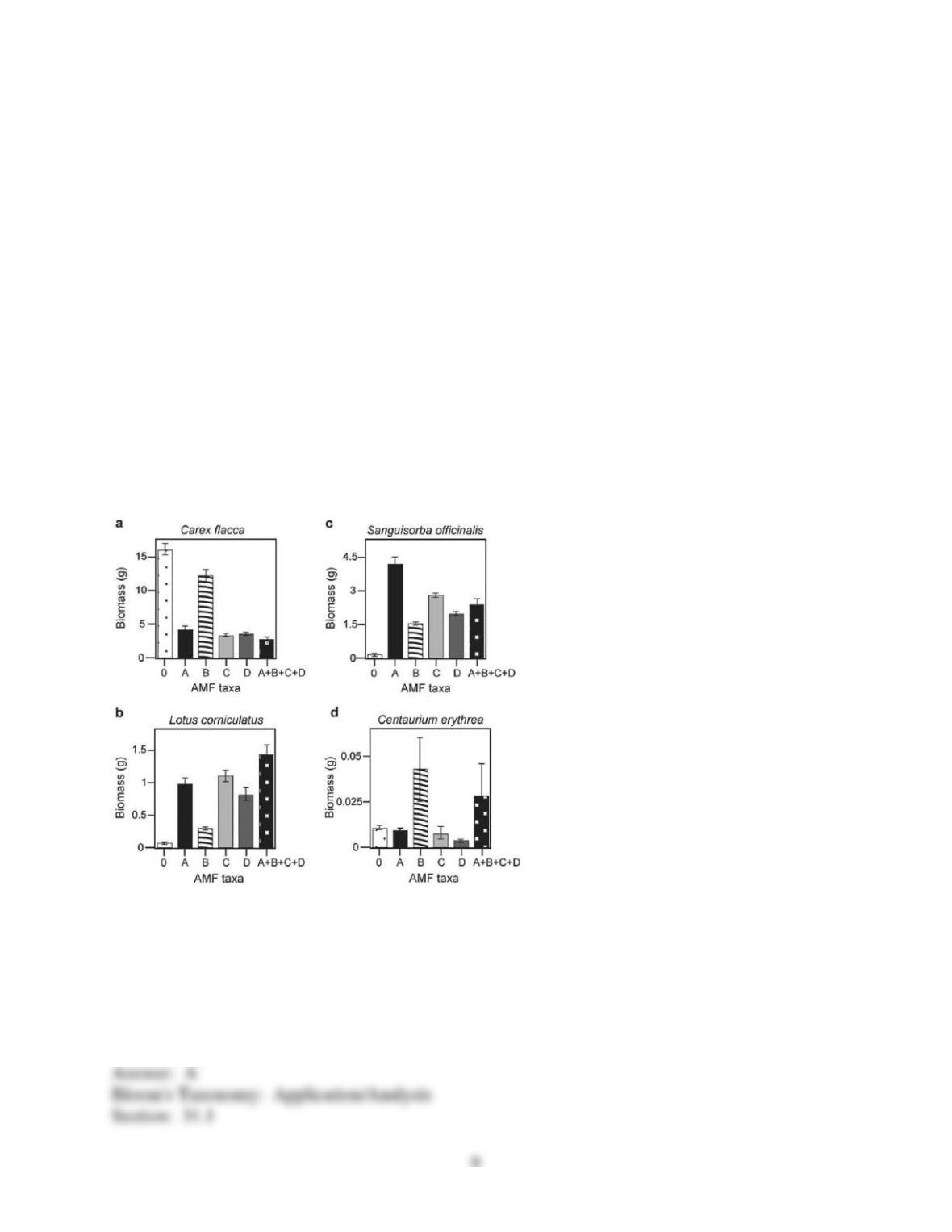
On the graphs below, the x-axis labels indicate the number and identity of AMF species (bar 0 =
no fungi; bars A-D = individual AMF species; bar A+B+C+D = all AMF species together). The
y-axis indicates the amount (grams) of plant biomass for the species shown in italics above each
graph.
17) Based on the van der Heijden et al. (1998) graphs in the figure above, which of the following
is the best description of the data supporting the idea that a plant species did not form
mycorrhizae with a fungus? Its biomass is greatest when _____.
A) no AMF are present
B) AM fungus A is present
C) AM fungus B is present
D) AM fungus C is present
18) In graph (b) in the figure above, which of the following best explains the data given about
Lotus corniculatus?
A) This plant grows best when AMF taxa A or C are present.
B) Lotus corniculatus does not form mycorrhizal associations.
C) Mycorrhizal fungi parasitize the plant’s roots when they are present, reducing its growth.
D) This plant forms multiple AMF associations, growing best with increased fungal diversity.
Use the following information to answer the question(s) below.
Canadian and Swiss researchers wanted to know if the diversity of arbuscular mycorrhizal fungi
(AMF) was important to the productivity of grasslands (M.G.A. van der Heijden, J. N.
Klironomos, M. Ursic, P. Moutoglis, R. Streitwolf-Engel, T. Boler, A. Wiemken, and I. R.
Sanders. 1998. Mycorrhizal fungal diversity determines plant biodiversity, ecosystem variability
and productivity. Nature 396:69-72). Specifically, they wanted to know if it mattered which
specific AMF species were present, or just that some type of AMF was present. They grew
various plants in combination with one of four AMF species (A, B, C, & D), no AMF species
(O), or all four AMF species together (A+B+C+D); and they measured plant growth under each
set of conditions. All plant species were grown in each plot, so they always competed with each
other with the only difference being which AMF species were present.
On the graphs below, the x-axis labels indicate the number and identity of AMF species (bar 0 =
no fungi; bars A-D = individual AMF species; bar A+B+C+D = all AMF species together). The
y-axis indicates the amount (grams) of plant biomass for the species shown in italics above each
graph. Graph (e) is the total biomass (grams) of all 11 plant species combined; graph (f) is the
biomass of Bromus erectus plants only, separated from the total.
19) What is the major difference between Bromus erectus (graph f) and the other plant species
(graphs a-d) included in the study?
A) Bromus erectus grows best with a diversity of fungal partners.
B) Bromus erectus is unaffected by AMF diversity.
C) Bromus erectus does not form mycorrhizal associations.
D) Bromus erectus produces very little biomass regardless of AMF.

20) Why does total biomass (graph e in the figure above) not vary with AMF diversity?
A) Plant growth is unaffected by fungal diversity.
B) Most of the plants in this system do not form mycorrhizal associations.
C) Bromus erectus is the dominant plant species.
D) Lotus corniculatus is a rare species.
21) Based on graphs (e) and (f) in the figure above, which is the most well-supported prediction
for the effect on total plant biomass if AMF diversity were increased to eight species?
A) No effect is predicted, because the dominant species is unaffected by AMF diversity.
B) Total biomass for eight species would double in comparison to that for four species.
C) Rare species would produce more biomass compared to the case when fewer AMF are
present.
D) No effect is predicted, because the dominant species is non-mycorrhizal.
22) At which stage of a basidiomycete’s life cycle would reproduction be halted if an enzyme
that prevented the fusion of hyphae was introduced?
A) fertilization
B) karyogamy
C) plasmogamy
D) germination
23) Deuteromycetes _____.
A) represent the phylum in which all the fungal components of lichens are classified
B) are the group of fungi that have, at present, no known sexual stage
C) are the group that includes molds, yeasts, and lichens
D) include the imperfect fungi that lack hyphae

Use the following information to answer the question(s) below.
For several decades now, amphibian species worldwide have been in decline. A significant
proportion of the decline seems to be due to the spread of the chytrid fungus, Batrachochytrium
dendrobatidis (Bd). Chytrid sporangia reside within the epidermal cells of infected animals,
animals that consequently show areas of sloughed skin. They can also be lethargic, which is
expressed through failure to hide and failure to flee. The infection cycle typically takes four to
five days, at the end of which zoospores are released from sporangia into the environment. In
some amphibian species, mortality rates approach 100%; other species seem able to survive the
infection.
24) Sexual reproduction has not been observed in Bd. If its morphology and genetics did not
identify it as a chytridiomycete, then to which fungal group would Bd be assigned?
A) zygomycetes
B) glomeromycetes
C) basidiomycetes
D) deuteromycetes
25) Plasmogamy can directly result in which of the following?
1. cells with a single haploid nucleus
2. heterokaryotic cells
3. dikaryotic cells
4. cells with two diploid nuclei
A) 1 or 3
B) 2 or 3
C) 2 or 4
D) 3 or 4
26) After cytokinesis occurs in budding yeasts, the daughter cell has a _____.
A) similar nucleus and more cytoplasm than the mother cell
B) smaller nucleus and less cytoplasm than the mother cell
C) larger nucleus and less cytoplasm than the mother cell
D) similar nucleus and less cytoplasm than the mother cell