Chapter 3 Cell Structure and Function
3.1 Multiple Choice Questions
1) Using a microscope, you observe an amoeba moving toward a food source. This is an
example of
A) reproduction.
B) cellular structure.
C) metabolism.
D) growth.
E) responsiveness.
2) Which of the following is NOT a component of bacterial flagella?
A) flagellin
B) basal body
C) tubulin
D) filament
E) hook
3) Which of the following statements concerning the characteristics of life is FALSE?
A) Reproduction is defined as an increase in the size of an organism.
B) Viruses have some, but not all, of the characteristics of living things.
C) Organisms may not exhibit all of the characteristics of life at all times.
D) Reproduction can occur asexually or sexually in living things.
E) Living things store metabolic energy in the form of chemicals such as ATP.
4) Protein synthesis occurs in the
A) nucleus.
B) ribosome.
C) inclusion.
D) cytoskeleton.
E) periplasmic space.
5) Which of the following bacterial cell structures plays an important role in the creation of
biofilms?
A) glycocalyces
B) flagella
C) fimbriae
D) pili
E) both fimbriae and glycocalyces
6) Which of the following organisms is a prokaryote?
A) algae
B) archaea
C) fungus
D) protozoa
E) both archaea and protozoa
7) Which of the following is NOT a characteristic of all living things?
A) metabolism
B) motility
C) growth
D) reproduction
E) responsiveness
8) Some bacteria have a water-soluble outer slime layer composed of
A) carbohydrate.
B) lipid.
C) peptidoglycan.
D) protein.
E) lipoteichoic acid.
9) Which of the following statements concerning conjugation pili is FALSE?
A) Pili are longer than fimbriae and flagella.
B) Pili facilitate the transfer of DNA among bacterial cells.
C) Pili are long, hollow tubules.
D) Not all bacteria have pili.
E) A bacterial cell will usually have only one or two pili.
10) Which of the following may be a component of bacterial cell walls?
A) carrageenan
B) lipoteichoic acids
C) mycolic acid
D) tubulin
E) both lipoteichoic and mycolic acids
11) Bacterial cell walls that are resistant to drying contain
A) carbohydrates.
B) amino acids.
C) lipopolysaccharide.
D) tubulin.
E) waxes.
12) Lipid A is a component of
A) lipopolysaccharides.
B) plant cell walls.
C) cytoplasmic membranes.
D) mycolic acid.
E) bacterial glycocalyces.
13) Bacteria of the genus Mycoplasma lack cell walls. What sort of environment do they
require for survival?
A) low temperature
B) hypotonic
C) isotonic
D) hypertonic
E) a biofilm
14) Lipid-soluble molecules would be expected to cross the cytoplasmic membrane by which of
the following processes?
A) osmosis
B) facilitated diffusion
C) diffusion
D) active transport
E) group translocation
15) ATP is expended in which of the following processes?
A) facilitated diffusion
B) diffusion
C) group translocation
D) active transport
E) both active transport and group translocation
16) Which of the following statements concerning osmosis is FALSE?
A) Osmosis requires a selectively permeable membrane.
B) During osmosis, water crosses to the side of the membrane with a lower solute
concentration.
C) Cells placed in hypotonic solutions will gain water.
D) Crenation results when blood cells are placed in a hypertonic solution.
E) Osmosis stops when the system reaches equilibrium.
17) Endospores survive a variety of harsh conditions in part because of the presence of
A) mycolic acid.
B) lipopolysaccharide.
C) hopanoids.
D) dipicolinic acid.
E) glycoproteins.
18) Bacterial ________ are sites of metabolite storage.
A) nucleoids
B) vacuoles
C) inclusions
D) pili
E) periplasm
19) Which of the following is unique to archaea?
A) hypotonic
B) hypertonic
C) isotonic
D) fluid mosaic
E) passive
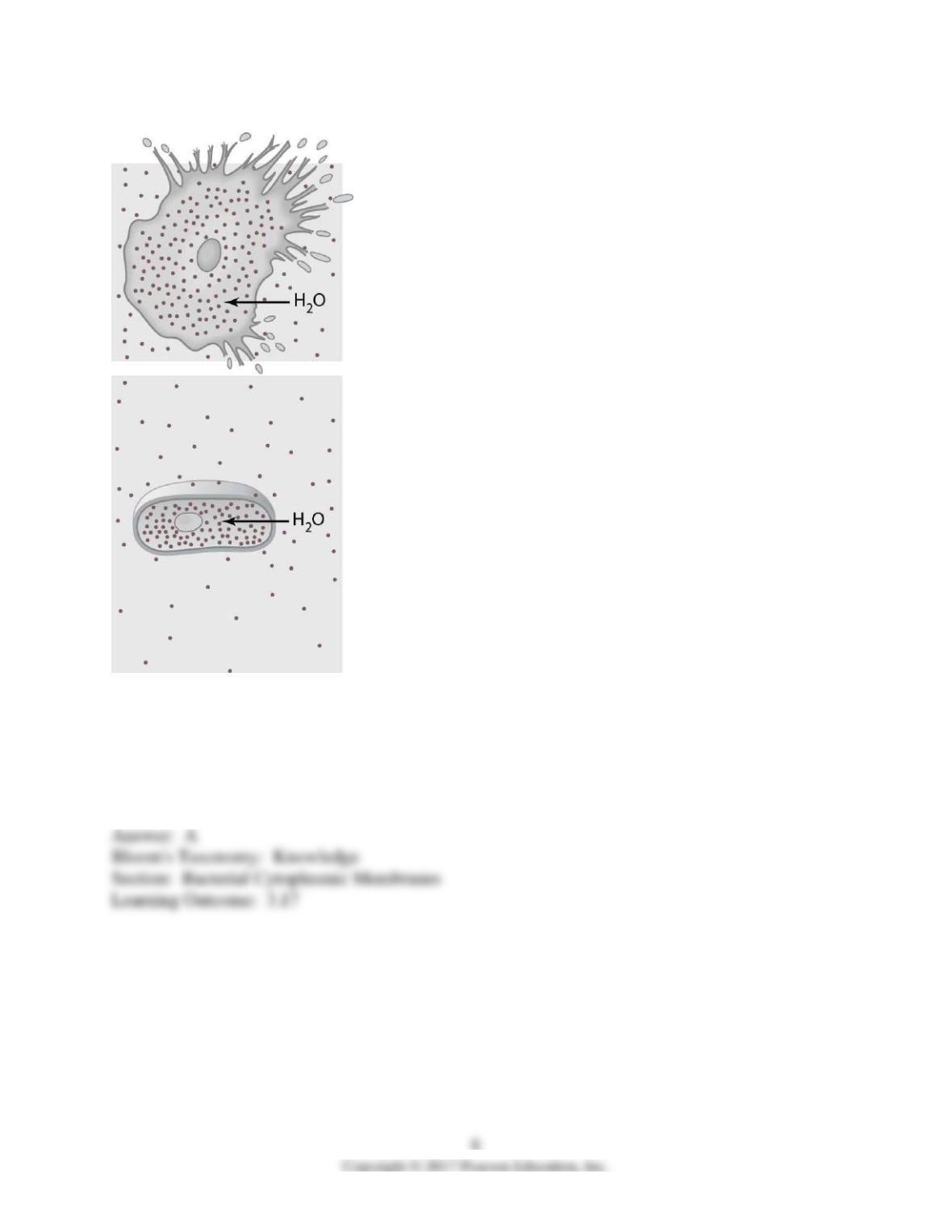
20)
The cells illustrated in Figure 3.1 are in a(n) ________ environment.
A) hypotonic
B) hypertonic
C) isotonic
D) fluid mosaic
E) passive
21) The bacterial ________ facilitates the process of bacterial cell division.
A) nucleoid
B) inclusion
C) pilus
D) cytoskeleton
E) fimbriae
22) Bacterial ribosomes are composed of several polypeptides and
A) three RNA molecules in two subunits.
B) three RNA molecules in three subunits.
C) two RNA molecules in two subunits.
D) two RNA molecules in a single complex.
E) one large RNA molecule in a single complex.
23) The glycocalyx of a eukaryotic cell performs all of the following functions EXCEPT
A) protection against dehydration.
B) anchoring cells to each other.
C) cellular recognition and communication.
D) transfer of genetic material between cells.
E) strengthening the cell surface.
24) Which of the following is classified as a nonmembranous organelle of eukaryotic cells?
A) endoplasmic reticulum
B) Golgi body
C) mitochondrion
D) centriole
E) peroxisome
25) Which of the following is part of the structure of the mitochondria of a eukaryotic cell?
A) cilia
B) cristae
C) thylakoids
D) inclusions
E) nucleolus
26) Which of the following statements about the endoplasmic reticulum (ER) is CORRECT?
A) The rough ER is the site of lipid synthesis.
B) The smooth ER has ribosomes associated with it.
C) The ER is a lipid storage organelle.
D) The ER is a transport system within the cytoplasm.
E) The smooth ER is a site of ATP synthesis.
27) Short, hairlike structures used only by eukaryotic cells for movement are called
A) pili.
B) flagella.
C) fimbriae.
D) pseudopodia.
E) cilia.
28) Chloroplasts differ from mitochondria in that the former have
A) DNA.
B) two lipid bilayers.
C) 70S ribosomes.
D) thylakoids.
E) cristae.
29) Which of the following is paired INCORRECTLY?
A) plants; cellulose cell wall
B) algae; glycocalyx
C) bacteria; peptidoglycan cell wall
D) fungi; polysaccharide cell wall
E) archaea; protein cell wall
30) Which of the following eukaryotic processes involve pseudopodia?
A) endocytosis
B) exocytosis
C) amoeboid action
D) both amoeboid action and endocytosis
E) both endocytosis and exocytosis
31) Which of the following is NOT a function of the eukaryotic cytoskeleton?
A) anchors organelles
B) gives shape to the cell
C) packages cellular secretions
D) performs endocytosis
E) aids in contraction of the cell
32) The accumulation of glucose 6-phosphate inside a bacterial cell via phosphorylation of
glucose is an example of
A) facilitated diffusion.
B) group translocation.
C) osmosis.
D) plasmolysis.
E) diffusion.
33) What types of molecules may NOT need transport proteins to be able to cross cytoplasmic
membranes?
A) large molecules
B) ions
C) small hydrophobic molecules
D) small hydrophilic molecules
E) nothing crosses cytoplasmic membranes without transport proteins
34) Which of the following processes requires a carrier protein?
A) diffusion only
B) facilitated diffusion only
C) active transport only
D) endocytosis only
E) both facilitated diffusion and active transport
35) Which of the following chemical substances contributes to the unique characteristics of
acid-fast bacteria?
A) N-acetylglucosamine
B) peptidoglycan
C) lipoteichoic acid
D) endotoxin
E) mycolic acid
36) The cytoplasmic membranes of ________ contain unbranched phospholipids and proteins.
A) archaeal cells
B) bacterial cells
C) eukaryotic cells
D) both bacterial and eukaryotic cells
E) archaeal, bacterial, and eukaryotic cells
37) Membrane rafts are found in the cytoplasmic membranes of
A) archaea only.
B) bacteria only.
C) eukaryotes only.
D) both archaea and bacteria.
E) both archaea and eukaryotes.
38) Endocytosis and exocytosis are means of transport used by
A) bacteria.
B) eukaryotes.
C) archaea.
D) all prokaryotes.
E) nothing; no cells use both processes.
39) Some ________ use group translocation as a means of transport.
A) eukaryotes
B) bacteria
C) archaea
D) protozoa
E) eukaryotes and prokaryotes
40) Cholesterols are typically found in ________ cytoplasmic membranes.
A) eukaryotic
B) bacterial
C) archaeal
D) prokaryotic
E) both eukaryotic and prokaryotic
41) The cell walls of some ________ are composed of minerals such as calcium carbonate.
A) archaea
B) bacteria
C) algae
D) fungi
E) bacteria and fungi
42) Cytoplasmic membranes of ________ are composed of unbranched phospholipids.
A) bacteria
B) eukaryotes
C) archaea
D) prokaryotes
E) bacteria and eukaryotes
43) Some members of ________ have hami.
A) archaea
B) bacteria
C) eukaryotes
D) archaea and bacteria
E) bacteria and eukaryotes
44) ________ may have pili.
A) Eukaryotes
B) Archaea
C) Bacteria
D) Prokaryotes
E) Both eukaryotes and bacteria