79) A double-stranded DNA molecule contains a total of 120 purines and 120 pyrimidines. This
DNA molecule could be composed of
A) 120 adenine and 120 uracil molecules.
B) 120 adenine and 120 guanine molecules.
C) 120 cytosine and 120 thymine molecules.
D) 120 thymine and 120 adenine molecules.
80) The difference between the sugar in DNA and the sugar in RNA is that the sugar in DNA
A) is a six-carbon sugar and the sugar in RNA is a five-carbon sugar.
B) is a five-carbon sugar and the sugar in RNA is a six-carbon sugar.
C) is in the α configuration and the sugar in RNA is in the β configuration.
D) contains one less oxygen atom than the sugar in RNA.
81) The sequence 5′-GAACUT-3′ may be found in which of the following?
A) DNA only
B) RNA only
C) either DNA or RNA
D) neither DNA nor RNA
82) The sequence 5′- GAACGA’3′ may be found in which of the following?
A) DNA only
B) RNA only
C) either DNA or RNA
D) neither DNA nor RNA
83) If one strand of a DNA molecule has the sequence of bases 5′-ATTGCA-3′, the other
complementary strand would have the sequence
A) 5-‘TAACGT-3’.
B) 5′-TGCAAT-3′.
C) 5′-UAACGU-3′.
D) 3′-UAACGU-5′.
84) If cells are grown in a medium containing radioactive 15N, which of these molecules will be
labeled?
A) fatty acids only
B) nucleic acids only
C) proteins only
D) both fatty acids and proteins
E) both proteins and nucleic acids
3.2 Art Questions
1)
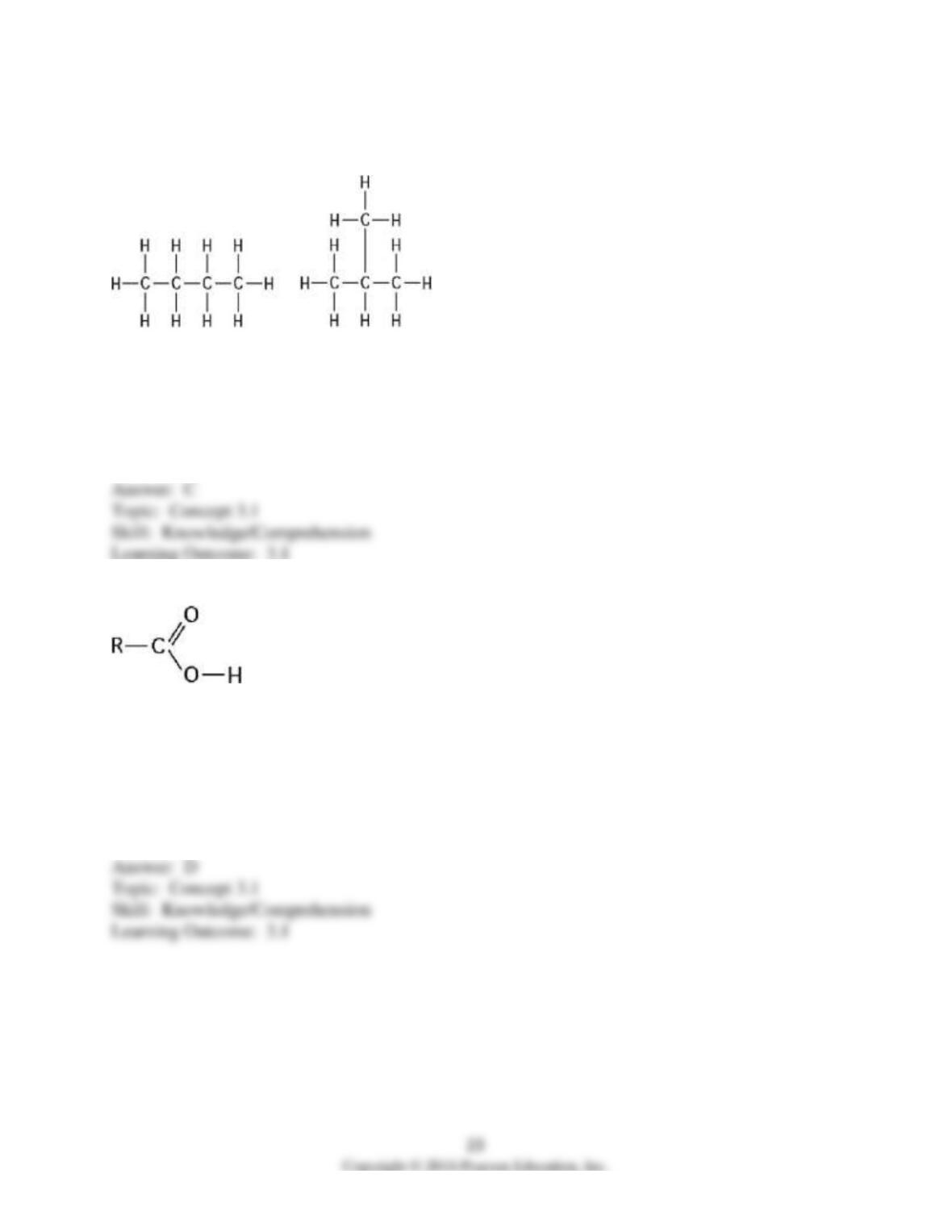
Figure 3.1
The two molecules shown in Figure 3.1 are best described as
A) optical isomers.
B) enantiomers.
C) structural isomers.
D) cis-trans isomers.
2)
Figure 3.2
What is the name of the functional group shown in Figure 3.2?
A) carbonyl
B) ketone
C) aldehyde
D) carboxyl
E) hydroxyl
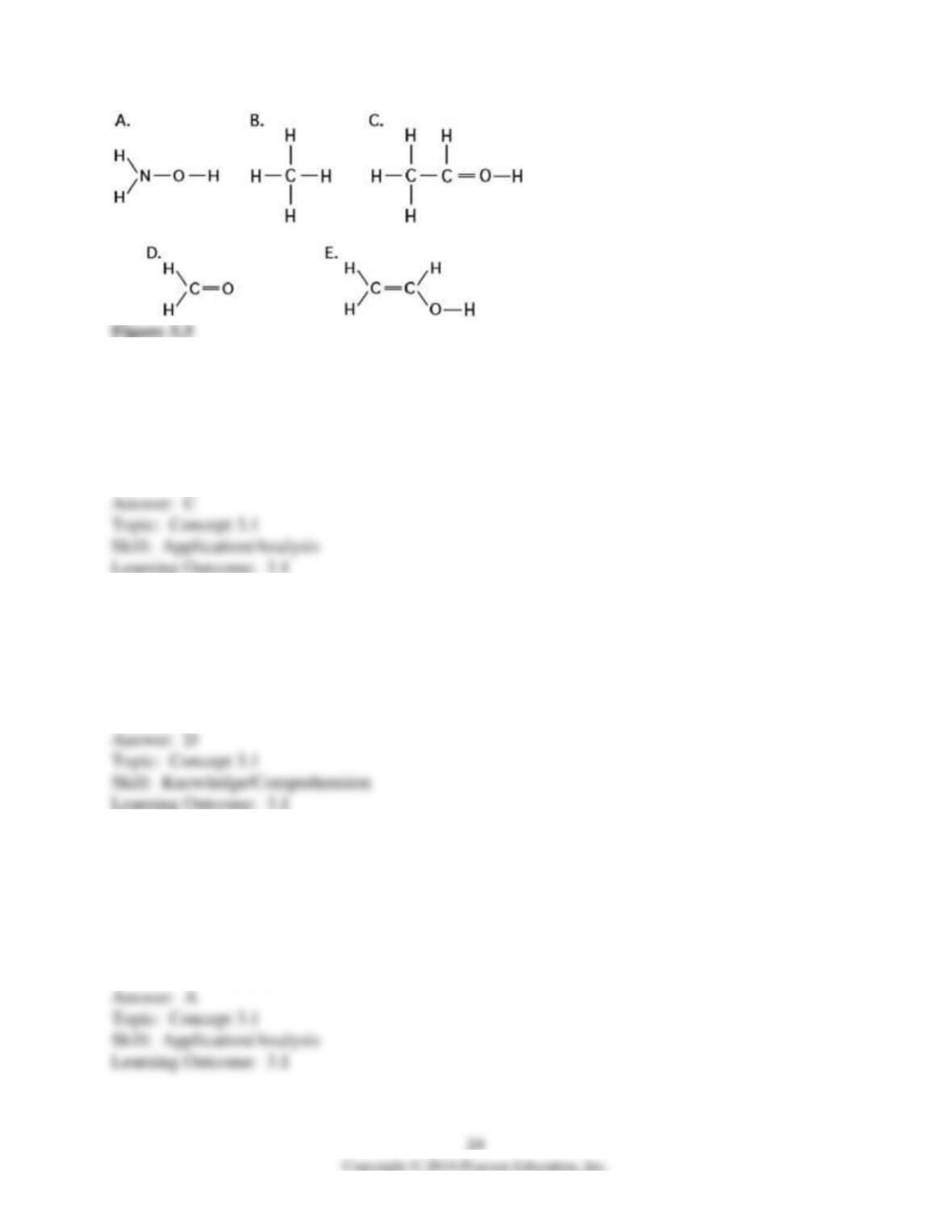
3) Which of the structures illustrated in Figure 3.3 is an impossible covalently bonded molecule?
A) A
B) B
C) C
D) D
E) E
4) Which of the structures illustrated in Figure 3.3 contain(s) a carbonyl functional group?
A) A
B) C and D
C) C
D) D
E) C and E
5) In which structure(s) illustrated in Figure 3.3 are all bonds with hydrogen polar covalent
bonds?
A) only A
B) A and D
C) A and E
D) only D
E) none of the structures
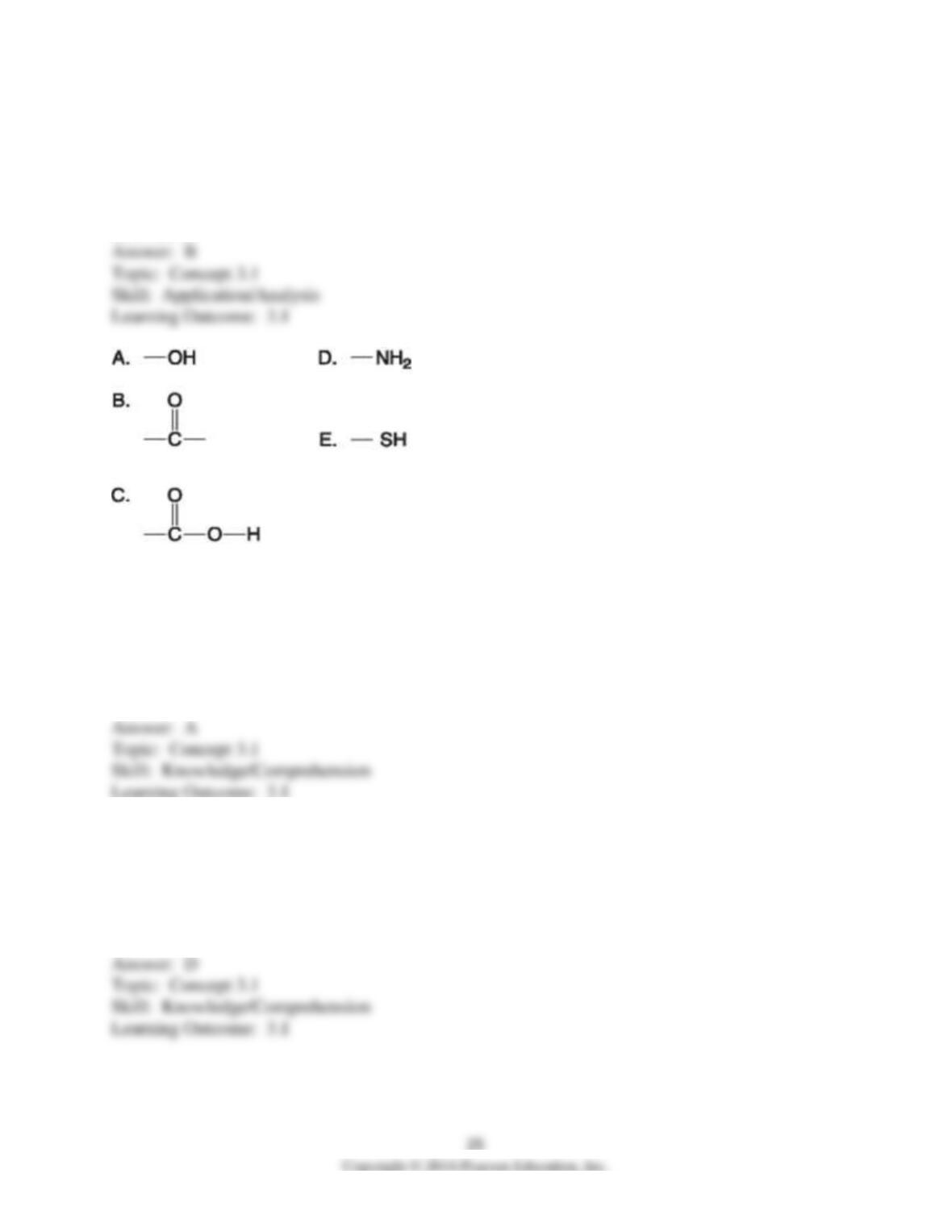
6) Which of the structures illustrated in Figure 3.3 contain only nonpolar single covalent bonds?
A) A
B) B
C) B and C
D) B and D
E) B and E
Figure 3.4
7) Which functional group shown in Figure 3.4 is characteristic of alcohols?
A) A
B) B
C) C
D) D
E) E
8) Which two functional groups shown in Figure 3.4 are present in all amino acids?
A) A and B
B) A and D
C) B and D
D) C and D
E) C and E
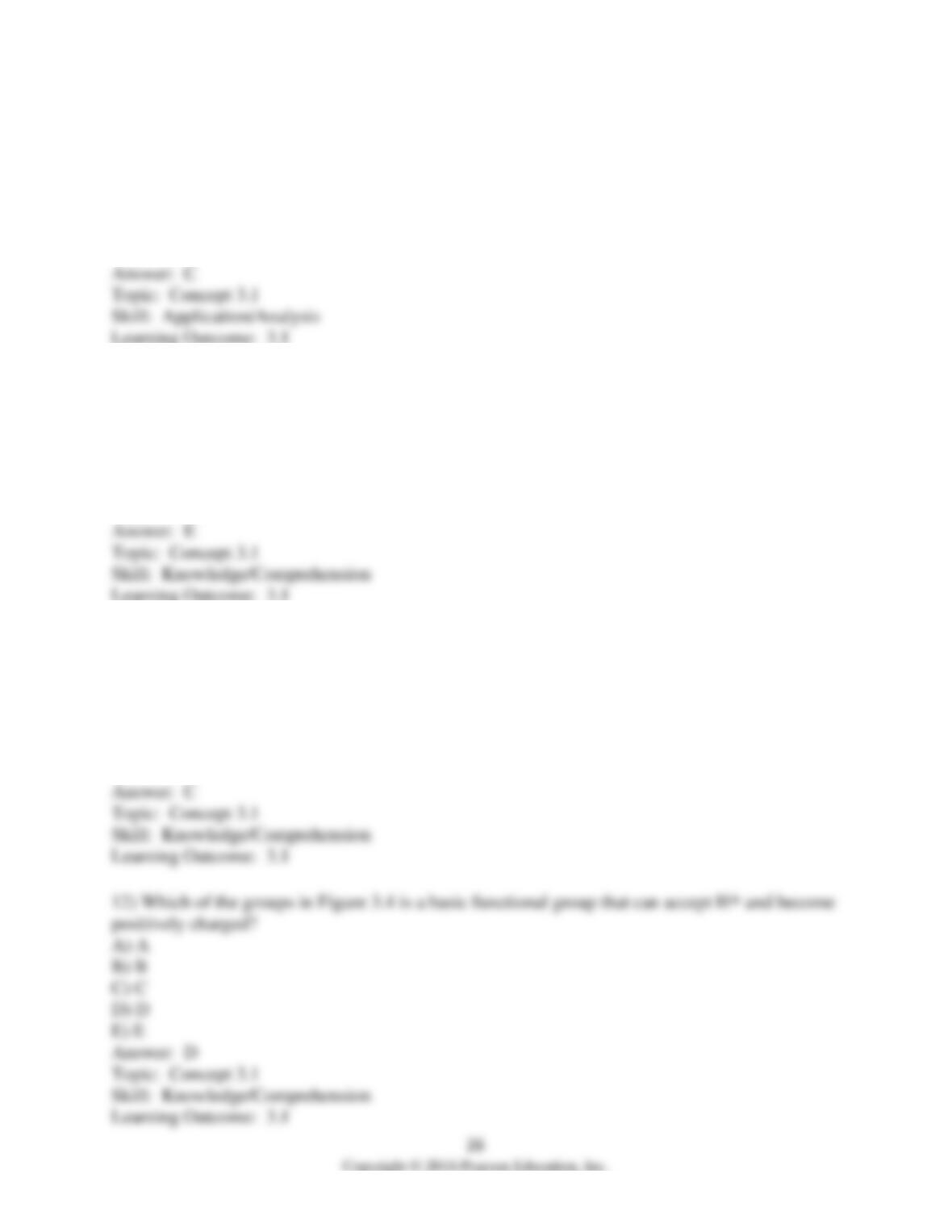
9) During the synthesis of a polypeptide the next amino acid in the growing polymer is added to
which functional group shown in Figure 3.4?
A) A
B) B
C) C
D) D
E) E
10) Which of the groups shown in Figure 3.4 is a functional group that helps stabilize proteins by
forming covalent cross-links within or between protein molecules?
A) A
B) B
C) C
D) D
E) E
11) Which of the groups in Figure 3.4 is an acidic functional group that can dissociate and
release H+ into a solution?
A) A
B) B
C) C
D) D
E) E
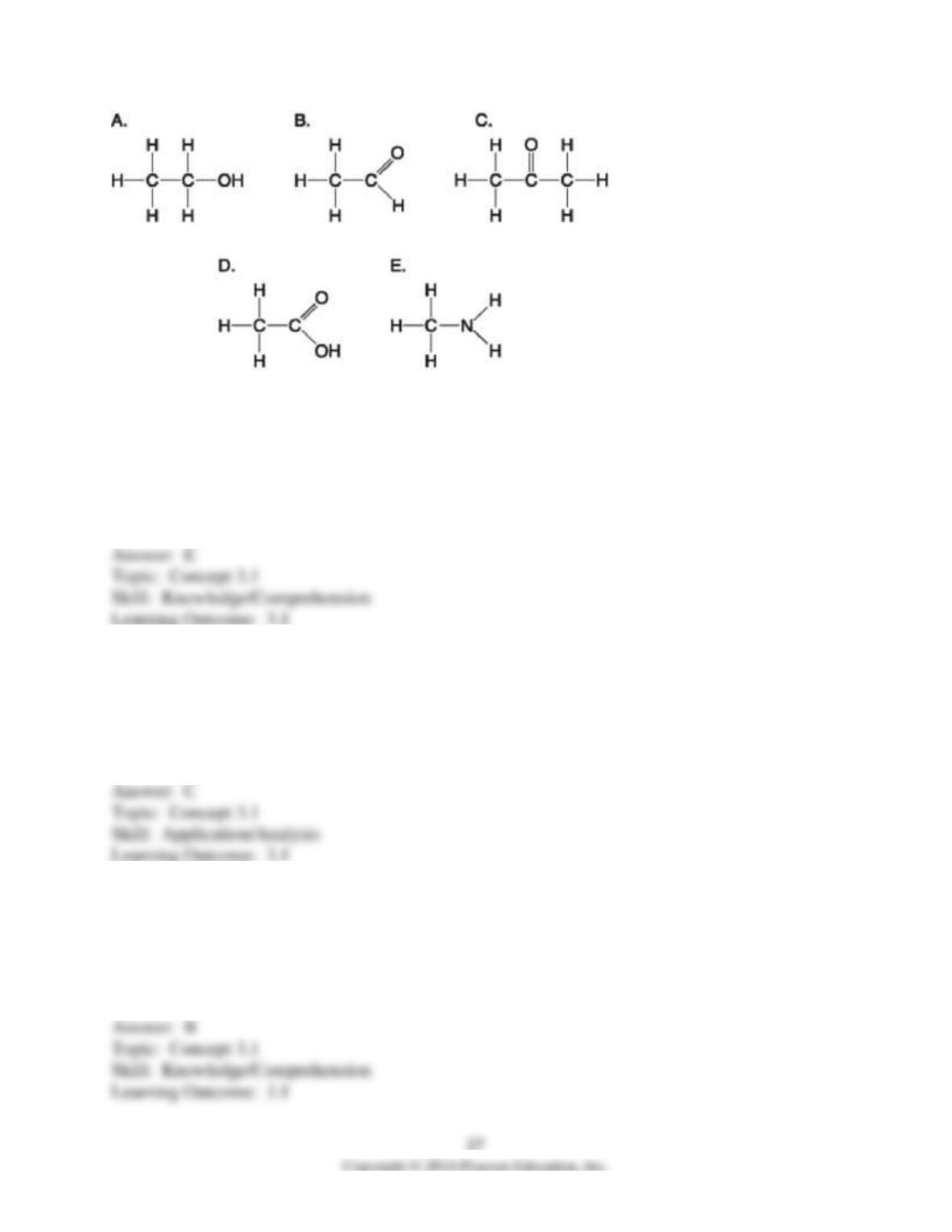
Figure 3.5
13) Which molecule shown in Figure 3.5 would have a positive charge in a cell?
A) A
B) B
C) C
D) D
E) E
14) Which molecule(s) shown in Figure 3.5 is (are) ionized in a cell?
A) A only
B) B and D
C) D and E
D) D only
E) E only
15) Which molecules shown in Figure 3.5 contain a carbonyl group?
A) A and B
B) B and C
C) B, C, and D
D) D and E
E) E and A

16) Which molecule shown in Figure 3.5 contains a carboxyl group?
A) A
B) B
C) C
D) D
E) E
17) Which molecule shown in Figure 3.5 can increase the concentration of hydrogen ions in a
solution and is therefore an organic acid?
A) A
B) B
C) C
D) D
E) E
18) Which molecule shown in Figure 3.5 has a carbonyl functional group in the form of a
ketone?
A) A
B) B
C) C
D) D
E) E
19) Which molecule shown in Figure 3.5 has a carbonyl functional group in the form of an
aldehyde?
A) A
B) B
C) C
D) D
E) E
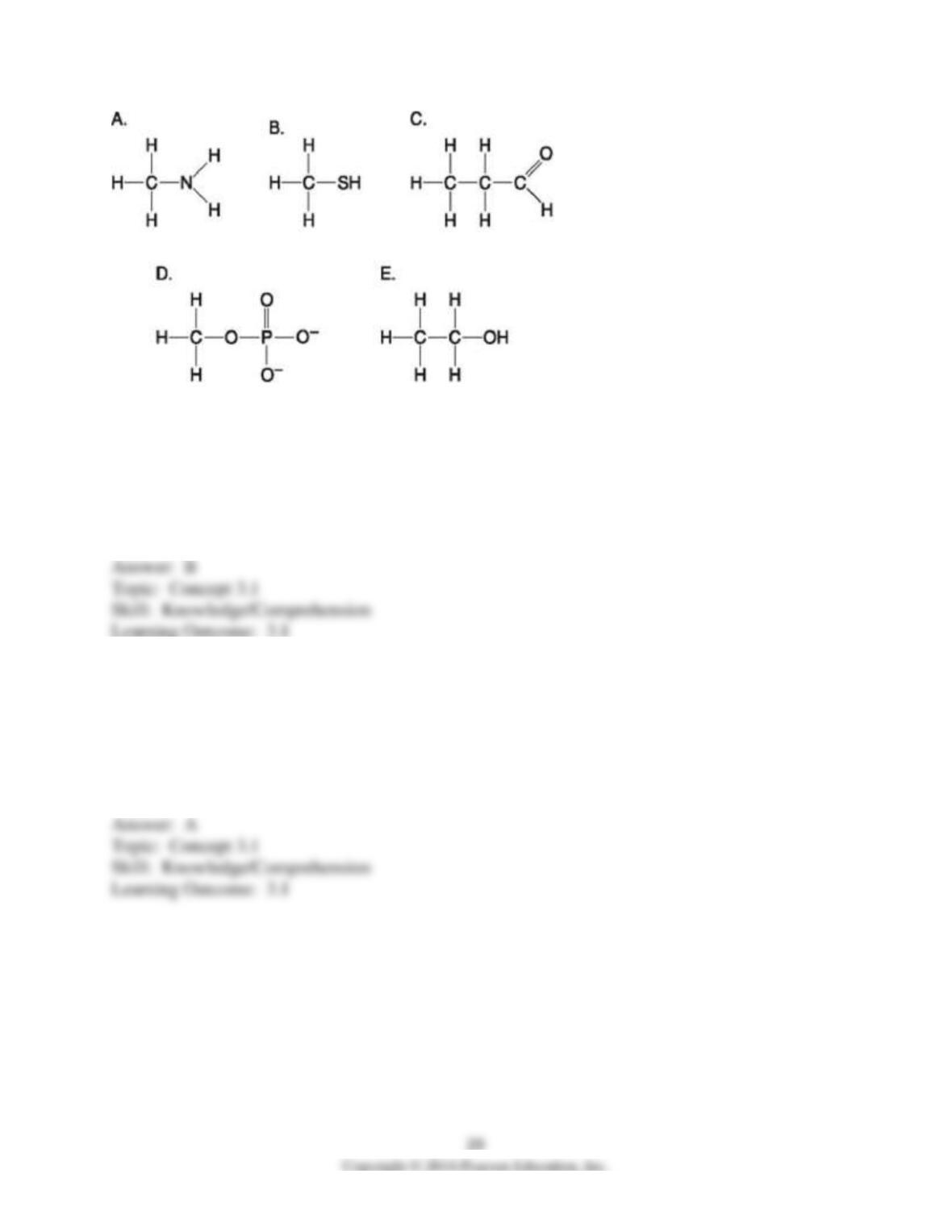
Figure 3.6
20) Which molecule shown in Figure 3.6 is a thiol?
A) A
B) B
C) C
D) D
E) E
21) Which molecule shown in Figure 3.6 contains an amino functional group, but is not an amino
acid?
A) A
B) B
C) C
D) D
E) E

22) Which molecule shown in Figure 3.6 contains a functional group that cells use to transfer
energy between organic molecules?
A) A
B) B
C) C
D) D
E) E
23) Which molecule shown in Figure 3.6 can function as a base?
A) A
B) B
C) C
D) D
E) E
24) Which molecule shown in Figure 3.6 can form a covalent bond between side chains (R
groups) in a polypeptide?
A) A
B) B
C) C
D) D
E) E
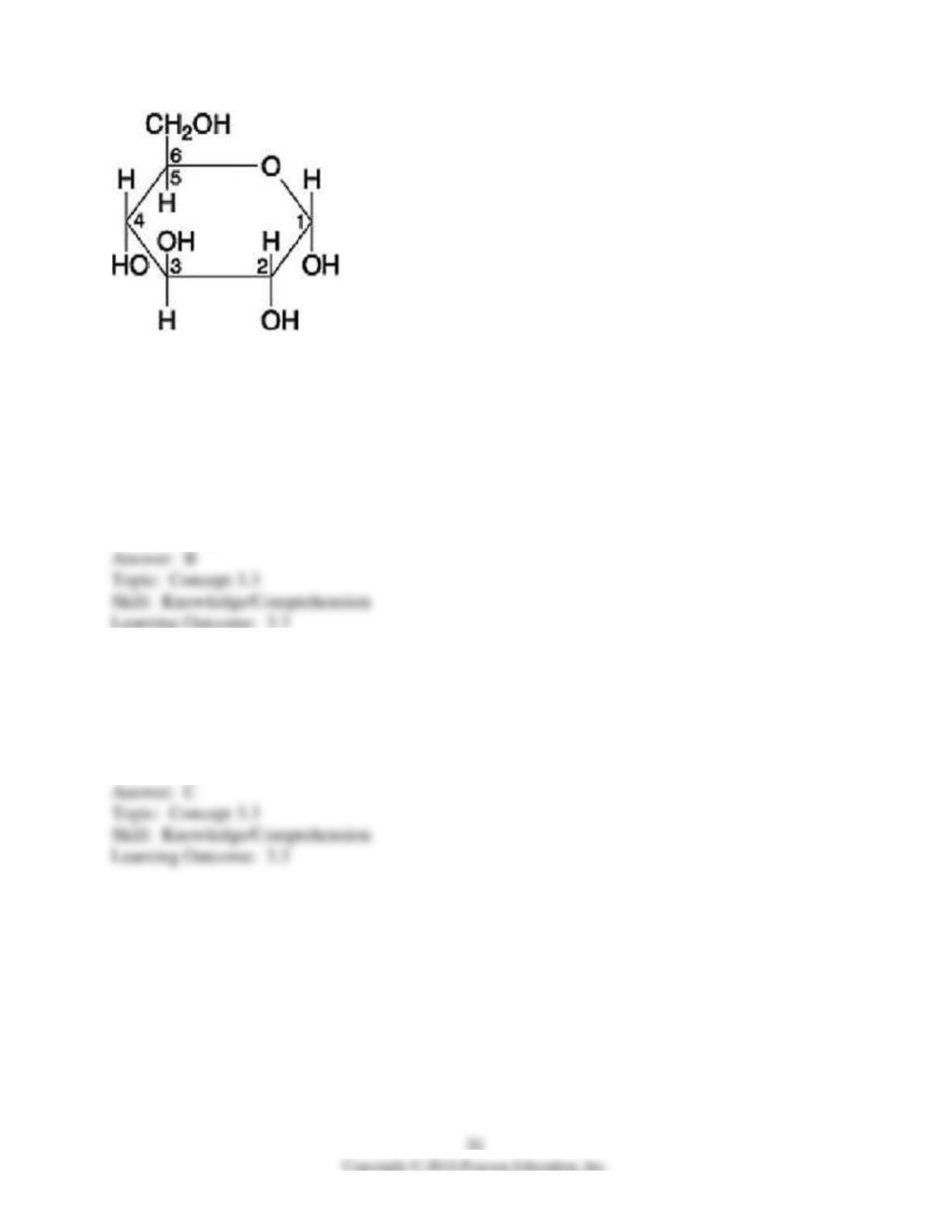
Figure 3.7
25) If two of the molecules shown in Figure 3.7 were linked together, carbon-1 of one molecule
to carbon-4 of the other, the bond that is formed may be found in which of the following
polymers?
A) cellulose
B) glycogen
C) chitin
D) polypeptide
E) nucleic acid
26) Which of the following describes the molecule shown in Figure 3.7?
A) pentose
B) fructose
C) α glucose
D) β glucose
E) ribose
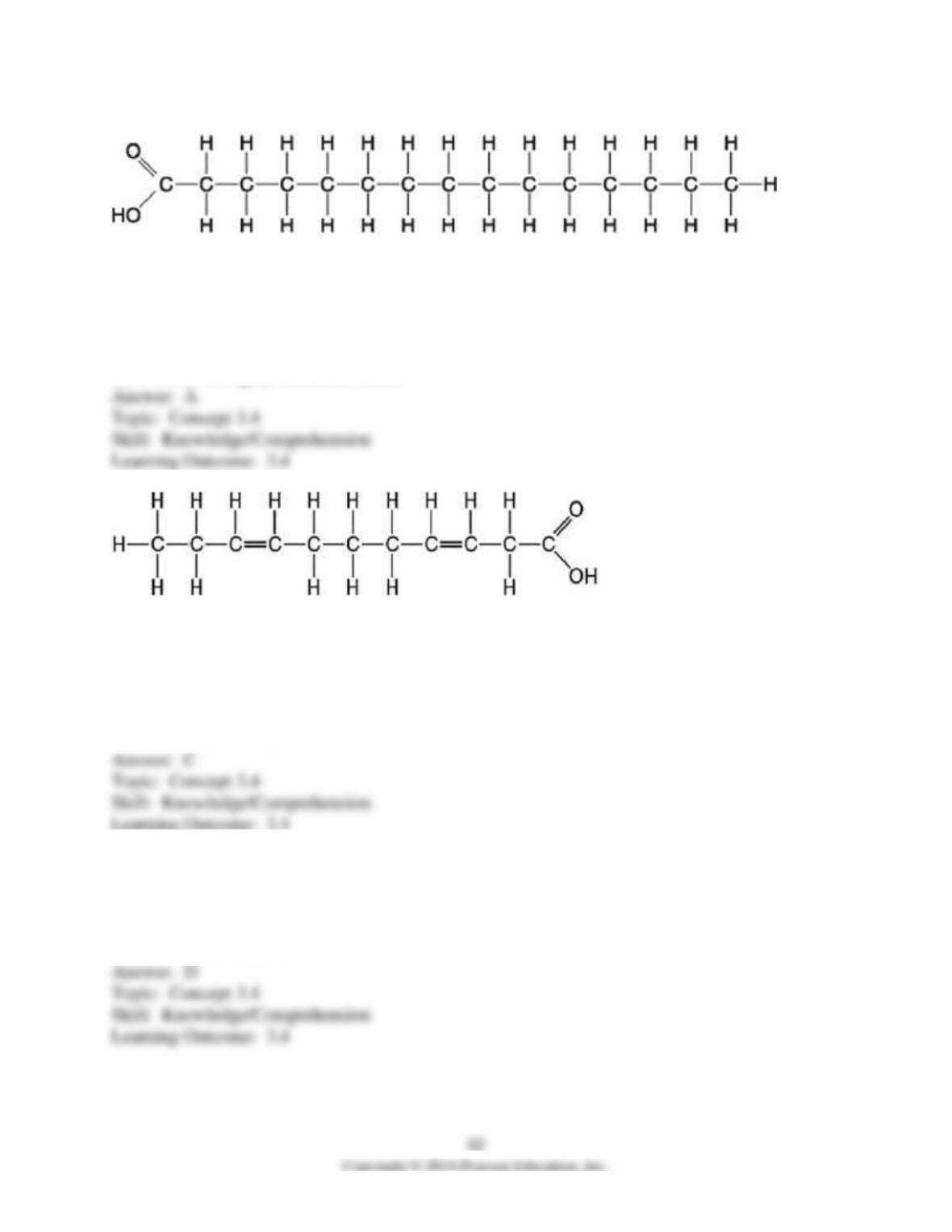
27)
Figure 3.8
Which of the following statements regarding the molecule illustrated in Figure 3.8 is true?
A) It is a saturated fatty acid.
B) It is an entirely nonpolar molecule.
C) Molecules of this type are usually liquid at room temperature.
D) It would be highly soluble in water.
Figure 3.9
28) Which of the following statements regarding the molecule illustrated in Figure 3.9 is true?
A) It is a saturated fatty acid.
B) It is an entirely nonpolar molecule.
C) Molecules of this type are usually liquid at room temperature.
D) It is highly soluble in water.
29) The molecule shown in Figure 3.9 is a(n)
A) polysaccharide.
B) saturated fatty acid.
C) triacylglycerol.
D) unsaturated fatty acid.
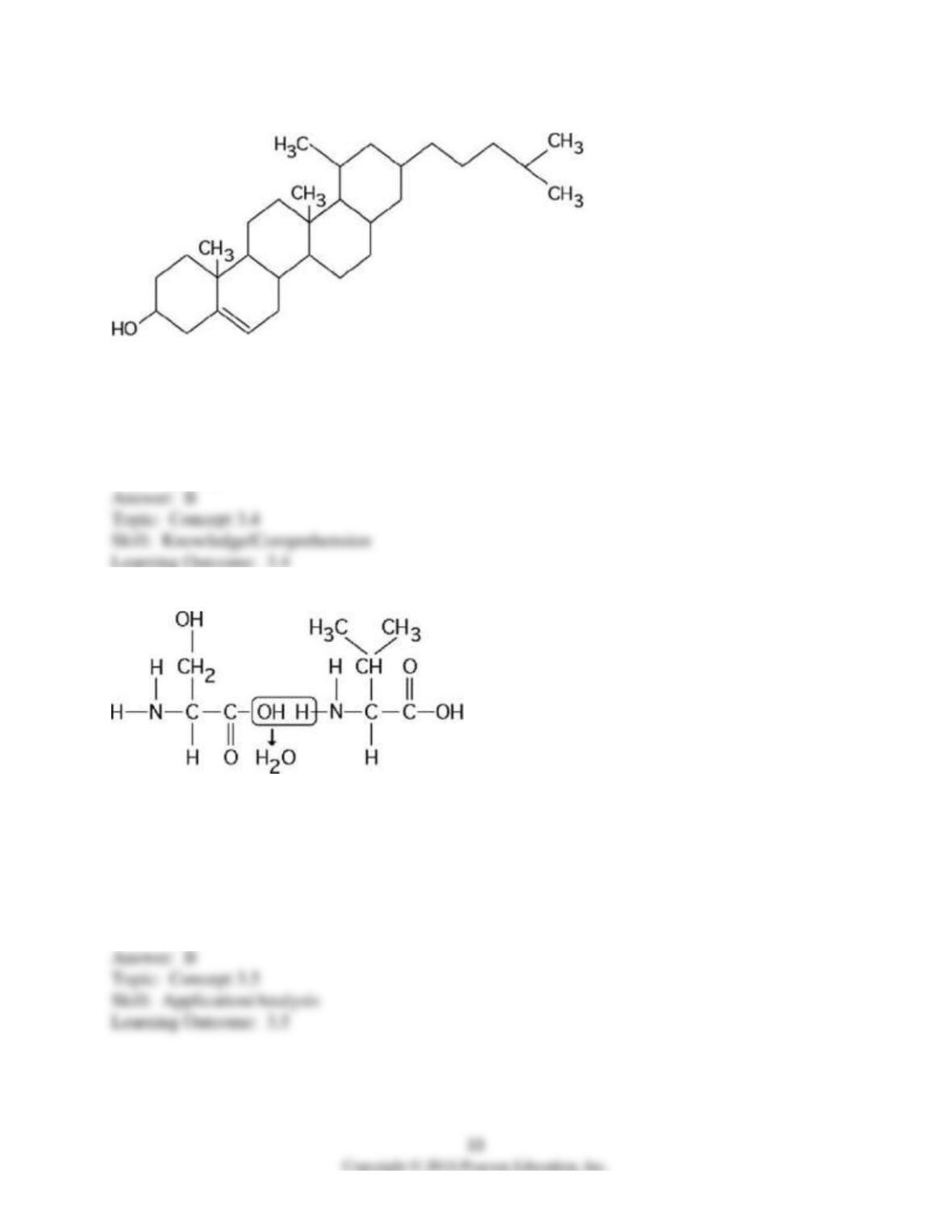
30)
Figure 3.10
What is the structure shown in Figure 3.10?
A) fatty acid molecule
B) steroid molecule
C) triacylglycerol molecule
D) phospholipid molecule
31)
Figure 3.11
Which of the following statements regarding the chemical reaction illustrated in Figure 3.11 is
true?
A) It is a hydrolysis reaction.
B) It results in a peptide bond.
C) It forms a disaccharide.
D) It forms two amino acids.
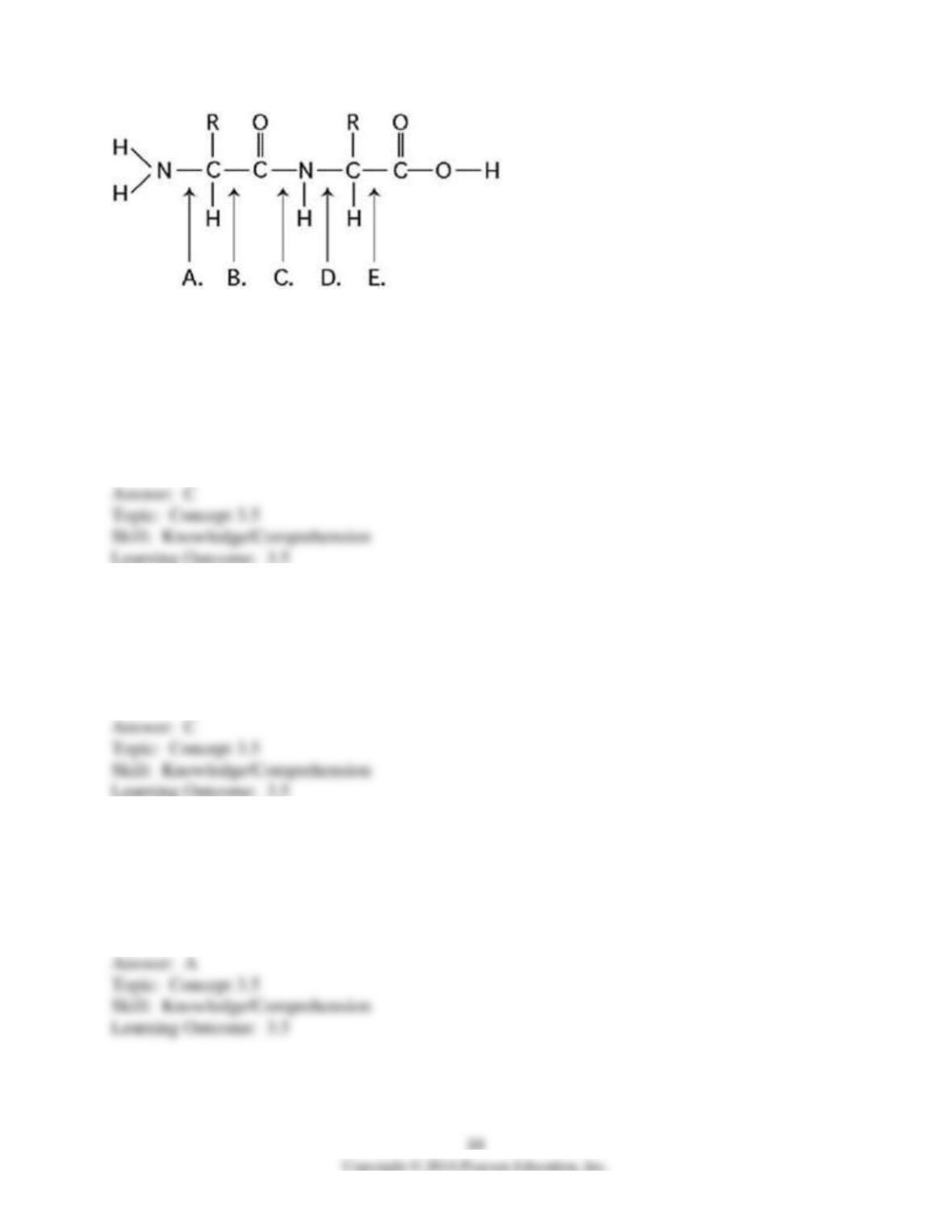
Figure 3.12
32) At which bond in Figure 3.12 would water need to be added to achieve hydrolysis of the
dipeptide, back to its component amino acids?
A) A
B) B
C) C
D) D
E) E
33) Which bond in Figure 3.12 is a peptide bond?
A) A
B) B
C) C
D) D
E) E
34) Which bond in Figure 3.12 is closest to the amino-terminus of the molecule?
A) A
B) B
C) C
D) D
E) E

35) Which bond in Figure 3.12 is farthest from an carbon?
A) A
B) B
C) C
D) D
E) E
3.3 Scenario Questions
1) A chemist wishes to make an organic molecule less acidic. Which of the following functional
groups should be added to the molecule in order to do so?
A) carboxyl
B) sulfhydryl
C) hydroxyl
D) amino
E) phosphate
2) Approximately 32 different monomeric carbohydrate subunits are found in various natural
polysaccharides. Proteins are composed of 20 different amino acids. DNA and RNA are each
synthesized from four nucleotides.
Which class of biological polymer has the greatest functional variety?
A) polysaccharides
B) proteins
C) DNA
D) RNA
3) A new organism is discovered in the forests of Costa Rica. Scientists there determine that the
polypeptide sequence of hemoglobin from the new organism has 72 amino acid differences from
humans, 65 differences from a gibbon, 49 differences from a rat, and 5 differences from a frog.
These data suggest that the new organism is more closely related to
A) humans than to frogs.
B) frogs than to humans.
C) rats than to frogs.
D) humans than to rats.
E) gibbons than to rats.
4) A nutritional supplement developed for athletes is shown to contain only carbon, hydrogen,
and oxygen. Based on these data, you may safely conclude that
A) the food may contain carbohydrates and protein.
B) the food may contain carbohydrates and nucleic acids.
C) the food may contain lipids and protein.
D) the food may contain carbohydrates and lipids, but not protein.
5) A nutritional supplement developed for athletes is shown to contain only carbon, hydrogen,
oxygen, and sulfur. Based on these data, you may safely conclude that
A) the food may contain carbohydrates, lipids, and protein.
B) the food may contain carbohydrates, lipids, and nucleic acids.
C) the food may contain carbohydrates, phospholipids, and protein.
D) the food may contain carbohydrates and lipids, but not protein.

6) A nutritional supplement developed for athletes is shown to contain only carbon, hydrogen,
nitrogen, and oxygen. Based on these data, you may safely conclude that
A) the food does not contain protein.
B) the food does not contain nucleic acids.
C) the food does not contain carbohydrates.
D) the food does not contain lipids.
7) A scientist suspects that food in an ecosystem may have been contaminated by radioactive
nitrogen over a period of several months. Which of the following should be isolated from
mammals living in the ecosystem and examined for radioactivity in order to test the hypothesis?
A) glycogen
B) DNA
C) hair
D) fat
8) A food company wishes to convert corn oil into a spread that is solid at room temperature.
One way to accomplish this goal would be to
A) remove hydrogens, increasing the number of double bonds in the oil molecules.
B) remove hydrogens, decreasing the number of double bonds in the oil molecules.
C) add hydrogens, increasing the number of double bonds in the oil molecules.
D) add hydrogens, decreasing the number of double bonds in the oil molecules.
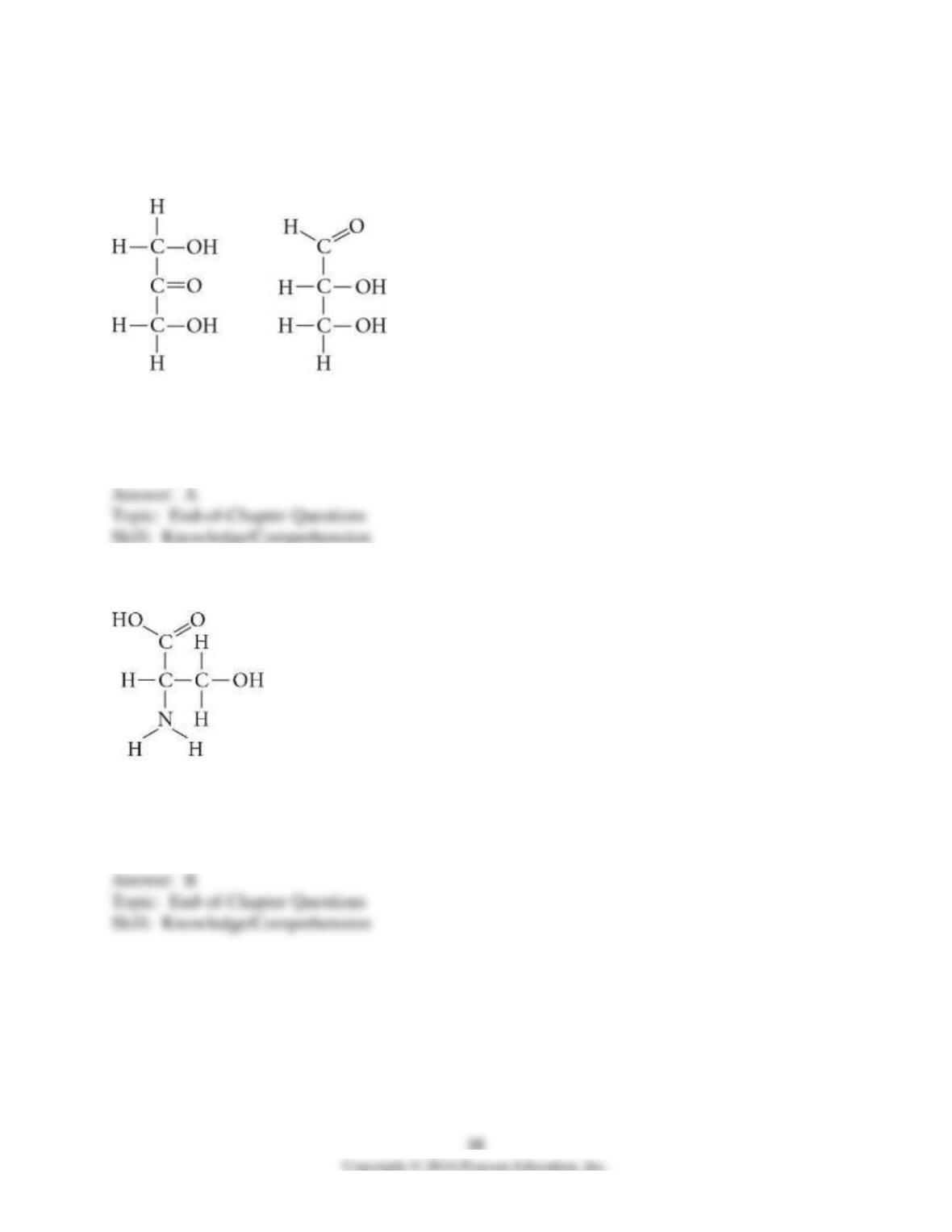
3.4 End-of-Chapter Questions
1) Choose the term that correctly describes the relationship between these two sugar molecules:
A) structural isomers
B) cis-trans isomers
C) enantiomers
D) isotopes
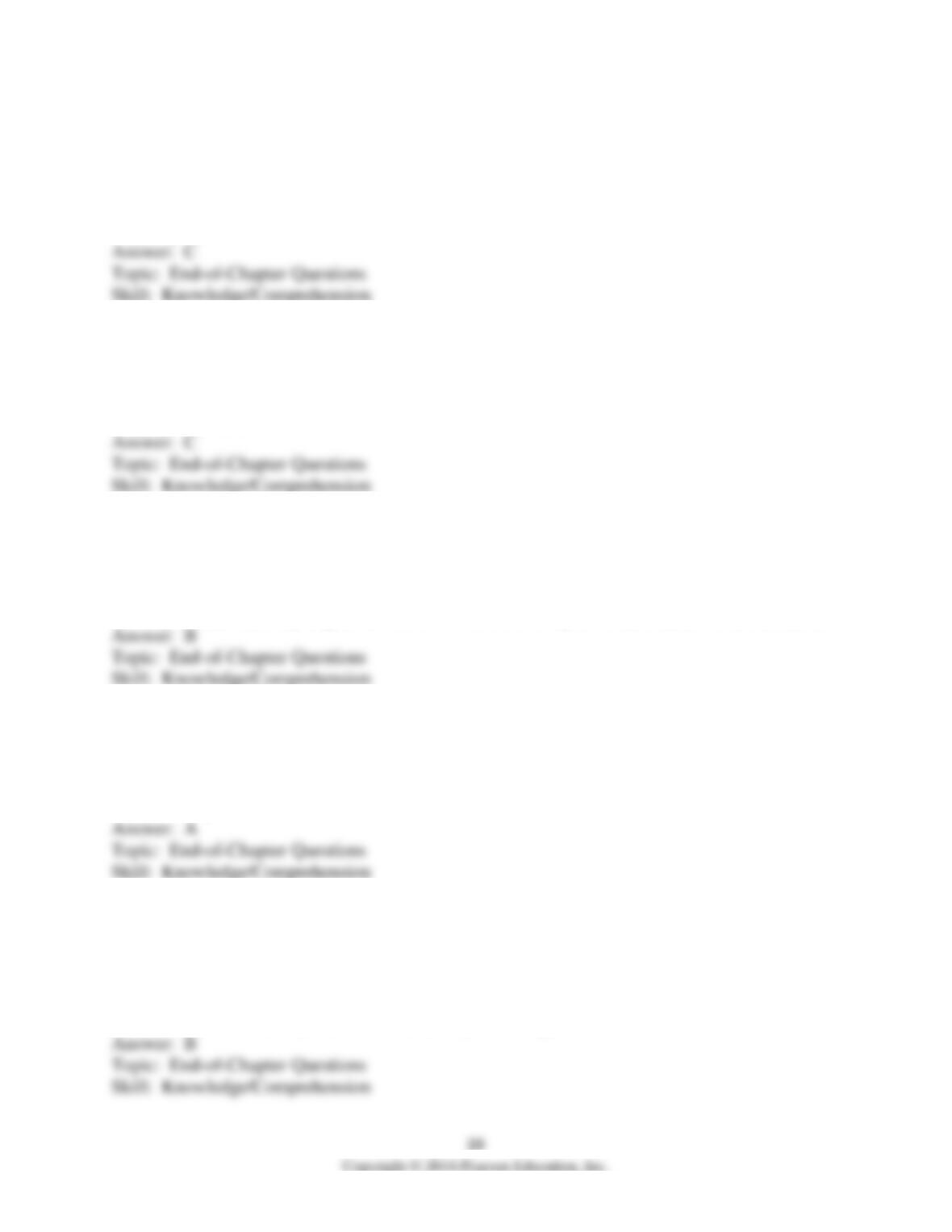
2) Which functional group is not present in this molecule?
A) carboxyl
B) sulfhydryl
C) hydroxyl
D) amino
3) Which chemical group is most likely to be responsible for an organic molecule behaving as a
base (see Concept 2.5)?
A) hydroxyl
B) carbonyl
C) amino
D) phosphate
4) Which of the following categories includes all others in the list?
A) disaccharide
B) starch
C) carbohydrate
D) polysaccharide
5) Which of the following statements concerning unsaturated fats is true?
A) They are more common in animals than in plants.
B) They have double bonds in their fatty acid chains.
C) They generally solidify at room temperature.
D) They contain more hydrogen than do saturated fats having the same number of carbon atoms.
6) The structural level of a protein least affected by a disruption in hydrogen bonding is the
A) primary level.
B) secondary level.
C) tertiary level.
D) quaternary level.
7) Enzymes that break down DNA catalyze the hydrolysis of the covalent bonds that join
nucleotides together. What would happen to DNA molecules treated with these enzymes?
A) The two strands of the double helix would separate.
B) The phosphodiester linkages of the polynucleotide backbone would be broken.
C) The pyrimidines would be separated from the deoxyribose sugars.
D) All bases would be separated from the deoxyribose sugars.

8) Which of the following hydrocarbons has a double bond in its carbon skeleton?
A) C3H8
B) C2H6
C) C2H4
D) C2H2
9) The molecular formula for glucose is C6H12O6. What would be the molecular formula for a
polymer made by linking ten glucose molecules together by dehydration reactions?
A) C60H120O60
B) C60H102O51
C) C60H100O50
D) C60H111O51