
39) Which of the following triggers flowering for plants sensitive to photoperiod?
A) temperature
B) night length
C) day length
D) intensity of sunlight
40) Which of the following best describe(s) the dependencies of most flowering plants?
I) Many depend on insects or other animals for pollination.
II) Many depend on insects or other animals for seed dispersal.
III) Many depend on fungi to help them acquire nutrients.
A) I
B) II
C) I and III
D) I, II, and III
41) Across the globe, billions of people eat rice. In order to make rice grains (the seed), a rice
plant must flower and be pollinated. Rice plants flower only after days become shorter (i.e.,
summer to autumn). What is the best classification for rice?
A) long night
B) short night
C) night neutral
D) long day

42) Oats are eaten by humans as oatmeal or rolled oats, and as feed for livestock such as cattle.
In order for an oat plant to make the part we eat (the seed), it must flower and be pollinated.
Typically, oat plants flower when days are lengthening (i.e., late spring to early summer). What
is the best classification for oat plants?
A) long night
B) short night
C) night neutral
D) short day
43) Three very popular strawberry cultivars grown by farmers in the United States are Earliglow,
Ozark Beauty, and Tristar. Earliglow produces all of its fruit in the early summer (June-bearing).
Ozark Beauty produces fruit from mid to late summer (everbearing). Tristar produces fruit all
summer long, starting when conditions become favorable for flowering and fruit production.
What is the best classification for these three strawberry cultivars?
A) Earliglow: long night; Ozark Beauty: short night; Tristar: night neutral
B) Earliglow: short night; Ozark Beauty: short night; Tristar: night neutral
C) Earliglow: night neutral; Ozark Beauty: short night; Tristar: long night
D) Earliglow: short night; Ozark Beauty: long night; Tristar: long neutral
29.2 Art Questions
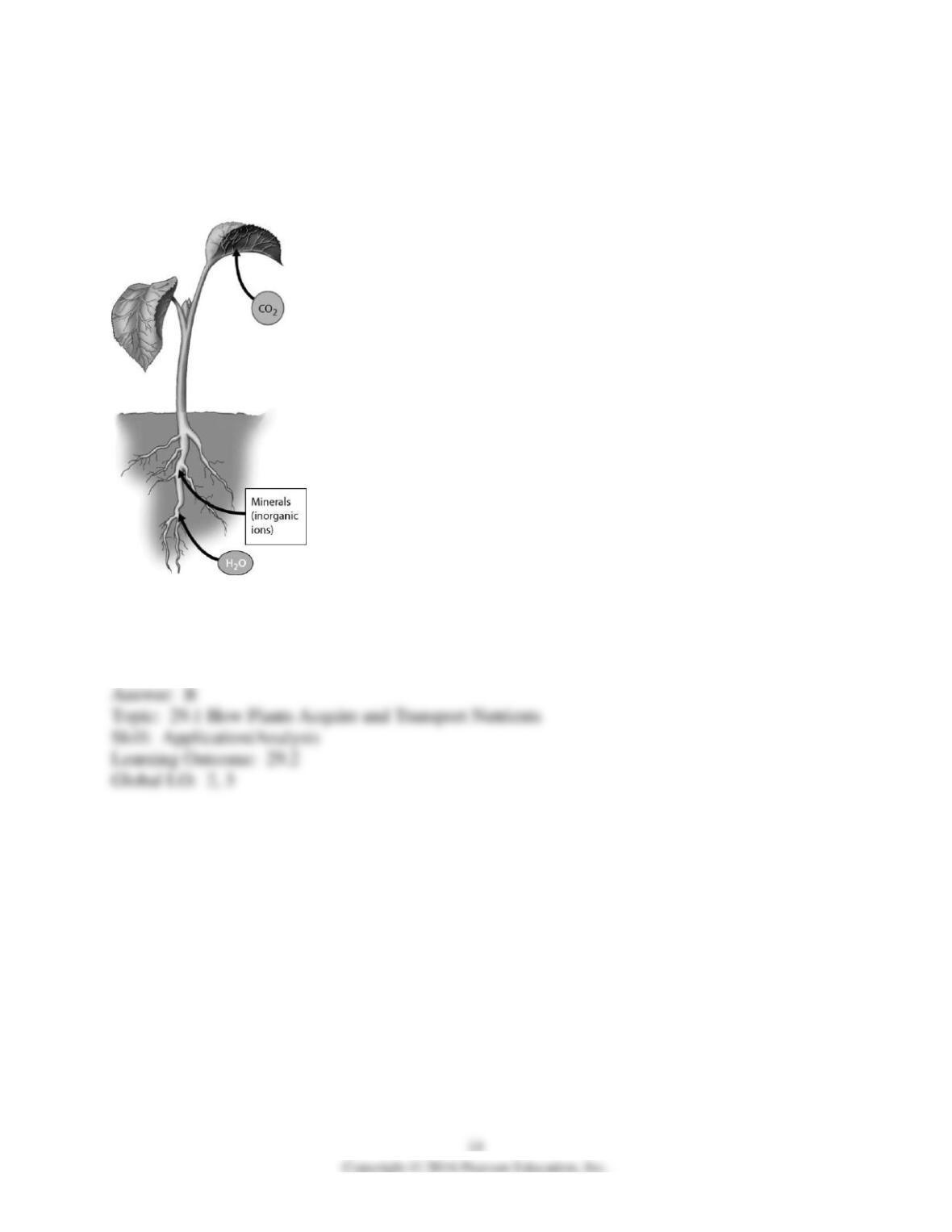
1) Examine the figure below. Which of the following is the site of carbon dioxide uptake by a
plant?
A) root hairs
B) stomata
C) rhizomes
D) internodes
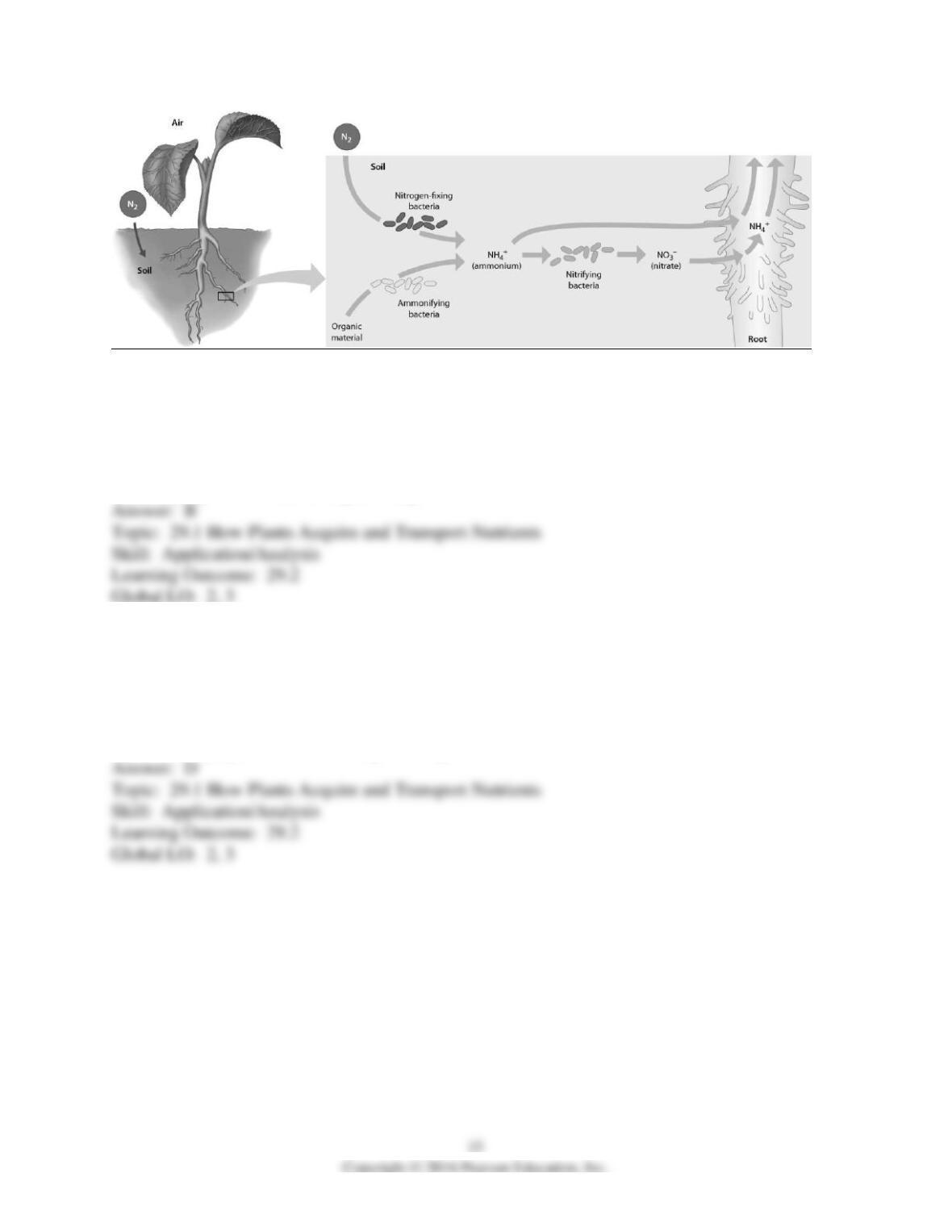
2) Examine the figure above. Which of the following add ammonium to the soil by decomposing
organic matter?
A) nitrifying bacteria only
B) ammonifying bacteria only
C) nitrogen-fixing bacteria only
D) nitrifying bacteria and nitrogen fixing bacteria
3) In the figure above, which of the following produce nitrogen in a form that can be used
directly by the plant, without need for conversion?
A) nitrifying bacteria only
B) ammonifying bacteria only
C) nitrogen-fixing bacteria only
D) ammonifying bacteria and nitrogen fixing bacteria
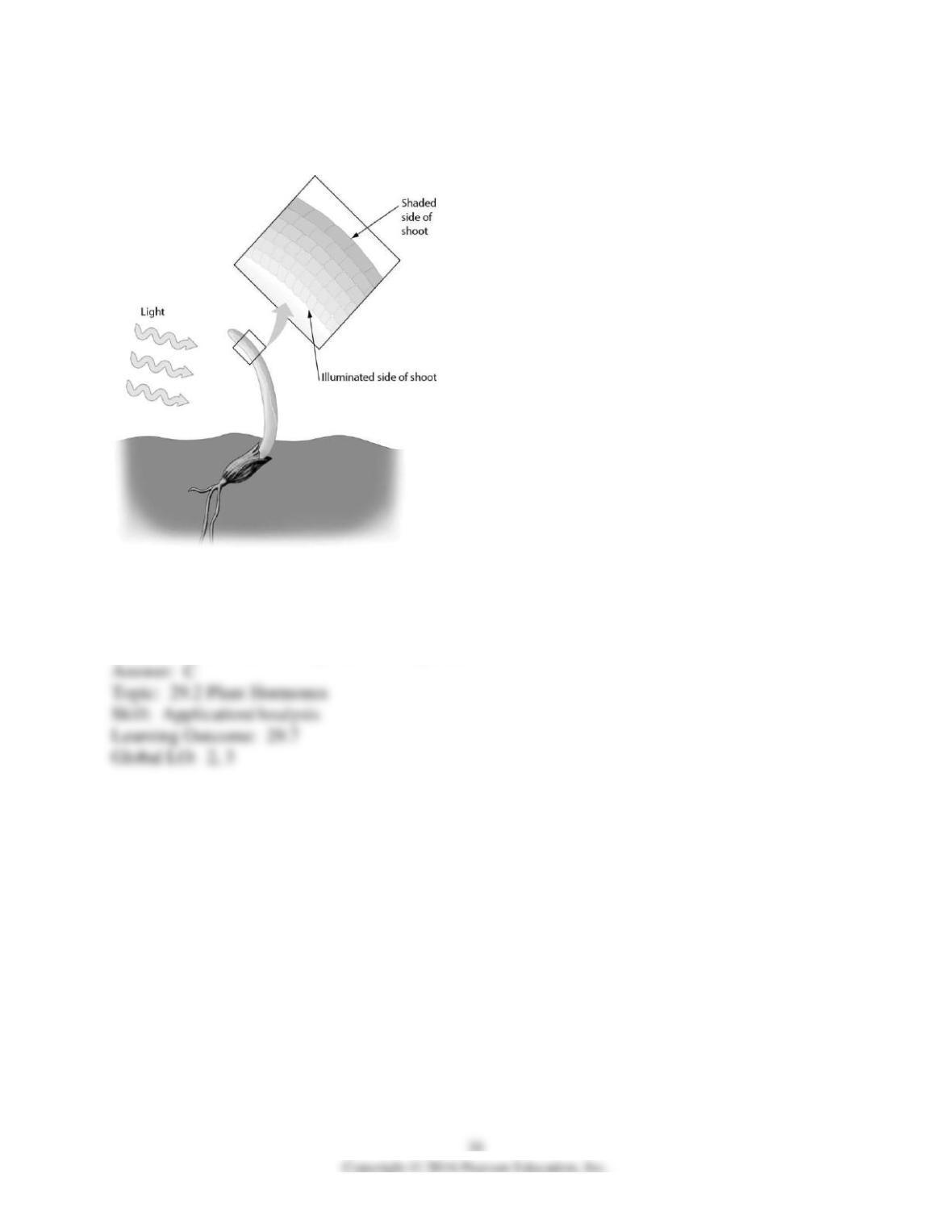
4) Examine the figure below. When considering the shaded side of a grass shoot, which of the
following best describes why it bends toward the light?
A) Reduction in auxin levels allows gibberellins to promote cell elongation.
B) Reduction in gibberellin levels allows auxin to promote cell elongation.
C) Increase in auxin levels promotes cell elongation.
D) Increase in auxin levels promotes cell proliferation.
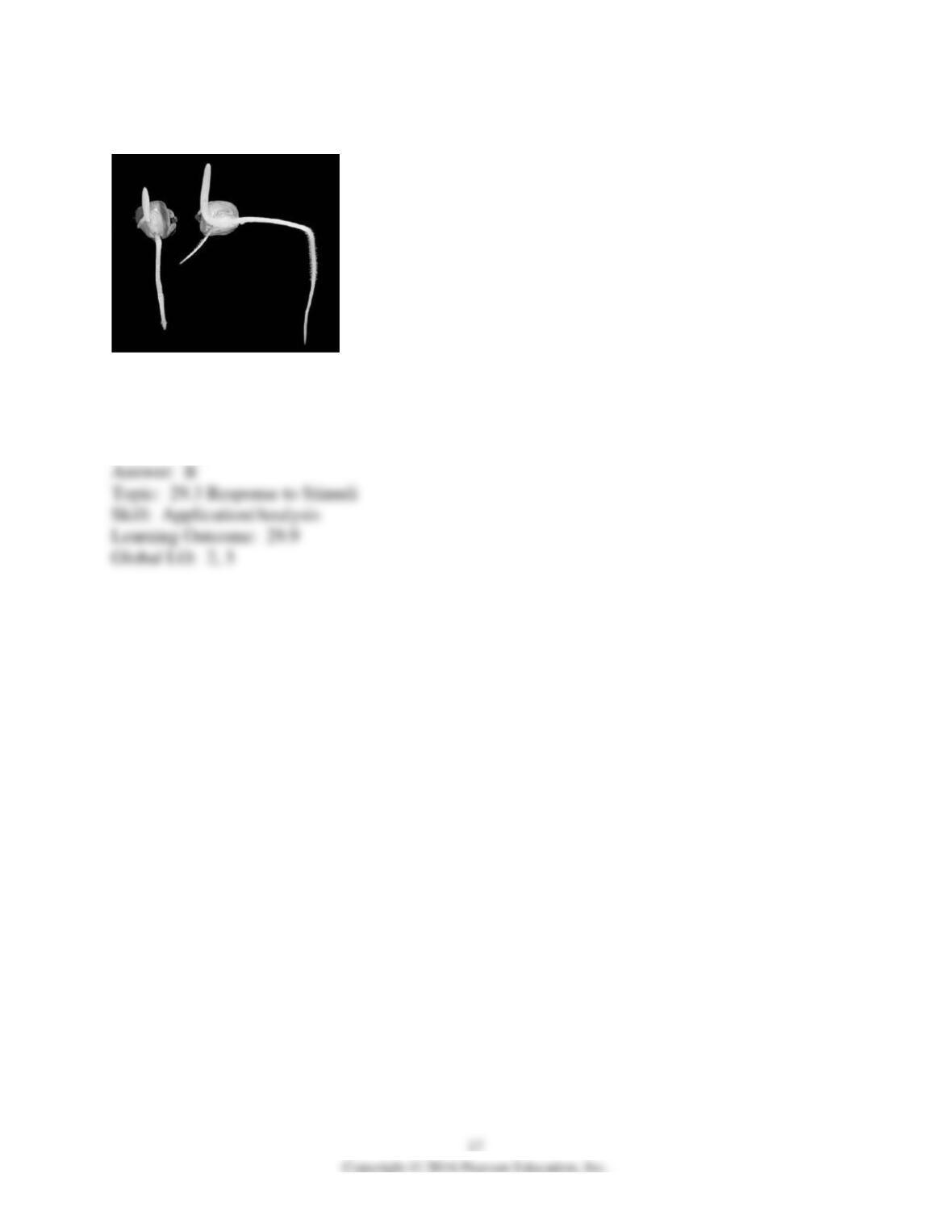
5) The figure below shows plants grown in the dark, and illustrates ________ in plants.
A) photoperiod
B) gravitropism
C) thigmotropism
D) phototropism

6) The figure below shows plants originally grown in the dark, and then a light is added on one
side only (arrow). Predict the response of the plants to the addition of the light source.
A) Auxin becomes concentrated on the lighted side of the plants, and the plants begin to grow
toward the light.
B) Auxin becomes concentrated on the darker side of the plants, and the plants begin to grow
toward the light.
C) Auxin becomes concentrated on the lighted side of the plants, and the plants begin to grow
away from the light.
D) Auxin becomes concentrated on the darker side of the plants, and the plants begin to grow
away from the light.

7) A scientist finds seeds of an unknown plant on top of the soil in a desert. She measures the
concentration of two hormones in these seeds. After it rains, she collects more of these seeds,
and finds that the concentration of the two hormones has changed. A graph of her results is
shown above. Identify the most likely hormones measured by the scientist.
A) hormone 1: gibberellin; hormone 2: cytokinin
B) hormone 1: auxin; hormone 2: ethylene
C) hormone 1: abscisic acid; hormone 2: gibberellin
D) hormone 1: ethylene; hormone 2: auxin
8) A scientist finds seeds of an unknown plant on top of the soil in a desert. She measures the
concentration of two hormones in these seeds. After it rains, she collects more of these seeds,
and finds that the concentration of the two hormones has changed. A graph of her results is
shown above. If the scientist returns to the desert to collect more seeds, a few days later, what
should she observe?
A) The seeds that are still in the desert will be dormant.
B) The seeds that are still in the desert will be germinating.
C) The seeds that are still in the desert will be dead.
D) The seeds that are still in the desert will have increased levels of hormones 1 and 2.

29.3 Scenario Questions
Read the following scenario to answer the following questions.
Nitrogen shortage is a common nutritional problem for plants. In crops, a nitrogen deficiency can
result in stunted growth as well as lower nutritional content. Farmers sometimes apply fertilizers
containing nitrogen as well as other essential nutrients, such as phosphorus and potassium.
Compost can also be used to fertilize soils. Compost consists of vegetable matter that adds
nutrients to soil as it is decomposed by microorganisms, fungi, and animals. Certain plants,
including legumes such as peas and beans, house nitrogen-fixing bacteria in swellings called
“root nodules.” The bacteria have enzymes that help convert atmospheric N2 to ammonium ions
that can be readily used by the plants. The plant, in turn, provides the bacteria with other
nutrients. When conditions are favorable, root nodule bacteria fix so much nitrogen that the
nodules secrete excess ammonia.
1) Some farmers practice crop rotation, alternating between planting nonlegumes such as corn or
wheat one year and legumes the next year. What is the advantage of crop rotation?
A) The legumes in the rotation will transfer nitrogen, phosphorus, and potassium to the other
crop plants.
B) Planting legumes enriches the soil for the next year when root nodule bacteria fix so much
nitrogen that excess ammonia is secreted into the soil.
C) The nitrogen-fixing bacteria in legumes can migrate to nonlegume crop plants and provide
them with nitrogen.
D) Any nitrogen fertilizer that is applied to the soil will be converted into ammonium ions by the
nitrogen-fixing bacteria.
2) Which approach could an organic farmer use to deal with nitrogen deficiency?
A) plant legumes in alternate years and fertilize the soil with compost
B) apply synthetic fertilizers that provide nitrogen
C) plant legumes in alternate years and use synthetic fertilizers
D) use genetically modified plants that require less nitrogen

Read the following scenario to answer the following questions.
In the late 1800s, Charles Darwin and his son Francis conducted the first experiments on
phototropism. Several years later, their work was furthered by Peter Boysen-Jensen, Arpad Paal,
and Frits Went. Peter Boysen-Jensen separated the tip of grass shoots from the rest of the plant
using either tiny blocks of agar (a gelatin) or a mica wafer (an impervious rock). Like the
Darwins, Boysen-Jensen noticed that the grass did not grow toward a light without its tips.
However, when he separated the tip from the rest of the plant using agar, the grass would grow
toward a light. The grass would not grow toward a light if the tip of the shoot was separated
using a mica wafer. Arpad Paal cut off the tips of grass shoots that were growing in the dark. He
placed these cut tips back on the shoots, but with only part of the tip covering the cut surface,
and found that the plants grew, in the dark, in the opposite direction from the side with the tip
covering it. Lastly, Frits Went removed the tips of many grass shoots and placed them on a large
block of agar for a few hours. Then, he cut up the agar block, and was able to make grass shoots
without any tips at all grow toward a light by putting these agar blocks on the cut surfaces of the
shoots (i.e., no tips were placed back on the shoots, only the agar).
3) Boysen-Jensen also used the mica to separate a tip of a grass shoot only partially, by cutting
the tip halfway and inserting a wafer of mica into the cut. If this experiment supported the
Darwins’ hypothesis, what would Boysen-Jensen have observed?
A) The grass shoot would not grow toward a light.
B) The grass shoot would grow toward a light when the mica wafer was on the side of the grass
that was facing the light.
C) The grass shoot would grow toward a light when the mica wafer was on the side of the grass
that was shaded from the light.
D) The grass shoot would grow toward a light no matter which direction the light was coming
from.
4) If Paal grew his plants using a light source that was directly overhead, what should he have
observed?
A) The grass shoot would not grow.
B) The grass shoot would grow upward and straight.
C) The grass shoot would grow in the opposite direction from the side with the tip covering the
cut surface.
D) The grass shoot would grow in the same direction as the side with the tip covering the cut
surface.

5) If Wents placed his agar blocks only halfway on the cut surfaces of grass shoots with their tips
removed, what should he have observed?
A) The grass shoot would not grow toward a light.
B) The grass shoot would grow toward a light when the agar block was on the side of the grass
that was facing the light.
C) The grass shoot would grow toward a light when the agar block was on the side of the grass
that was shaded from the light.
D) The grass shoot would grow toward a light no matter which direction the light was coming
from.
6) Considering the experiments of the Darwins, Boysen-Jensen, Paal, and Went, what do you
conclude about phototropism?
A) We still do not know the mechanism for phototropism.
B) The substance that regulates phototropism is produced in the tips of plants, and causes the
same response even when it comes from an external source (not from the same individual).
C) For a plant to bend toward a light source, the substance that regulates phototropism must be
able to move into cells on the same side as the light source.
D) The substance that regulates phototropism is distributed throughout a plant equally, but cells
on the side away from the light source are the only ones that respond to the substance.