44) The diploid number for the tomato, a eudicot, is 24. One of its pollen grains has ________
chromosomes, and the nutritive tissue of the seed has ________ chromosomes.
A) 12… 12
B) 12… 24
C) 24… 24
D) 24… 36
45) Unlike angiosperms, gymnosperms like pines have single instead of double fertilization, but
otherwise have an identical life cycle. What structure should have the greatest difference
between angiosperms and gymnosperms?
A) egg cell
B) seedling
C) seed
D) leaf cell
46) Which of the following is an example of flowering plant/animal interdependence?
I) Most angiosperms depend on insects, birds, or mammals for pollination.
II) Most angiosperms depend on insects, birds, or mammals for seed dispersal.
III) Most land animals depend on angiosperms for food.
A) I only
B) I and II
C) III only
D) I, II, and III
47) Bermudagrass is a plant that is commonly used on golf courses. It has a fibrous root system,
and its leaf veins are parallel. Because it is mowed on a regular basis in golf courses, it spreads
via horizontal stems that root at the nodes, rather than by seed. It can live for many years. What
is the best classification for bermudagrass on a golf course?
A) It is a perennial monocot that reproduces asexually.
B) It is an annual eudicot that reproduces asexually.
C) It is a perennial eudicot that reproduces sexually.
D) It is an annual monocot that reproduces sexually.
48) Humans domesticated the rose from a wild ancestor with large, scented flowers. Why might
fragrant chemicals in flowers be adaptive for wild roses?
A) They attract herbivores.
B) They repel seed dispersal agents.
C) They attract pollinators.
D) They prevent seed germination.
49) In a sporophyte of an angiosperm, growth occurs at ________ via ________.
A) meristems… mitosis
B) meristems… meiosis
C) flowers… fertilization
D) seeds… dispersal
28.2 Art Questions
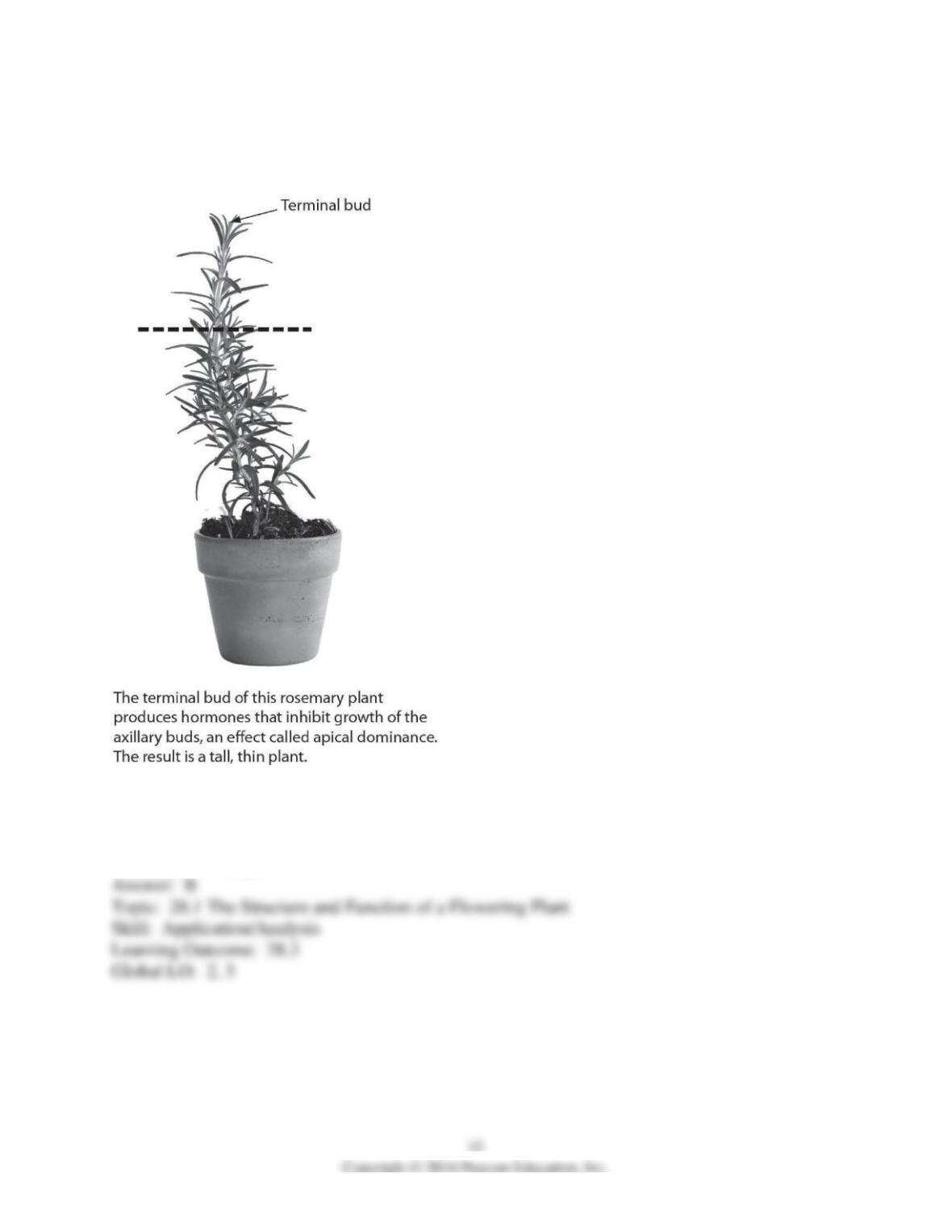
1) What is the likely effect of pruning a plant at the dotted line?
A) The plant will grow taller.
B) The plant will grow bushier.
C) The plant will produce flowers.
D) The plant will grow more roots.
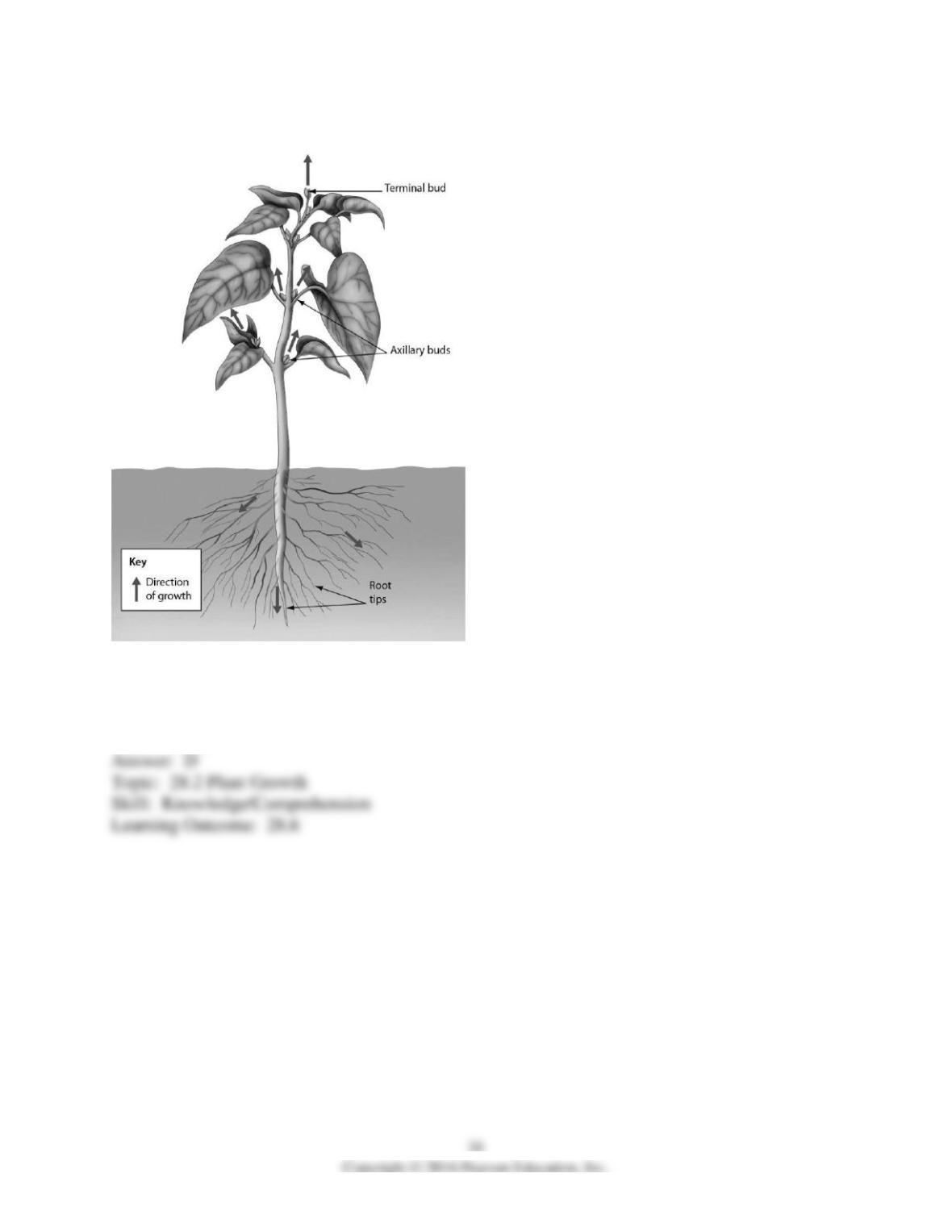
2) The arrows in the figure below illustrate ________.
A) germination
B) secondary growth
C) meiosis
D) primary growth
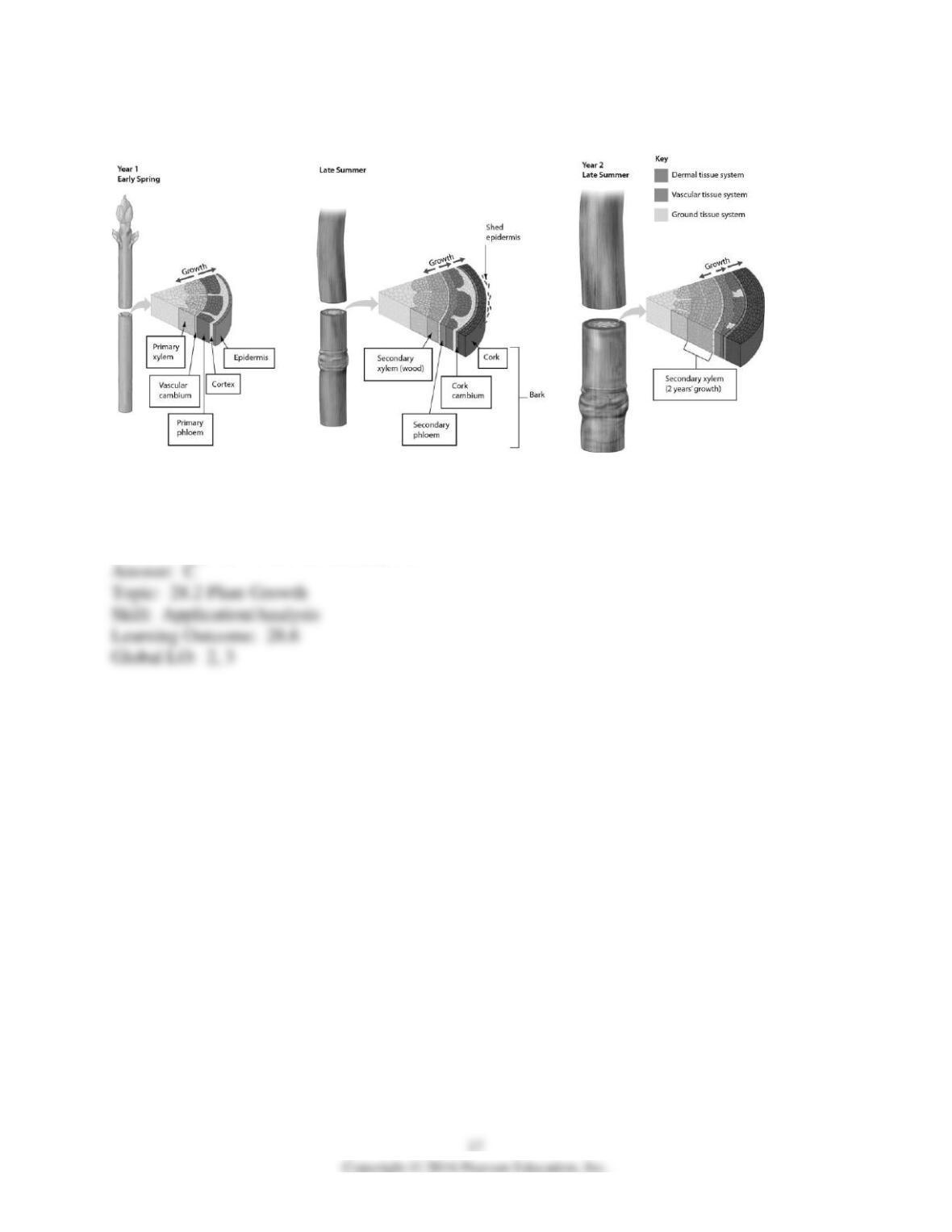
3) Examine the figure below. Secondary growth involves cell division in the ________.
A) cork cambium and apical meristem
B) vascular cambium and apical meristem
C) vascular cambium and cork cambium
D) secondary xylem and secondary phloem
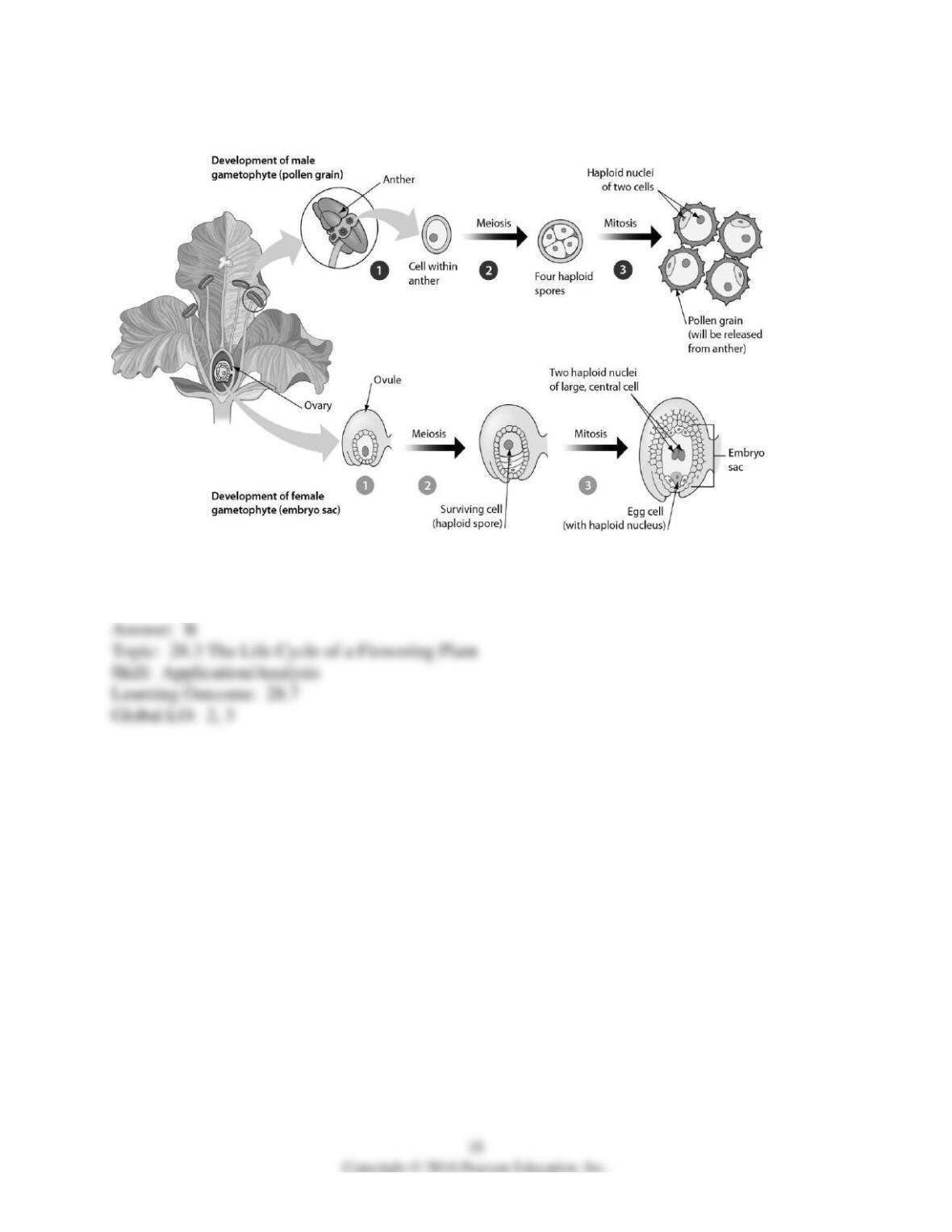
4) Examine the figure below. What process has to occur to produce a haploid embryo sac?
A) meiosis
B) meiosis followed by mitosis
C) mitosis followed by meiosis
D) mitosis
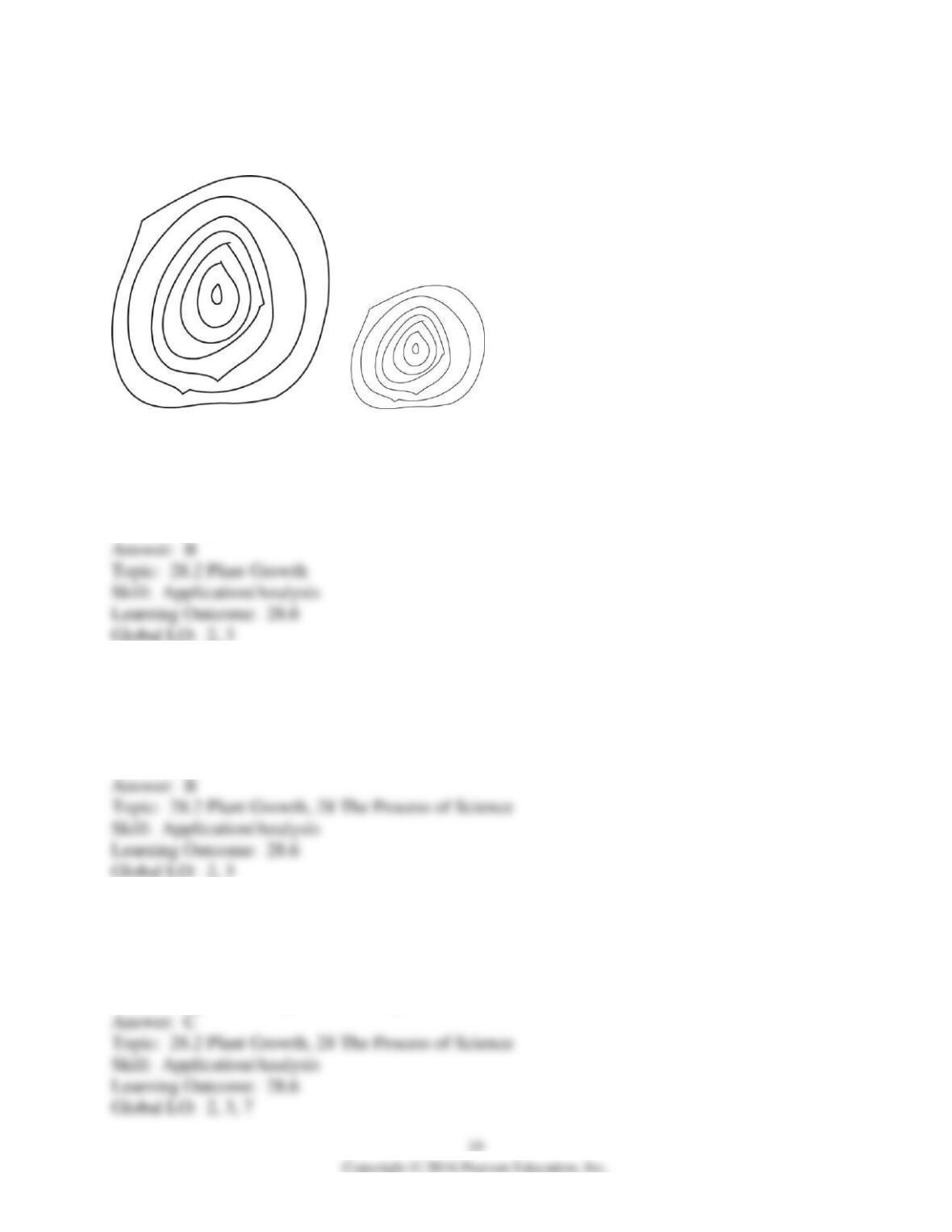
Please refer to the following art of the cross-sections of two trees to answer the following
questions.
5) How old are these trees?
A) 3.5 years old
B) 7 years old
C) 14 years old
D) 28 years old
6) When were the cross-sections of these trees made?
A) before completion of the first year of growth
B) in the spring
C) later in the summer
D) in the winter
7) These trees most likely grew in an environment with ________.
A) constant cold temperatures
B) constant warm temperatures
C) alternating warm and cold seasons
D) It is not possible to predict the temperatures of the trees’ environment.
8) Which statement CORRECTLY compares the growth of these two trees?
A) The two trees grew at the same rate.
B) The tree on the left grew at a slower rate than the tree on the right.
C) The tree on the left grew at a faster rate than the tree on the right.
D) The growth of the two trees cannot be compared with the images shown.
28.3 Scenario Questions
Read the following scenario to answer the following questions.
In late 2006, bee workers in the United States started to notice a disturbing phenomenon: the
sudden disappearance of honeybees from commercial hives. This mysterious condition was
called “colony collapse disorder,” and it has caused a drastic reduction in commercial honeybee
populations all over the country. It is estimated that one-third of our food supply relies on bees
and is in danger. Crops that rely most heavily on honeybees include apples, almonds, blueberries,
and pumpkins. If colony collapse disorder cannot be cured or treated effectively, farmers may
have to turn to other insects, perhaps other bee species or even moths.
1) Without honeybees, which process in the life cycle of plants such as apples, almonds,
blueberries, and pumpkins is most affected?
A) seed dispersal
B) secondary growth
C) pollination
D) seed germination
2) Which plant structure is adapted for attracting beneficial insects such as honeybees?
A) axillary bud
B) terminal bud
C) flower
D) petiole
Read the following scenario to answer the following questions.
The North American beaver is a large rodent that builds dams to convert freshwater streams into
ponds. Beavers build their dams out of trees, which they cut down using their front teeth.
Beavers also eat the leaves and bark of trees, as well as the starchy roots of water lilies.
3) As a beaver chews from the outside to the inside of a tree, in what order does it encounter
plant tissues?
A) secondary xylem ⇒ secondary phloem ⇒ cork ⇒ cork cambium ⇒ vascular cambium
B) cork cambium ⇒ cork ⇒ secondary xylem ⇒ vascular cambium ⇒ secondary phloem
C) cork ⇒ cork cambium ⇒ vascular cambium ⇒ secondary xylem ⇒ secondary phloem
D) cork ⇒ cork cambium ⇒ secondary phloem ⇒ vascular cambium ⇒ secondary xylem
4) When a beaver is eating bark, what plant structures is it ingesting?
A) secondary phloem, cork cambium, and cork
B) secondary xylem, secondary phloem, and cork cambium
C) primary phloem, cortex, and endodermis
D) primary xylem, vascular cambium, and primary phloem
5) When a beaver is eating leaves, what plant structure(s) is it ingesting?
I) mesophyll
II) parenchyma
III) cork
A) I
B) II
C) III
D) I and II
6) Water lilies store carbohydrates in their roots, which is why beavers like to eat water lily
roots. What type of plant cells store these carbohydrates?
A) guard cells
B) sclerenchyma cells
C) parenchyma cells
D) collenchyma cells
7) Beavers dams are sturdy, because the part of a tree that provides structural support when the
tree is alive lends its strength to the dam, even after the tree is dead. What part of a tree provides
this structural support?
A) heartwood
B) bark
C) collenchyma
D) parenchyma
8) Water lily shoots and roots have very little structural support because this support is not
needed in aquatic habitats. What structures would you be LEAST likely to see in a water lily
stem?
A) epidermis
B) parenchyma
C) sclerenchyma
D) tracheids
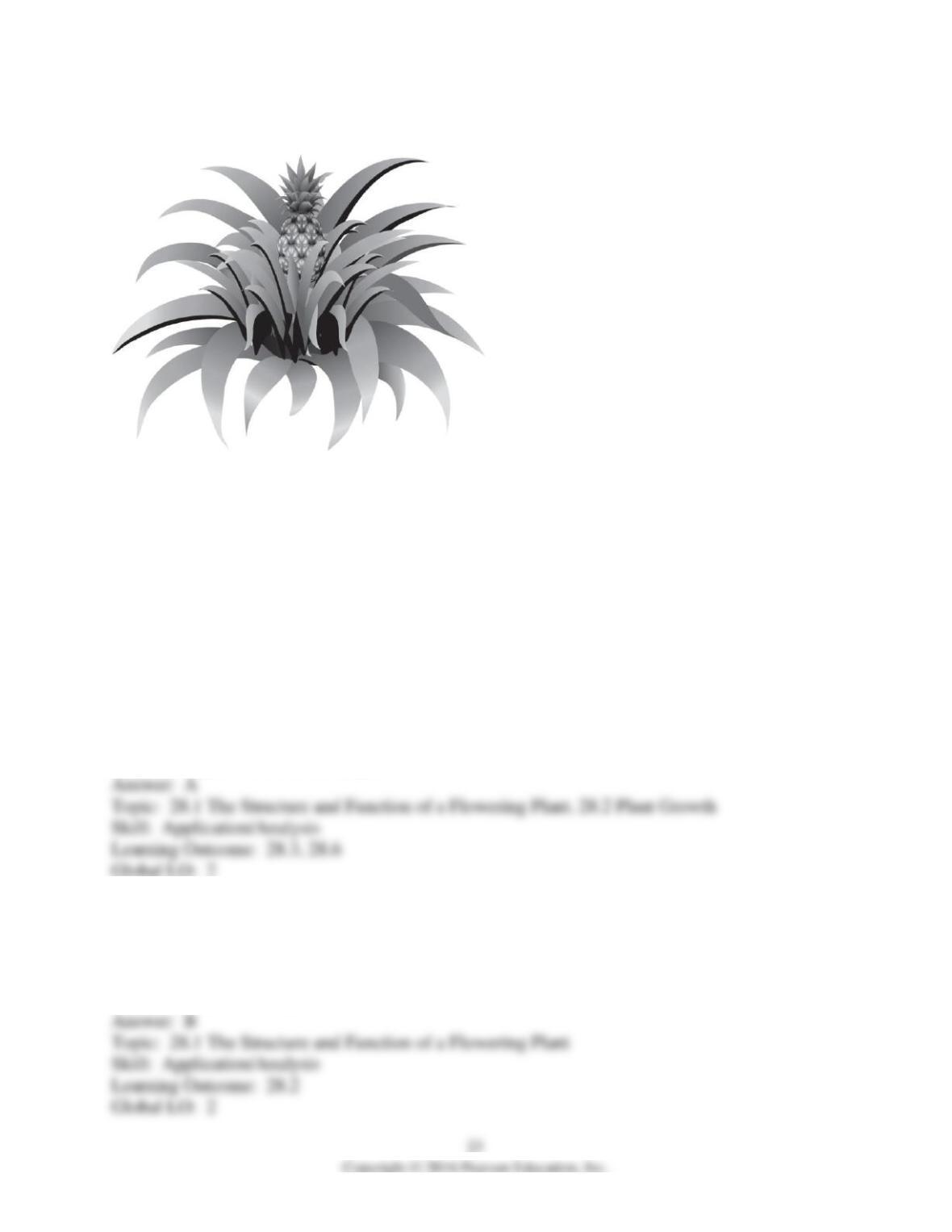
Read the following scenario to answer the following questions.
The pineapple, grown for its sweet fruit, is a tropical monocot with a diploid number of 50. It can
live for many years. The plant starts as one short stem with tough leaves. The flowers of the
pineapple are located as a cluster at the very top of the stem. After pollination, the single fruit
forms from the fusion of the ovaries of the flowers in the cluster. The seeds are located just
underneath the surface of the fruit. The pineapple fruit is harvested by cutting at the base of the
fruit. After the first fruit is produced, side shoots grow from the main stem, which can go on to
produce additional fruits.
9) The first pineapple on a plant develops from ________, whereas the pineapples from the
second harvest of the same plant develop from ________.
A) the terminal bud… the axillary buds
B) the terminal bud… the root caps
C) the axillary bud… the terminal buds
D) primary growth… secondary growth
10) What evidence best supports the pineapple’s classification as a monocot?
A) It does not produce woody tissue.
B) It produces a fruit.
C) Its flowers have three petals each.
D) It has double fertilization.
11) Where would we expect to find cells with 25 unpaired chromosomes in a pineapple plant?
A) in the leaves
B) in the ovaries prior to pollination
C) in the fruit
D) in the fused ovaries