Campbell Biology, 10e (Reece)
Chapter 28 Protists
1) According to the endosymbiotic theory, why was it adaptive for the larger (host) cell to keep
the engulfed cell alive, rather than digesting it as food?
A) The engulfed cell provided the host cell with adenosine triphosphate (ATP).
B) The engulfed cell provided the host cell with carbon dioxide.
C) The engulfed cell allowed the host cell to metabolize glucose.
D) The host cell was able to survive anaerobic conditions with the engulfed cell alive.
2) The chloroplasts of land plants are thought to have been derived according to which
evolutionary sequence?
A) cyanobacteria → green algae → land plants
B) cyanobacteria → green algae → fungi → land plants
C) red algae → brown algae → green algae → land plants
D) cyanobacteria → red algae → green algae → land plants
3) A particular species of protist has obtained a chloroplast via secondary endosymbiosis. You
know this because the chloroplasts _____.
A) have nuclear and cyanobacterial genes
B) are exceptionally small
C) have three or four membranes
D) have only a single pigment
4) All protists are _____.
A) unicellular
B) eukaryotic
C) symbionts
D) mixotrophic
5) An individual mixotroph loses its plastids, yet continues to survive. Which of the following
most likely accounts for its continued survival?
A) It relies on photosystems that float freely in its cytosol.
B) It must have gained extra mitochondria when it lost its plastids.
C) It engulfs organic material by phagocytosis or by absorption.
D) It has an endospore.
6) Which of the following have chloroplasts (or structures since evolved from chloroplasts)
thought to be derived from ancestral green algae?
A) stramenopiles
B) apicomplexans
C) dinoflagellates
D) chlorarachniophytes
Use the following information to answer the question(s) below.
Paulinella chromatophora is one of the few cercozoans that is autotrophic, carrying out aerobic
photosynthesis with its two elongated “chromatophores.” The chromatophores are contained
within vesicles of the host cell, and each is derived from a cyanobacterium, though not the same
type of cyanobacterium that gave rise to the chloroplasts of algae and plants.
7) The closest living relative of P. chromatophora is the heterotroph P. ovalis. P. ovalis uses
threadlike pseudopods to capture its prey, which it digests internally. Which of the following, if
observed, would be the best reason for relabeling P. chromatophora as a mixotroph instead of an
autotroph?
A) a pigmented central vacuole, surrounded by a tonoplast
B) a vacuole with food inside
C) a secretory vesicle
D) a contractile vacuole
8) Which process could have allowed the nucleomorphs of chlorarachniophytes to be reduced,
without the net loss of any genetic information?
A) conjugation
B) horizontal gene transfer
C) phagocytosis
D) meiosis
Use the following information to answer the question(s) below.
Giardia intestinalis is an intestinal parasite of humans and other mammals that causes intestinal
ailments in most people who ingest the cysts. Upon ingestion, each cyst releases two motile cells,
called trophozoites. These attach to the small intestine’s lining via a ventral adhesive disk. The
trophozoites anaerobically metabolize glucose from the host’s intestinal contents to produce
ATP. Reproduction is completely asexual, occurring by longitudinal binary fission of
trophozoites, with each daughter cell receiving two haploid nuclei (n = 5). A trophozoite will
often encyst as it passes into the large intestine by secreting around itself a case that is resistant
to cold, heat, and dehydration. Infection usually occurs by drinking untreated water that contains
cysts.
9) The cysts of Giardia function most like the _____.
A) mitochondria of ancestral diplomonads
B) nuclei of archaeans
C) endospores of bacteria
D) capsids of viruses
10) Consider the following data: (a) Most ancient eukaryotes are unicellular. (b) All eukaryotes
alive today have a nucleus and cytoskeleton. (c) Most ancient eukaryotes lack a cell wall. Which
of the following conclusions could reasonably follow the data presented? The first eukaryote
may have been _____.
A) very similar to a plant cell
B) anaerobic
C) capable of phagocytosis
D) photosynthetic
4
Use the following information to answer the question(s) below.
Giardia intestinalis is an intestinal parasite of humans and other mammals that causes intestinal
ailments in most people who ingest the cysts. Upon ingestion, each cyst releases two motile cells,
called trophozoites. These attach to the small intestine’s lining via a ventral adhesive disk. The
trophozoites anaerobically metabolize glucose from the host’s intestinal contents to produce
ATP. Reproduction is completely asexual, occurring by longitudinal binary fission of
trophozoites, with each daughter cell receiving two haploid nuclei (n = 5). A trophozoite will
often encyst as it passes into the large intestine by secreting around itself a case that is resistant
to cold, heat, and dehydration. Infection usually occurs by drinking untreated water that contains
cysts.
11) Giardia’s mitosome can be said to be “doubly degenerate,” because it is a degenerate type of
________, an organelle that is itself a degenerate form of ________.
A) nucleus; archaean
B) nucleus; bacterium
C) mitochondria; proteobacterium
D) mitochondria; spirochete
12) The mitosome of Giardia has no DNA within it. If it did contain DNA, then what predictions
should we be able to make about its DNA?
1. It is linear.
2. It is circular.
3. It has many introns.
4. It has few introns.
5. It is not associated with histone proteins.
6. It is complexed with histone proteins.
A) 1, 3, and 5
B) 1, 4, and 5
C) 2, 3, and 6
D) 2, 4, and 5
13) Given its mode of reproduction and internal structures, which of the following should be
expected to occur in Giardia at some stage of its life cycle?
A) separation (segregation) of daughter chromosomes
B) crossing over
C) meiosis
14) If the mitosomes of Giardia contain no DNA, yet are descendants of what were once free-
living organisms, then where are we likely to find the genes that encode their structures, and
what accounts for their current location there?
A) plasmids; conjugation
B) plasmids; transformation
C) nucleus; horizontal gene transfer
D) nucleus; S phase
15) When a mosquito infected with Plasmodium first bites a human, the Plasmodium _____.
A) gametes fuse, forming an oocyst
B) cells infect the human liver cells
C) cells cause lysing of the human red blood cells
D) oocyst undergoes meiosis
16) Which two genera have members that can evade the human immune system by frequently
changing their surface proteins?
1. Plasmodium
2. Trichomonas
3. Paramecium
4. Trypanosoma
5. Entamoeba
A) 1 and 4
B) 2 and 3
C) 2 and 4
D) 4 and 5
17) Which of the following pairs of protists and their characteristics is mismatched?
A) apicomplexans — internal parasites
B) euglenozoans — unicellular flagellates
C) ciliates — red tide organisms
D) entamoebas — ingestive heterotrophs
18) Dinoflagellates _____.
A) possess two flagella
B) are all autotrophic
C) lack mitochondria
D) include species that cause malaria
19) You are given an unknown organism to identify. It is unicellular and heterotrophic. It is
motile, using many short extensions of the cytoplasm, each featuring the 9 + 2 filament pattern.
It has well-developed organelles and two nuclei, one large and one small. This organism is most
likely to be a _____.
A) foraminiferan
B) radiolarian
C) ciliate
D) kinetoplastid
20) Which of the following is characteristic of ciliates?
A) They use pseudopods as feeding structures.
B) They are often multinucleate.
C) They can exchange genetic material with other ciliates by the process of mitosis.
D) Most live as solitary autotrophs in fresh water.
21) Diatoms are mostly asexual members of the phytoplankton. Diatoms lack any organelles that
might have the 9 + 2 pattern. They obtain their nutrition from functional chloroplasts, and each
diatom is encased within two porous, glasslike valves. Which question would be most important
for one interested in the day-to-day survival of individual diatoms?
A) How do diatoms get transported from one location on the water’s surface layers to another
location on the surface?
B) How do diatoms with their glasslike valves keep from sinking into poorly lit waters?
C) How do diatoms with their glasslike valves avoid being shattered by the action of waves?
D) How do diatom sperm cells locate diatom egg cells?
22) A large seaweed that floats freely on the surface of deep bodies of water would be expected
to lack which of the following?
A) thalli
B) bladders
C) holdfasts
D) gel-forming polysaccharides
23) Reinforced, threadlike pseudopods that can perform phagocytosis are generally characteristic
of _____.
A) forams
B) water molds
C) dinoflagellates
D) oomycetes
24) A snail-like, coiled, porous test (shell) of calcium carbonate is characteristic of _____.
A) diatoms
B) foraminiferans
C) ciliates
D) water molds
25) You are given the task of designing an aquatic protist that is a primary producer. It cannot
swim on its own, yet must stay in well-lit surface waters. It must be resistant to physical damage
from wave action. It should be most similar to a(n) _____.
A) diatom
B) dinoflagellate
C) apicomplexan
D) red alga
26) A gelatinous seaweed that grows in shallow, cold water and undergoes heteromorphic
alternation of generations is most probably what type of alga?
A) red
B) green
C) brown
D) yellow
You are given four test tubes, each containing an unknown protist, and your task is to read the
following description and match these four protists to the correct test tube.
When light, especially red and blue light, is shone on the tubes, oxygen bubbles accumulate on
the inside of test tubes 1 and 2. Chemical analysis of test tube 1 indicates the presence of a
chemical that is toxic to fish and humans. Chemical analysis of test tube 2 indicates the presence
of substantial amounts of silica. Microscopic analysis of organisms in test tubes 1, 3, and 4
reveals the presence of permanent, membrane-bounded sacs just under the plasma membrane.
Microscopic analysis of organisms in test tube 3 reveals the presence of an apicoplast in each.
Microscopic analysis of the contents in test tube 4 reveals the presence of one large nucleus and
one small nucleus in each organism.
27) Test tube 3 contains _____.
A) Paramecium
B) Pfiesteria (dinoflagellate)
C) Entamoeba
D) Plasmodium
28) Test tube 4 contains _____.
A) Paramecium
B) Pfiesteria (dinoflagellate)
C) Entamoeba
D) Plasmodium
Use the following description and table to answer the question(s) below.
Diatoms are encased in petri-platelike cases (valves) made of translucent hydrated silica whose
thickness can be varied. The material used to store excess calories can also be varied. At certain
times, diatoms store excess calories in the form of the liquid polysaccharide, laminarin, and at
other times as oil. The following are data concerning the density (specific gravity) of various
components of diatoms, and of their environment.
Specific Gravities of Materials Relevant to Diatoms
Material
Specific Gravity
(kg/m3)
Pure water
1000
Seawater
1026
Hydrated silica
2250
Liquid laminarin
1500
Diatom oil
910
29) Water’s density and, consequently, its buoyancy decrease at warmer temperatures. Based on
this consideration and using data from the table above, at which time of year should one expect
diatoms to be storing excess calories mostly as oil?
A) mid-winter
B) early spring
C) late summer
D) late fall
30) Water’s density and, consequently, its buoyancy decrease at warmer temperatures.
Considering the impact of temperature, and the table above, in which environment should
diatoms sinking be slowest?
A) cold fresh water
B) warm fresh water
C) cold seawater
D) warm seawater
Use the following information to answer the question(s) below.
Healthy individuals of Paramecium bursaria contain photosynthetic algal endosymbionts of the
genus Chlorella. When within their hosts, the algae are referred to as zoochlorellae. In aquaria
with light coming from only one side, P. bursaria gather at the well-lit side, whereas other
species of Paramecium gather at the opposite side. The zoochlorellae provide their hosts with
glucose and oxygen, and P. bursaria provides its zoochlorellae with protection and motility. P.
bursaria can lose its zoochlorellae in two ways: (1) if kept in darkness, the algae will die; and (2)
if prey items (mostly bacteria) are absent from its habitat, P. bursaria will digest its
zoochlorellae.
31) Which term best describes the symbiotic relationship of well-fed P. bursaria to their
zoochlorellae?
A) mutualistic
B) parasitic
C) predatory
D) pathogenic
32) The motility that permits P. bursaria to move toward a light source is provided by _____.
A) pseudopods
B) a single flagellum featuring the 9 + 2 pattern
C) many cilia
D) contractile vacuoles
33) A P. bursaria cell that has lost its zoochlorellae is said to be aposymbiotic. It might be able
to replenish its contingent of zoochlorellae by ingesting them without subsequently digesting
them. Which of the following situations would be most favorable to the reestablishment of
resident zoochlorellae, assuming compatible Chlorella are present in P. bursaria’s habitat?
A) abundant light, no bacterial prey
B) abundant light, abundant bacterial prey
C) no light, no bacterial prey
D) no light, abundant bacterial prey
34) A P. bursaria cell that has lost its zoochlorellae is aposymbiotic. If aposymbiotic cells have
population growth rates the same as those of healthy, zoochlorella-containing P. bursaria in
well-lit environments with plenty of prey items, then such an observation would be consistent
with which type of relationship?
A) parasitic
B) commensalistic
C) toxic
D) mutualistic
35) Theoretically, P. bursaria can obtain zoochlorella either vertically (via the asexual
reproduction of its mother cell) or horizontally (by ingesting free-living Chlorella from its
habitat). Consider a P. bursaria cell containing zoochlorellae but whose habitat lacks free-living
Chlorella. If this cell subsequently undergoes many generations of asexual reproduction, if all of
its daughter cells contain roughly the same number of zoochlorellae as it had originally
contained, and if the zoochlorellae are all haploid and identical in appearance, then what is true?
The zoochlorellae _____.
A) also reproduced asexually, at an increasing rate over time
B) also reproduced asexually, at a decreasing rate over time
C) also reproduced asexually, at a fairly constant rate over time
D) reproduced sexually, undergoing heteromorphic alternation of generations
36) Which process in Paramecium results in genetic recombination but no increase in population
size?
A) budding
B) meiotic division
C) conjugation
D) binary fission
12
Use the following information to answer the question(s) below.
The mechanism of cell crawling in protist species is not well defined. Pseudopodia extension
involves interactions between actin and myosin (the same molecules that are involved in
vertebrate muscle contraction). However, prior to the study described below, no one had
provided convincing data that actin and myosin were actually involved in cell crawling in
protists. Anatomical studies had identified the cytoskeletal protein actin just below the surface of
the cell membrane in several species of protist, but physiological studies had failed to show a
functional link between actin, myosin, and cell crawling.
In a study by N. Poulsen et al. (Diatom gliding is the result of an actin-myosin motility system,
Cell Motility and the Cytoskeleton 44 (1999):23-22), researchers tested whether motility in a
particular species of diatom involves interactions between actin and myosin.
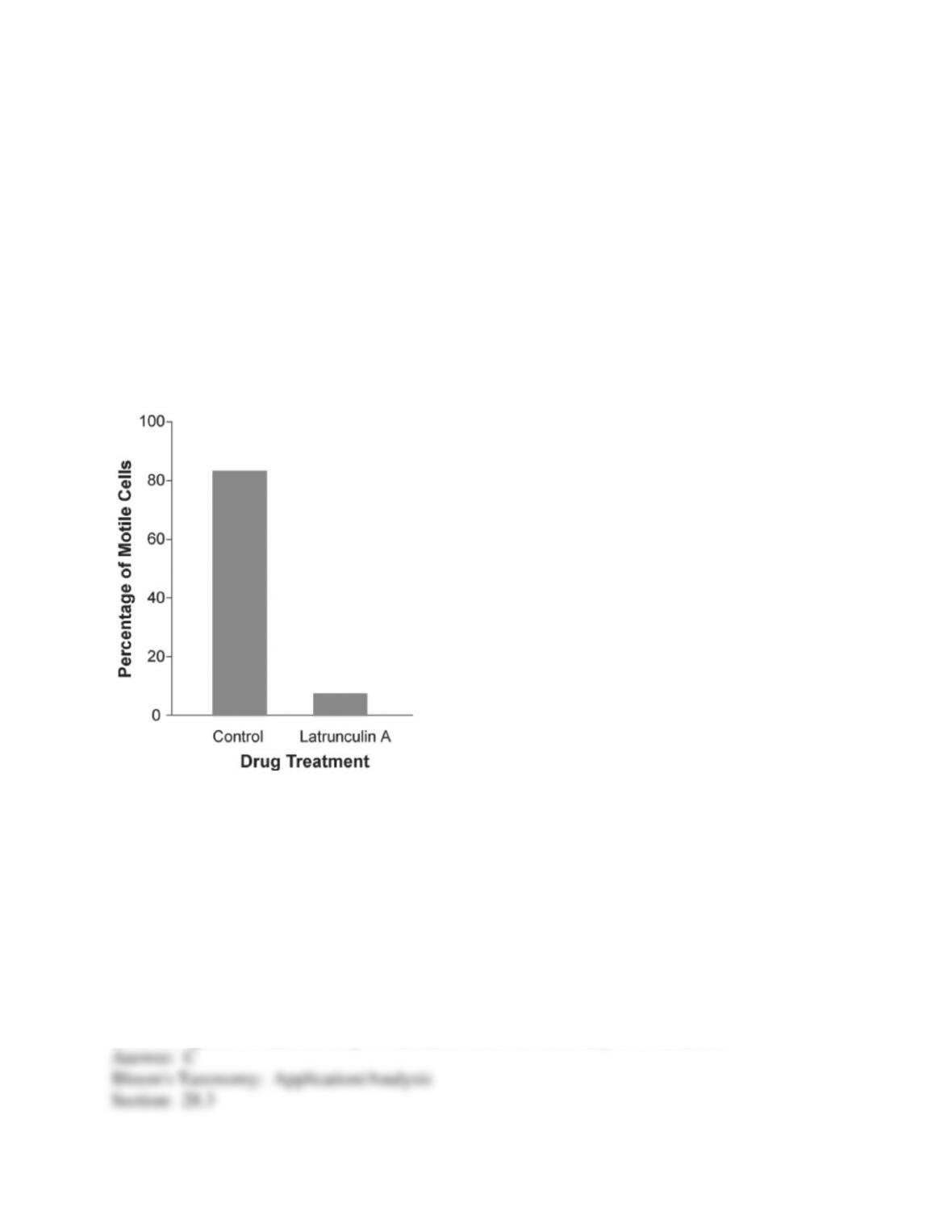
37) Refer to the study by Poulsen et al. and the figure above. Latrunculin A is a reversible toxin
that disrupts the formation of actin fibers. A culture of a particular species of diatom was treated
with this toxin diluted in a buffer, while another culture was treated only with the buffer (no
toxin; control). The motility of cells in each culture was assessed by counting the number of cells
that were moving during a defined period of time. Which of the following conclusions is
reasonable based on the above figure?
A) Formation of actin fibers is not necessary for the movement in this species of diatom.
B) The buffer alone largely inhibited movement in this species of diatom.
C) In this species of diatom, fully formed actin fibers are necessary for movement.
38) Refer to the study by Poulsen et al. and the figure above. The data graphed in the figure
could be an artifact if latrunculin A kills this species of diatoms (that is, that may be why the
cells are not moving). Which of the following would be the best evidence that latrunculin A is
NOT killing the cells?
A) When the toxin was washed off the culture, the cells began to move again.
B) There were still a small percentage of motile cells in the culture treated with the toxin.
C) Most of the cells in the control were moving, indicating that they were alive.
D) When the toxin was applied to another species of diatom, 25% of them continued to move.
39) Refer to the study by Poulsen et al. and the figure above. Cultures of a species of diatom
were treated with BDM, a reversible inhibitor of myosin function. Which of the following
predictions is consistent with the hypothesis that an actin-myosin interaction is necessary for
motility?
A) BDM will significantly decrease motility of the cells in culture.
B) BDM will not significantly alter motility of the cells in culture.
C) BDM will significantly increase motility of the cells in culture.
Use the following information to answer the question(s) below.
Paulinella chromatophora is one of the few cercozoans that is autotrophic, carrying out aerobic
photosynthesis with its two elongated “chromatophores.” The chromatophores are contained
within vesicles of the host cell, and each is derived from a cyanobacterium, though not the same
type of cyanobacterium that gave rise to the chloroplasts of algae and plants.
40) P. chromatophora secretes around itself a test, or case, of plates made of silica. Which of the
following is another rhizarian that would be in competition with P. chromatophora for the silica
needed to make these plates, assuming limited quantities of silica in the environment?
A) radiolarians
B) foraminiferans
C) dinoflagellates
D) diatoms
41) Including the membrane of the surrounding vesicle, how many phospholipid (NOT
lipopolysaccharide) bilayers should be found around each P. chromatophora‘s chromatophore,
and which one of these bilayers should have photosystems embedded in it?
A) two; innermost
B) two; outermost
C) three; innermost
D) three; outermost
42) If true, which of the following would be most important in determining whether P.
chromatophora‘s chromatophore is still an endosymbiont, or is an organelle, as the term
chromatophore implies?
A) if P. chromatophora is less fit without its chromatophore than with it
B) if the chromatophore is less fit without the host cercozoan than with it
C) if there is ongoing metabolic cooperation between the chromatophore and the host cercozoan
D) if there has been movement of genes from the chromatophore genome to the nuclear genome,
such that these genes are no longer present in the chromatophore genome
43) The genome of modern chloroplasts is roughly 50% the size of the genome of the
cyanobacterium from which it is thought to have been derived. In comparison, the genome of P.
chromatophora‘s chromatophore is only slightly reduced relative to the size of the genome of the
cyanobacterium from which it is thought to have been derived. What is a valid hypothesis that
can be drawn from this comparison?
A) Lytic phage infections have targeted the chloroplast genome more often than the P.
chromatophora genome.
B) P. chromatophora‘s chromatophore is the result of an evolutionarily recent endosymbiosis.
C) The genome of the chloroplast ancestor contained many more introns that could be lost
without harm, compared to the chromatophore’s genome.
D) The genome of the cyanobacteria was smaller than the genome of P. chromatophora.
44) A biologist discovers an alga that is marine, multicellular, and lives at a depth reached only
by blue light. This alga is most likely a type of _____.
A) red algae
B) brown algae
C) green algae
D) golden algae

15
45) Green algae differ from land plants in that many green algae _____.
A) are unicellular
B) have plastids
C) have alternation of generations
D) have cell walls containing cellulose
46) You are given the task of designing an aerobic, mixotrophic protist that can perform
photosynthesis in fairly deep water (for example, 250 meters deep) and can also crawl about and
engulf small particles. With which two of the following structures would you provide your
protist?
1. hydrogenosome
2. apicoplast
3. pseudopods
4. chloroplast from red alga
5. chloroplast from green alga
A) 1 and 2
B) 2 and 3
C) 3 and 4
D) 4 and 5
47) Similar to most amoebozoans, the forams and the radiolarians also have pseudopods, as do
some of the white blood cells of animals (monocytes). If one were to erect a taxon that included
all organisms that have cells with pseudopods, the taxon would _____.
A) be polyphyletic
B) be paraphyletic
C) be monophyletic
D) include all eukaryotes
48) Which of the following groups is matched with a correct anatomical feature?
A) foraminifera → silicon-rich tests
B) dinoflagellata → holdfast
C) diatoms → tests made of cellulose
D) phaeophyta (brown algae) → blade
49) Unikonta is a supergroup that includes all of the following except _____.
A) fungi
16
B) protists
C) animals
D) plants
50) Previously understood similarities that seemed to connect slime molds and fungi are now
considered to be _____.
A) homologies
B) examples of convergent evolution
C) variations of common ancestral traits
D) adaptations for much different functions
51) Branching points at the root of the eukaryotic phylogenetic tree
A) reveal that unikonts are derived from the SAR clade
B) suggest that Archaeplastids were the first eukaryotes
C) strongly suggest that fungi are more closely related to plants than animals
D) are presently unclear
52) Super cells characteristic of plasmodial slime molds result when which one of the following
common cellular processes does not occur?
A) mitosis
B) cytokinesis
C) aerobic metabolism
D) endocytosis
53) Which of the following is responsible for nearly 100,000 human deaths worldwide every
year?
A) Entamoeba histolytica
B) Amoeba proteus
C) plasmodial slime molds
D) Dictyostelium discoideum
54) Assume that some members of an aquatic species of motile, photosynthetic protists evolve to
become parasitic to fish. They gain the ability to live in the fish gut, absorbing nutrients as the
fish digests food. Over time, which of the following phenotypic changes would you expect to
observe in this population of protists?
A) loss of motility
B) loss of chloroplasts
C) gain of a rigid cell wall
D) gain of meiosis
Use the following information to answer the question(s) below.
Healthy individuals of Paramecium bursaria contain photosynthetic algal endosymbionts of the
genus Chlorella. When within their hosts, the algae are referred to as zoochlorellae. In aquaria
with light coming from only one side, P. bursaria gather at the well-lit side, whereas other
species of Paramecium gather at the opposite side. The zoochlorellae provide their hosts with
glucose and oxygen, and P. bursaria provides its zoochlorellae with protection and motility. P.
bursaria can lose its zoochlorellae in two ways: (1) if kept in darkness, the algae will die; and (2)
if prey items (mostly bacteria) are absent from its habitat, P. bursaria will digest its
zoochlorellae.
55) Which term most accurately describes the nutritional mode of healthy P. bursaria?
A) photoautotroph
B) photoheterotroph
C) chemoautotroph
D) mixotroph
56) Living diatoms contain brownish plastids. If global warming causes blooms of diatoms in the
surface waters of Earth’s oceans, how might this be harmful to the animals that build coral reefs?
A) The coral animals, which capture planktonic organisms, may be outcompeted by the diatoms.
B) The coral animals’ endosymbiotic dinoflagellates may get “shaded out” by the diatoms.
C) The coral animals may die from overeating the plentiful diatoms with their cases of silica.
D) The diatoms’ photosynthetic output may over-oxygenate the water.
57) Which of the following is a producer?
A) kinetoplastid
B) apicomplexan
C) diatom
D) ciliates
58) If we were to apply the most recent technique used to fight potato late blight to the fight
against the malarial infection of humans, then we would _____.
A) increase the dosage of the least-expensive antimalarial drug administered to humans
B) introduce a predator of the malarial parasite into infected humans
C) use a “cocktail” of at least three different pesticides against Anopheles mosquitoes
D) insert genes from a Plasmodium-resistant strain of mosquito into Anopheles mosquitoes